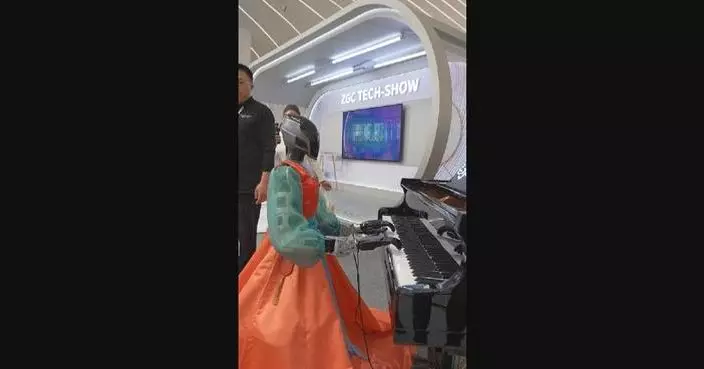
Chinese tech companies are able to stand out globally due to key advantages including execution efficiency and resilience, leaving them poised to lead the future, said Chris Pereira, founder and CEO of the south China-based tech ecosystem company iMpact, at the ongoing 2026 Consumer Electronics Show (CES) in Las Vegas.
CES, first held in 1967, is a bellwether for the global consumer electronics industry. It annually presents cutting-edge innovations from tech companies in fields including artificial intelligence (AI), robotics, smart home systems, and autonomous vehicles.
This year's event runs from January 6-9, featuring product launches, exhibitions, business meetings, and industry forums.
During the exhibition, Pereira shared his observations on the global market performance of Chinese tech enterprises in recent years, highlighting how their success in innovation has reshaped international perceptions of China’s capabilities.
"We're seeing a major shift in views towards Chinese companies in 2026. The last few years has been a gradual evolution of more Chinese tech, more Chinese brands going overseas. You've seen it with Labubu, BYD, TikTok, etc. But this year, 2026, I think there's a massive change, actually. There's a recognition. We're sitting in a Chinese car, enjoying the best of tech and comfort here at CES. And I think that goes across all industries here: we've got smart health, we have new energy. There's even furniture manufacturers building everything across the board that you can think of, building true connection overseas. I think, in building trust along the way -- so, I think that's what we're seeing here," he said.
He emphasized his personal experience working with these companies in south China's tech hub Shenzhen City, noting they possess unique strengths that not only enable them to develop practical, market-ready smart products but also empower them to navigate challenges amid adverse international conditions.
"iMpact, my company -- our slogan is 'We bring the speed of Shenzhen to the world.' I think the number one thing that almost every Chinese company brings is fast execution and very quick responsiveness. That's number one. The second also -- just as important -- (is) to bringing AI to the real world. So AI plus hardware -- you're seeing lots of robot applications here. So using AI to do real things in the world, not just in the cloud or through LLMs (large language models). It's really things -- moving things, cleaning things, helping people. That's the second strength for Chinese companies," said Pereira.
"And the third is the resilience. Chinese companies have had it very difficult overseas the last few years, and I think a lot of the investment that they've made in friendships and connections overseas are bearing fruit in 2026," he said.

Chinese tech firms' newfound global presence builds on responsiveness, resilience: insider