Meta has cut a trio of deals to power its artificial intelligence data centers, securing enough energy to light up the equivalent of about 5 million homes.
The parent company of Facebook on Friday announced agreements with TerraPower, Oklo and Vistra for nuclear power for its Prometheus AI data center that is being built in New Albany, Ohio. Meta announced Prometheus, which will be a 1-gigawatt cluster spanning across multiple data center buildings, in July. It's anticipated to come online this year.
Financial terms of the deals with TerraPower, Oklo and Vistra were not disclosed.
The Mark Zuckerberg-led Meta said in a statement on Friday that the three deals will support up to 6.6 gigawatts of new and existing clean energy by 2035. A single gigawatt, according to a general industry standard for utilities, can power about 750,000 homes.
“These projects add reliable and firm power to the grid, reinforce America’s nuclear supply chain, and support new and existing jobs to build and operate American power plants,” the company said.
Meta said its agreement with TerraPower will provide funding that supports the development of two new Natrium units capable of generating up to 690 megawatts of firm power with delivery as early as 2032. The deal also provides Meta with rights for energy from up to six other Natrium units capable of producing 2.1 gigawatts and targeted for delivery by 2035.
Meta will also buy more than 2.1 gigawatts of energy from two operating Vistra nuclear power plants in Ohio, in addition to the energy from expansions at the two Ohio plants and a third Vistra nuclear power plant in Pennsylvania.
Vistra said that electricity from the three power plants — Beaver Valley in Pennsylvania and Davis-Besse and Perry in Ohio — will still run through the mid-Atlantic grid for all electricity customers. It also said the agreements with Meta “provide certainty” for it to ask federal regulators for 20-year license renewals for the reactors.
Tech companies have been under pressure in the stressed mid-Atlantic grid — which includes Ohio and Pennsylvania — to build new power sources to supply the entire electricity needs of their new data centers there.
Jesse Jenkins, an assistant professor of engineering at Princeton University who specializes in energy systems, said bringing Prometheus online without a new power source for it will only increase electricity rates across the mid-Atlantic grid.
Ratepayers in the mid-Atlantic are already paying higher electricity bills to support new and proposed data centers.
The deal with Oklo, which counts OpenAI's Sam Altman as one of its largest investors, will help to develop a 1.2 gigawatt power campus in Pike County, Ohio to support Meta’s data centers in the region.
The nuclear power agreements come after Meta announced in June that it reached a 20-year deal with Constellation Energy.
Associated Press writer Marc Levy in Harrisburg, Pennsylvania, contributed to this report.

FILE -A Meta logo is shown on a video screen at LlamaCon 2025, an AI developer conference, in Menlo Park, Calif., April 29, 2025. (AP Photo/Jeff Chiu, File)
MUNICH--(BUSINESS WIRE)--Mar 20, 2026--
Dr. James Yu, Chairman and CEO of autonomous vehicle technology leader QCraft, engaged in an in-depth discussion with industry experts at the Intelligent Vehicles & Production 2026 conference on March 18, contending that autonomous driving is the most commercially viable pathway to physical AI—the emerging class of intelligence that understands and operates in the real world.
This press release features multimedia. View the full release here: https://www.businesswire.com/news/home/20260320906995/en/
The two-day conference, held in Garching bei München and jointly organized by the Center Automotive Research (CAR) and Technische Universität München (TUM), drew senior leaders from Mercedes-Benz, Audi, Bosch, Siemens, Rheinmetall, and other major industry players for a series of discussions on the future of intelligent vehicles, autonomous driving, and production innovation.
Dr. Yu's presentation, titled "Beyond Autonomous Driving: Physical AI in the Real World," was followed by a detailed exchange with Professor Ferdinand Dudenhöffer, founder of the Center Automotive Research in Bochum, Germany, and host of the forum. The conversation touched on the challenges and opportunities of bringing physical AI from theory to production at global scale.
During the session, which also featured Nico Michels of Siemens, Dr. Christian Steinborn of Rheinmetall, and Prof. Alois Knoll of TUM, Dr. Yu traced the arc of autonomous driving through three distinct stages. The first, he explained, relied on modular machine intelligence, where perception, prediction, and planning operated independently. The second saw the rise of human-like end-to-end learning, with AI trained on massive datasets to mimic human driving behavior. Now, in 2026, Dr. Yu maintained the industry is entering a third and defining phase: superhuman intelligence, driven by VLA large models, world models, and reinforcement learning. This is where AI no longer imitates humans but begins to truly understand the physical world.
"In the digital world, AI has already approached the level of general intelligence, and may even be entering the era of superintelligence. But the next great breakthrough will come from the physical world. When AI begins to understand gravity, friction, and human intention, that is where the biggest impact will be felt,” said Dr. Yu.
As an example of how this vision is becoming a reality, Dr. Yu pointed to a major milestone QCraft reached: more than one million vehicles now operate with the company's Navigate on Autopilot system. He described each of those vehicles as a robot on four wheels, collecting real-world data from complex and unpredictable driving scenarios every day. Taken together, he emphasized, this growing fleet forms an unmatched training ground for physical AI.
A central topic in the discussion was the core challenge facing autonomous driving: testing in the physical world is inherently costly and time-consuming. Because autonomous driving must be thoroughly validated across an enormous range of scenarios to ensure safety, Dr. Yu underscored, achieving that bar is exceptionally difficult. That is why QCraft has built what Dr. Yu likened to a virtual driving school, where world models simulate millions of these safety-critical scenarios and reinforcement learning allows the AI to test, fail, and optimize its decisions, all before the vehicle hits the road.
QCraft chose Munich for its European headquarters, which opened in September 2025. That was no coincidence, Dr. Yu said. Munich sits at the crossroads of two worlds QCraft wants to bridge: the fast-moving AI ecosystem forged on China's dense, unpredictable roads, and Germany's century-long tradition of automotive engineering excellence. The company is now actively building a team there, recruiting top talent to support its global expansion.
Dr. Yu closed with a broader ambition. What QCraft is building, he said, is not simply a smarter car. It is a physical intelligence platform. Today it drives passenger cars. Tomorrow, he suggested, the same underlying intelligence could power robots and any machine that must perceive, reason, and act in the physical world. The autonomous vehicle, in his telling, is just the first chapter.
About QCraft
QCraft is a global leader in L2++ to L4 autonomous driving (AD) solutions for automakers. Founded in Silicon Valley in 2019, the company has deployed its technology in more than 1 million vehicles. Powered by a world-class R&D team and partnerships with leading OEMs and tech companies, QCraft combines proven large-scale adoption with industry-leading safety and efficiency to bring autonomous driving into real life.
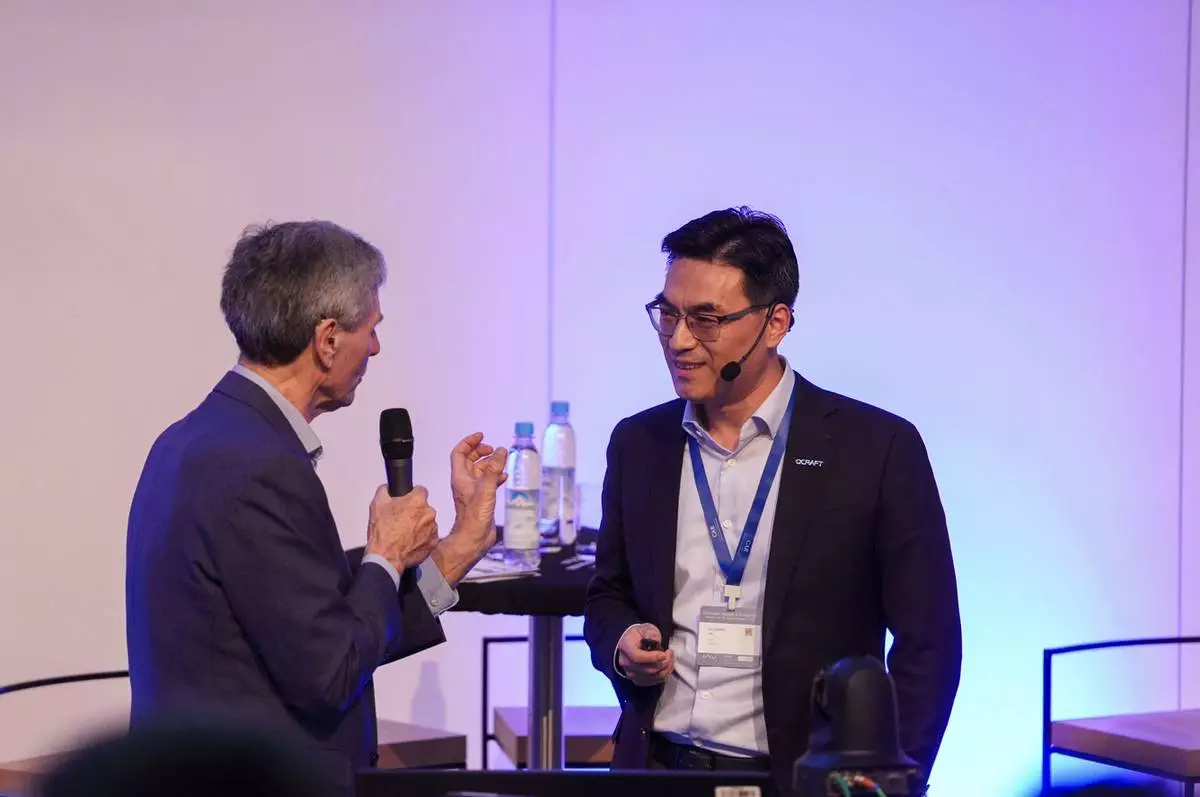
Dr. James Yu of QCraft and Prof. Dr. Ferdinand Dudenhöffer, the founder of the Center Automotive Research (CAR)