NEW YORK (AP) — U.S. flu infections showed signs of a slight decline last week, but health officials say it is not clear that this severe flu season has peaked.
New government data posted Friday — for flu activity through last week — showed declines in medical office visits due to flu-like illness and in the number of states reporting high flu activity.
However, some measures show this season is already surpassing the flu epidemic of last winter, one of the harshest in recent history. And experts believe there is more suffering ahead.
“This is going to be a long, hard flu season,” New York State Health Commissioner Dr. James McDonald said, in a statement Friday.
One type of flu virus, called A H3N2, historically has caused the most hospitalizations and deaths in older people. So far this season, that is the type most frequently reported. Even more concerning, more than 91% of the H3N2 infections analyzed were a new version — known as the subclade K variant — that differs from the strain in this year’s flu shots.
The last flu season saw the highest overall flu hospitalization rate since the H1N1 flu pandemic 15 years ago. And child flu deaths reached 289, the worst recorded for any U.S. flu season this century — including that H1N1 “swine flu” pandemic of 2009-2010.
So far this season, there have been at least 15 million flu illnesses and 180,000 hospitalizations, the U.S. Centers for Disease Control and Prevention estimates. It also estimates there have been 7,400 deaths, including the deaths of at least 17 children.
Last week, 44 states reported high flu activity, down slightly from the week before. However, flu deaths and hospitalizations rose.
Determining exactly how flu season is going can be particularly tricky around the holidays. Schools are closed, and many people are traveling. Some people may be less likely to see a doctor, deciding to just suffer at home. Others may be more likely to go.
Also, some seasons see a surge in cases, then a decline, and then a second surge.
For years, federal health officials joined doctors' groups in recommending that everyone 6 months and older get an annual influenza vaccine. The shots may not prevent all symptoms but can prevent many infections from becoming severe, experts say.
But federal health officials on Monday announced they will no longer recommend flu vaccinations for U.S. children, saying it is a decision parents and patients should make in consultation with their doctors.
“I can’t begin to express how concerned we are about the future health of the children in this country, who already have been unnecessarily dying from the flu — a vaccine preventable disease,” said Michele Slafkosky, executive director of an advocacy organization called Families Fighting Flu.
“Now, with added confusion for parents and health care providers about childhood vaccines, I fear that flu seasons to come could be even more deadly for our youngest and most vulnerable," she said in a statement.
Flu is just one of a group of viruses that tend to strike more often in the winter. Hospitalizations from COVID-19 and RSV, or respiratory syncytial virus, also have been rising in recent weeks — though were not diagnosed nearly as often as flu infections, according to other federal data.
The Associated Press Health and Science Department receives support from the Howard Hughes Medical Institute’s Department of Science Education and the Robert Wood Johnson Foundation. The AP is solely responsible for all content.

FILE - Pharmacy manager Aylen Amestoy administers a patient with a seasonal flu vaccine at a CVS Pharmacy in Miami, Tuesday, Sept. 9, 2025. (AP Photo/Rebecca Blackwell, File)
MUNICH--(BUSINESS WIRE)--Mar 20, 2026--
Dr. James Yu, Chairman and CEO of autonomous vehicle technology leader QCraft, engaged in an in-depth discussion with industry experts at the Intelligent Vehicles & Production 2026 conference on March 18, contending that autonomous driving is the most commercially viable pathway to physical AI—the emerging class of intelligence that understands and operates in the real world.
This press release features multimedia. View the full release here: https://www.businesswire.com/news/home/20260320906995/en/
The two-day conference, held in Garching bei München and jointly organized by the Center Automotive Research (CAR) and Technische Universität München (TUM), drew senior leaders from Mercedes-Benz, Audi, Bosch, Siemens, Rheinmetall, and other major industry players for a series of discussions on the future of intelligent vehicles, autonomous driving, and production innovation.
Dr. Yu's presentation, titled "Beyond Autonomous Driving: Physical AI in the Real World," was followed by a detailed exchange with Professor Ferdinand Dudenhöffer, founder of the Center Automotive Research in Bochum, Germany, and host of the forum. The conversation touched on the challenges and opportunities of bringing physical AI from theory to production at global scale.
During the session, which also featured Nico Michels of Siemens, Dr. Christian Steinborn of Rheinmetall, and Prof. Alois Knoll of TUM, Dr. Yu traced the arc of autonomous driving through three distinct stages. The first, he explained, relied on modular machine intelligence, where perception, prediction, and planning operated independently. The second saw the rise of human-like end-to-end learning, with AI trained on massive datasets to mimic human driving behavior. Now, in 2026, Dr. Yu maintained the industry is entering a third and defining phase: superhuman intelligence, driven by VLA large models, world models, and reinforcement learning. This is where AI no longer imitates humans but begins to truly understand the physical world.
"In the digital world, AI has already approached the level of general intelligence, and may even be entering the era of superintelligence. But the next great breakthrough will come from the physical world. When AI begins to understand gravity, friction, and human intention, that is where the biggest impact will be felt,” said Dr. Yu.
As an example of how this vision is becoming a reality, Dr. Yu pointed to a major milestone QCraft reached: more than one million vehicles now operate with the company's Navigate on Autopilot system. He described each of those vehicles as a robot on four wheels, collecting real-world data from complex and unpredictable driving scenarios every day. Taken together, he emphasized, this growing fleet forms an unmatched training ground for physical AI.
A central topic in the discussion was the core challenge facing autonomous driving: testing in the physical world is inherently costly and time-consuming. Because autonomous driving must be thoroughly validated across an enormous range of scenarios to ensure safety, Dr. Yu underscored, achieving that bar is exceptionally difficult. That is why QCraft has built what Dr. Yu likened to a virtual driving school, where world models simulate millions of these safety-critical scenarios and reinforcement learning allows the AI to test, fail, and optimize its decisions, all before the vehicle hits the road.
QCraft chose Munich for its European headquarters, which opened in September 2025. That was no coincidence, Dr. Yu said. Munich sits at the crossroads of two worlds QCraft wants to bridge: the fast-moving AI ecosystem forged on China's dense, unpredictable roads, and Germany's century-long tradition of automotive engineering excellence. The company is now actively building a team there, recruiting top talent to support its global expansion.
Dr. Yu closed with a broader ambition. What QCraft is building, he said, is not simply a smarter car. It is a physical intelligence platform. Today it drives passenger cars. Tomorrow, he suggested, the same underlying intelligence could power robots and any machine that must perceive, reason, and act in the physical world. The autonomous vehicle, in his telling, is just the first chapter.
About QCraft
QCraft is a global leader in L2++ to L4 autonomous driving (AD) solutions for automakers. Founded in Silicon Valley in 2019, the company has deployed its technology in more than 1 million vehicles. Powered by a world-class R&D team and partnerships with leading OEMs and tech companies, QCraft combines proven large-scale adoption with industry-leading safety and efficiency to bring autonomous driving into real life.
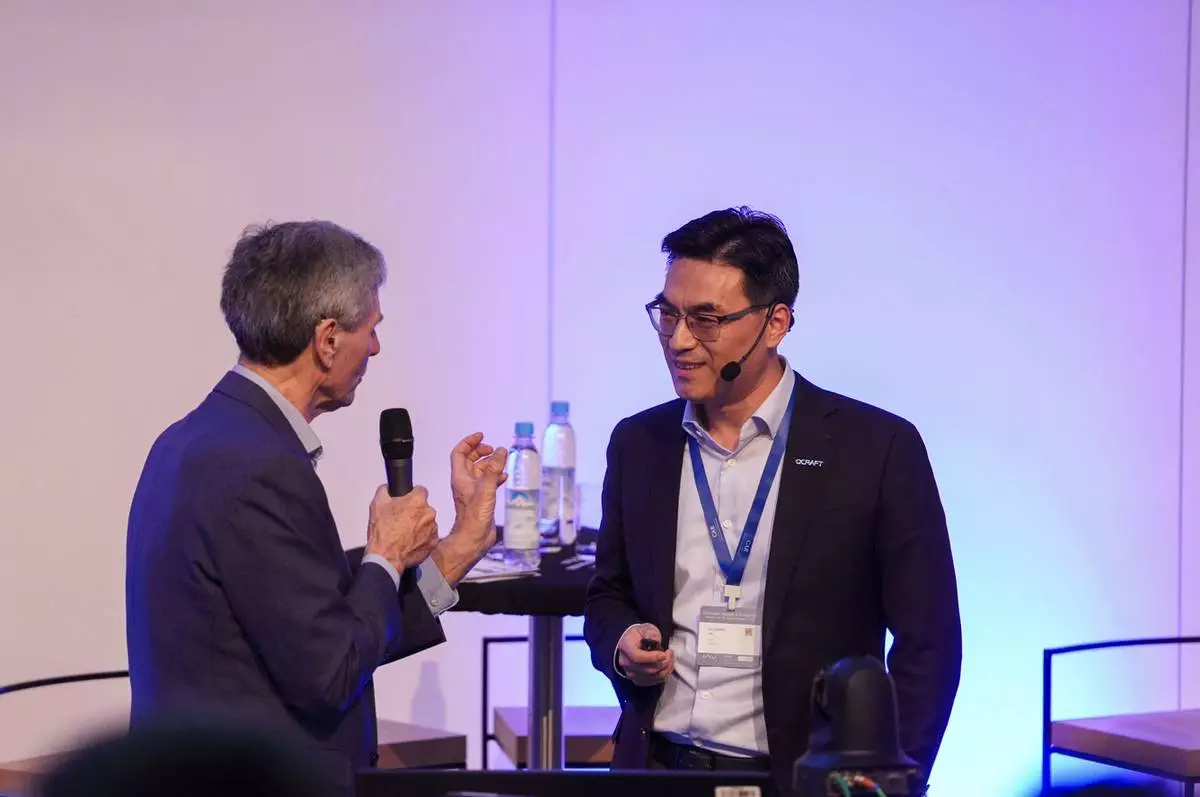
Dr. James Yu of QCraft and Prof. Dr. Ferdinand Dudenhöffer, the founder of the Center Automotive Research (CAR)