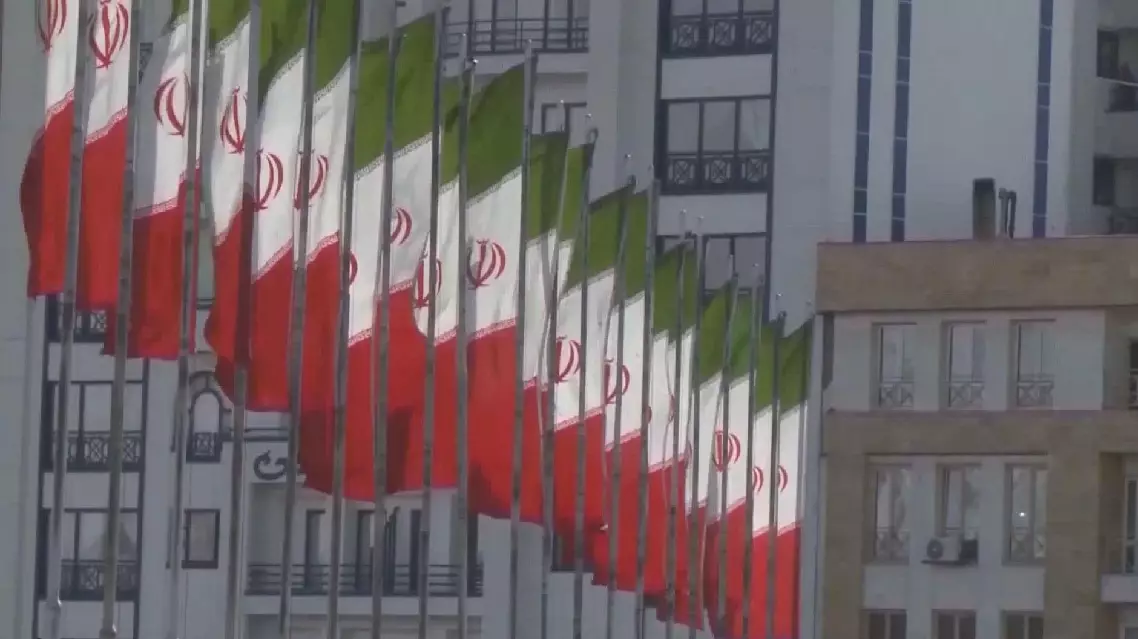
Internet services have partially resumed and daily supplies remain sufficient in the Iranian capital of Tehran, a reporter from China Media Group (CMG) said on Saturday.
Since Thursday, Iran has been undergoing a widespread internet blackout, with local communications and media also facing significant disruptions.
"Today is Saturday local time, which is the first working day of the week in Iran. Since this morning, some websites, including ride-hailing apps, have resumed operation in the country, but the public still cannot make international long-distance calls, and internet conditions remain restricted," said Li Jiannan, a China Media Group reporter in Tehran.
Protests have erupted in several Iranian cities since late December over the sharp fall of the rial and long-standing economic hardship. Iranian authorities have acknowledged the demonstrations and voiced willingness to address economic grievances, while warning against violence and vandalism.
"The current internet blackout in Iran is largely influenced by ongoing protests. According to feedback from my friends across Iran, large-scale protests are still continuing nationwide, with some areas even experiencing significant unrest. Iranian officials from the government and military have repeatedly noted that these protests, aimed at Iran's economic issues, are a way for the Iranian people to express their demands. However, some protests have escalated into unrest, allegedly instigated by hidden elements within the crowd, funded by the U.S. and Israel. The Iranian government has called on the public not to be incited by these rioters, warning people not to fall into what it described as the enemies' trap," said Li.
"From my observations, there is currently a sufficient supply of daily necessities in Tehran, with supermarkets maintaining stable and normal supplies of vegetables, rice, flour, and oil," the reporter said.
Internet services partially resume, sufficient daily supplies available in Iran's Tehran
The Guangdong–Hong Kong–Macao Greater Bay Area (GBA) is emerging as a key engine for China's fast-growing low-altitude economy by leveraging its dense industrial networks, efficient logistics systems, and rapid innovation capacity.
From logistics and manufacturing to urban services, the region is building an integrated industrial chain that allows low-altitude industries to scale up at unprecedented speed, thus turning drone-based applications from isolated trials into large-scale, commercial operations.
China's 15th Five-Year Plan, covering 2026 to 2030, calls for the cultivation of new pillar industries and the accelerated development of strategic emerging industrial clusters, including the low-altitude economy.
At a drone operations center in Bao'an District, Shenzhen City in south China's Guangdong Province, a dozen logistics drones take off and land within minutes. Urgently needed production parts, documents, and small parcels are dispatched from here to cities in the province including Dongguan, Zhongshan, and Zhuhai.
Behind these high-flying aircraft lies what observers describe as an "invisible industrial chain", built on speed and efficiency.
"Look at this aircraft. About 90 percent of its components come from nearby areas. Relying on Shenzhen's strong logistics capabilities and its complete supply chain, these parts can be delivered to our factory within half an hour for assembly, processing, and production," said Li Kunhuang, person-in-charge of Shenzhen GODO Innovation Technology Co., Ltd.
Once a new product is unveiled, testing and calibration begin immediately at the drone testing field. As soon as the process is completed, the new models can be put into real-world operation, realizing almost “zero delay” from research and development to application.
Supported by a robust industrial chain, low-altitude routes in Shenzhen are effectively connecting the urban landscape. From its Bao'an District to Songshan Lake in Dongguan City, production components can be delivered within one hour. Supplies are transported between Zhuhai City's Xiangzhou Port to Dong'ao Island in just 25 minutes. And light industrial goods can travel round-trip within a single day between Guzhen Town in Zhongshan City and Xinhui District in Jiangmen City.
More low-altitude application scenarios are expected to be implemented in the near future.
In Qianhai District, Shenzhen is accelerating the construction of a pilot demonstration zone of low-altitude integrated three-dimensional transportation hub.
"We have built the country's first low-altitude integrated three-dimensional transportation hub, and are gradually developing a pilot flight zone that integrates multiple scenarios such as inspection, logistics, and cultural tourism. This will provide technical support for the next step of commercializing cross-border logistics and emergency rescue services across the Guangdong–Hong Kong–Macao Greater Bay Area," said Wu Xuemin, head of the Shenzhen Qianhai Low-Altitude Integrated Three-Dimensional Transportation Hub Pilot Demonstration Zone.
Integrated supply chains propel Greater Bay Area's low-altitude economy growth