Cuban President Miguel Diaz-Canel on Sunday said Cuba is a free, independent and sovereign nation, rejecting U.S. President Donald Trump's accusations that the island country provided "security services" to Venezuela in exchange for oil.
Earlier on Sunday, Trump suggested Cuba should make a deal with Washington.
"There will be no more oil or money going to Cuba -- Zero! I strongly suggest they make a deal, before it is too late," Trump wrote on his social media platform Truth Social.
"Cuba lived, for many years, on large amounts of oil and money from Venezuela," Trump said.
However, Trump did not specify the terms of a deal or the consequences Cuba could face.
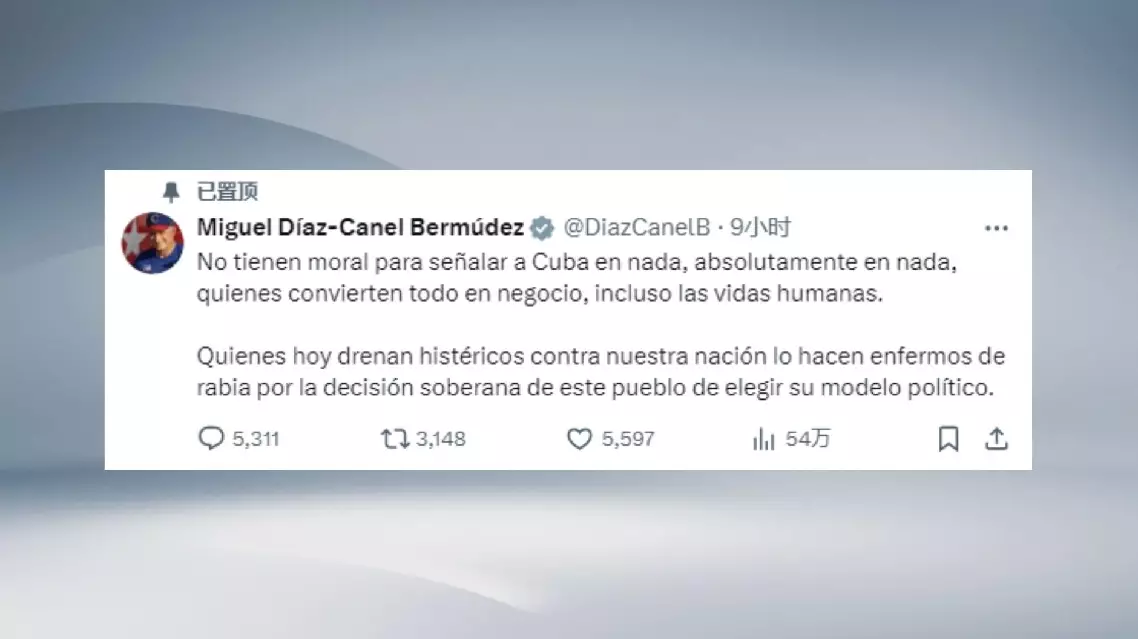
Diaz-Canel said on X that the United States has "no moral authority to point the finger at Cuba in anything", adding that the U.S. side turns everything, even human lives, into a business.
Diaz-Canel said that the United States is "hysterical" against the Caribbean nation because of the sovereign decision of the Cuban people to choose their political model.
"Those who blame the Revolution for the severe economic hardships we suffer should be ashamed and keep quiet," he said. "Because they know and recognize that they are the result of the draconian measures of extreme asphyxiation that the United States has imposed on us for six decades."
Cuba does not attack or threaten other countries, said Diaz-Canel, adding that the country is ready to defend itself "to the last drop of blood".
Also on Sunday, Cuban Foreign Minister Bruno Rodriguez said the United States behaves like a criminal and unchecked hegemon that threatens peace and security, not only in Cuba and this hemisphere, but throughout the entire world.
In an X post, Rodriguez said Cuba has the absolute right to import fuel from markets willing to export it and develop trade relations without interference or subordination to unilateral coercive measures imposed by the United States.
Venezuela on Sunday reiterated its "historic stance" toward Cuba, reaffirming its unwavering commitment to the principles of "fraternity, solidarity, cooperation and complementarity", despite mounting pressure from Washington to isolate the Caribbean nation.
The Venezuelan government released a statement underscoring its support for the free exercise of self-determination and sovereignty of peoples, which it considers fundamental pillars of international relations.
It emphasized its adherence to the principles enshrined in the United Nations Charter and international law, highlighting the longstanding and evolving ties between Venezuela and Cuba.
The Venezuelan government stressed that relations between states should be governed by the principles of non-intervention, sovereign equality and self-determination, and that "political and diplomatic dialogue" is the only viable path to "peacefully resolve disputes of any kind".
Cuban president says ready to defend Cuba, refutes Trump's accusations