FEHD releases first batch of gravidtrap indexes for Aedes albopictus in January
The Food and Environmental Hygiene Department (FEHD) today (January 13) released the first batch of gravidtrap indexes and density indexes for Aedes albopictus in January, covering 20 survey areas, as follows:
District |
Survey Area |
January 2026 |
First Phase Gravidtrap Index |
First Phase Density Index |
Eastern |
Chai Wan |
0.0% |
N/A |
North Point and Quarry Bay |
0.0% |
N/A |
Wan Chai |
Tin Hau and Causeway Bay |
0.0% |
N/A |
Wan Chai |
0.0% |
N/A |
Islands |
Tung Chung |
0.0% |
N/A |
Kowloon City |
Hung Hom and To Kwa Wan |
3.5% |
1.0 |
Kai Tak |
0.0% |
N/A |
Kwun Tong |
Kwun Tong Central |
0.0% |
N/A |
Yau Tong and Cha Kwo Ling |
0.0% |
N/A |
Sham Shui Po |
Lai Chi Kok |
0.0% |
N/A |
Wong Tai Sin |
Diamond Hill and Tsz Wan Shan |
0.0% |
N/A |
Yau Tsim |
Tsim Sha Tsui East and King's Park |
0.0% |
N/A |
North |
Fanling North |
0.0% |
N/A |
Fanling South |
0.0% |
N/A |
Sai Kung |
Tseung Kwan O East |
0.0% |
N/A |
Tseung Kwan O North |
0.0% |
N/A |
Tseung Kwan O West |
0.0% |
N/A |
Kwai Tsing |
Tsing Yi South |
0.0% |
N/A |
Tsuen Wan |
Tsuen Wan Town |
0.0% |
N/A |
Yuen Long |
Tin Shui Wai |
0.0% |
N/A |
Among the first batch of First Phase Gravidtrap Indexes covering 20 survey areas in January, all were below 10 per cent, and most of the areas recorded 0 per cent, indicating that the distribution of Aedes albopictus mosquitoes was not extensive.
The eggs of Aedes albopictus can withstand long periods of desiccation and will hatch when the temperature becomes suitable and water is present. Members of the public should continue to take mosquito control measures during winter to eliminate mosquito eggs.
Public participation is crucial to the effective control of mosquito problems. The FEHD appeals to members of the public to continue to work together in strengthening personal mosquito control measures, including:
tidy up their premises and check for any accumulation of water inside their premises;
remove all unnecessary water collections and eliminate the sources;
check household items (those placed in outdoor and open areas in particular), such as refuse containers, vases, air conditioner drip trays, and laundry racks to prevent stagnant water;
change the water in flower vases and clear the water in saucers of potted plants at least once every seven days;
properly cover all containers that hold water to prevent mosquitoes from accessing the water;
properly dispose of articles that can contain water, such as empty lunch boxes and cans; and
scrub drains and surface sewers with alkaline detergent at least once a week to remove any mosquito eggs.
Starting in August 2025, following the completion of the surveillance of individual survey areas, and once the latest gravidtrap index and the density index are available, the FEHD has been disseminating relevant information through press releases, its website and social media. It aims to allow members of the public to quickly grasp the mosquito infestation situation and strengthen mosquito control efforts, thereby reducing the risk of chikungunya fever (CF) transmission.
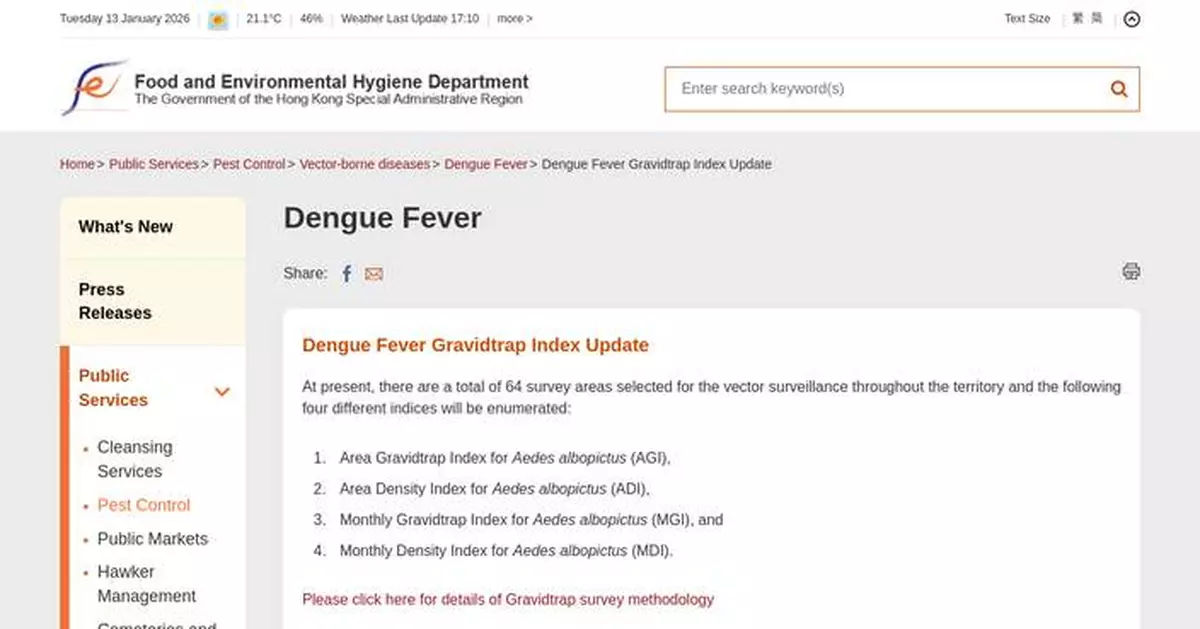
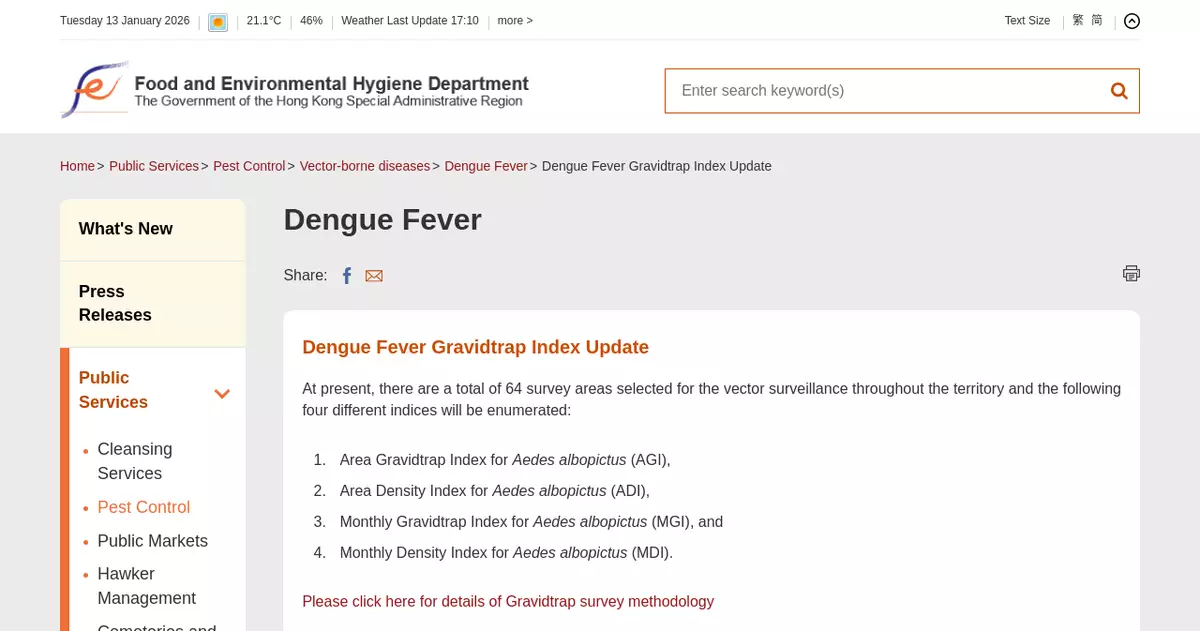
Following recommendations from the World Health Organization and taking into account the local situation in Hong Kong, the FEHD sets up gravidtraps in districts where mosquito-borne diseases have been recorded in the past, as well as in densely populated places such as housing estates, hospitals and schools to monitor the breeding and distribution of Aedes albopictus mosquitoes, which can transmit CF and dengue fever (DF). After reviewing the present DF and CF vector surveillance programme, the FEHD has expanded the coverage for monitoring Aedes albopictus mosquitoes starting from 2026. The number of survey areas set up in the community has been revised to 62, with some survey areas renamed. Additional gravidtraps will also be set up at different locations across the territory to strengthen the monitoring of the breeding of mosquitoes. Under the present surveillance mechanism, the FEHD has set up gravidtraps in survey areas of the community, with a surveillance period of two weeks. During the surveillance period, the FEHD will collect the gravidtraps once a week. After the first week of surveillance, the FEHD will immediately examine the glue boards inside the retrieved gravidtraps for the presence of adult Aedine mosquitoes to compile the Gravidtrap Index (First Phase) and Density Index (First Phase). At the end of the second week of surveillance, the FEHD will instantly check the glue boards for the presence of adult Aedine mosquitoes. Data from the two weeks of surveillance will be combined to obtain the Area Gravidtrap Index and the Area Density Index. The gravidtrap and density indexes for Aedes albopictus in different survey areas, as well as information on mosquito prevention and control measures, are available on the department's webpage (www.fehd.gov.hk/english/pestcontrol/dengue_fever/Dengue_Fever_Gravidtrap_Index_Update.html#).
Source: AI-found images
Health risk category for Air Quality Health Index has reached "Serious" level
The Environmental Protection Department (EPD) has recorded higher than normal pollution levels today (January 13). At 5pm, the Air Quality Health Index (AQHI) at theTuen Mungeneral monitoring station reached 10+, corresponding to the "Serious" health risk category.
Winds are weak over Hong Kong today, which is unfavourable for pollutant dispersion. The intense sunshine enhances photochemical smog activity, leading to the rapid formation of ozone and fine particulates in the Pearl River Delta region. The high ozone level also promotes the formation of nitrogen dioxide.
According to the Hong Kong Observatory,amoderate easterly airstream is expected to affect the coast of Guangdong gradually tomorrow. It is expected that pollution levels will remain higher than normal until then.
With a health risk category in the "Very High" range or above, children, the elderly and persons with existing heart or respiratory illnesses are advised to reduce physical exertion and outdoor activities to a minimum or avoid such activities. The general public is advised to reduce, or reduce to a minimum, outdoor physical exertion, and to reduce time outdoors, especially in areas with heavy traffic. As health effects of air pollutants may vary for individuals, persons who are in doubt or experience discomfort should seek advice from healthcare professionals. The public may visit the Centre for Health Protection's website (www.chp.gov.hk/en/content/9/460/3557.html) for more information on health effects of air pollution and relevant health advice.
The Education Bureau (EDB) urges all schools to visit the EDB website for appropriate measures to safeguard students' health and take note of changes in the index. The relevant hyperlink is as follows: www.edb.gov.hk/en/sch-admin/admin/about-activities/sch-activities-guidelines/index.html.
When the AQHI is at the "Very High" level, employers of outdoor workers performing heavy manual work are advised to assess the risk of outdoor work and take appropriate preventive measures to protect the health of their employees, such as reducing outdoor physical exertion and the time of their stay outdoors, especially in areas with heavy traffic. At the "Serious" level, employers of all outdoor workers are advised to assess the risk of outdoor work and take appropriate preventive measures to protect the health of their employees.
Members of the public can check the current AQHI readings at the EPD's website (www.aqhi.gov.hk/en.html) or by calling the hotline 2827 8541.
Source: AI-found images