China's domestically developed, world's largest-diameter vertical shaft boring machine "Qiming" was officially put into operation in Taicang City of east China's Jiangsu Province on Tuesday, for the Chongming-Taicang Yangtze River Tunnel project.
The "Qiming" shaft boring machine has a digging diameter of 24 meters, a main unit height of approximately 13 meters, and a maximum digging depth of 75 meters.
At the operation site, which is 200 meters from the south bank of the Yangtze River, the machine will dig vertically for over 50 meters to complete Shaft No.2 of the Chongming-Taicang Yangtze River Tunnel.
According to technicians, Shaft No. 2 is equivalent to a maintenance station for "Linghang", China's domestically developed, world's largest-diameter high-speed-rail shield tunneling machine, which has already excavated over 10,000 meters along the underwater railway channel.
However, the geological environment at this location is complex, posing extremely high safety risks during construction for vertical excavation.
Therefore, the "Qiming" machine is equipped with multiple innovative technologies such as tunneling self-adaptation and assembly self-synchronization, successfully solving major technical problems of invisibility, intangibility, and inaccuracy in ultra-deep water-rich composite strata.
Application of the machine promotes upgrade of ultra-deep vertical shaft construction from the traditional excavation mode to an intelligent construction mode, according to officials. "We have adopted the operation mode of minimal manpower above ground and no manpower underground, which allows us to tunnel in both soft and hard rock earth structures. The machine can handle both very soft and rough terrains, making it highly adaptable to various geological formations," said Fu Bowei, deputy manager of the Chongming-Taicang Yangtze River Tunnel Project under China Railway Tunnel Group Co., Ltd.
The Chongming-Taicang Yangtze River Tunnel runs 14.25 kilometers in total mileage, with 13.2 km planned for boring. Once operational, it will allow high-speed trains to pass beneath the Yangtze River without reducing speed.
The Tunnel, connecting Chongming in Shanghai with Taicang in Jiangsu Province, is expected to be completed by the end of 2026. As a key project on the Shanghai-Nanjing section of the Shanghai-Chongqing-Chengdu High-Speed Railway, it will significantly reduce the travel time between cities along the Yangtze River such as Shanghai, Nanjing and Hefei.
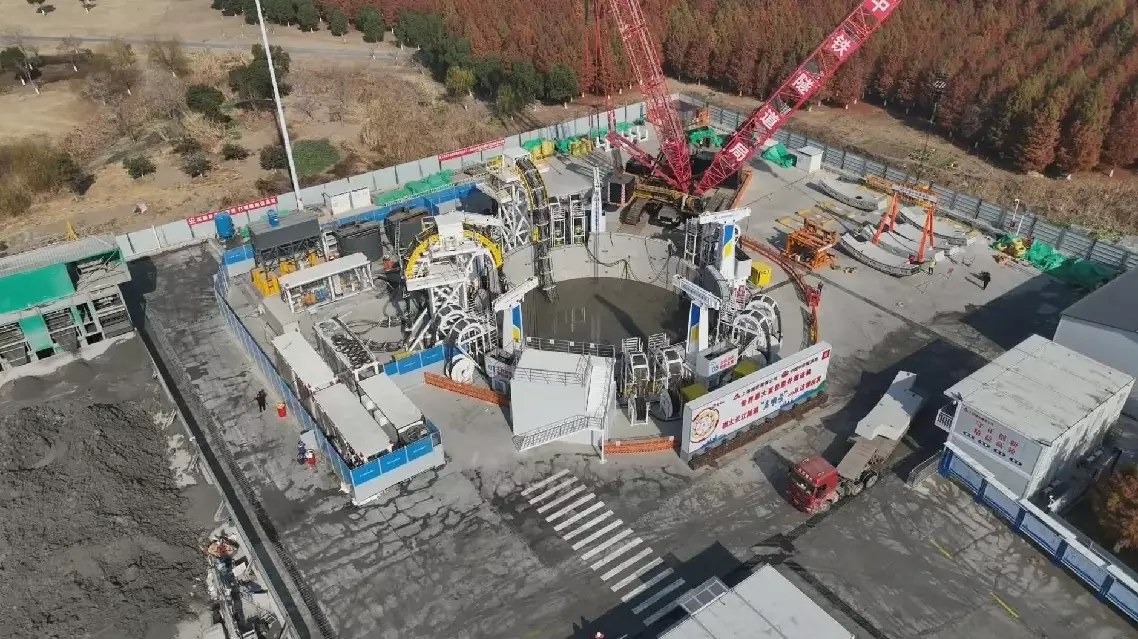
World’s largest-diameter boring machine put into use for Yangtze River railway tunnel
A new round of trade-in subsidy program is energizing China's consumer market these days, with provinces across the country seeing a surge in demand for cars, home appliances and digital devices.
In north China's Shanxi Province, the new trade-in subsidy program, which started on January 9, has further helped boost sales in home appliances and digital devices which are covered by the new round of subsidies.
To enjoy the subsidies, six types of home appliances, including refrigerators and washing machines, must meet national Level 1 energy-efficiency or water-efficiency standards. Digital and smart products include four types, such as mobile phones and tablets, with a sales price cap of 6,000 yuan (about 800 U.S. dollars) per item.
In both categories, subsidies are set at 15 percent of the final transaction price. For home appliances, the maximum subsidy is 1,500 yuan per item. For digital products, the cap is 500 yuan per item. Each consumer can receive a subsidy for one unit in each category.
Neighboring Shanxi, Hebei Province kicked off the year of 2026 with the new round of trade-in subsidy program starting on January 1.
The subsidies cover automobiles, home appliances, and digital products. Individual consumers who purchase designated Level 1 energy-efficiency appliances or eligible digital products priced at no more than 6,000 yuan can receive subsidies equal to 15 percent of the transaction price. The maximum subsidy is 1,500 yuan per appliance and 500 yuan per digital or smart device, with each person limited to one subsidized item in each category.
Data showed that from Jan 1 to 9, Hebei's home appliance trade-in program alone disbursed more than 130 million yuan in subsidies, driving sales of over 920 million yuan.
In east China's Jiangsu Province, the new trade-in subsidy program, taking effect for two weeks, has brought the province a boom in trade-in.
At a local 4S store in Jiangsu's Suqian City, showroom traffic has spiked as salespeople walked customers through the new benefits from the trade-in subsidy program.
"Under the scrappage-and-replacement scheme, customers who buy a new energy vehicle (NEV) can receive a subsidy worth 12 percent of the vehicle price, capped at 20,000 yuan (about 2,860 U.S. dollars). For combustion-engine cars, the subsidy is 10 percent, with an upper limit of 15,000 yuan. For trade-ins, NEVs are able to receive a subsidy worth 8 percent of the vehicle price, up to 15,000 yuan, while combustion-engine cars will receive a 6-percent subsidy, with a cap of 13,000 yuan," said Sun Yue, a saleswoman at the store.
In the home appliance sector, Jiangsu's policy this year stipulates that only products that meet China's Level 1 energy-efficiency standard are eligible for subsidies. The scheme covers six major categories, including refrigerators and washing machines.
Consumers who purchase qualifying appliances can receive a subsidy equal to 15 percent of the final retail price, up to a maximum of 1,500 yuan per item. Each person is limited to one subsidized unit per product category.
Four types of digital and smart products, such as mobile phones and tablets, are eligible for a 15-percent subsidy capped at 500 yuan per unit, with a retail price no more than 6,000 yuan.
"With the national subsidy policy back in place this year, I went to the store to check what discounts I could get. It knocked 500 yuan off the price. [The discounted price is] very reasonable," said Wang Kang, a resident of Jiangsu's Xuzhou Province.
To enhance the shopping experience for consumers, many retailers are pairing subsidies with "one-stop" services that combine the delivery of new products with on-site collection of old ones.
"After consumers place an order for new home appliances, our staff will schedule a time to pick up the old units. Recycling the old appliance can also further offset the purchase price of the new one," said Yang Jie, a sales supervisor at a major home appliance company.
China's new trade-in program sparks consumption boom