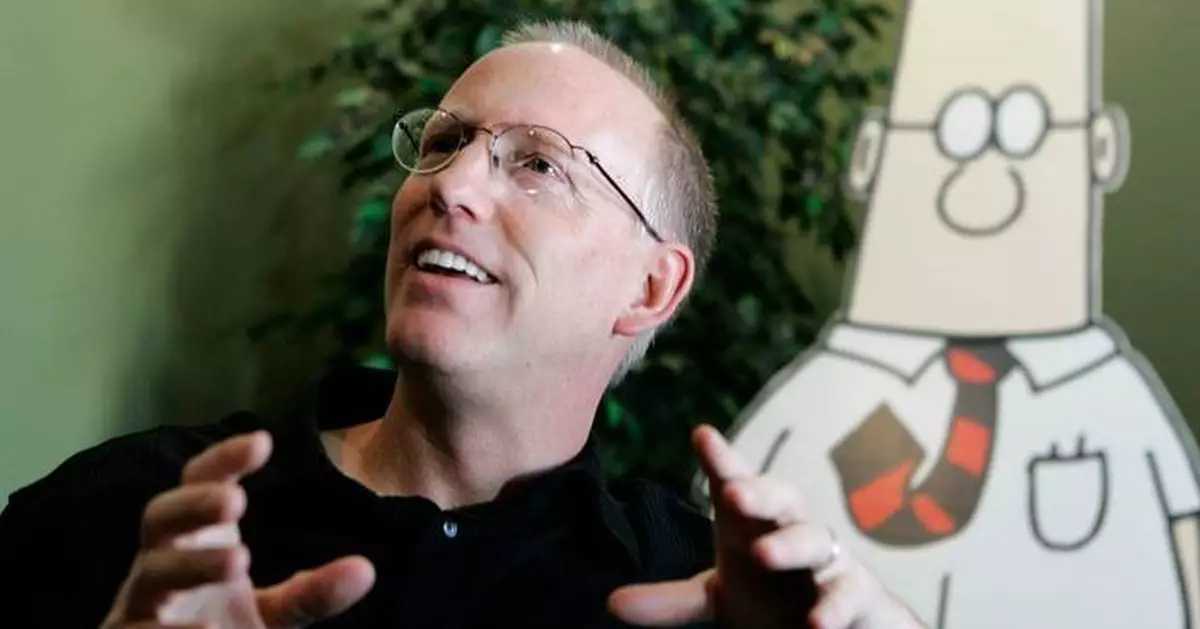
Scott Adams, whose popular comic strip “Dilbert” captured the frustration of beleaguered, white-collar cubicle workers and satirized the ridiculousness of modern office culture until he was abruptly dropped from syndication in 2023 for racist remarks, has died. He was 68.
His first ex-wife, Shelly Miles, announced the death Tuesday on a livestream posted on Adams’ social media accounts. “He’s not with us right anymore,” she said. Adams revealed in 2025 that he had prostate cancer that had spread to his bones. Miles had said he was in hospice care in his Northern California home on Monday.
“I had an amazing life,” the statement said in part. “I gave it everything I had.”
At its height, “Dilbert,” with its mouthless, bespectacled hero in a white short-sleeved shirt and a perpetually curled red tie, appeared in 2,000 newspapers worldwide in at least 70 countries and 25 languages.
Adams was the 1997 recipient of the National Cartoonist Society’s Reuben Award, considered one of the most prestigious awards for cartoonists. That same year, “Dilbert” became the first fictional character to make Time magazine’s list of the most influential Americans.
“We are rooting for him because he is our mouthpiece for the lessons we have accumulated — but are too afraid to express — in our effort to avoid cubicular homicide,” the magazine said.
“Dilbert” strips were routinely photocopied, pinned up, emailed and posted online, a popularity that would spawn bestselling books, merchandise, commercials for Office Depot and an animated TV series, with Daniel Stern voicing Dilbert.
It all collapsed quickly in 2023 when Adams, who was white, repeatedly referred to Black people as members of a “hate group” and said he would no longer “help Black Americans.” He later said he was being hyperbolic, yet continued to defend his stance.
Almost immediately, newspapers dropped “Dilbert” and his distributor, Andrews McMeel Universal, severed ties with the cartoonist. The Sun Chronicle in Attleboro, Massachusetts, decided to keep the “Dilbert” space blank for a while “as a reminder of the racism that pervades our society.” A planned book was scrapped.
“He’s not being canceled. He’s experiencing the consequences of expressing his views,” Bill Holbrook, the creator of the strip “On the Fastrack,” told The Associated Press at the time. “I am in full support with him saying anything he wants to, but then he has to own the consequences of saying them.”
Adams relaunched the same daily comic strip under the name Dilbert Reborn via the video platform Rumble, popular with conservatives and far-right groups. He also hosted a podcast, “Real Coffee,” where talked about various political and social issues.
After Jimmy Kimmel’s late-night show on ABC was suspended in September in the wake of the host’s comments on the murder of conservative activist Charlie Kirk, Adams stood for free speech.
“Would I like some revenge?” Adams said. “Yes. Yes, I would enjoy that. But that doesn’t mean I get it. That doesn’t mean I should pursue it. Doesn’t mean the world’s a better place if it happens.”
Adams, who earned a bachelor’s degree from Hartwick College and an MBA from the University of California, Berkeley, was working a corporate job at the Pacific Bell telephone company in the 1980s, sharing his cartoons to amuse co-workers. He drew Dilbert as a computer programmer and engineer for a high-tech company and mailed a batch to cartoon syndicators.
“The take on office life was new and on target and insightful,” Sarah Gillespie, who helped discover “Dilbert” in the 1980s at United Media, told The Washington Post. “I looked first for humor and only secondarily for art, which with ‘Dilbert’ was a good thing, as the art is universally acknowledged to be… not great.”
The first “Dilbert” comic strip officially appeared April 16, 1989, long before such workplace comedies as “Office Space” and “The Office.” It portrayed corporate culture as a “Severance”-like, Kafkaesque world of heavy bureaucracy and pointless benchmarks, where employee effort and skill were underappreciated.
The strip would introduce the “Dilbert Principle”: The most ineffective workers will be systematically moved to the place where they can do the least damage — management.
“Throughout history, there have always been times when it’s very clear that the managers have all the power and the workers have none,” Adams told Time. “Through ‘Dilbert,’ I would think the balance of power has slightly changed.”
Other strip characters included Dilbert’s pointy-haired boss; Asok, a young, naive intern; Wally, a middle-aged slacker; and Alice, a worker so frustrated that she was prone to frequent outbursts of rage. Then there was Dilbert’s pet, Dogbert, a megalomaniac.
“There’s a certain amount of anger you need to draw ‘Dilbert’ comics,” Adams told the Contra Costa Times in 2009.
In 1993, Adams became the first syndicated cartoonist to include his email address in his strip. That triggered a dialogue between the artist and his fans, giving Adams a fountain of ideas for the strip.
“Dilbert” was also known for generating aphorisms, like “All rumors are true — especially if your boss denies them” and “OK, let’s get this preliminary pre-meeting going.”
“If you can come to peace with the fact that you’re surrounded by idiots, you’ll realize that resistance is futile, your tension will dissipate, and you can sit back and have a good laugh at the expense of others,” Adams wrote in his 1996 book “The Dilbert Principle.”
In one real-life case, an Iowa worker was fired from the Catfish Bend Casino in 2007 for posting a “Dilbert” comic strip on the office bulletin board. In the strip, Adams wrote: “Why does it seem as if most of the decisions in my workplace are made by drunken lemurs?” A judge later sided with the worker; Adams helped find him a new job.
While Adams’ career fall seemed swift, careful readers of “Dilbert” saw a gradual darkening of the strip’s tone and its creator’s descent into misogyny, anti-immigration and racism.
He attracted attention for controversial comments, including saying in 2011 that women are treated differently by society for the same reason as children and the mentally disabled — “it’s just easier this way for everyone.” In a blog post from 2006, he questioned the death toll of the Holocaust.
In June 2020, Adams tweeted that when the “Dilbert” TV show ended in 2000 after just two seasons, it was “the third job I lost for being white.” But, at the time, he blamed it on lower viewership and time slot changes.
Adams’ beliefs began bleeding into his strips. In one in 2022, a boss says that traditional performance reviews would be replaced by a “wokeness” score. When an employee complains that could be subjective, the boss said, “That’ll cost you two points off your wokeness score, bigot.”
Adams put a brave face on his fall from grace, tweeting in 2023: “Only the dying leftist Fake News industry canceled me (for out-of-context news of course). Social media and banking unaffected. Personal life improved. Never been more popular in my life. Zero pushback in person. Black and White conservatives solidly supporting me.”
On Tuesday, President Donald Trump remembered Adams as a “Great Influencer.”
“He was a fantastic guy, who liked and respected me when it wasn’t fashionable to do so. He bravely fought a long battle against a terrible disease,” the president posted on his social media platform Truth Social.
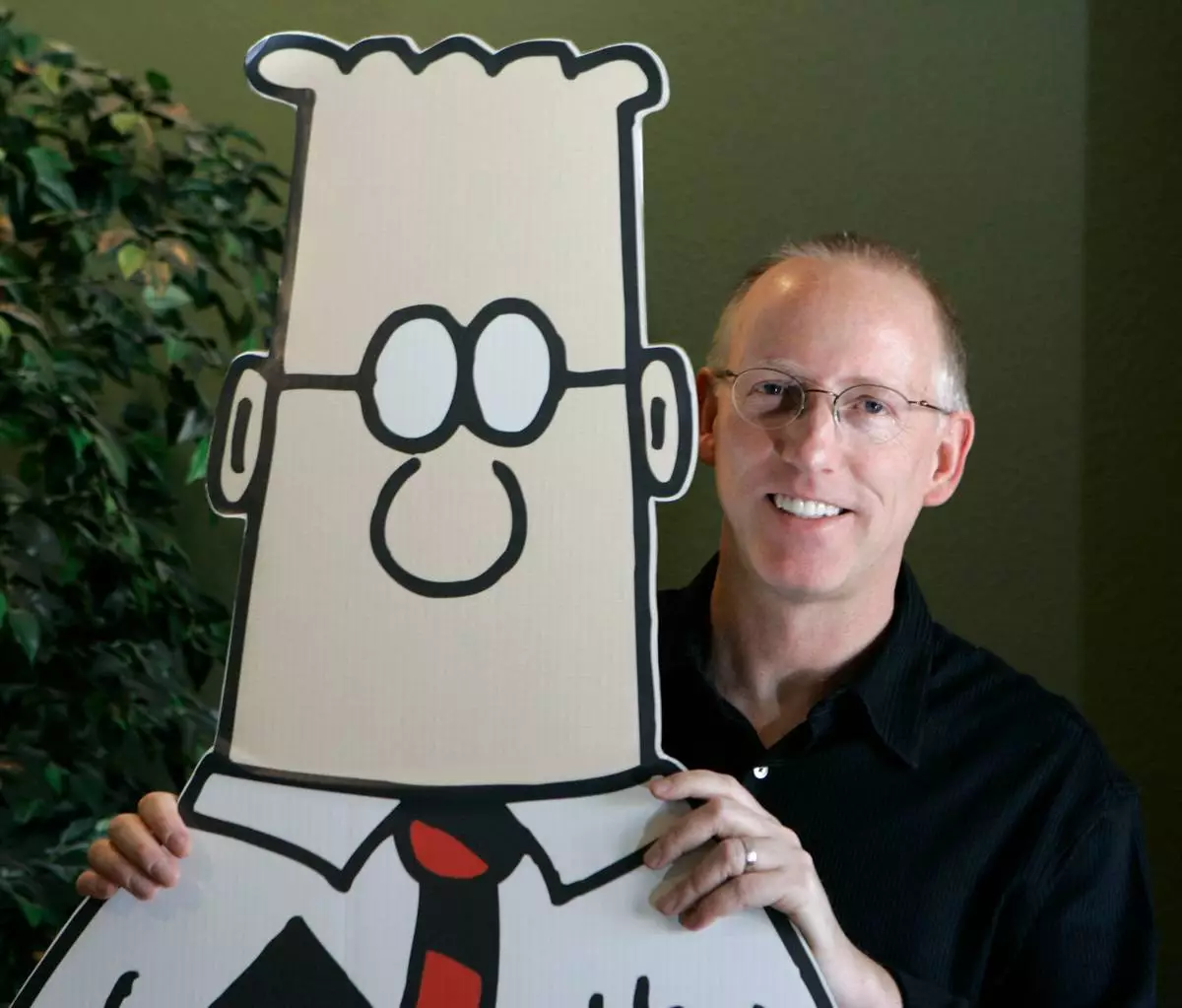
FLE - Scott Adams, creator of the comic strip Dilbert, poses for a portrait with the Dilbert character in his studio in Dublin, Calif., Oct. 26, 2006. (AP Photo/Marcio Jose Sanchez, File)
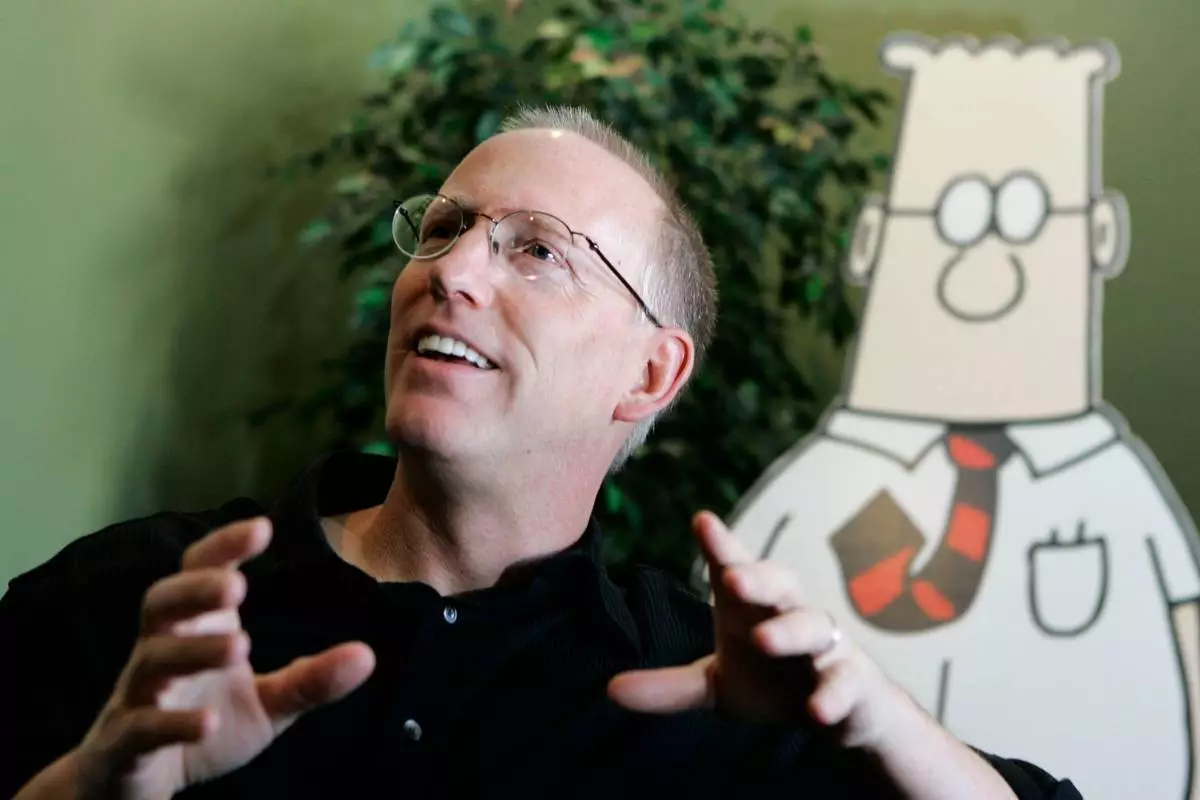
FILE - Scott Adams, creator of the comic strip Dilbert, talks about his work at his studio in Dublin, Calif., on Oct. 26, 2006. (AP Photo/Marcio Jose Sanchez, File)