WASHINGTON (AP) — The developer of a major offshore wind project to serve New York is set to go before a federal judge Wednesday, hoping to convince him to lift a Trump administration order they say could mean the death of a project that's 60% complete.
The Empire Wind project is designed to power more than 500,000 homes. Norwegian company Equinor said it will likely have to kill the project if construction can’t resume soon due to the availability of specialized vessels and heavy financial losses.
The case is being heard by District Judge Carl J. Nichols, an appointee of President Donald Trump.
Empire Wind is one of five big offshore wind projects on the East Coast that the administration froze days before Christmas, citing national security concerns. Developers and states have sued seeking to block the order. Equinor’s hearing is the second of three hearings for these legal challenges this week; on Monday, a judge ruled that a project serving Rhode Island and Connecticut could resume.
Trump has targeted offshore wind from his first days back in the White House, most recently calling wind farms “losers” that lose money, destroy the landscape and kill birds. When his administration cited national security concerns, it gave no detail for those concerns, and at least one expert has said the offshore projects were permitted following years of careful review that included the Department of Defense.
The administration's stance against offshore wind and renewable energy more broadly runs counter to dozens of other countries.
The global offshore wind market is growing, with China leading the world in new installations. Nearly all of the new electricity added to the grid in 2024 was renewable. Experts say the world needs a major buildout of renewable electricity to address climate change.
Molly Morris, Equinor’s senior vice president overseeing Empire Wind, said federal officials have not given them any explanation of the national security concerns or how to mitigate them.
A specialized heavy lift vessel, Heerema’s Sleipnir, must begin lifting the topside to the project’s offshore substation off the transport ship and onto its foundation because the Sleipnir is scheduled to depart by Feb. 1 for other commitments, Morris said. The topside weighs more than 3,000 tons and there are few specialized offshore wind installation ships in the world.
“Right now the project is in a critical situation,” Morris said. “Construction must resume by mid-January to avoid cascading delays that could ultimately lead to a cancellation of the project. We have been clear and consistent that we are ready to address any additional security concerns that were not already addressed through our lengthy engagement with various defense agencies.”
Monday's hearing was in the same federal court, with Danish energy company Orsted prevailing. A judge ruled that work on its project, called Revolution Wind, can resume while the administration considers ways to mitigate its national security concerns. Revolution Wind is nearly complete.
After that hearing, White House spokesperson Taylor Rogers said the pause is meant to protect the national security of the American people, and “we look forward to ultimate victory on the issue.”
The Trump administration paused leases for the Vineyard Wind project under construction in Massachusetts, Revolution Wind, Coastal Virginia Offshore Wind, and two projects in New York: Sunrise Wind and Empire Wind. New York’s attorney general sued the Trump administration on Friday over Empire Wind and Sunrise Wind.
The Trump administration previously halted work on both Empire Wind and Revolution Wind. In April, it stopped construction on Empire Wind, accusing the Biden administration of rushing the permits, then allowed work to resume a month later. In August, the administration paused work on Revolution Wind for what it said were national security concerns. A month later, a federal judge ruled the project could resume.
Equinor finalized the federal lease for Empire Wind in March 2017, early in Trump’s first term. The final federal approval was in February 2024. Equinor's limited liability company has spent about $4 billion to develop and construct the project so far.
McDermott reported from Providence, Rhode Island.
The Associated Press’ climate and environmental coverage receives financial support from multiple private foundations. AP is solely responsible for all content. Find AP’s standards for working with philanthropies, a list of supporters and funded coverage areas at AP.org.
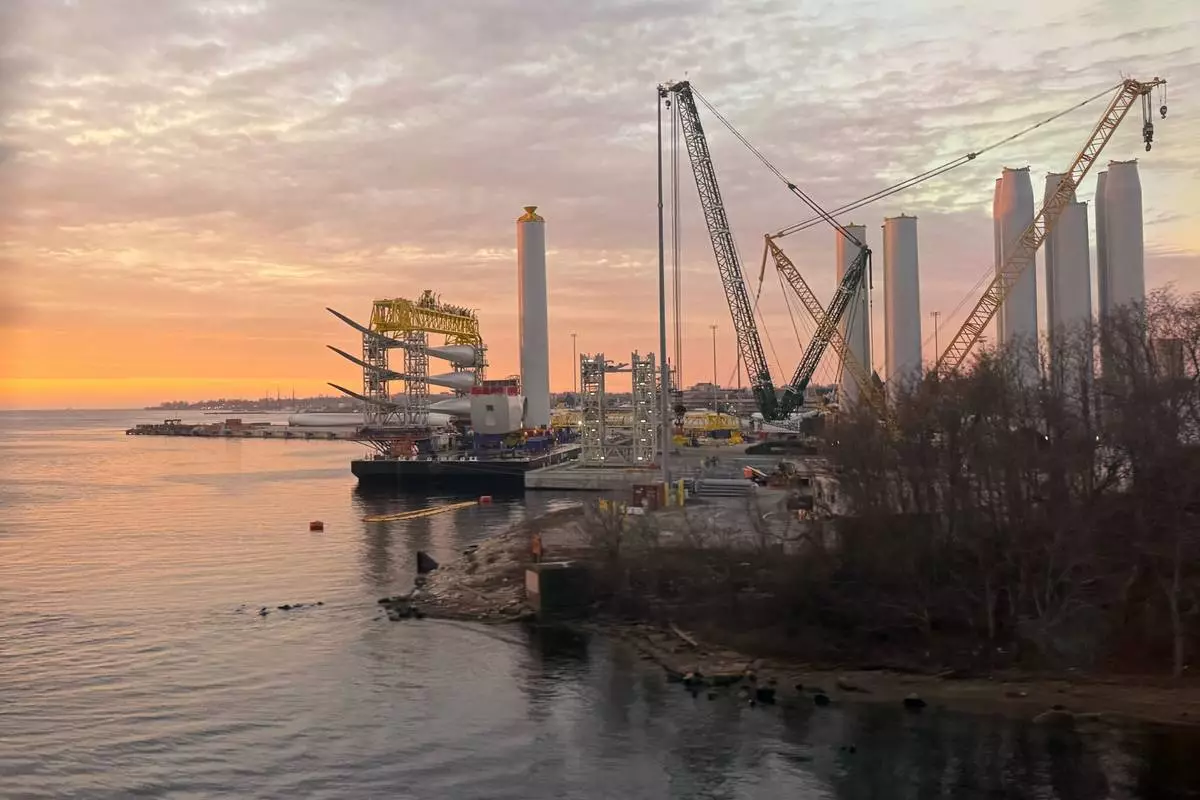
Blades and turbine bases for offshore wind sit at a staging area at New London State Pier, Wednesday, Jan. 14, 2026, in New London, Conn. (AP Photo/Matt O'Brien)
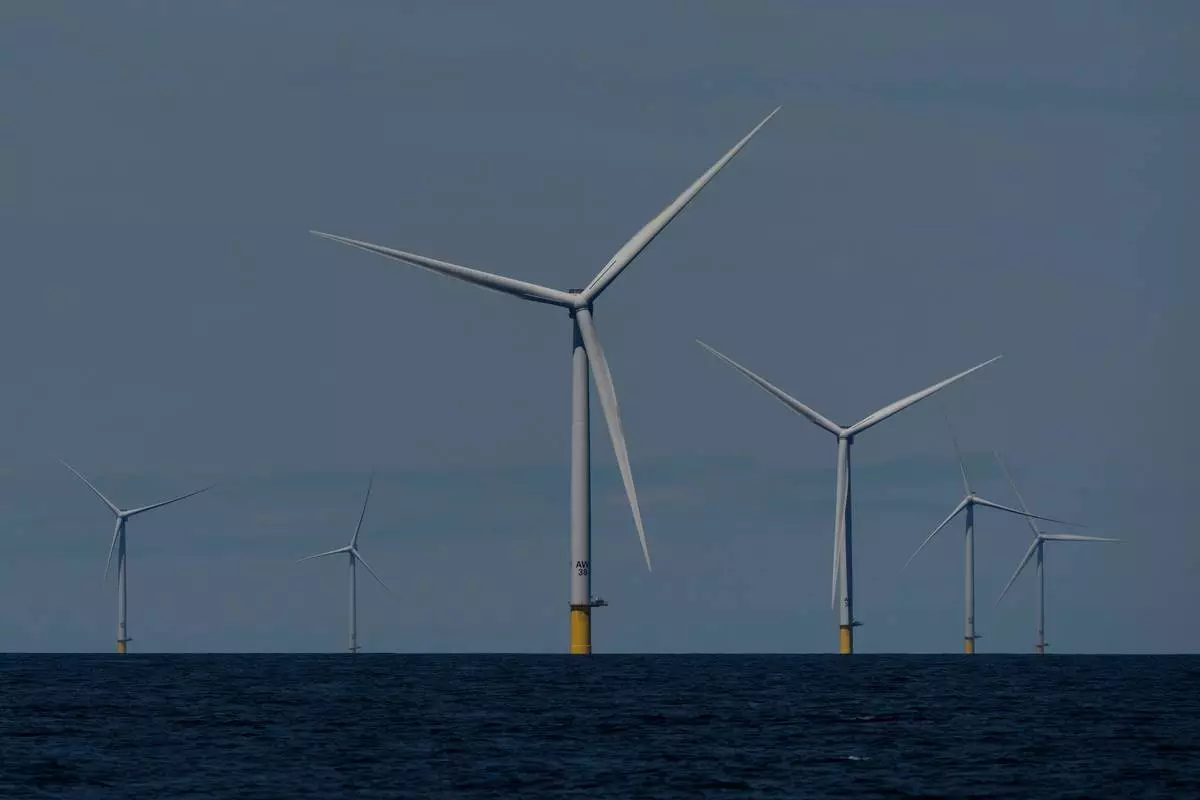
FILE - Wind turbines operate at Vineyard Wind 1 offshore wind farm off the coast of Massachusetts, July 19, 2025. (AP Photo/Carolyn Kaster, File)

FILE - A sign for the company Equinor is displayed on Oct. 28, 2020, in Fornebu, Norway. (Håkon Mosvold Larsen/NTB Scanpix via AP, File)

NAKHON RATCHASIMA, Thailand (AP) — A construction crane crashed onto a moving passenger train in northeastern Thailand on Wednesday, triggering a fiery derailment that killed at least 32 people and injured dozens more.
The crash occurred in Nakhon Ratchasima, some 200 kilometers (135 miles) northeast of Bangkok, on a section of a planned high-speed rail project that is intended to eventually connect China with much of Southeast Asia.
The province's Public Health Provincial Office said there were 32 fatalities and 64 injured victims, including seven with severe injuries. There were still three passengers missing among the 171 believed to have been on board the train, it said in a statement issued as night fell.
Authorities said the crane was being used to build an elevated part of the railway when it fell as the train was traveling from the capital, Bangkok, to Ubon Ratchathani province. Thailand's Rail Transport Department said the crane was what is called a launching gantry crane, a self-supporting structure with vertical legs that usually runs on rails or wheels for mobility, allowing it to progress along with the construction project that it straddles. Such cranes are often used to help build elevated roads.
Images published in Thai media showed plumes of white, then dark, smoke rising from the crash site, with construction equipment dangling from girders between two concrete support pillars.
Rescue workers stood on top of overturned railway carriages, some of them with gaping holes torn on their sides, video from public broadcaster ThaiPBS showed. What appeared to be sections of the crane were scattered along the track.
Sixty-two year-old Samai Teechantuek, whose house is about 100 meters (yards) from the site of the accident, told The Associated Press of the horror of witnessing the accident, and hearing “the noises screeching, and then bam, bam, bam, all the way over there.”
“When the dust settled, I saw the top of the train carriage. I heard people shouting ‘save the children first!’” she said. "A conductor pulled people out. I saw them pulling many people out. People from the shop over there also ran out to help.”
“My legs were shaking. I was standing there shaking. I didn’t dare going any closer,” she said.
Transport Minister Phiphat Ratchakitprakarn said he ordered an investigation.
In August 2024, a railway tunnel on the planned route, also in Nakhon Ratchasima, collapsed, killing three workers. Days of heavy rainfall were believed to have been a factor in the collapse.
The elevated segment that collapsed is a part of a Thai-Chinese high-speed railway project linking the capital to the northeastern province of Nong Khai, bordering Laos. The two-stage rail project has a total investment cost of more than 520 billion baht ($16.8 billion) and is associated with an ambitious plan to connect China with Southeast Asia under Beijing's Belt and Road Initiative. The section where the accident took place had a budget of more than 179 billion baht ($5.7 billion) and according to its original plans was expected to start operating in 2027.
Anan Phonimdaeng, acting governor of the State Railway of Thailand, said the project's contractor is Italian-Thai Development, with a Chinese company responsible for design and construction supervision.
He said authorities will examine the responsibilities of both parties, and the Railway Department plans to take legal action against the contractor as a first step. Damage to the train was estimated to be more than 100 million baht ($3.2 million), while construction equipment suffered limited damage, said Anan.
A statement posted on the company's website expressed condolences to the victims and said the company would take responsibility for paying compensation to the families of the dead and hospitalization expenses for the injured.
The main contractor for the route's first stage between Bangkok and Nakhon Ratchasima, Italian-Thai Development, was also the directly responsible for construction of the segment where Wednesday's accident occurred.
The rail accident sparked outrage because the company, also known as Italthai, was also the co-lead contractor for the State Audit Building in the Thai capital Bangkok, which collapsed during construction in March during a major earthquake.
About 100 people were killed in the collapse, which was the only major structure in Thailand to suffer such serious damage. Dozens of executives were indicted in connection with the disaster but none have yet been tried.
The involvement of Chinese companies in both projects has also drawn attention, as has Italthai's and Chinese companies' involvement in the construction of several expressway extensions in and around Bangkok where several accidents, some fatal, had occurred.
Prime Minister Anutin Charnvirakul, who was interior minister when the State Audit Building collapsed, said that the Comptroller General’s Department and Transport Ministry are responsible for blacklisting contractors, and the laws could not be amended in the brief time he was interior minister to expedite the matter.
In Beijing, Chinese Foreign Ministry spokesperson Mao Ning said the government was aware of the reports about the accident and had expressed condolences.
“The Chinese government attaches great importance to the safety of projects and personnel, and we are also learning about the situation,” he said. “At present, it appears that the relevant section is being constructed by a Thai company, and the cause of the accident is still under investigation.”
Wasamon reported from Bangkok.
Rescuers try to lift the wreckage after a construction crane fell into a passenger train in Nakhon Ratchasima province, Thailand, Wednesday, Jan.14, 2026. (AP Photo/Sakchai Lalit))
Rescuers work amid the wreckage after a construction crane fell into a passenger train in Nakhon Ratchasima province, Thailand, Wednesday, Jan.14, 2026. (AP Photo/Sakchai Lalit))
A rescuer stands near the wreckage after a construction crane fell into a passenger train in Nakhon Ratchasima province, Thailand, Wednesday, Jan.14, 2026. (AP Photo/Sakchai Lalit))
Rescuers try to lift the wreckage after a construction crane fell into a passenger train in Nakhon Ratchasima province, Thailand, Wednesday, Jan.14, 2026. (AP Photo/Sakchai Lalit))
Rescuers work amidst the wreckage after a construction crane fell into a passenger train in Nakhon Ratchasima province, Thailand, Wednesday, Jan.14, 2026. (AP Photo/Sakchai Lalit))
An aid workers at the scene after a construction crane fell into a passenger train in Nakhon Ratchasima province, Thailand, Wednesday, Jan. 14, 2026. (AP Photo/Nathathida Adireksarn)
The wreckage after a construction crane fell into a passenger train in Nakhon Ratchasima province, Thailand, Wednesday, Jan. 14, 2026. (AP Photo/Nathathida Adireksarn)
This photo released from Thailand's Ministry of Transport, shows a scene after a construction crane fell into a passenger train in Nakhon Ratchasima province, Thailand Wednesday, Jan. 14, 2026. (Ministry of Transport via AP)
This photo released from State Railway of Thailand, shows aid workers after a construction crane fell into a passenger train in Nakhon Ratchasima province, Thailand Wednesday, Jan. 14, 2026. (State Railway of Thailand via AP)
This photo released from State Railway of Thailand, shows a scene after a construction crane fell into a passenger train in Nakhon Ratchasima province, Thailand Wednesday, Jan. 14, 2026. (State Railway of Thailand via AP)
This photo released from State Railway of Thailand, shows aid workers after a construction crane fell into a passenger train in Nakhon Ratchasima province, Thailand Wednesday, Jan. 14, 2026. (State Railway of Thailand via AP)
This photo provided by State Railway of Thailand shows a scene after a construction crane fell into a passenger train in Nakhon Ratchasima province, Thailand Wednesday, Jan. 14, 2026. (State Railway of Thailand via AP)