U.S. President Donald Trump's administration on Wednesday announced the launch of the second phase of the Gaza peace plan, shifting the focus from ceasefire to demilitarization, technocratic governance and reconstruction.
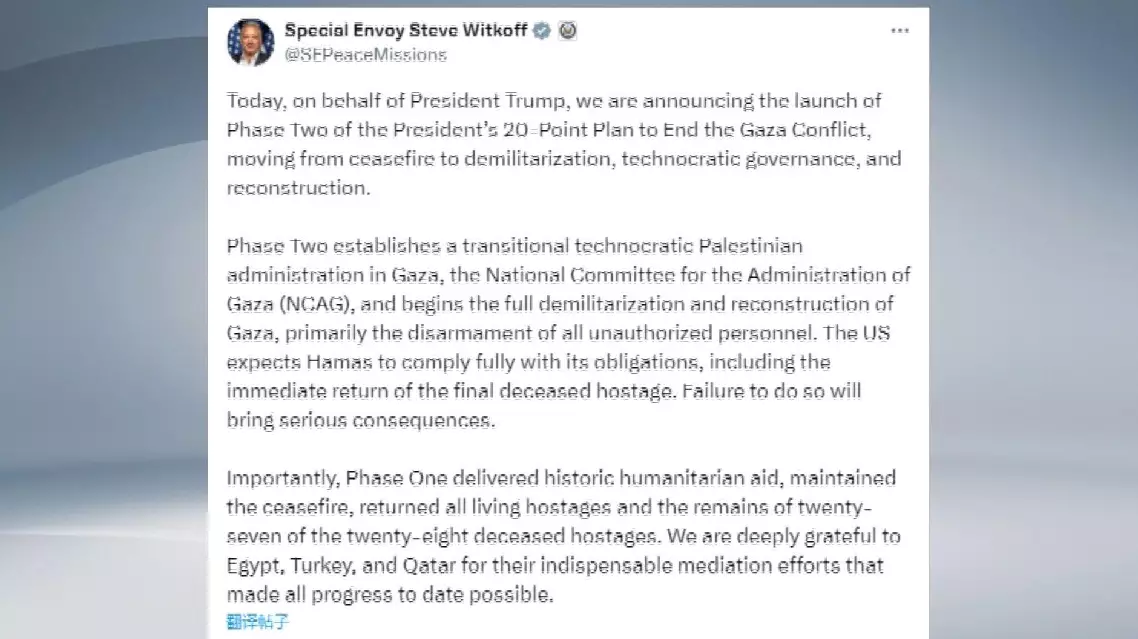
"Today, on behalf of President Trump, we are announcing the launch of Phase Two of the President's 20-Point Plan to End the Gaza Conflict, moving from ceasefire to demilitarization, technocratic governance, and reconstruction," U.S. presidential special envoy Steve Witkoff posted on social media platform X.
"Phase Two establishes a transitional technocratic Palestinian administration in Gaza, the National Committee for the Administration of Gaza (NCAG), and begins the full demilitarization and reconstruction of Gaza, primarily the disarmament of all unauthorized personnel," he said.
The announcement reiterated the U.S. side's expectation that Hamas would comply fully with its obligations, including the immediate return of the final deceased hostage. The envoy warned that failure to comply "will bring serious consequences."
Following the announcement, Israeli Prime Minister Benjamin Netanyahu said it will not affect Israel's demand that Hamas must make a full effort to return the last body of an Israeli hostage held in Gaza.
Egypt, Qatar and Türkiye announced on Wednesday the completion of forming a Palestinian technocratic committee to administer Gaza, according to a joint statement issued by the Egyptian Foreign Ministry.
The three mediators described the move as "an important development" toward enhancing stability and improving humanitarian conditions in the enclave, noting that the committee is headed by Ali Abdel Hamid Shaath, a veteran engineer and former deputy planning minister in the Palestinian Authority.
The mediators voiced hope that the formation of the committee would pave the way for the implementation of the second phase of the Gaza ceasefire agreement, in line with the U.S.-proposed plan, and help to cement calm and prevent a return to escalation.
The announcement followed a meeting held earlier in the day in Cairo among Palestinian factions and political forces, which affirmed in a statement their full commitment to implementing the Gaza ceasefire agreement and called on Israel to halt its aggression and open border crossings.
A delegation of senior leaders from Hamas arrived in Cairo on Tuesday evening, headed by Khalil al-Hayya, the movement's leader in Gaza.
Hamas said in a statement that the delegation would hold talks with Egyptian officials on completing the implementation of the ceasefire agreement, accelerating the transition to its second phase, including the formation of an independent administrative committee to manage Gaza, and completing the withdrawal of Israeli forces from the enclave.
The Gaza ceasefire agreement continues to face challenges amid mutual accusations between Hamas and Israel of violations, with casualties still being reported since its entry into force.
Brokered by Egypt, Qatar, Türkiye, and the United States, an ongoing ceasefire between Israel and Hamas took effect on Oct. 10, 2025, following two years of conflict. However, Gaza's health authorities said Wednesday that at least 449 people have been killed and 1,246 injured since the ceasefire began.
Since Oct. 7, 2023, Israel's military campaign in Gaza has killed 71,439 Palestinians and wounded 171,324 others, while causing widespread destruction and worsening humanitarian conditions in the enclave, the authorities added.
U.S. announces launch of phase 2 of Gaza peace plan