WASHINGTON (AP) — One week after the nation marked the fifth anniversary of the Jan. 6, 2021, Capitol attack, the history of what happened that day is being reconsidered, revised and reassessed by the party in power.
The House GOP's new Select Committee on the Jan. 6 attack held its first hearing Wednesday, what was billed as an examination of the FBI's investigation into the pipe bombs that had been found outside the Democratic and Republican party headquarters during the day. The FBI's work dragged on for years until the arrest of a suspect last month.
But the House hearing quickly devolved into a revisionist spectacle --- militant Oath Keepers founder Stewart Rhodes sat in the front row -- as Republicans pursued alternative theories about why President Donald Trump’s supporters engaged in mob violence that day. They suggested the rioters were essentially tricked into laying siege to the Capitol, an attack watched around the world.
“There's been a lot of talk about conspiracy theories and narratives,” acknowledged Rep. Barry Loudermilk, R-Ga., the chairman, as tensions flared during the two-hour hearing. He said his “objective is to get to the truth.”
But the top Democrat on the panel, Rep. Jamie Raskin of Maryland, warned he and others would not sit by silently as the Republican-led committee tried to rewrite history.
“The truth is a resilient thing,” Raskin said. “We’re not going to put up with a pack of lies in this subcommittee and a bunch of conspiracy theories.”
What’s clear is that five years on, the national trauma left behind by Jan. 6 still engulfs Congress, and the country, as Americans come to terms with what happened that day, when Trump’s supporters stormed the Capitol after the defeated president told them to “fight like hell” as Congress certified the 2020 election results for Democrat Joe Biden.
It's the second time House Republicans, since they took control, have stood up a new committee to probe Jan. 6, as they dispute the findings of the original panel established by then-Speaker Nancy Pelosi in the immediate aftermath of the riot. That panel, which released its findings in 2022, put the blame on Trump for having incited the violence at the Capitol, part of a last gasp in his months-long effort to overturn his election defeat to Biden.
Trump was impeached on the charge of inciting the insurrection, but acquitted by the Senate. The Justice Department’s four-count indictment against Trump brought by special counsel Jack Smith was abandoned once Trump won reelection in 2024, adhering to department protocol against prosecuting a sitting president.
One GOP lawmaker, Rep. Troy Nehls of Texas — who was among those seen at the barricaded doors to the House chamber — called the original Jan. 6 committee a “total sham.” He disputed the eyewitness testimony of police officers who had recounted in detail how they were bloodied and injured in the mayhem as “highly scripted” accounts from “Trump haters.”
“They put on a pretty good show,” he said about the panel.
The Republicans tried to pin the violence at the Capitol on certain agitators, and they portrayed the militia groups who were central to the siege as having been entrapped by the federal government.
Rhodes, seated in the audience wearing a black cowboy hat, was among those convicted of seditious conspiracy over his role. He was among the more than 1,500 people pardoned by Trump once the president retook office last year.
At one point, Rep. Jasmine Crockett, D-Texas, turned to her colleagues, exasperated.
“I am so frustrated with this country and I don’t think I’m the only one,” she said.
“The conspiracy theories," she said, "are driving me insane.”
The panel did dive into the details of the pipe bomb investigation, as lawmakers tried to understand why it took federal law enforcement some five years to have a potential break in the case. Last month, the FBI arrested Brian Cole Jr. of Virginia on suspicion of placing the pipe bombs.
Republicans had long believed the pipe bombs were part of a potential inside job — a distraction that diverted law enforcement that day as Trump’s supporters marched to the Capitol to confront Congress.
“I've been concerned with this whole pipe bomb situation for some time,” said Rep. Morgan Griffith, R-Va.
He was among those questioning why bomb-sniffing dogs failed that day to discover the device outside one of the party headquarters.
Cole told investigators after his arrest last month that he believed someone needed to “speak up” for people who believed the 2020 election was stolen and that he was “disappointed” that Trump lost to Biden.
Rep. Harriet Hageman, R-Wyo., also probed why investigators overlooked various leads that day.
John Nantz, a former FBI special agent, testified to the panel that the Biden-era FBI under then-Director Christopher Wray was focused elsewhere.
"Every resource should have been made available," he said.
Hageman quipped that was the “understatement of the century.”
Trump's pardons of the rioters were also discussed, as Raskin detailed how many of those convicted in the siege have gone on to commit other crimes.
Mike Romano, a former Justice Department prosecutor, said he viewed Trump’s pardons as “ill-advised."
Romano said many of them remained proud of their conduct. “They have celebrated the pardons and tried to lie about what happened,” he said.
Pressed by Raskin about whether Trump's pardon would apply to Cole, if convicted in the pipe bomb case, Romano said it’s an open question.
“I don't know that there's a clear yes or no,” he testified. “And I think that’s a problem.”

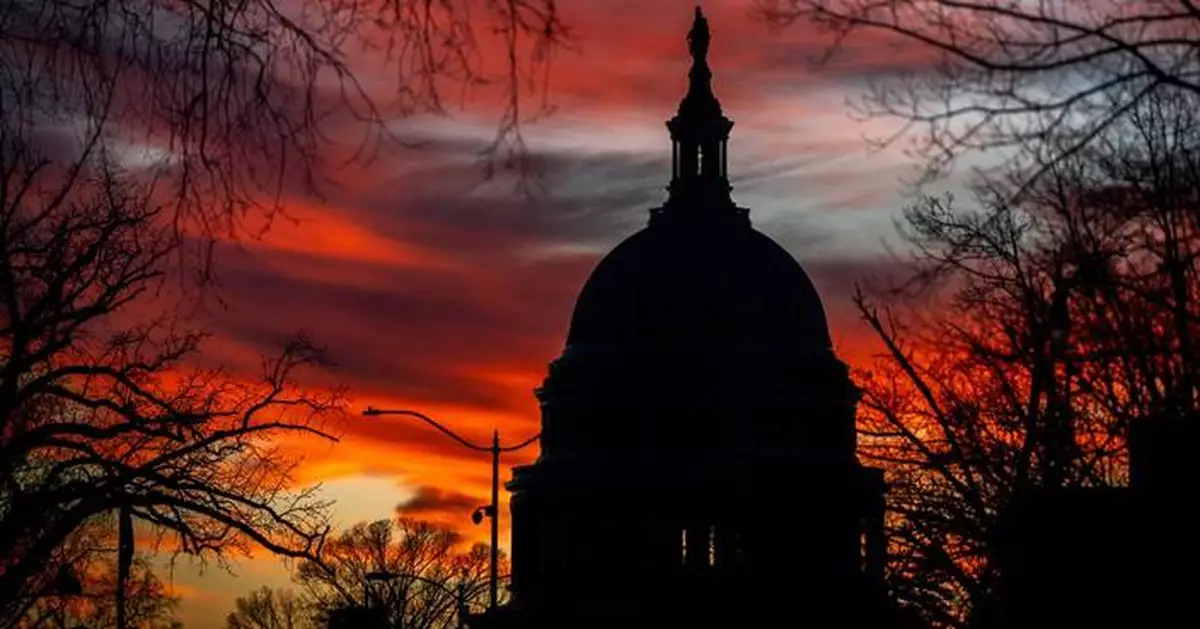
The U.S. Capitol is seen at sunset, Monday, Jan. 12, 2026, in Washington. (AP Photo/Julia Demaree Nikhinson)
CAPE CANAVERAL, Fla. (AP) — NASA’s Artemis II astronauts fired their engines and blazed toward the moon Thursday night, breaking free of the chains that have trapped humanity in shallow laps around Earth in the decades since Apollo.
The so-called translunar ignition came 25 hours after liftoff, putting the three Americans and a Canadian on course for a lunar fly-around early next week. Their Orion capsule bolted out of orbit around Earth right on cue and chased after the moon nearly 250,000 miles (400,000 kilometers) away.
“Ladies and gentlemen, I am so, so excited to be able to tell you that for the first time since 1972 during Apollo 17, human beings have left Earth orbit,” NASA’s Lori Glaze announced at a news conference.
The engine firing was flawless, she noted.
Canadian astronaut Jeremy Hansen said he and his crewmates were glued to the capsule's windows as they left Earth in the rearview mirror, taking in the “phenomenal” views. Their faces were pressed so tightly against the windows that they had to wipe them clean.
“Humanity has once again shown what we are capable of, and it’s your hopes for the future that carry us now on this journey around the moon,” Hansen said.
NASA had the Artemis II crew stick close to home for a day to test their capsule’s life-support systems before clearing them for lunar departure.
Now committed to the moon, the Artemis II test flight is the opening act for NASA’s grand plans for a moon base and sustained lunar living.
Commander Reid Wiseman, pilot Victor Glover, Christina Koch and Hansen will dash past the moon then hang a U-turn and zip straight home without stopping on land. In the process, they will go the farthest humans have ever traveled from Earth, breaking the Apollo 13 distance record set in 1970. They also may become the fastest during their reentry at flight’s end on April 10.
Glover, Koch and Hansen already have made history as the first Black person, the first woman and the first non-U.S. citizen to launch to the moon. Apollo’s 24 lunar travelers were all white men.
“Trust us, you look amazing. You look beautiful," Glover said in a TV interview after beholding the globe from pole to pole. "And from up here you also look like one thing: homo sapiens as all of us no matter where you’re from or what you look like, we’re all one people.”
To set the mood for the day’s main event, Mission Control woke up the crew with John Legend’s “Green Light” featuring Andre 3000 and a medley of NASA teams cheering them.
“We are ready to go,” Glover said.
Mission Control gave the final go-ahead minutes before the critical engine firing, telling the astronauts that they were embarking on “humanity’s lunar homecoming arc” to bring them back to Earth. The capsule is relying on the gravity of Earth and the moon — termed a free-return lunar trajectory — to complete the round-trip figure-eight loop. The engine accelerated their capsule to more than 24,000 mph (38,000 kph) to shove them out of Earth's orbit.
“I’ve got to tell you, there is nothing normal about this," Wiseman said. "Sending four humans 250,000 miles away is a herculean effort, and we are now just realizing the gravity of that.”
Flight director Judd Frieling said he and his team were all business while on duty but will likely reflect on the momentousness of it all once they go home.
“I suspect everybody understands that this is a once-in-a-lifetime moment," he told reporters.
The next major milestone will be Monday’s lunar flyby.
Orion will zoom 4,000 miles (6,400 kilometers) beyond the moon before turning back, providing unprecedented and illuminated views of the lunar far side, at least for human eyes. The cosmos will even treat the Artemis II astronauts to a total solar eclipse as the moon temporarily blocks the sun from their perspective.
While awaiting their orbital departure earlier Thursday, the astronauts savored the views of Earth from tens of thousands of miles high. Koch told Mission Control that they can make out the entire coastlines of continents and even the South Pole, her old stomping ground.
NASA is counting on the test flight to kickstart the entire Artemis program and lead to a moon landing by two astronauts in 2028.
The so-called lunar loo may need some design tweaks, however.
Orion's toilet malfunctioned as soon as the Artemis crew reached orbit Wednesday evening. Mission Control guided astronaut Koch through some plumbing tricks and she finally got it going, but not before having to resort to using contingency urine storage bags.
The urine pouches are serving double duty. Mission Control ordered the crew to fill a bunch of the empty bags with water from the capsule’s dispenser on Thursday. A valve issue arose with the dispenser following liftoff, and NASA wanted plenty of drinking water on hand for the crew in case the problem recurred. The astronauts used straws and syringes to fill the pouches with more than 2 gallons (7 liters) worth before pivoting to the moon.
The Associated Press Health and Science Department receives support from the Howard Hughes Medical Institute’s Department of Science Education and the Robert Wood Johnson Foundation. The AP is solely responsible for all content.
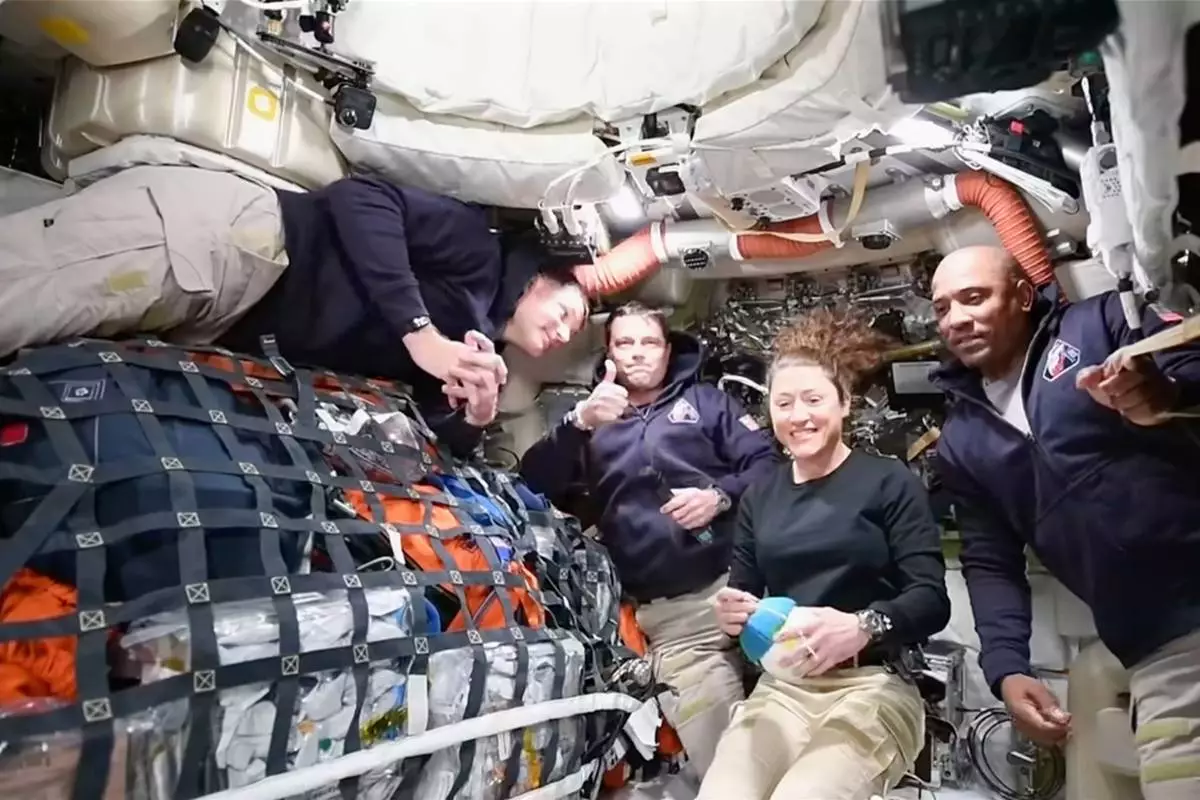
This image taken from video provided by NASA shows the Artemis II crew, from left, Canadien astronaut and mission specialist Jeremy Hansen, Commander Reid Wiseman, mission specialist Christina Koch and pilot Victor Glover as they speak with NASA Mission Control via video conference from the moon's orbit Thursday, April 2, 2026. (NASA via AP)
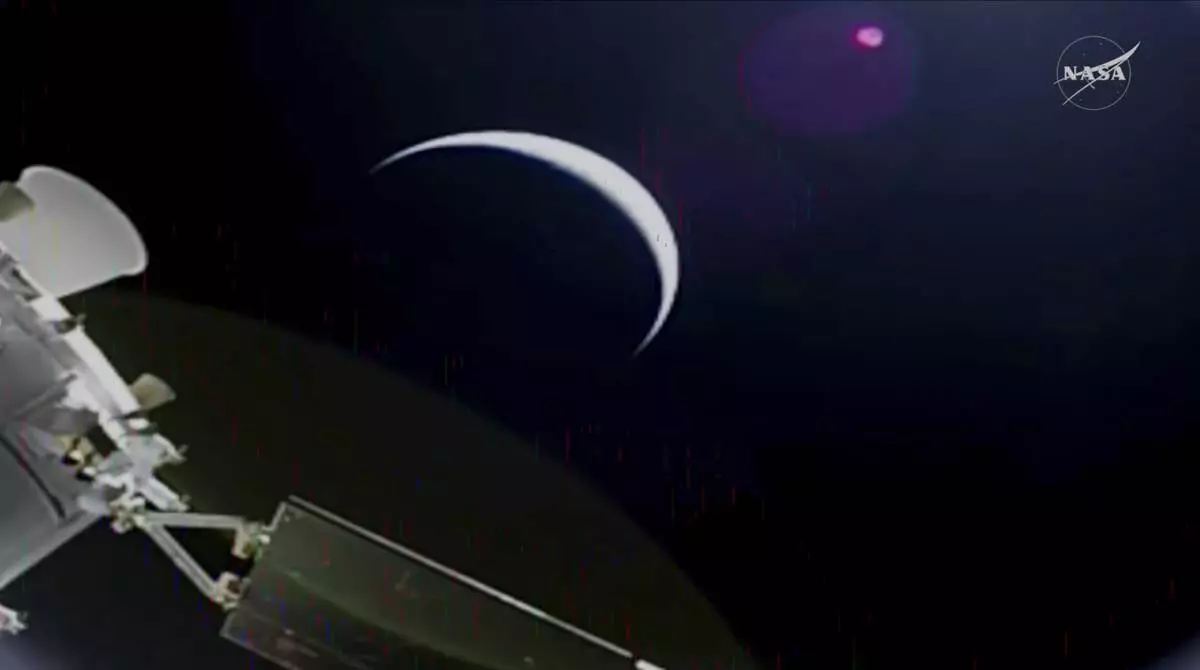
This image released by NASA on Thursday, April 2, 2026, shows NASA’s Orion spacecraft with Earth in the background. (NASA via AP)

This image taken from video provided by NASA shows the Earth, left, from NASA's Orion spacecraft as it fired its engines heading toward the moon Thursday, April 2, 2026. (NASA via AP)
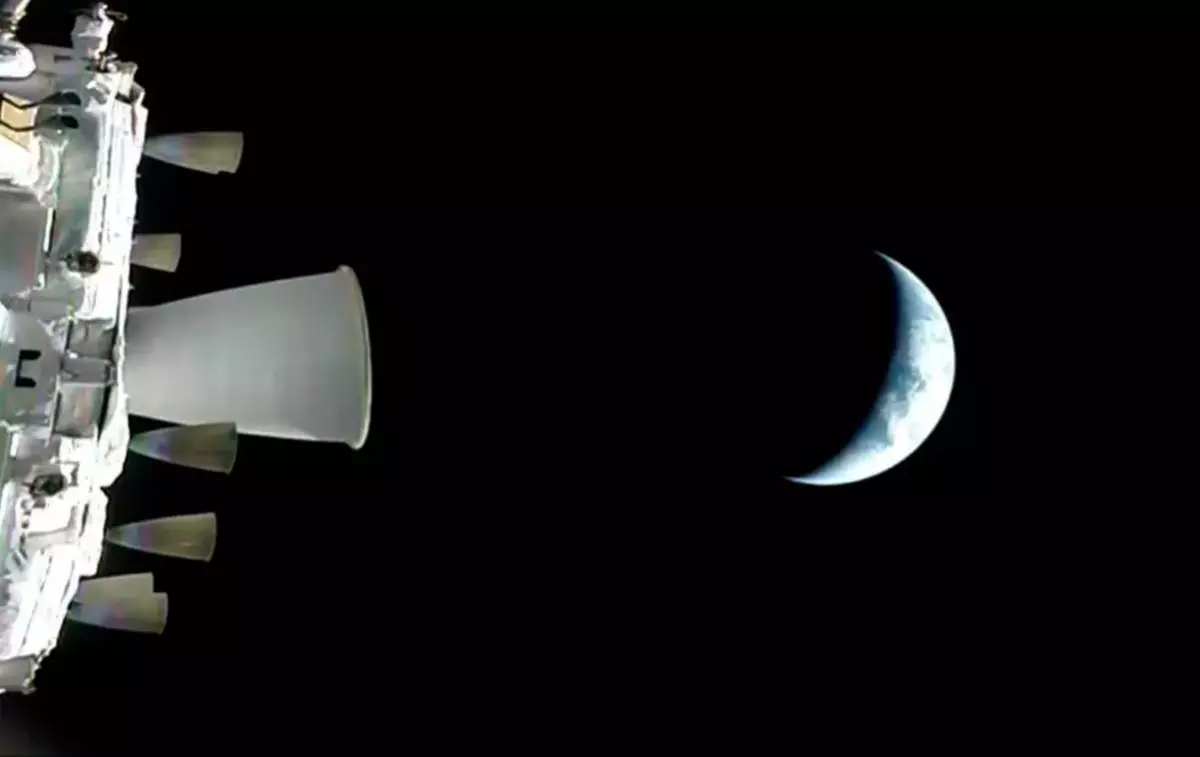
In this photo provided by NASA, a view of the Earth from NASA's Orion spacecraft as it orbits above the planet during the Artemis II test flight, on Thursday, April 2, 2026. (NASA via AP)
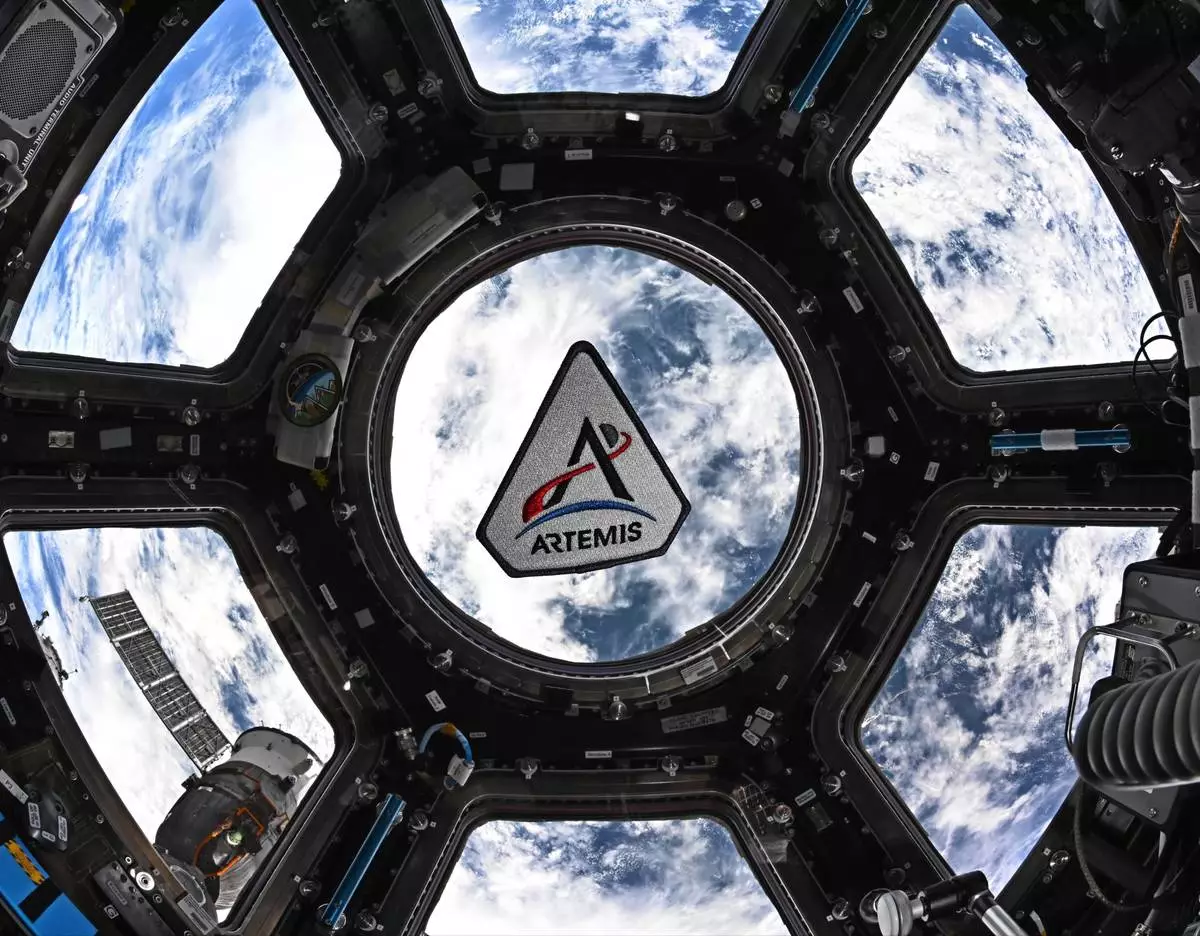
In this photo provided by NASA, an Artemis program patch floating in the International Space Station's cupola, on March 30, 2026. (Jessica Meir/NASA via AP)

Spectators view NASA's Artemis II moon rocket launch from the A. Max Brewer Bridge, Wednesday, April 1, 2026, in Titusville, Fla. (AP Photo/Phelan M. Ebenhack)
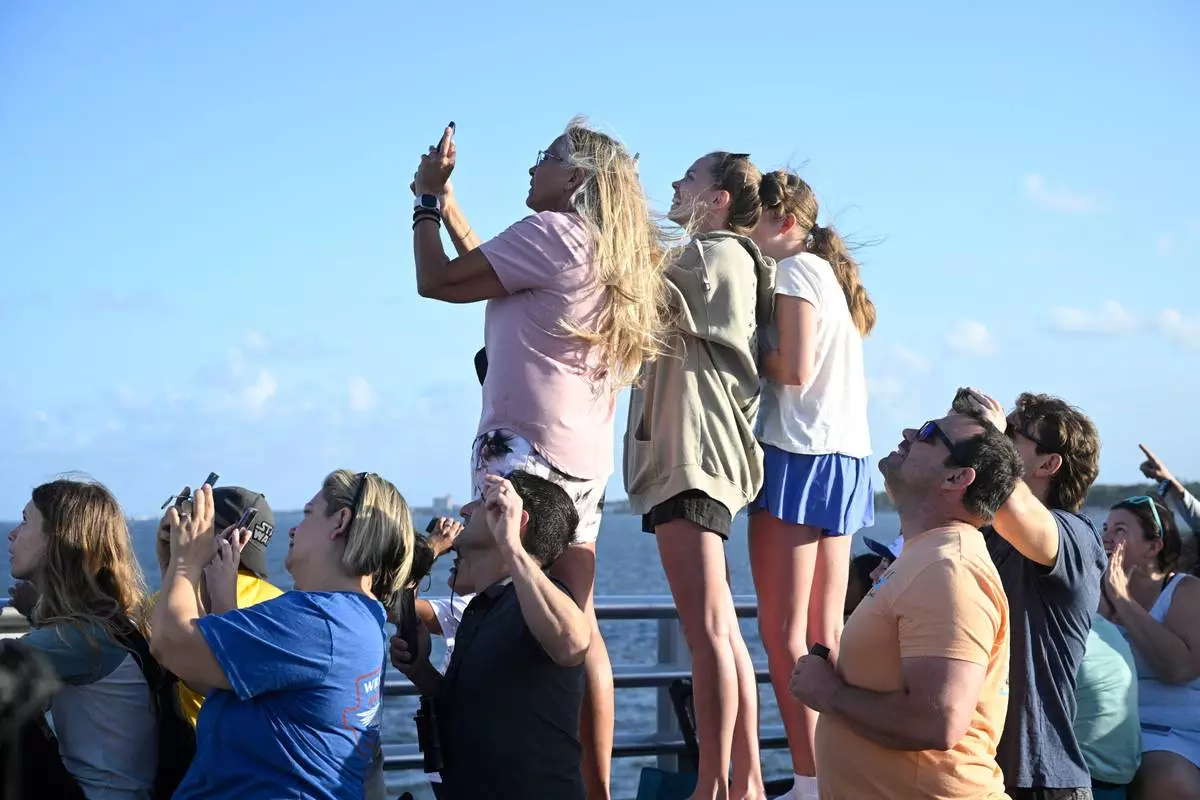
Spectators view NASA's Artemis II moon rocket launch from the A. Max Brewer Bridge, Wednesday, April 1, 2026, in Titusville, Fla. (AP Photo/Phelan M. Ebenhack)
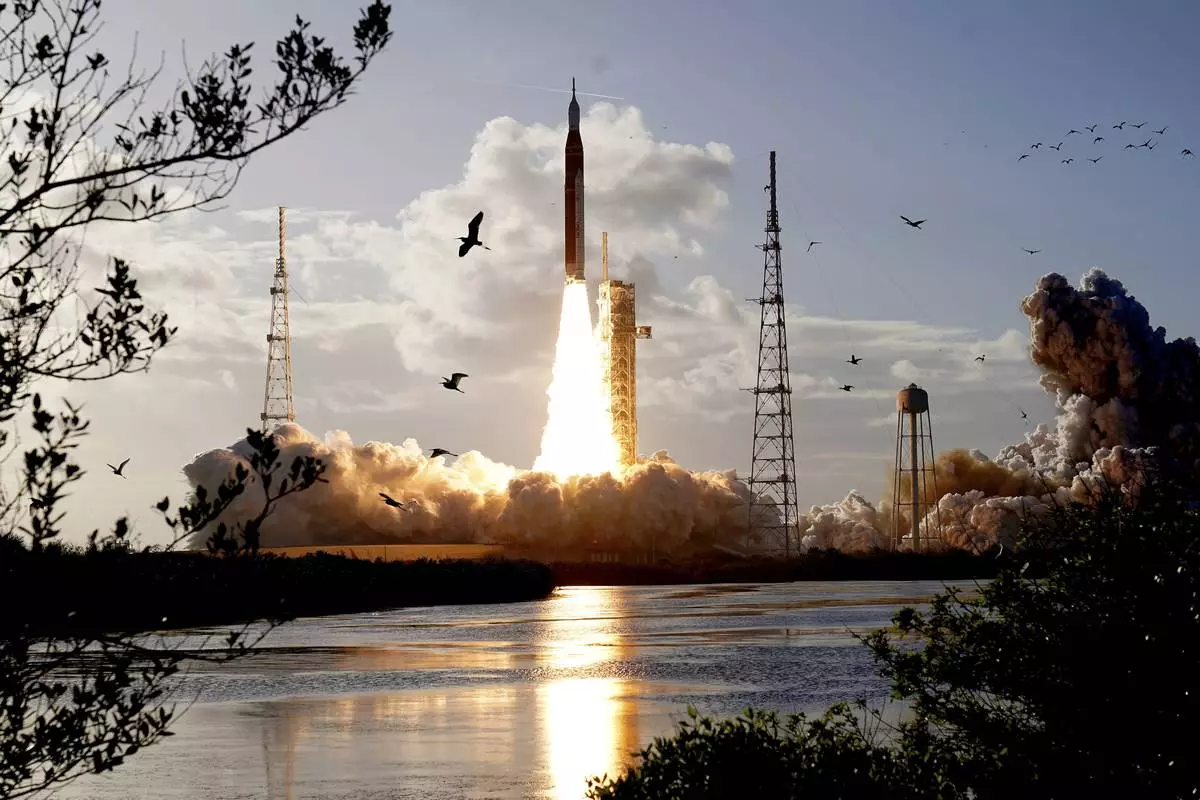
NASA's Artemis II moon rocket lifts off from the Kennedy Space Center's Launch Pad 39-B Wednesday, April 1, 2026, in Cape Canaveral, Fla. (AP Photo/Chris O'Meara)
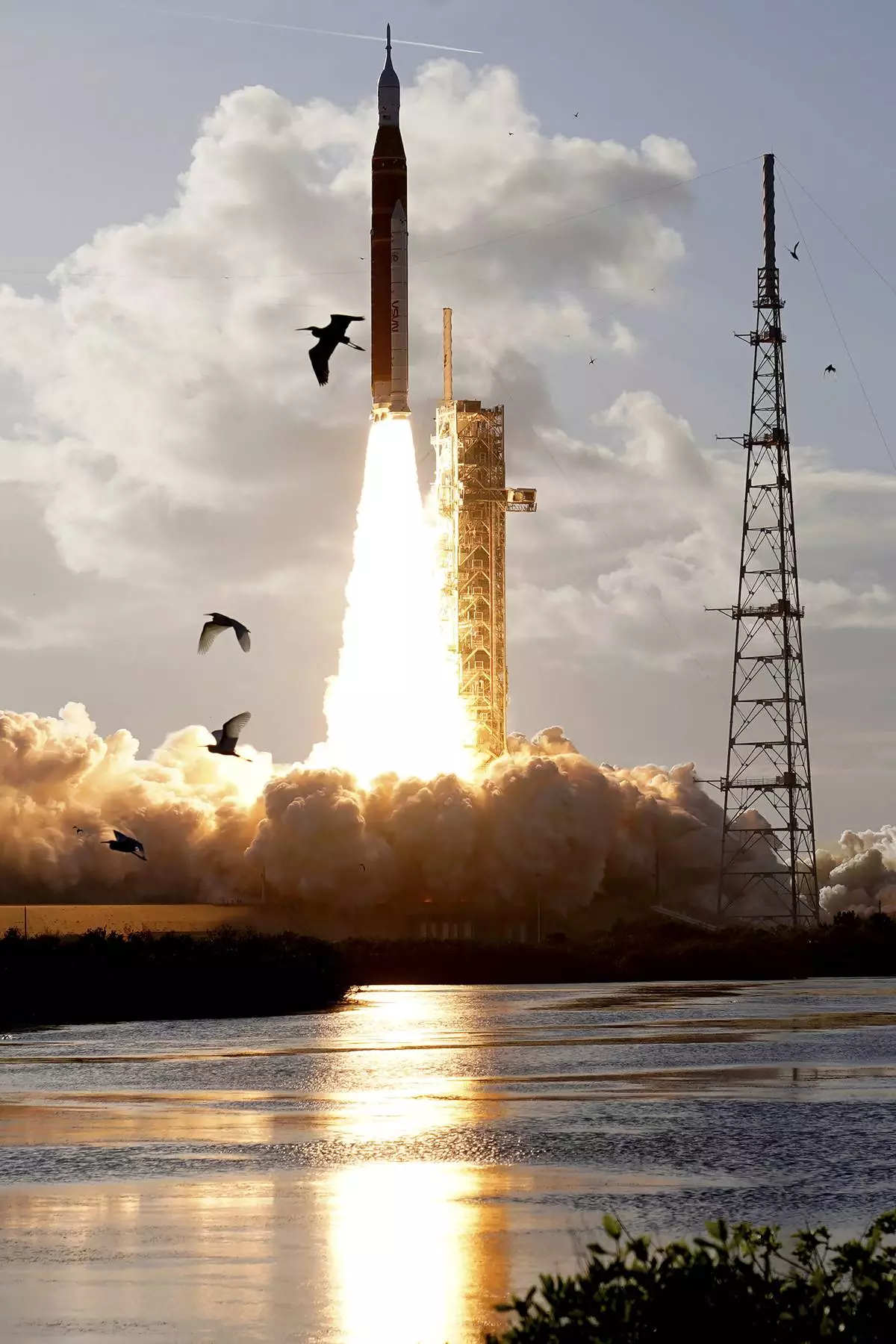
NASA's Artemis II moon rocket lifts off from the Kennedy Space Center's Launch Pad 39-B Wednesday, April 1, 2026, in Cape Canaveral, Fla. (AP Photo/Chris O'Meara)
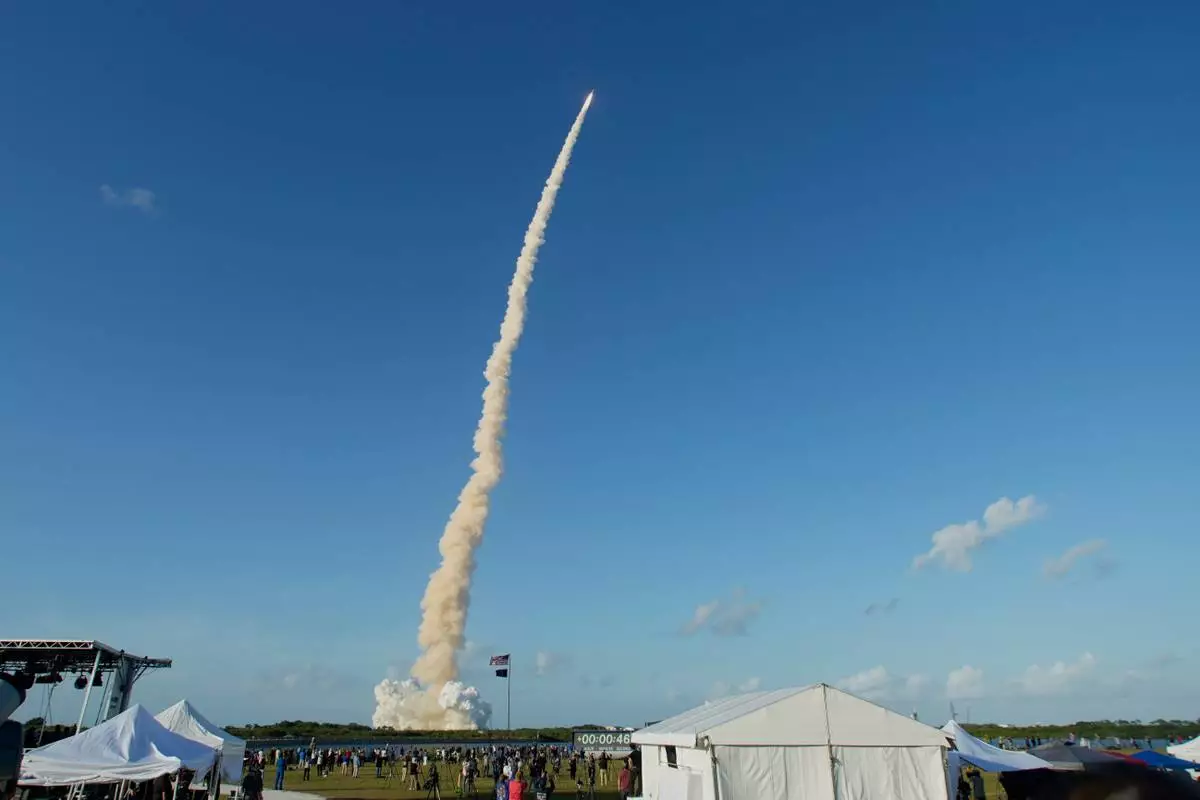
NASA's Artemis II moon rocket lifts off from the Kennedy Space Center's Launch Pad 39-B Wednesday, April 1, 2026, in Cape Canaveral, Fla. (AP Photo/John Raoux)