BASEL, Switzerland & WALLDORF, Germany--(BUSINESS WIRE)--Jan 15, 2026--
SAP SE (NYSE: SAP) and Syngenta, a global leader in agricultural innovation, today announced a multi-year strategic technology partnership to accelerate AI-assisted innovation across Syngenta’s global operations.
This press release features multimedia. View the full release here: https://www.businesswire.com/news/home/20260115682130/en/
The partnership will embed artificial intelligence at the core of Syngenta’s enterprise, modernizing operations and enabling accelerated innovation through advanced data analytics across the business — from manufacturing and supply chain to grower-facing products and services.
Agriculture continues to navigate challenges driven by climate variability, supply chain complexity, and global uncertainty. By deploying AI-assisted tools enterprise-wide, this partnership positions Syngenta to meet the challenge of feeding a projected 10 billion people by 2050, while unlocking faster innovation, stronger operational resilience, and scalable impact across the business.
“AI is the catalyst for agricultural transformation and has quickly become a core competitive edge for Syngenta,” said Feroz Sheikh, Chief Information and Digital Officer, Syngenta Group. “Our partnership with SAP is transforming how we run the enterprise, modernizing core operations and unlocking new ways to work — a testament to our commitment to becoming an agriculture company with AI at its core.”
“Syngenta’s transformation sets a benchmark for digital innovation in agriculture,” said Philipp Herzig, Chief Technology Officer at SAP SE. “Together, we’re demonstrating how cloud and AI technologies can drive sustainable growth and efficiency in one of the world’s most critical industries. This partnership will help Syngenta future-proof its operations to feed the world responsibly."
Scaling an AI-First Operating Model for Agriculture
Syngenta’s transformation will begin with SAP Cloud ERP Private solutions, modernizing core operations across the value-chain to deliver agility, resilience, and scalability. The company’s ambition is clear: unlock innovation faster, strengthen its leadership in agriculture, and future-proof operations against volatility.
Through SAP Business Data Cloud, Syngenta will create a unified, more secure, and scalable data foundation essential for real-time decision-making and AI integration. Combined with SAP Business AI and AI-assisted tools such as the Joule copilot, this will help the company explore smarter, faster decisions that drive operational efficiency and accelerate innovation. Additionally, Syngenta will be able to deliver better products and services to growers worldwide while enabling them to retain control and privacy over their proprietary information.
About SAP
As a global leader in enterprise applications and business AI, SAP (NYSE:SAP) stands at the nexus of business and technology. For over 50 years, organizations have trusted SAP to bring out their best by uniting business-critical operations spanning finance, procurement, HR, supply chain, and customer experience. Visit the SAP News Center. Get SAP news via LinkedIn and Bluesky.
About Syngenta
Syngenta is a global leader in agricultural innovation with a presence in more than 90 countries. Syngenta is focused on developing technologies and farming practices that empower farmers, so they can make the transformation required to feed the world’s population while preserving our planet. Its bold scientific discoveries deliver better benefits for farmers and society on a bigger scale than ever before. Guided by its Sustainability Priorities, Syngenta is developing new technologies and solutions that support farmers to grow healthier plants in healthier soil with a higher yield. Syngenta Crop Protection is headquartered in Basel, Switzerland; Syngenta Seeds is headquartered in the United States. Read our stories and follow us on LinkedIn, Instagram & X.
Data protection is important to us. You are receiving this publication on the legal basis of Article 6 para 1 lit. f GDPR (“legitimate interest”). However, if you do not wish to receive further information about Syngenta, just send us a brief informal message and we will no longer process your details for this purpose. You can also find further details in our privacy statement.
Syngenta’s Cautionary Statement Regarding Forward-Looking Statements
This document may contain forward-looking statements, which can be identified by terminology such as ‘expect’, ‘would’, ‘will’, ‘potential’, ‘plans’, ‘prospects’, ‘estimated’, ‘aiming’, ‘on track’ and similar expressions. Such statements may be subject to risks and uncertainties that could cause the actual results to differ materially from these statements. For Syngenta, such risks and uncertainties include risks relating to legal proceedings, regulatory approvals, new product development, increasing competition, customer credit risk, general economic and market conditions, compliance and remediation, intellectual property rights, implementation of organizational changes, impairment of intangible assets, consumer perceptions of genetically modified crops and organisms or crop protection chemicals, climatic variations, fluctuations in exchange rates and/or commodity prices, single source supply arrangements, political uncertainty, natural disasters, and breaches of data security or other disruptions of information technology. Syngenta assumes no obligation to update forward-looking statements to reflect actual results, changed assumptions or other factors.
©2026 Syngenta. Rosentalstrasse 67, 4058 Basel, Switzerland.
SAP’s Cautionary Statement Regarding Forward-Looking Statements
This document contains forward-looking statements, which are predictions, projections, or other statements about future events. These statements are based on current expectations, forecasts, and assumptions that are subject to risks and uncertainties that could cause actual results and outcomes to materially differ. Additional information regarding these risks and uncertainties may be found in our filings with the Securities and Exchange Commission, including but not limited to the risk factors section of SAP's 2024 Annual Report on Form 20-F.
© 2026 SAP SE. All rights reserved.
SAP and other SAP products and services mentioned herein as well as their respective logos are trademarks or registered trademarks of SAP SE in Germany and other countries. Please see https://www.sap.com/copyright for additional trademark information and notices.
Web Resources
Pictures

Jeff Rowe - CEO of Syngenta Group (left) and Christian Klein - CEO of SAP (right)
WASHINGTON (AP) — President Donald Trump used his first major address since launching his war in Iran to assure Americans that all of his military objectives will be completed "shortly” and urge an increasingly skeptical electorate to give him a little bit more time.
Trump in his Wednesday evening speech dialed back the bluster that's dominated his rhetoric in recent days as world markets convulse and a badly battered Iran is still landing some effective blows on Gulf neighbors' infrastructure and U.S. bases.
But the Republican president's promise to “finish the job” hardly built confidence with a jittery market as oil prices surged and Asian stocks fell as he vowed that the U.S. will continue to hit Iran very hard.
He offered no detail about the state of negotiations with Iran that could bring about a promised endgame that he insists could come in a matter of weeks. There was also no overt lashing out at NATO allies for failing to fall in line and help him reopen the critical Strait of Hormuz waterway — something White House officials had said would be a prominent part of his roughly 20-minute address.
The U.S. will continue to hit Iran hard for the next two or three weeks, he said, without saying how much longer the war would last. But he offered a plea to Americans to show a little patience.
“We are in this military operation, so powerful, so brilliant, against one of the most powerful countries for 32 days, and the country has been eviscerated and essentially is really no longer a threat,” Trump said. “This is a true investment in your children and your grandchildren’s future. The whole world is watching, and they can’t believe the power, strength and brilliance.”
Trump finds himself not only negotiating with an enemy that refuses to throw in the towel but also dealing with an American tolerance for a conflict that's being stretched.
Most Americans believe recent U.S. military action against Iran has gone too far, and many are worried about affording gasoline, according to an AP-NORC poll conducted in mid-March, a couple of weeks after the war started. While Trump is deploying more warships and troops to the Middle East, about 59% of Americans say U.S. military action in Iran has been excessive.
Meanwhile, 45% are “extremely” or “very” concerned about being able to afford gas in the next few months, up from 30% in an AP-NORC poll conducted shortly after Trump won reelection with promises that he would improve the economy and lower the cost of living.
Americans, Trump noted, have certainly shown patience during times of war.
“American involvement in World War I,” he said, “lasted one year, seven months and five days. World War II lasted for three years, eight months and 25 days. The Korean War lasted for three years, one month and two days. The Vietnam War lasted for 19 years, five months and 29 days. Iraq went on for eight years, eight months and 28 days.”
Hours before his address, Trump seemed to reflect on the domestic pressure he’s feeling to wrap up the war.
Speaking at a private lunch at the White House to mark Easter, Trump argued that the U.S. could “very easily” use this moment to take Iran’s oil. It is "unfortunate," he lamented, that there did not seem to be patience among the American people for such an effort.
“They want to see it end,” he said. He added, “People in the country sort of say, ‘Just win. You’re winning so big. Just win. Come home.’ And I’m OK with that, too.”
Sen. Chris Murphy, D-Conn., said Trump's speech was “grounded in a reality that only exists in Donald Trump’s mind.”
The president, Democrats fumed, offered no plan for how he would go about reopening Hormuz, the critical waterway for oil tankers that a battered Iran has effectively choked off even though Trump claims it's been defeated.
For allies worried about a global economy that's been rattled by rising oil prices, Trump suggested they “buy oil from the United States of America” and “build up some delayed courage” and help the U.S. secure the strait. Trump made no attempt to answer his European critics who say he entered his war of choice against Iran without consulting global allies but is now expecting the world to help him fix the unintended damage that it has caused.
“We are losing this war," Murphy added. "We cannot destroy all their missiles or drones, nor their nuclear program. Iran projects more power in the region than they did before the war, especially if they now permanently control the Strait of Hormuz. We are spending billions we don’t have and losing American lives in a war that is destabilizing the world and making us look feckless.”
Trump offered cautious optimism that those now in power in Iran after more than a month of U.S. and Israeli strikes are “less radical and much more reasonable" with much of the pre-war Islamic Republic’s hierarchy taken out. He didn’t explicitly mention a Monday deadline he has set for Iran to open the strait or face attacks from U.S. forces on its energy infrastructure, though he made clear that he remains open to targeting the heartbeat of Tehran’s economy.
“If there is no deal, we are going to hit each and every one of their electric generating plants very hard and probably simultaneously,” Trump said. “We have not hit their oil, even though that’s the easiest target of all, because it would not give them even a small chance of survival or rebuilding. But we could hit it, and it would be gone.”
Trump also notably did not signal that he's making any preparation for a ground invasion by American troops.
He seemed to steer away from the possibility of sending ground troops to secure Iran’s nearly 1,000 pounds (450 kilograms) of highly enriched uranium, saying it “would take months” for Iran to get to it as it’s buried under the rubble created by last year’s American bombing campaign of Iran’s nuclear sites.
Trump has offered shifting reasons for launching the war, but he has been consistent in articulating that a primary objective in joining Israel in the military action is ensuring that Iran will “never have a nuclear weapon.”
But over the course of the conflict, he has been more circumspect about how far he’s willing to go to follow through on his pledge to destroy Iran’s weapons program once and for all, including seizing or destroying the near-bomb-grade nuclear material that Iran possesses.
“We have it under intense satellite surveillance and control,” Trump said in his prime-time speech. “If we see them make a move, even a move for it, we’ll hit them with missiles very hard again. We have all the cards. They have none.”
Associated Press writers Collin Binkley, Michelle L. Price and Konstantin Toropin contributed to this report.
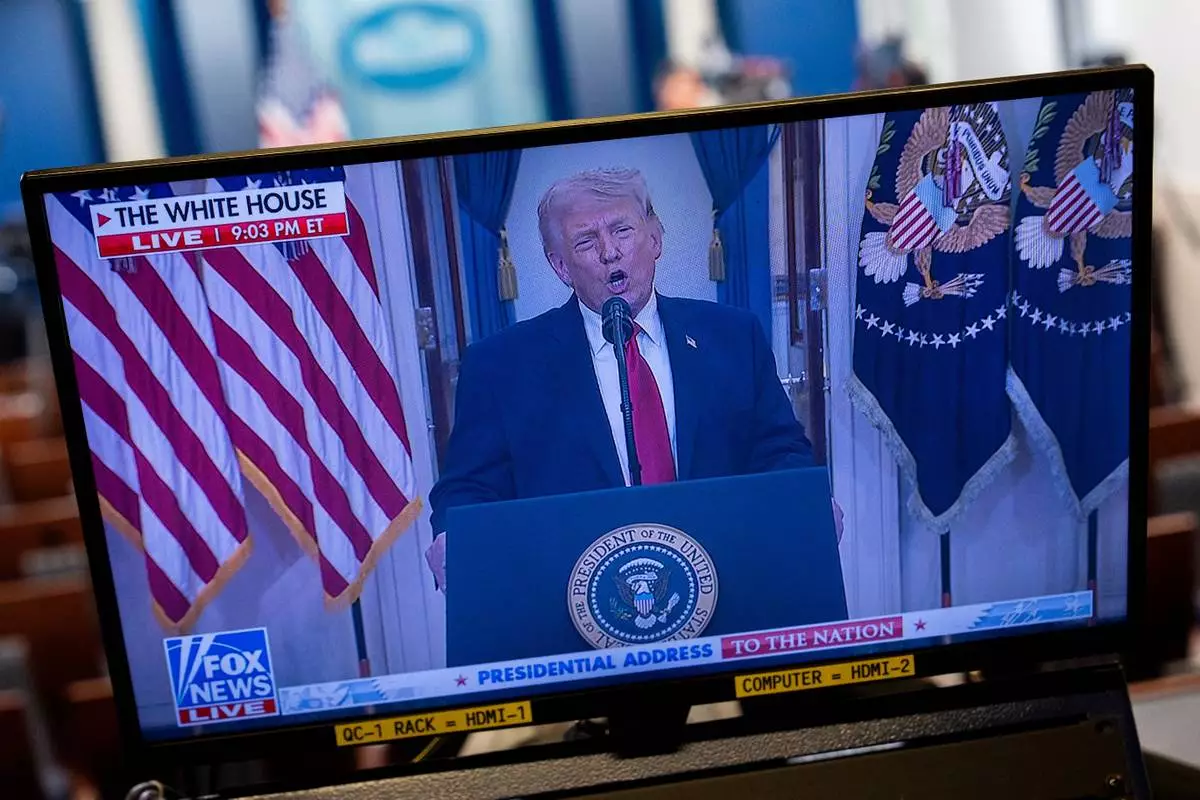
President Donald Trump is seen speaking about the Iran war on a television screen in the James Brady Press Briefing Room of the White House, Wednesday, April 1, 2026, in Washington. (AP Photo/Julia Demaree Nikhinson)
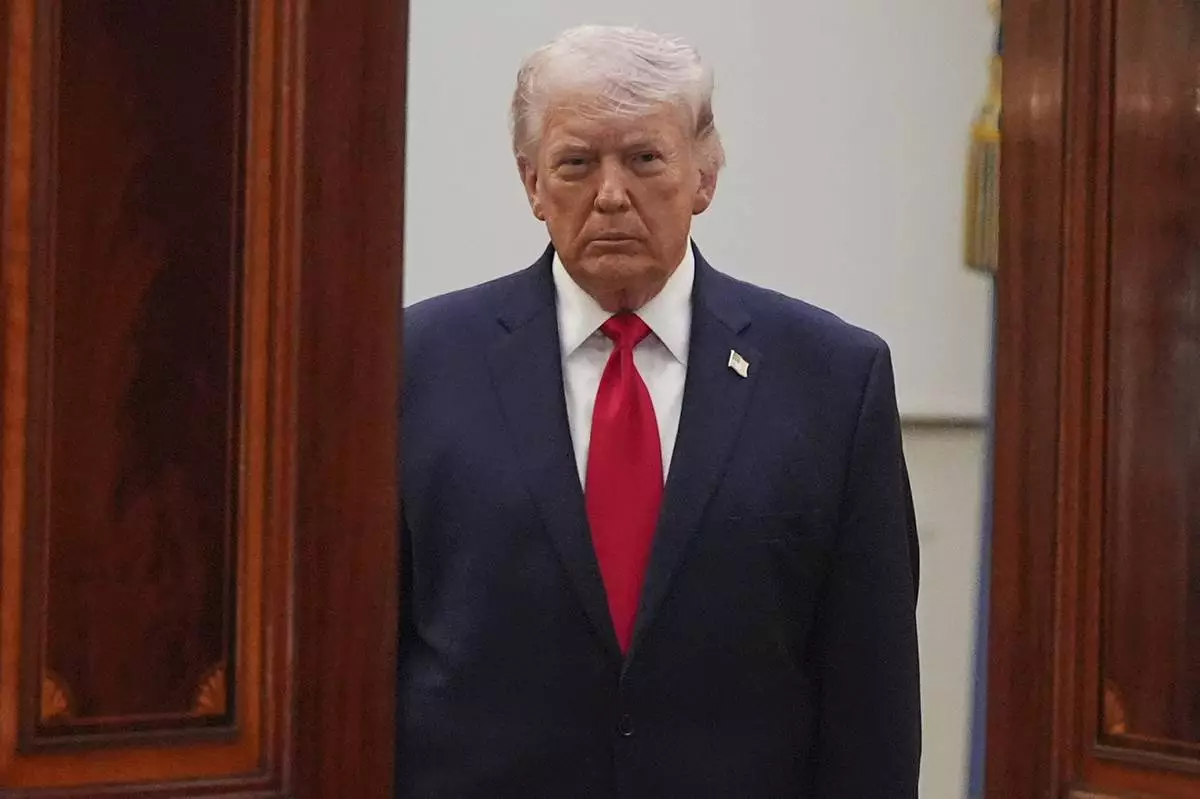
President Donald Trump arrives from the Blue Room to speak about the Iran war from the Cross Hall of the White House on Wednesday, April 1, 2026, in Washington. (AP Photo/Alex Brandon, Pool)
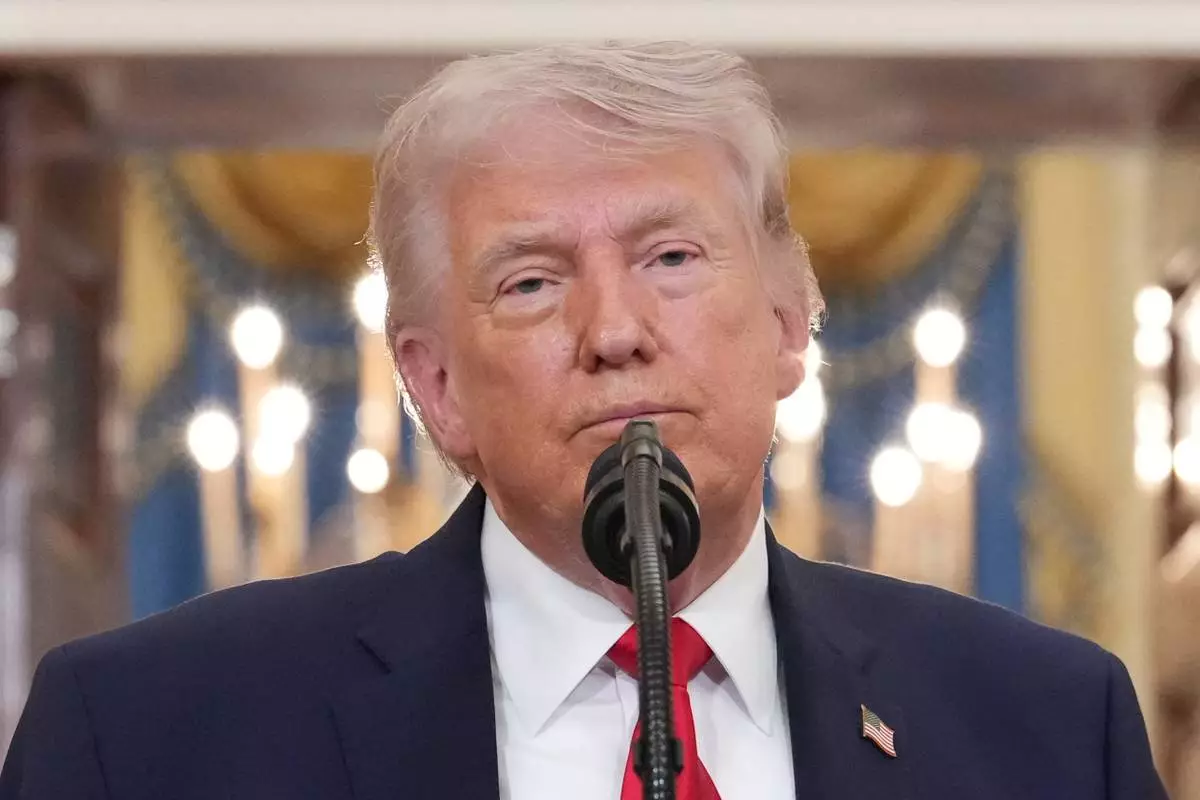
President Donald Trump speaks about the Iran war from the Cross Hall of the White House on Wednesday, April 1, 2026, in Washington. (AP Photo/Alex Brandon, Pool)