Skip to Content Facebook Feature Image

New Survey from LegalZoom Reveals Rising Interest in Entrepreneurship Among Underemployed Adults as Economic Uncertainty Reshapes Career Priorities

Business

New Survey from LegalZoom Reveals Rising Interest in Entrepreneurship Among Underemployed Adults as Economic Uncertainty Reshapes Career Priorities
Business

Business

New Survey from LegalZoom Reveals Rising Interest in Entrepreneurship Among Underemployed Adults as Economic Uncertainty Reshapes Career Priorities

2026-01-15 21:00 Last Updated At:01-16 13:41

MOUNTAIN VIEW, Calif.--(BUSINESS WIRE)--Jan 15, 2026--

LegalZoom.com, Inc. (Nasdaq: LZ), a leading online platform for legal services, today released the results of a new survey revealing that unstable work opportunities and shifting economic conditions are prompting many adults to rethink what they want from their careers. For more than half, the idea of working for themselves is becoming more appealing than returning to a traditional career path.

This press release features multimedia. View the full release here: https://www.businesswire.com/news/home/20260115700644/en/

This period of professional reevaluation coincides with a significant economic shift driven by artificial intelligence. Research from Goldman Sachs suggests that AI adoption could displace the equivalent of 6-7% of the US workforce, with white-collar roles particularly exposed. Yet, AI is also opening up new areas of opportunity by lowering barriers to entry, automating complex tasks, and making it possible to launch and grow a business with fewer resources.

To better understand how people are weighing their career choices, LegalZoom surveyed more than 1,200 adults navigating job loss, reduced hours, or limited opportunities. The responses offer a detailed look at how interest in entrepreneurship is evolving, what motivates people to consider starting a business, and what may be holding them back.

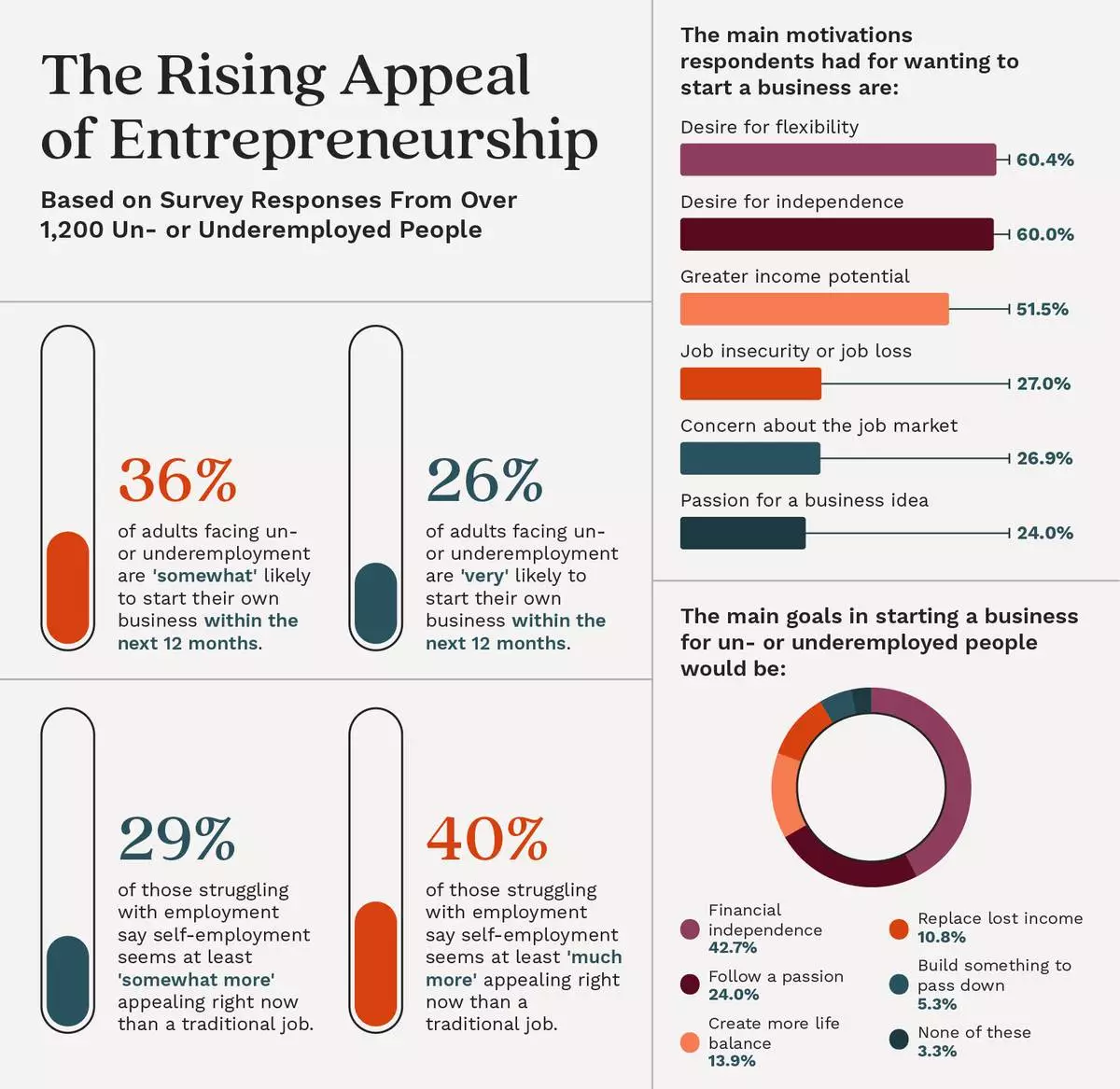
Interest in entrepreneurship is high among adults facing unemployment or underemployment, with most believing it could offer greater stability, control, and long-term opportunity. Sixty-two percent (62%) of unemployed or underemployed adults say they’re somewhat or very likely to start a business within the next 12 months, with 26% saying they’re very likely. Sixty-nine percent (69%) say self-employment feels more appealing than a traditional job right now, including 40% who say it feels much more appealing.

“During periods of economic transition or uncertainty, we often see a surge in entrepreneurship as people seek to take control of their future,” said Jeff Stibel, CEO of LegalZoom. “What’s striking in this data is not just the high level of interest, but the clear pattern of individuals actively pursuing a path to business ownership as a response to both personal disruption and market opportunity.”

Most of the survey respondents appear to be experiencing that firsthand. Flexibility, financial potential, and independence stand out as the clearest motivators. Sixty percent (60%) cite flexibility and independence as key motivations. Fifty-two percent (52%) point to greater income potential, though this varies notably between unemployed (43%) and underemployed (61%) adults. Job insecurity and broader concerns about the job market also play a role, each cited by 27% of respondents.

However, strong interest does not always translate to immediate action. Respondents identified significant challenges to launching a business: 66% cite a lack of start-up capital, 56% worry about financial risk, 48% are unsure where to start, 47% feel a lack of confidence, and 45% say they don’t have enough experience. While 57% feel at least somewhat confident in their ability to run a business, they are seeking support to move forward, with 44% wanting legal and business help to set up their business. Moreover, 59% stated that they are unprepared for the legal paperwork and compliance associated with launching a business.

“We see a clear pattern of entrepreneurship here. Most unemployed or underemployed adults are open to entrepreneurship and can picture what their future businesses might look like, but they want stability, guidance, and manageable entry points to move forward,” added Stibel. “As more people explore business ownership, accessible tools and clear guidance can make the process more attainable. I am proud that LegalZoom helps support entrepreneurs with resources that simplify business formation, compliance, and long-term management, helping them build momentum as they embark on the next stage of their careers.”

About LegalZoom

LegalZoom is a leading online platform for legal services, transforming how individuals and small businesses navigate the legal system. By combining intuitive technology with access to experienced attorneys—whether through our vast independent attorney network or the LegalZoom-owned law firm—we offer the tools and guidance people need to confidently manage everything from business formations and compliance to estate planning and ongoing legal support.

With over two decades of experience and millions of customers served, LegalZoom helps individuals and small businesses navigate legal needs with confidence. For more information, visit www.legalzoom.com.
LegalZoom: The Rising Appeal of Entrepreneurship


LegalZoom: The Rising Appeal of Entrepreneurship

SIOUX FALLS, S.D. (AP) — Easter is around the corner, and it's time to start thinking about how to decorate your eggs.

Whether you're dying eggs for your table spread or planning to hide them for an egg hunt, it's important to follow food safety guidelines to minimize germs and maximize your egg quality.

Eggs are remarkably long lasting, so there needn't be a giant rush to eat them.

“Stores usually do turn over eggs pretty quickly, so the recommendations is you should consume eggs three to five weeks after you purchase them,” said Kara Lynch, food safety educator with Michigan State University Extension.

There is also a benefit in letting eggs age just a bit, as older eggs can be easier to peel. That's because eggs shrink over time within the shell, creating an air pocket between the egg and the shell.

Egg processors clean eggs before they reach store shelves, but it also is important to thoroughly cook eggs to reduce the risk of foodborne illness, especially salmonella. That bacteria lives naturally in the gastrointestinal and reproductive tracts of chickens, said Kimberly Baker, associate extension specialist at Clemson University.

To cook your eggs, place them in a saucepan, fill it with water and bring it to a boil. After that, put the lid on, turn the heat off and let it sit for about 12 minutes. Some also favor turning down the heat and simmering eggs.

You can vary the time in the hot water depending on a desire for harder boiled or slightly creamier eggs, but the yolk should be pretty solid to be safe. Boiling them for too long can risk creating green sulfur development on the outside of the yolk.

After that, Don Schaffner, food science department chair at Rutgers University, said there are two options.

You can run your eggs under cold water to reduce the temperature. From there, you can color them right away or place them back in the fridge until you're ready. Or, after you've boiled them, you can let them air dry until they've cooled.

The boiling process sanitizes the eggs, and as long as they are kept out of water, Schaffner said, they will remain safe to eat.

“You’ve boiled the egg, you’ve gotten rid of any bacteria that might be in the egg. And now you’ve air-cooled it, right? So it’s going to cool more slowly, it’s probably going to cook more,” he said. “But most importantly, you don’t have to worry about any bacteria from the water getting internalized into the egg.”

Either artificial or natural food dye is OK as long as the dye label says it's food grade. For those keeping track, the U.S. Food and Drug Administration has been updating its guidance and regulations regarding certain dyes.

And no, it's not a problem if the dye seeps through the shell.

“Eggs kind of naturally have their own abilities to absorb only so much,” Baker said.

As you're decorating the eggs and have the eggs outside, she suggested keeping your eggs in an ice bath, so they can stay at a cooler temperature while you're decorating.

Eggs should generally be kept at or below 40 degrees (4.4 degrees Celsius) to minimize the risk of contaminants.

Cooked eggs that weren't air-cooled should spend no more than two hours at room temperature. And that's cumulative, including the time spent decorating and the time spent hiding during the Easter egg hunt.

But if it's particularly warm, then that two-hour rule may be shortened to one hour, Lynch said.

Hard boiled eggs are generally good for about a week in the fridge.

Be careful with your eggs as you handle them.

One of the biggest concerns is making sure your eggs haven't cracked during an Easter egg hunt, making them vulnerable to contaminants. And once the egg has been hard boiled, there's no way to kill bacteria that get inside, Baker said.

“We don’t want to be putting them in the soil or in lawns where pets have gone to the bathroom,” she said.

Whether the eggs are hidden outdoors or in a corner of your home, you should rinse them in cool water before you peel them. And wash your hands, too, just in case the eggs have picked up something.

If the Easter egg hunt means your eggs will be at room temperature for longer than two hours, experts recommended using plastic eggs for the hunt instead of real ones to minimize food safety risk.

“If it’s an outdoor Easter egg hunt at any time, I would say go with the plastic eggs and be safe,” Baker said. “And use your dyed Easter eggs as your centerpiece on your table or your buffet, and enjoy them that way.”

FILE - Painted Easter eggs hang from an Easter Tree in Saalfeld, central Germany, March 30, 2018. (AP Photo/Jens Meyer, File)

FILE - Painted Easter eggs hang from an Easter Tree in Saalfeld, central Germany, March 30, 2018. (AP Photo/Jens Meyer, File)

Recommended Articles