Skip to Content Facebook Feature Image

Court ruling jeopardizes freedom for pro-Palestinian activist Mahmoud Khalil

News

Court ruling jeopardizes freedom for pro-Palestinian activist Mahmoud Khalil
News

News

Court ruling jeopardizes freedom for pro-Palestinian activist Mahmoud Khalil

2026-01-16 01:39 Last Updated At:01:40

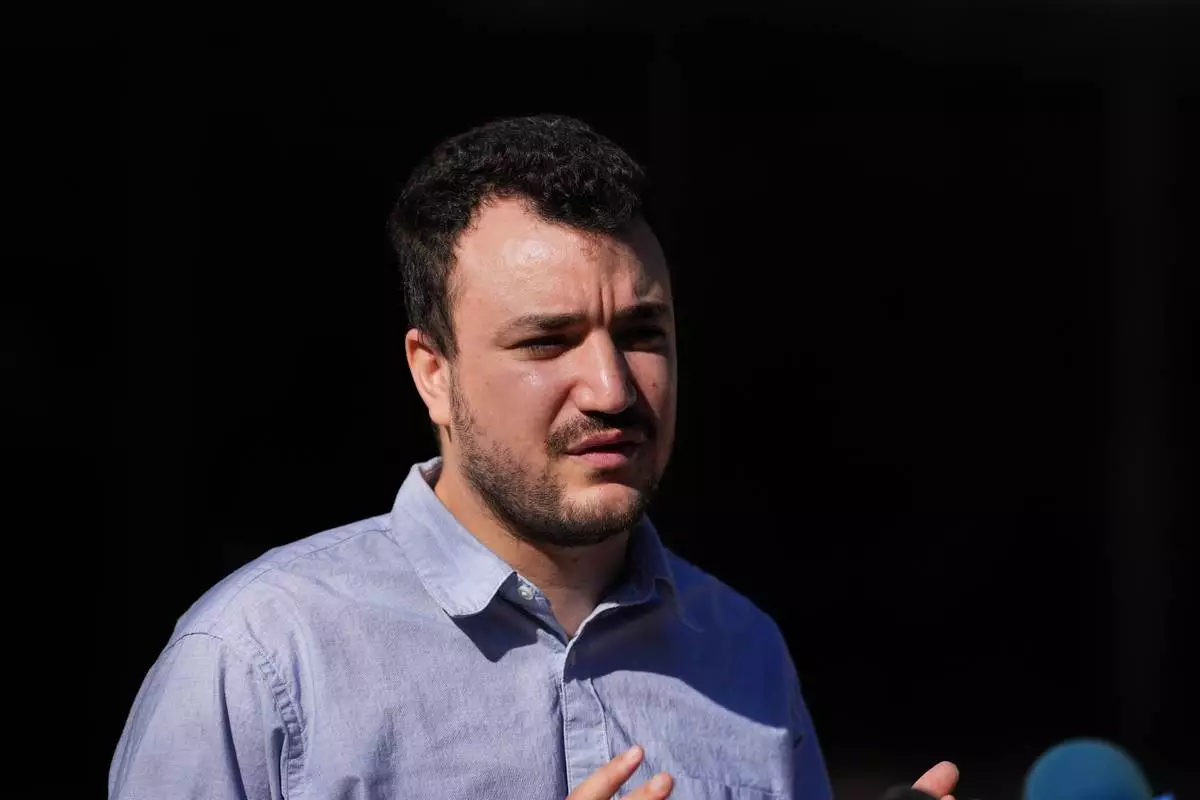
A federal appeals panel on Thursday reversed a lower court decision that released former Columbia University graduate student Mahmoud Khalil from an immigration jail, bringing the government one step closer to detaining and ultimately deporting the Palestinian activist.

The three-judge panel of the 3rd U.S. Circuit Court of Appeals didn’t decide the key issue in Khalil’s case: whether the Trump administration’s effort to throw Khalil out of the U.S. over his campus activism and criticism of Israel is unconstitutional.

But in its 2-1 decision, the panel ruled a federal judge in New Jersey didn’t have jurisdiction to decide the matter at this time. Federal law requires the case to fully move through the immigration courts first, before Khalil can challenge the decision, they wrote.

“That scheme ensures that petitioners get just one bite at the apple — not zero or two,” the panel wrote. “But it also means that some petitioners, like Khalil, will have to wait to seek relief for allegedly unlawful government conduct.”

The law bars Khalil “from attacking his detention and removal in a habeas petition,” the panel added.

It was not clear whether the government would seek to detain Khalil, a legal permanent resident, again while his legal challenges continue.

Thursday’s decision marked a major win for the Trump administration’s sweeping campaign to detain and deport noncitizens who joined protests against Israel.

In a statement distributed by the American Civil Liberties Union, Khalil said the appeals ruling was “deeply disappointing, but it does not break our resolve.”

He added: “The door may have been opened for potential re-detainment down the line, but it has not closed our commitment to Palestine and to justice and accountability. I will continue to fight, through every legal avenue and with every ounce of determination, until my rights, and the rights of others like me, are fully protected.”

Baher Azmy, one of Khalil's lawyers, said the ruling was “contrary to rulings of other federal courts.” He noted the panel’s finding concerned a “hypertechnical jurisdictional matter,” rather than the legality of the Trump administration’s policy.

“Our legal options are by no means concluded, and we will fight with every available avenue,” he added, saying Khalil would remain free pending the full resolution of all appeals, which could take months or longer.

The ACLU said the Trump administration cannot lawfully re-detain Khalil until the order takes formal effect, which won't happen while he can still immediately appeal.

Khalil's lawyers can request the active judges on the 3rd Circuit hear an appeal, or they can go to the U.S. Supreme Court.

An outspoken leader of the pro-Palestinian movement at Columbia, Khalil was arrested on March 8, 2025. He then spent three months detained in a Louisiana immigration jail, missing the birth of his firstborn.

Federal officials have accused Khalil of leading activities “aligned to Hamas,” though they have not presented evidence to support the claim and have not accused him of criminal conduct. They have also accused Khalil, 30, of failing to disclose information on his green card application.

The government has justified the arrest under a seldom-used statute that allows for the expulsion of noncitizens whose beliefs are deemed to pose a threat to U.S. foreign policy interests.

In June, a federal judge in New Jersey ruled that justification would likely be declared unconstitutional and ordered Khalil released.

President Donald Trump's administration appealed that ruling, arguing the deportation decision should fall to an immigration judge, rather than a federal court.

Khalil has dismissed the allegations as “baseless and ridiculous,” framing his arrest and detention as a “direct consequence of exercising my right to free speech as I advocated for a free Palestine and an end to the genocide in Gaza.”

Judge Arianna Freeman dissented Thursday, writing that her colleagues were holding Khalil to the wrong legal standard. Khalil, she wrote, is raising “now-or-never claims” that can be handled at the district court level. He does not have a final order of removal, which would permit a challenge in an appellate court, she wrote.

Both judges who ruled against Khalil, Thomas Hardiman and Stephanos Bibas, were Republican appointees. President George W. Bush appointed Hardiman to the 3rd Circuit, while Trump appointed Bibas. President Joe Biden, a Democrat, appointed Freeman.

The majority opinion noted Freeman worried the ruling would leave Khalil with no remedy for unconstitutional immigration detention, even if he later can appeal.

“But our legal system routinely forces petitioners — even those with meritorious claims — to wait to raise their arguments, the judges wrote. “To be sure, the immigration judge’s order of removal is not yet final; the Board has not affirmed her ruling and has held the parties’ briefing deadlines in abeyance pending this opinion. But if the Board ultimately affirms, Khalil can get meaningful review.”

The decision comes as an appeals board in the immigration court system weighs a previous order that found Khalil could be deported. His attorneys have argued that the federal order should take precedence.

That judge has suggested Khalil could be deported to Algeria, where he maintains citizenship through a distant relative, or Syria, where he was born in a refugee camp to a Palestinian family.

His attorneys have said he faces mortal danger if forced to return to either country.

Associated Press Writer Larry Neumeister contributed to this story.

FILE - Palestinian activist Mahmoud Khalil holds a news conference outside Federal Court on Tuesday, Oct. 21, 2025 in Philadelphia (AP Photo/Matt Rourke, File)

FILE - Palestinian activist Mahmoud Khalil holds a news conference outside Federal Court on Tuesday, Oct. 21, 2025 in Philadelphia (AP Photo/Matt Rourke, File)
WASHINGTON (AP) — Venezuelan opposition leader María Corina Machado comes to the White House on Thursday to discuss her country's future with President Donald Trump even after he publicly dismissed her credibility to take over after an audacious U.S. military raid captured then-President Nicolás Maduro.

Trump has raised doubts about his stated commitment to backing democratic rule in Venezuela. His administration has signaled its willingness to work with acting President Delcy Rodríguez, who was Maduro’s vice president and, along with others in the deposed leader’s inner circle, remains in charge of day-to-day governmental operations.

In endorsing Rodríguez so far, Trump has sidelined Machado, who has long been a face of resistance in Venezuela and sought to cultivate relationships with Trump and key administration voices like Secretary of State Marco Rubio among the American right wing in a gamble to ally herself with the U.S. government.

The White House says Machado sought the face-to-face meeting with Trump without setting expectations for what would occur. Her party is widely believed to have won 2024 elections rejected by Maduro. Machado previously offered to share with Trump the Nobel Peace Prize she won last year, an honor he has coveted.

Machado plans to have a meeting at the Senate following her lunch with Trump, who has called her “a nice woman” while indicating they might not touch on major issues in their talks Thursday.

Her Washington swing began after U.S. forces in the Caribbean Sea seized another sanctioned oil tanker that the Trump administration says had ties to Venezuela. It is part of a broader U.S. effort to take control of the South American country’s oil after U.S. forces seized Maduro and his wife at a heavily guarded compound in the Venezuelan capital of Caracas and brought them to New York to stand trial on drug trafficking charges.

The White House says Venezuela has been fully cooperating with the Trump administration since Maduro’s ouster.

Rodríguez, the acting president, herself has adopted a less strident position toward Trump and his “America First” policies toward the Western Hemisphere, saying she plans to continue releasing prisoners detained under Maduro — a move thought to have been made at the behest of the Trump administration. Venezuela released several Americans this week.

Trump, a Republican, said Wednesday that he had a “great conversation” with Rodríguez, their first since Maduro was ousted.

“We had a call, a long call. We discussed a lot of things,” Trump said during an Oval Office bill signing. “And I think we’re getting along very well with Venezuela.”

Even before indicating the willingness to work with Venezuela's interim government, Trump was quick to snub Machado. Just hours after Maduro's capture, Trump said of Machado that “it would be very tough for her to be the leader. She doesn’t have the support within or the respect within the country.”

Machado has steered a careful course to avoid offending Trump, notably after winning last year’s Nobel Peace Prize, which Trump wanted to win himself. She has since thanked Trump. Her offer to share the peace prize with him was rejected by the Nobel Institute.

Machado’s whereabouts have been largely unknown since she went into hiding early last year after being briefly detained in Caracas. She briefly reappeared in Oslo, Norway, in December after her daughter received the Nobel Peace Prize on her behalf.

The industrial engineer and daughter of a steel magnate began challenging the ruling party in 2004, when the nongovernmental organization she co-founded, Súmate, promoted a referendum to recall then-President Hugo Chávez. The initiative failed, and Machado and other Súmate executives were charged with conspiracy.

A year later, she drew the anger of Chávez and his allies again for traveling to Washington to meet President George W. Bush. A photo showing her shaking hands with Bush in the Oval Office lives in the collective memory. Chávez considered Bush an adversary.

Almost two decades later, she marshaled millions of Venezuelans to reject Chávez’s successor, Maduro, for another term in the 2024 election. But ruling party-loyal electoral authorities declared him the winner despite ample credible evidence to the contrary. Ensuing anti-government protests ended in a brutal crackdown by state security forces.

Garcia Cano reported from Caracas, Venezuela, and Janetsky from Mexico City. AP Diplomatic Writer Matthew Lee in Washington contributed to this report.

FILE - U.S. President George Bush, right, meets with Maria Corina Machado, executive director of Sumate, a non-governmental organization that defends Venezuelan citizens' political rights, in the Oval Office of the White House, Washington, May 31, 2005. (AP Photo/Charles Dharapak, File)

FILE - U.S. President George Bush, right, meets with Maria Corina Machado, executive director of Sumate, a non-governmental organization that defends Venezuelan citizens' political rights, in the Oval Office of the White House, Washington, May 31, 2005. (AP Photo/Charles Dharapak, File)

FILE - Opposition leader Maria Corina Machado gestures to supporters during a protest against President Nicolas Maduro the day before his inauguration for a third term, in Caracas, Venezuela, Thursday, Jan. 9, 2025. (AP Photo/Ariana Cubillos, file)

FILE - Opposition leader Maria Corina Machado gestures to supporters during a protest against President Nicolas Maduro the day before his inauguration for a third term, in Caracas, Venezuela, Thursday, Jan. 9, 2025. (AP Photo/Ariana Cubillos, file)

Recommended Articles