BEIJING (AP) — Breaking with the United States, Canada has agreed to cut its 100% tariff on Chinese electric cars in return for lower tariffs on Canadian farm products, Prime Minister Mark Carney said Friday.
Carney made the announcement after two days of meetings with Chinese leaders. He said there would be an initial cap of 49,000 vehicles on Chinese EV exports to Canada, growing to 70,000 over five years. China will reduce its tariff on canola seeds, a major Canadian export, from about 84% to about 15%, he told reporters.
Click to Gallery
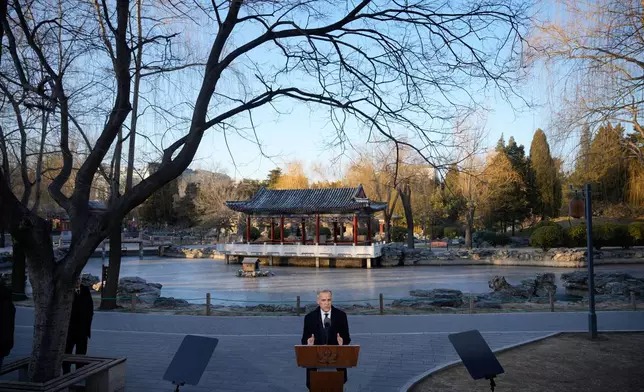
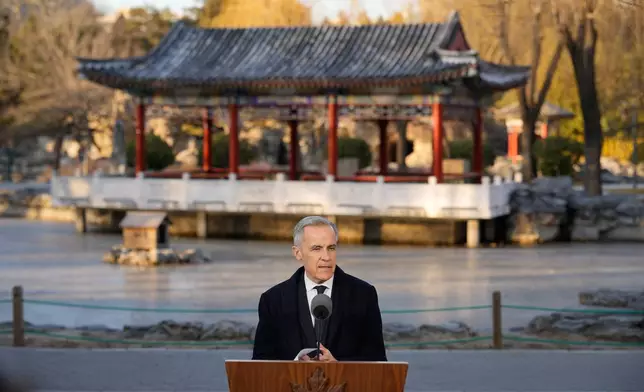
Canada's Prime Minister Mark Carney, speaks to the media at Ritan Park in Beijing, China, Friday, Jan. 16, 2026. (AP Photo/Vincent Thian)
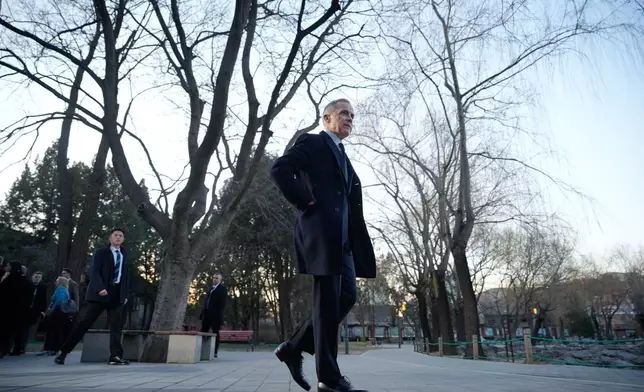
Canada's Prime Minister Mark Carney, leaves after speaking to the media at Ritan Park in Beijing, China, Friday, Jan. 16, 2026. (AP Photo/Vincent Thian)
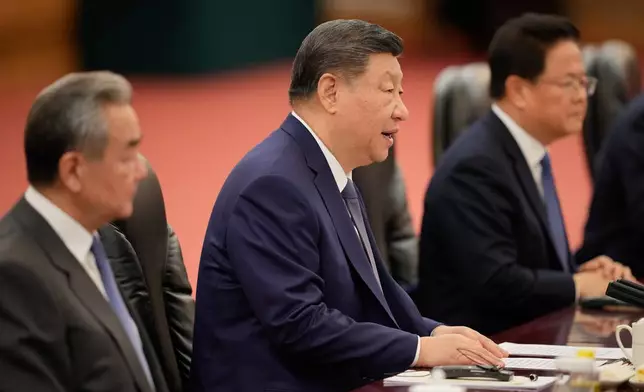
Chinese President Xi Jinping, centre, reacts during a meeting with Canada's Prime Minister Mark Carney (not in the picture), at the Great Hall of the People in Beijing, China, Friday, Jan. 16, 2026. (AP Photo/Vincent Thian, Pool)
Canada's Prime Minister Mark Carney, speaks to the media at Ritan Park in Beijing, China, Friday, Jan. 16, 2026. (AP Photo/Vincent Thian)
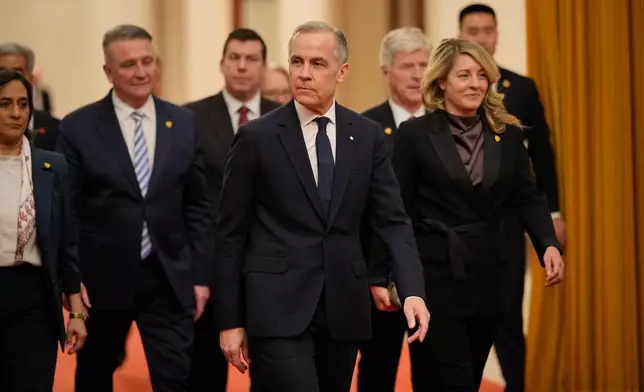
Canada's Prime Minister Mark Carney, center, arrives to meet with Chinese President Xi Jinping, at the Great Hall of the People in Beijing, China, Friday, Jan. 16, 2026. (AP Photo/Vincent Thian, Pool)
Canada's Prime Minister Mark Carney, left, meets with Chinese President Xi Jinping at the Great Hall of the People in Beijing Friday, Jan. 16, 2026. (Sean Kilpatrick/The Canadian Press via AP)
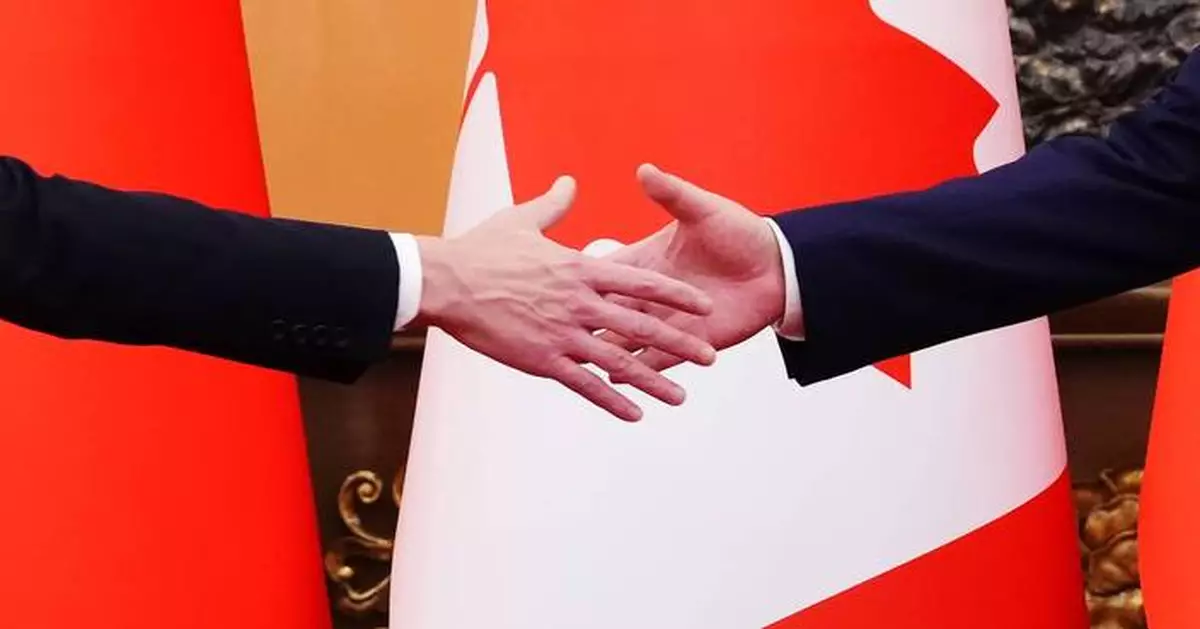
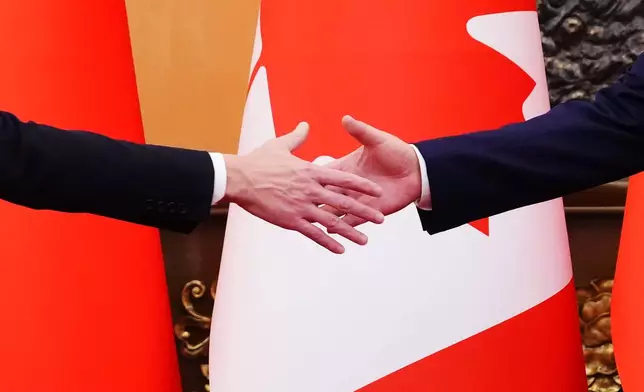
Canada's Prime Minister Mark Carney, left, shakes hands with China's President Xi Jinping at the Great Hall of the People in Beijing Friday, Jan. 16, 2026. (Sean Kilpatrick/The Canadian Press via AP)
“It has been a historic and productive two days,” Carney said, speaking outside against the backdrop of a traditional pavilion and a frozen pond at a Beijing park. “We have to understand the differences between Canada and other countries, and focus our efforts to work together where we’re aligned.”
Earlier Friday, he and Chinese leader Xi Jinping pledged to improve relations between their two nations after years of acrimony.
Xi told Carney in a meeting at the Great Hall of the People that he is willing to continue working to improve ties, noting that talks have been underway on restoring and restarting cooperation since the two held an initial meeting in October on the sidelines of a regional economic conference in South Korea.
“It can be said that our meeting last year opened a new chapter in turning China–Canada relations toward improvement,” China's top leader said.
Carney, the first Canadian prime minister to visit China in eight years, said better relations would help improve a global governance system that he described as “under great strain.”
He called for a new relationship “adapted to new global realities” and cooperation in agriculture, energy and finance.
Those new realities reflect in large part the so-called America-first approach of U.S. President Donald Trump. The tariffs he has imposed have hit both the Canadian and Chinese economies. Carney, who has met with several leading Chinese companies in Beijing, said ahead of his trip that his government is focused on building an economy less reliant on the U.S. at what he called “a time of global trade disruption.”
A Canadian business owner in China called Carney's visit game-changing, saying it re-establishes dialogue, respect and a framework between the two nations.
“These three things we didn’t have,” said Jacob Cooke, the CEO of WPIC Marketing + Technologies, which helps exporters navigate the Chinese market. “The parties were not talking for years.”
Canada had followed the U.S. in putting tariffs of 100% on EVs from China and 25% on steel and aluminum under former Prime Minister Justin Trudeau, Carney’s predecessor.
China responded by imposing duties of 100% on Canadian canola oil and meal and 25% on pork and seafood. It added a 75.8% tariff on canola seeds last August. Collectively, the import taxes effectively closed the Chinese market to Canadian canola, an industry group has said. Overall, China's imports from Canada fell 10.4% last year to $41.7 billion, according to Chinese trade data.
China is hoping Trump’s pressure tactics on allies such as Canada will drive them to pursue a foreign policy that is less aligned with the United States. The U.S. president has suggested Canada could become America's 51st state.
Carney departs China on Saturday and visits Qatar on Sunday before attending the annual gathering of the World Economic Forum in Switzerland next week. He will meet business leaders and investors in Qatar to promote trade and investment, his office said.
Associated Press business writer Chan Ho-him in Hong Kong contributed to this report.
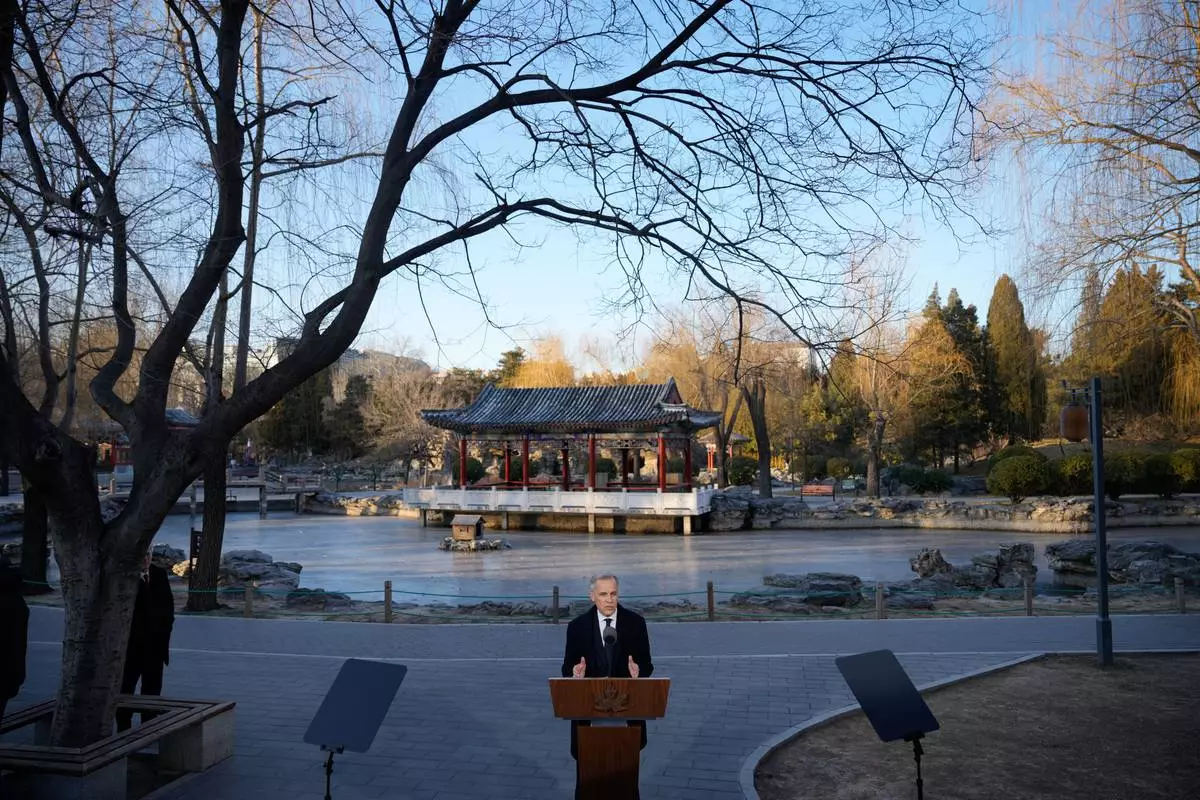
Canada's Prime Minister Mark Carney, speaks to the media at Ritan Park in Beijing, China, Friday, Jan. 16, 2026. (AP Photo/Vincent Thian)
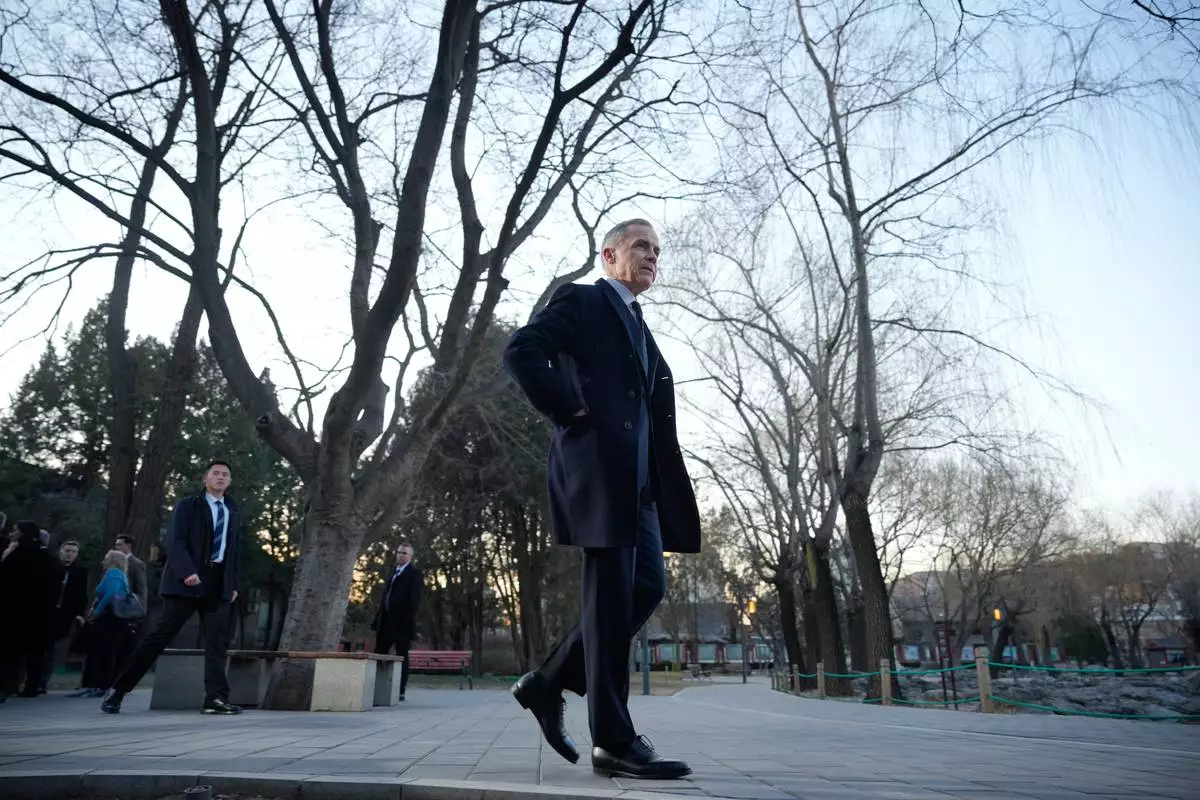
Canada's Prime Minister Mark Carney, leaves after speaking to the media at Ritan Park in Beijing, China, Friday, Jan. 16, 2026. (AP Photo/Vincent Thian)
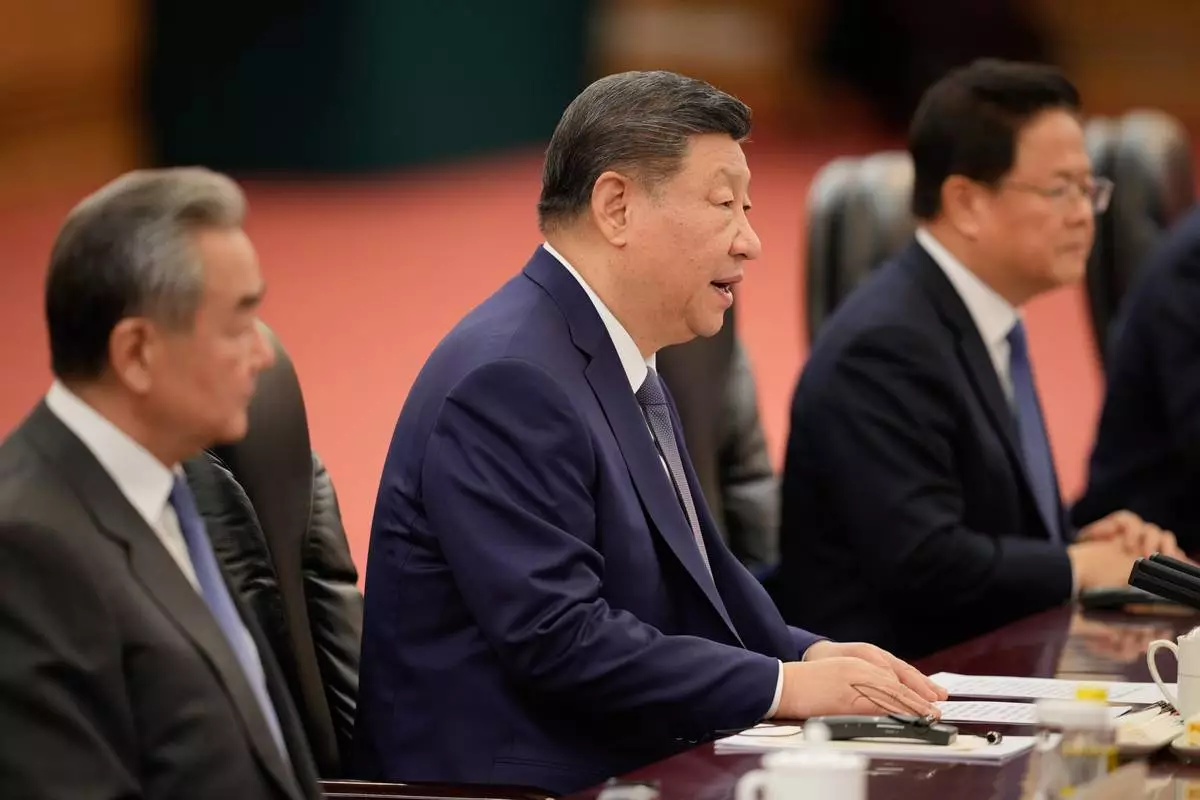
Chinese President Xi Jinping, centre, reacts during a meeting with Canada's Prime Minister Mark Carney (not in the picture), at the Great Hall of the People in Beijing, China, Friday, Jan. 16, 2026. (AP Photo/Vincent Thian, Pool)
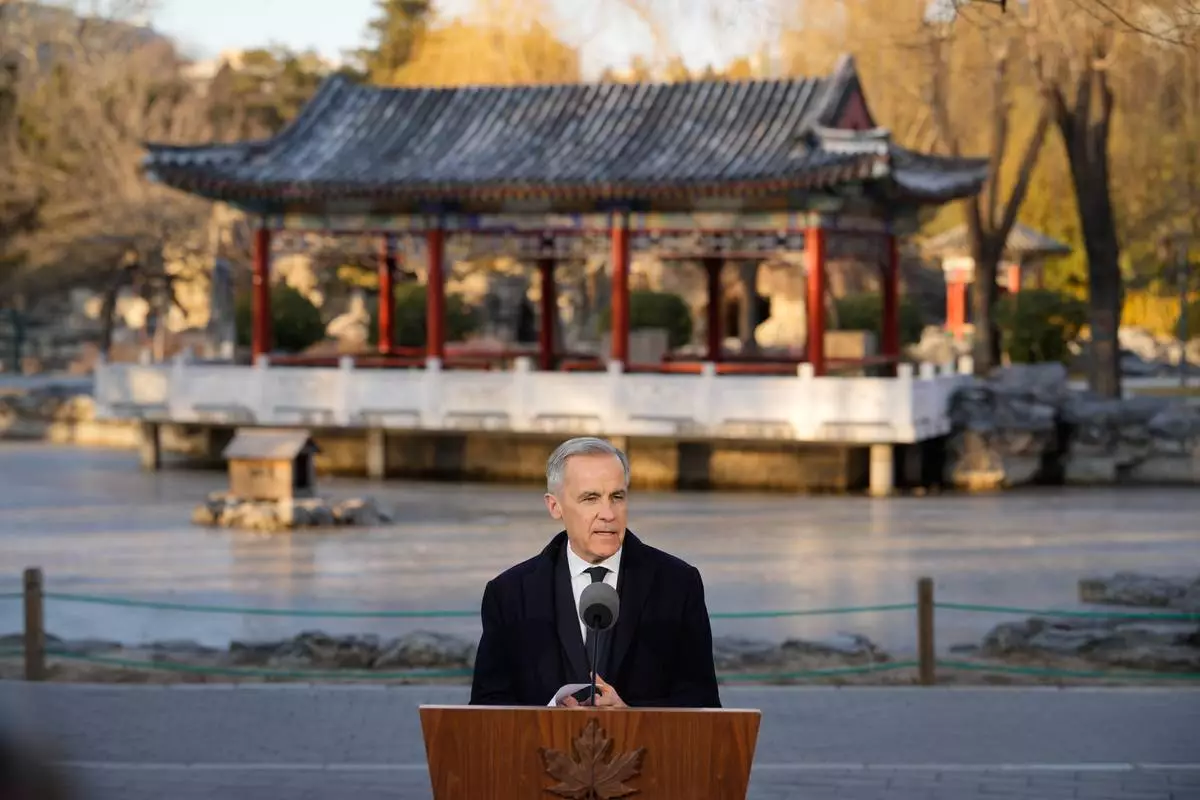
Canada's Prime Minister Mark Carney, speaks to the media at Ritan Park in Beijing, China, Friday, Jan. 16, 2026. (AP Photo/Vincent Thian)

Canada's Prime Minister Mark Carney, center, arrives to meet with Chinese President Xi Jinping, at the Great Hall of the People in Beijing, China, Friday, Jan. 16, 2026. (AP Photo/Vincent Thian, Pool)
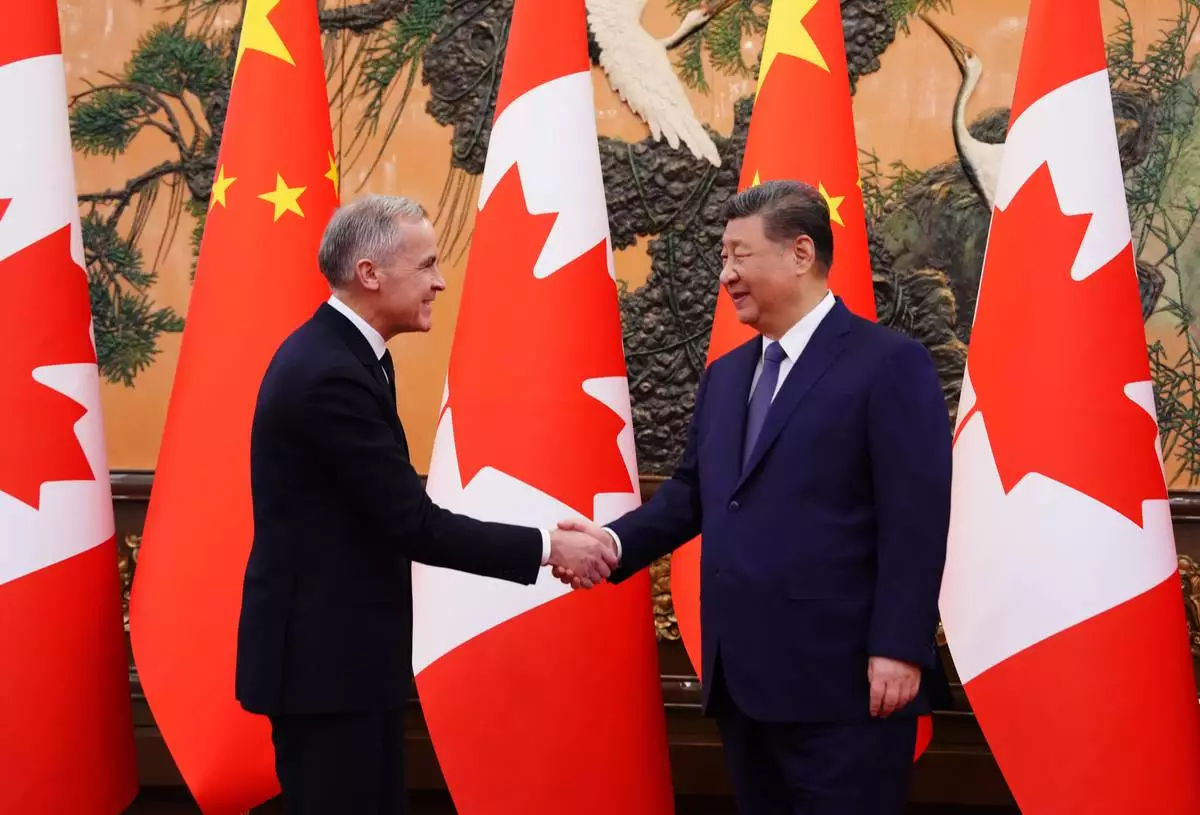
Canada's Prime Minister Mark Carney, left, meets with Chinese President Xi Jinping at the Great Hall of the People in Beijing Friday, Jan. 16, 2026. (Sean Kilpatrick/The Canadian Press via AP)
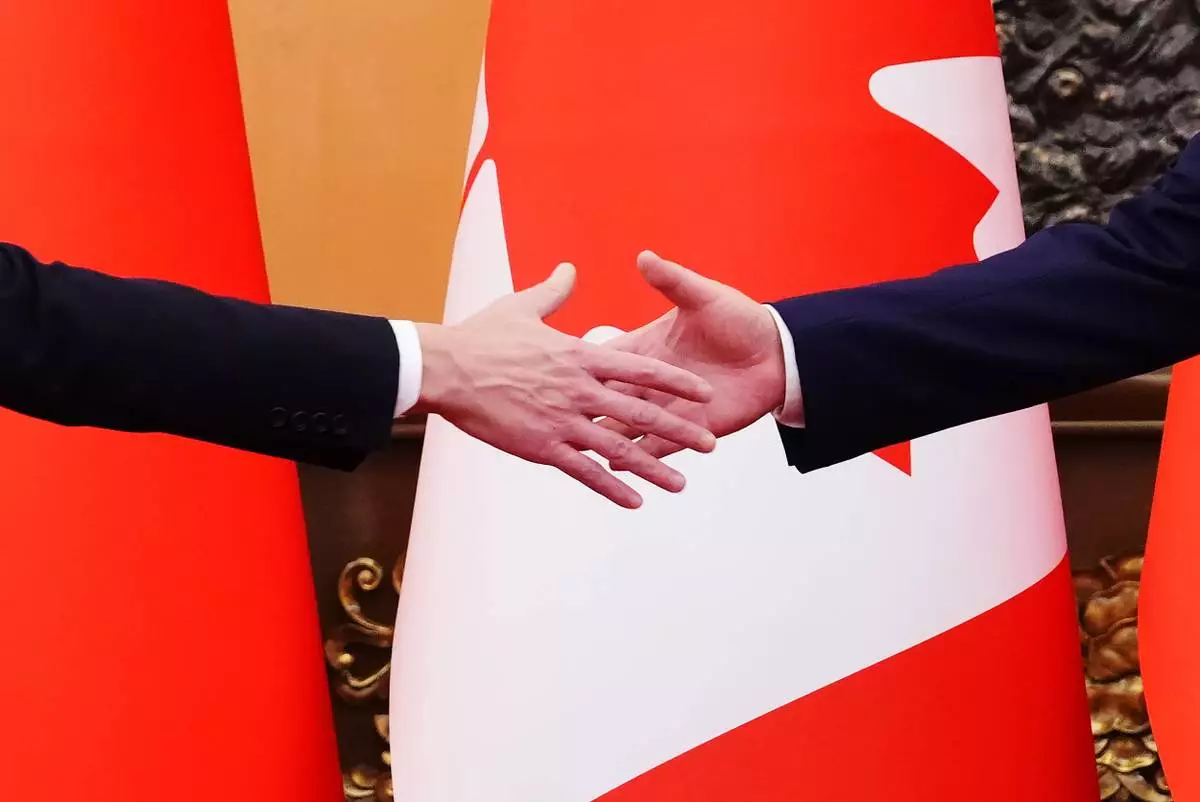
Canada's Prime Minister Mark Carney, left, shakes hands with China's President Xi Jinping at the Great Hall of the People in Beijing Friday, Jan. 16, 2026. (Sean Kilpatrick/The Canadian Press via AP)
MINNEAPOLIS (AP) — In a city that often seems to be staggering from one crisis to the next, the sudden resignation of police Chief Brian O’Hara after a finding he likely interfered in a misconduct investigation has left Minneapolis searching again for a way forward.
O’Hara was an outsider brought in with a mandate to reform the police department after the 2020 killing of George Floyd, which led to federal and state investigative findings of excessive force and racist policing practices. O’Hara had spent most of his career in Newark, New Jersey, where he instituted changes after that department was put under a federal consent decree for patterns of excessive force and unconstitutional stops and searches.
The challenges in Minneapolis were clear before O'Hara arrived in late 2022. For a time, it had seemed the department itself might not survive. In 2021, more than 43% of voters supported disbanding the department as the city reeled from Floyd’s killing and the massive protests and widespread rioting that followed.
Policing experts had noted the monumental task that faced the city’s next police chief, who would have to rebuild community trust and a department whose morale had dipped so low that it was hemorrhaging officers.
“I don’t think there was a bigger challenge to any American city than what Minneapolis faced when he arrived,” said Chuck Wexler, executive director of a Washington think tank, the Police Executive Research Forum. “They had gone from 850 to 500 officers, violent crime was significantly up, trust with the community was broken, a police station had burned down and a federal consent decree would face the next chief. Then you had the politics of Minneapolis.”
Coming in as an outsider to lead a large department is daunting, even without being asked to reform and rebuild, said Renée Hall, president of the National Organization of Black Law Enforcement Executives who moved from Detroit to lead the Dallas Police Department from 2017 to 2020.
“It’s extremely challenging to walk into an organization, where you don’t even know where the light switches are, where the bathrooms are. And that’s just the basics,” Hall said. “You have to learn the officers, the community, the politics of that particular city, and try to learn and navigate the existing relationships, like unions or officer associations and who is tied to whom and who is fighting for whom.”
Hall said outside hires can face resentment from those within an organization who supported internal candidates. They also have to earn the trust of the community, which she said takes time.
After the police disbandment measure failed, O'Hara joined the bureaucracy of a deeply progressive city that is regularly buffeted by political battles between the mayor and the City Council, and among council members.
Those battles were on full display Wednesday, when a City Council news conference about O'Hara's resignation quickly turned into an opportunity for the council's resolute progressives to attack Mayor Jacob Frey, who has long portrayed himself as a “pragmatic progressive.”
The resignation “is a symptom of a much larger problem, which is simply that Mayor Frey continues to be unable to effectively manage the Minneapolis Police Department,” said Council member Robin Wonsley, a cornerstone of the council's progressive bloc.
Frey, who just weeks ago pushed to have O'Hara reappointed as chief, fired back at criticism that he didn’t move aggressively enough when allegations of the chief's potential misconduct emerged.
“I don’t make decisions based on rumors and anonymous complaints,” he said in a statement, adding that he would work with the council to find a replacement. “I took action promptly after receiving the investigative report. … Decisions this serious have to be grounded in facts, evidence and completed investigations. Anything less would be irresponsible.”
O'Hara did not return a message seeking comment Wednesday. His attorney, Doug Kelley, released a statement touting successes during O'Hara's tenure, including diversifying and increasing the department's ranks, the decreasing violent crime rate and mitigating violent clashes during the immigration crackdown.
“The circumstances of Chief O’Hara’s departure should not define his service," Kelley wrote. "He was proud to serve Minneapolis, remains grateful to the officers and community partners who did difficult work under extraordinary pressure, and hopes the city continues moving forward. He understandably looks forward to returning to his young family in New Jersey.”
The resignation came just months after Minneapolis was plunged into the national spotlight amid a federal immigration surge that left three civilians shot, two fatally. O'Hara faced criticism he hadn't done enough to stop the crackdown.
Violence plagued the city in 2025, including deadly attacks on state politicians in the Minneapolis suburbs; gunfire that erupted at a popular city picnic spot; and a shooting during Mass at the Church of the Annunciation that left two children dead and more than a dozen people injured. O’Hara called the church attack a “ truly unthinkable tragedy. ”
Critics say dozens of complaints were filed against O'Hara, from accusations that he was rude to the public to the recent investigation into an ultimately unproven allegation he had a sexual relationship with a city employee. Most of the complaints have not been made public, and 17 complaints are still being investigated. Investigators closed 17 more without any disciplinary actions.
An independent investigator did not find evidence to substantiate the alleged sexual relationship with a city employee, but a second report released this week said O'Hara likely deleted the employee's contact from his phone during the investigation and that he talked to another employee about the probe despite being told it was not to be discussed.
That recent report led to a written reprimand; Frey told O'Hara he would be disciplined and that he could be terminated. Frey said O'Hara chose to resign instead.
Lauer reported from Philadelphia.

Minneapolis City Council Members, from left, Jason Chavez, Robin Wonsley and Council President Elliot Payne speak to reporters about the resignation of Police Chief Brian O'Hara on Wednesday, May 27, 2026 at City Hall in Minneapolis. (AP Photo/Mark Vancleave)
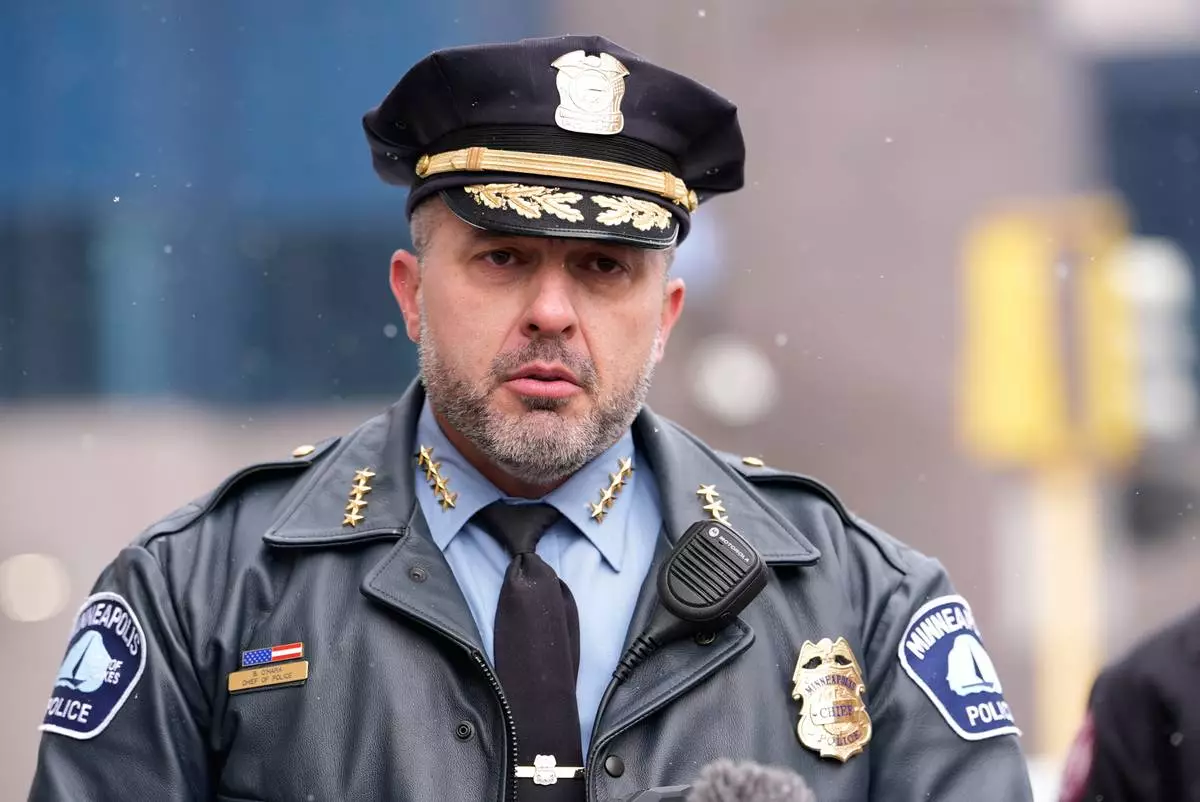
FILE - Minneapolis Police Chief Brian O'Hara speaks during a news conference, Jan. 10, 2026, in Minneapolis. (AP Photo/Jen Golbeck, File)