|
MELBOURNE, Australia, Jan. 17, 2026 /PRNewswire/ -- Panduit, a global leader in electrical and network infrastructure solutions, today announced the promotion of Holly Garcia to Chief Commercial Officer. In this role, Garcia will lead the company's global commercial strategy, focusing on the company's commitment to innovation and delivering a best-in-class experience for customers. Garcia will report directly to Panduit President, Marc Naese.
"Holly has the vision and expertise to position our company for continued growth and success while deepening our customer relationships," said Naese. "Holly's leadership as Chief Commercial Officer will be instrumental in strengthening the customer experience and delivering the value our markets expect."
In her most recent role as Vice President of Panduit's Data Center business unit, Garcia spearheaded global growth and innovation initiatives. She led the development of business strategy and directed new product introductions to strengthen Panduit's position in the rapidly evolving data center market. With more than 25 years of experience in sales, marketing, and business unit leadership, Garcia brings a proven track record of driving commercial success and transformative growth.
"I'm honored to take on the role of Chief Commercial Officer and excited to lead our commercial strategy during this time of growth," explained Garcia. "Our team's commitment to innovation and customer success has positioned us as a trusted partner globally, and I look forward to driving even greater value for our customers and stakeholders."
About Panduit
Panduit is a leading global manufacturer of high-quality electrical and network infrastructure and connectivity solutions. Operating from our headquarters in Tinley Park, Ill., USA, and across 112 worldwide locations, we drive innovation through strategic R&D investments and breakthrough product development while providing seamless global support and service. Since 1955, our commitment to our customers and partners has remained constant. And together, with them, we create exceptional solutions that support their businesses in a way that's good for them and good for the world. Panduit is making the connections that matter. For more information, visit www.panduit.com.
Media Contact:
Dawn Leach
Manager, Global Brand
Panduit Corp.
708-532-1800 x81316
dawn.leach@panduit.com
MELBOURNE, Australia, Jan. 17, 2026 /PRNewswire/ -- Panduit, a global leader in electrical and network infrastructure solutions, today announced the promotion of Holly Garcia to Chief Commercial Officer. In this role, Garcia will lead the company's global commercial strategy, focusing on the company's commitment to innovation and delivering a best-in-class experience for customers. Garcia will report directly to Panduit President, Marc Naese.
"Holly has the vision and expertise to position our company for continued growth and success while deepening our customer relationships," said Naese. "Holly's leadership as Chief Commercial Officer will be instrumental in strengthening the customer experience and delivering the value our markets expect."
In her most recent role as Vice President of Panduit's Data Center business unit, Garcia spearheaded global growth and innovation initiatives. She led the development of business strategy and directed new product introductions to strengthen Panduit's position in the rapidly evolving data center market. With more than 25 years of experience in sales, marketing, and business unit leadership, Garcia brings a proven track record of driving commercial success and transformative growth.
"I'm honored to take on the role of Chief Commercial Officer and excited to lead our commercial strategy during this time of growth," explained Garcia. "Our team's commitment to innovation and customer success has positioned us as a trusted partner globally, and I look forward to driving even greater value for our customers and stakeholders."
About Panduit
Panduit is a leading global manufacturer of high-quality electrical and network infrastructure and connectivity solutions. Operating from our headquarters in Tinley Park, Ill., USA, and across 112 worldwide locations, we drive innovation through strategic R&D investments and breakthrough product development while providing seamless global support and service. Since 1955, our commitment to our customers and partners has remained constant. And together, with them, we create exceptional solutions that support their businesses in a way that's good for them and good for the world. Panduit is making the connections that matter. For more information, visit www.panduit.com.
Media Contact:
Dawn Leach
Manager, Global Brand
Panduit Corp.
708-532-1800 x81316
dawn.leach@panduit.com
** The press release content is from PR Newswire. Bastille Post is not involved in its creation. **

Panduit Strengthens Commitment to Customer Excellence with Appointment of Holly Garcia to Chief Commercial Officer
|
Inaugural SME AI Impact Awards and new public-private partnerships to accelerate enterprise AI transformation, strengthen cyber resilience, and secure Singapore's digital infrastructure
SINGAPORE, May 21, 2026 /PRNewswire/ -- As enterprises accelerate AI adoption, the challenge is shifting from experimentation to secure deployment at scale. Many businesses continue to face technical barriers, operational complexity, and rising cybersecurity threats as they move from pilots to implementation. More than eight in 10 organisations experienced at least one cybersecurity incident annually, underscoring the growing need for stronger digital resilience.
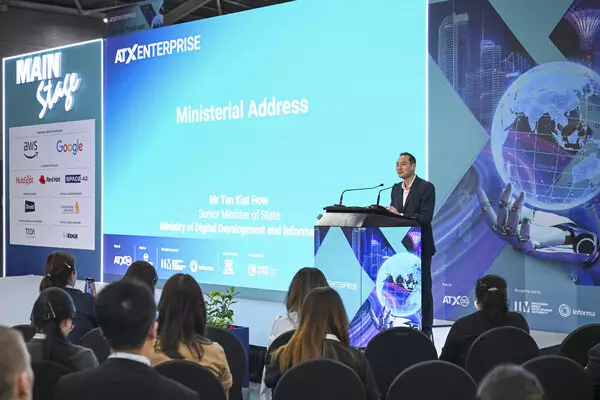
At ATxEnterprise 2026, part of Asia Tech x Singapore, jointly organised by the Infocomm Media Development Authority (IMDA) and Informa, Senior Minister of State, Ministry of Digital Development and Information Mr. Tan Kiat How announced new initiatives to help enterprises adopt AI with confidence, strengthen cyber resilience, and future-proof Singapore's digital infrastructure. The announcements include new partnerships under the Digital Enterprise Blueprint (DEB) and continued investments in quantum-safe infrastructure.
New award to recognise Singapore's AI trailblazers
AI adoption across Singapore enterprises has grown rapidly recently. IMDA's Singapore Digital Economy (SGDE) Report 2025 found that AI adoption among small and medium enterprises (SMEs) more than tripled from 4.2% to 14.5% in just one year, while adoption rates among non-SMEs jumped from 44% to 62.5% in 2024.
To commend SMEs achieving measurable business outcomes through AI, IMDA and the Singapore Business Federation will launch the inaugural SME AI Impact Awards 2026 as part of the National AI Impact Programme (NAIIP) and in support of the National AI Strategy (NAIS).
The awards will recognise up to 30 winners across two categories: enterprises developing proprietary AI tools, and enterprises successfully deploying off-the-shelf AI solutions. Winners will receive the SME AI Impact Award Trustmark to strengthen business credibility and market reputation.
Nominations will open from 1 June to 14 August 2026, with winners announced at the SMEs Go Digital Day on 13 October 2026.
New Partnerships to Boost Enterprise AI Capabilities and Cyber Resilience
To help SMEs build stronger digital capabilities in AI and cybersecurity, IMDA is expanding the Digital Enterprise Blueprint (DEB) through two new partnerships with Grab and RSM Stone Forest IT (RSM). Both partnerships offer SMEs hands-on guidance, practical tools and expertise to adopt AI with confidence and strengthen their cyber resilience.
Grab will launch the Grab AI Programme for SMEs with IMDA, to reach 10,000 food and beverage (F&B), e-commerce and retail SMEs through AI literacy initiatives, training and practical adoption support. This includes online training resources, webinars, masterclasses and a two-day AI course co-developed with the Singapore University of Technology and Design to help SMEs build practical AI roadmaps, using IMDA pre-approved AI solutions.
RSM will launch the RSM Cyber2SME™ Programme, offering complimentary phishing simulation exercises to 2,000 SMEs and cyber security awareness workshops covering cyber risks. Up to 1,000 SMEs will also benefit from cybersecurity awareness webinars and tabletop exercises covering cyber risks, AI and data threats, and incident response strategies.
These partnerships build on the DEB, which has already supported over 26,000 SMEs since its launch in May 2024. With Grab and RSM on board, IMDA aims to reach 12,000 more SMEs, bringing the programme closer to supporting 50,000 SMEs by 2029.
A New Playbook to Make AI Transformation Simpler for Digital Leaders
IMDA, SkillsFuture Singapore (SSG) and Workforce Singapore (WSG)[1]have jointly developed a new AI for Enterprise Impact Playbook to provide digitally progressive enterprises navigate AI adoption.
Built on insights from over 1,000 enterprise engagements, the Playbook helps enterprises assess their AI adoption readiness, identify relevant support, and take actionable next steps. It also consolidates programmes and resources from IMDA, Enterprise Singapore (EnterpriseSG), SSG and WSG into a single framework.
Staying Ahead of AI Vulnerabilities
Sonar globally launched its new AI remediation agent at ATxSummit Singapore, co-developed with engineers from IMDA and Singapore. The tool helps enterprises automatically detect, fix and validate code issues generated through AI-assisted software development, enabling organisations to deploy AI-enabled coding tools more securely.
Building a Quantum-safe Singapore
As a digital hub, Singapore must ensure that the telecommunication sector is robust to quantum threats.
IMDA has signed a Memorandum of Intent (MOI) with Singtel, Ericsson and NCS Singapore to pilot and validate quantum-safe technologies for migrating Singtel's infrastructure and systems. This collaboration will strengthen Singapore's defences against quantum threats, support wider telco adoption, and position Singapore as a reference point for secure quantum-era transformation.
These partnerships mark a significant step in Singapore's digital journey, empowering enterprises to adopt AI with confidence, strengthening cyber resilience, and laying the foundation for a more secure and innovative digital future.
For more information on ATxSG, please visit asiatechxsg.com.
[1] Workforce Singapore (WSG) and SkillsFuture Singapore (SSG) will be merged to form Skills and Workforce Development Agency (SWDA).
Media: atxsg.imda@archetype.co
Inaugural SME AI Impact Awards and new public-private partnerships to accelerate enterprise AI transformation, strengthen cyber resilience, and secure Singapore's digital infrastructure
SINGAPORE, May 21, 2026 /PRNewswire/ -- As enterprises accelerate AI adoption, the challenge is shifting from experimentation to secure deployment at scale. Many businesses continue to face technical barriers, operational complexity, and rising cybersecurity threats as they move from pilots to implementation. More than eight in 10 organisations experienced at least one cybersecurity incident annually, underscoring the growing need for stronger digital resilience.
At ATxEnterprise 2026, part of Asia Tech x Singapore, jointly organised by the Infocomm Media Development Authority (IMDA) and Informa, Senior Minister of State, Ministry of Digital Development and Information Mr. Tan Kiat How announced new initiatives to help enterprises adopt AI with confidence, strengthen cyber resilience, and future-proof Singapore's digital infrastructure. The announcements include new partnerships under the Digital Enterprise Blueprint (DEB) and continued investments in quantum-safe infrastructure.
New award to recognise Singapore's AI trailblazers
AI adoption across Singapore enterprises has grown rapidly recently. IMDA's Singapore Digital Economy (SGDE) Report 2025 found that AI adoption among small and medium enterprises (SMEs) more than tripled from 4.2% to 14.5% in just one year, while adoption rates among non-SMEs jumped from 44% to 62.5% in 2024.
To commend SMEs achieving measurable business outcomes through AI, IMDA and the Singapore Business Federation will launch the inaugural SME AI Impact Awards 2026 as part of the National AI Impact Programme (NAIIP) and in support of the National AI Strategy (NAIS).
The awards will recognise up to 30 winners across two categories: enterprises developing proprietary AI tools, and enterprises successfully deploying off-the-shelf AI solutions. Winners will receive the SME AI Impact Award Trustmark to strengthen business credibility and market reputation.
Nominations will open from 1 June to 14 August 2026, with winners announced at the SMEs Go Digital Day on 13 October 2026.
New Partnerships to Boost Enterprise AI Capabilities and Cyber Resilience
To help SMEs build stronger digital capabilities in AI and cybersecurity, IMDA is expanding the Digital Enterprise Blueprint (DEB) through two new partnerships with Grab and RSM Stone Forest IT (RSM). Both partnerships offer SMEs hands-on guidance, practical tools and expertise to adopt AI with confidence and strengthen their cyber resilience.
Grab will launch the Grab AI Programme for SMEs with IMDA, to reach 10,000 food and beverage (F&B), e-commerce and retail SMEs through AI literacy initiatives, training and practical adoption support. This includes online training resources, webinars, masterclasses and a two-day AI course co-developed with the Singapore University of Technology and Design to help SMEs build practical AI roadmaps, using IMDA pre-approved AI solutions.
RSM will launch the RSM Cyber2SME™ Programme, offering complimentary phishing simulation exercises to 2,000 SMEs and cyber security awareness workshops covering cyber risks. Up to 1,000 SMEs will also benefit from cybersecurity awareness webinars and tabletop exercises covering cyber risks, AI and data threats, and incident response strategies.
These partnerships build on the DEB, which has already supported over 26,000 SMEs since its launch in May 2024. With Grab and RSM on board, IMDA aims to reach 12,000 more SMEs, bringing the programme closer to supporting 50,000 SMEs by 2029.
A New Playbook to Make AI Transformation Simpler for Digital Leaders
IMDA, SkillsFuture Singapore (SSG) and Workforce Singapore (WSG)[1]have jointly developed a new AI for Enterprise Impact Playbook to provide digitally progressive enterprises navigate AI adoption.
Built on insights from over 1,000 enterprise engagements, the Playbook helps enterprises assess their AI adoption readiness, identify relevant support, and take actionable next steps. It also consolidates programmes and resources from IMDA, Enterprise Singapore (EnterpriseSG), SSG and WSG into a single framework.
Staying Ahead of AI Vulnerabilities
Sonar globally launched its new AI remediation agent at ATxSummit Singapore, co-developed with engineers from IMDA and Singapore. The tool helps enterprises automatically detect, fix and validate code issues generated through AI-assisted software development, enabling organisations to deploy AI-enabled coding tools more securely.
Building a Quantum-safe Singapore
As a digital hub, Singapore must ensure that the telecommunication sector is robust to quantum threats.
IMDA has signed a Memorandum of Intent (MOI) with Singtel, Ericsson and NCS Singapore to pilot and validate quantum-safe technologies for migrating Singtel's infrastructure and systems. This collaboration will strengthen Singapore's defences against quantum threats, support wider telco adoption, and position Singapore as a reference point for secure quantum-era transformation.
These partnerships mark a significant step in Singapore's digital journey, empowering enterprises to adopt AI with confidence, strengthening cyber resilience, and laying the foundation for a more secure and innovative digital future.
For more information on ATxSG, please visit asiatechxsg.com.
[1] Workforce Singapore (WSG) and SkillsFuture Singapore (SSG) will be merged to form Skills and Workforce Development Agency (SWDA).
Media: atxsg.imda@archetype.co
** This press release is distributed by PR Newswire through automated distribution system, for which the client assumes full responsibility. **
Building AI-Ready Enterprises: New Initiatives to Drive AI Deployment at Scale and Strengthen Digital Resilience