Skip to Content Facebook Feature Image

Greater Bay Area's nine Chinese mainland cities set foreign trade record in 2025

China

China

China

Greater Bay Area's nine Chinese mainland cities set foreign trade record in 2025

2026-01-20 09:23 Last Updated At:13:31

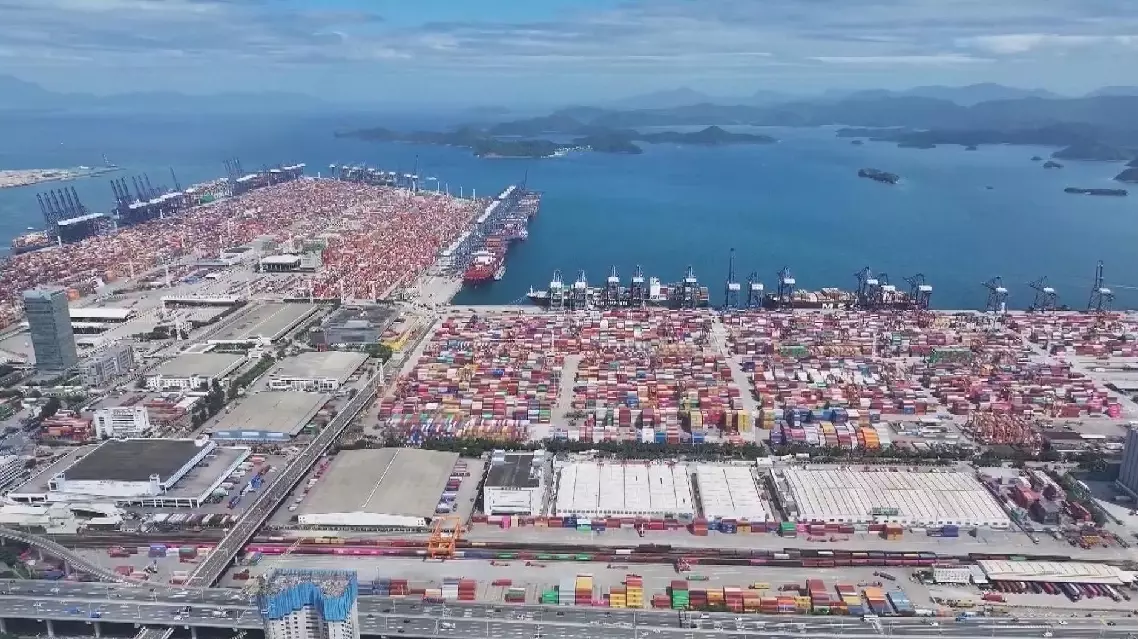
The nine cities of Guangdong Province in the Guangdong-Hong Kong-Macao Greater Bay Area (GBA) saw their foreign trade surpass 9 trillion yuan (about 1.29 trillion U.S. dollars) in 2025, hitting a record high.

The nine GBA mainland cities recorded imports and exports totaling 9.15 trillion yuan (about 1.31 trillion U.S. dollars) in 2025, a year-on-year increase of 4.7 percent, according to statistics from the Guangdong branch of the General Administration of Customs of China (GACC)

This value accounted for 20.1 percent of the national total and contributed over one-fourth of the country's total foreign trade growth.

Last year, the nine cities' exports reached 5.83 trillion yuan (about 836 billion U.S. dollars), growing by 2.7 percent, while imports hit 3.32 trillion yuan (about 476 billion U.S. dollars), up by 8.5 percent.

During the 14th Five-Year Plan period (2021-2025), both imports and exports in the nine cities increased, with an average annual growth rate of 6.2 percent.

The number of enterprises with import and export records in the nine cities exceeded 150,000, a record high.

Among them, private enterprises numbered 139,700, with a total import and export value of 5.87 trillion yuan (about 842 billion U.S. dollars), both setting historical records, up by 20.3 percent and 5.3 percent respectively.

Mechanical and electrical products accounted for nearly 70 percent of the total export value of the nine cities last year, reaching 4.07 trillion yuan (about 584 billion U.S. dollars), up 7.6 percent.

Among them, the traditional electronics manufacturing sector maintained a solid advantage.

Exports of electronic components, electrical equipment, computers and their parts grew steadily by 20.1 percent, 17 percent, and 9.7 percent, respectively.

Emerging industries developed rapidly, with exports of intelligent and green products such as the "new trio" (electric vehicles, lithium-ion batteries, photovoltaic products), 3D printers, and drones increasing by over 30 percent, specifically by 31.2 percent, 37.1 percent, and 40.8 percent, respectively.

In 2025, mechanical and electrical products accounted for 72.2 percent of the total import value across the nine cities, rising 12.2 percent to 2.39 trillion yuan (about 343 billion U.S. dollars).

Notably, imports of components and equipment for industrial production -- such as integrated circuits, computers and their parts, and semiconductor manufacturing equipment -- grew relatively fast, by 15.4 percent, 19.4 percent, and 33.1 percent, respectively.

During the same period, imports of consumer goods related to people's livelihood, including dairy products, aquatic products, grain, and edible vegetable oil, saw strong increase, rising by 20.5 percent, 21.5 percent, 22.5 percent, and 54.4 percent, respectively.

The GBA consists of the Hong Kong Special Administrative Region (HKSAR), the Macao Special Administrative Region (Macao SAR), as well as nine cities in Guangdong Province, namely Guangzhou, Shenzhen, Zhuhai, Foshan, Huizhou, Dongguan, Zhongshan, Jiangmen and Zhaoqing.
Greater Bay Area's nine Chinese mainland cities set foreign trade record in 2025

Greater Bay Area's nine Chinese mainland cities set foreign trade record in 2025
Li Li, a deputy to the National People's Congress (NPC) from southwest China's Guizhou Province, has made it her mission to preserve and promote the rich cultural heritage of the Buyi people, particularly their traditional clothing.

Born and raised in a village of Qinglong County, Qianxinan Buyei and Miao Autonomous Prefecture, Li began learning the intricate handicrafts of the Buyi people from her mother at a young age.

After spending over a decade working away from home, she felt a strong calling to return and safeguard her cultural roots. In 2015, she returned to her roots to start a business with the vision to revitalize Buyi clothing.

"Starting my own business was really tough in the beginning. If you want to make a Western-style suit, you could just buy some fabric and copy an existing design. But ethnic clothing is different. It requires constant innovation, and that takes a huge amount of time. Traditional fabrics tend to fade, and I spent months just trying to figure out how to fix the color. This problem had kept me up for a long time. But eventually, I tackled the challenges one by one," Li said.

Her persistence has paid off. This year, Li's team tapped into the cultural symbolism of the Year of the Horse, creating a range of horse-themed products that have quickly gained popularity.

"This year is the Year of the Horse, so we created a lot of horse-themed items. They are very popular and orders have been pouring in. Every year, we design our cultural products and clothing based on what the market wants. We started with a 300-square-meter workshop, and now we have our own intangible cultural heritage center. Over the years, we've trained more than a thousand embroiderers," she said.

As a grassroots NPC deputy, Li prioritizes listening to the voices of ordinary people. During work sessions with embroiderers, she takes time to listen to their concerns and offers flexible schedules for those with special needs.

The preservation of ethnic clothing and culture has always been at the heart of her work.

"During this year's 'two sessions', I will continue to focus on the preservation of ethnic clothing and culture. I want to encourage more young people to get involved in cultural inheritance. For example, I've been going to schools to teach students because I hope that intangible cultural heritage can take root in children's hearts from an early age. I want them to grow up knowing how remarkable our ethnic culture is and to develop a strong sense of cultural pride," Li said.

The "two sessions" refer to the annual meetings of the National People's Congress, China's top legislature, and the National Committee of the Chinese People's Political Conference, China's top political advisory body,which usually convene in early March.

NPC deputy from Guizhou revitalizes Buyi culture through inheritance and innovation

NPC deputy from Guizhou revitalizes Buyi culture through inheritance and innovation

Recommended Articles