Skip to Content Facebook Feature Image

Utah State keeps the winning carousel spinning in second season under Calhoun

Sport

Utah State keeps the winning carousel spinning in second season under Calhoun
Sport

Sport

Utah State keeps the winning carousel spinning in second season under Calhoun

2026-01-21 03:17 Last Updated At:03:21

PHOENIX (AP) — Utah State has become a stepping stone for coaches who parlay winning into jobs at bigger programs.

Craig Smith, Ryan Odom and Danny Sprinkle all coached in Logan, all went on to other jobs, yet are all still connected to the program.

“We're all very close,” current Utah State coach Jerrod Calhoun said. “When you get a job, the first thing you want to do is know the ins and outs of the program. They bend over backwards.”

The coaches' connection has been a big part of the Aggies' consistent success.

Stew Morrill set the standard, taking Utah State to the NCAA Tournament eight times between 1998-2011. The program went through a bit of a lull toward the end of Morrill's tenure and in three years under Tim Duryea but has become one of the most consistent mid-major programs since 2018.

The Aggies went to the NCAA Tournament twice in three seasons under Smith, who parlayed his success into the job at Utah. Odom kept the Aggies rolling, taking them to the NCAA Tournament in his second season, leading to his current job at Virginia.

Sprinkle lasted just one season in Logan, but it was a good one: Utah State won 28 games and knocked off TCU in the opening round of the NCAA Tournament before he took the head job at Washington.

Calhoun has kept the winning carousel spinning.

He led Youngstown State to consecutive 20-win seasons for the first time before becoming Utah State's coach in 2024. The Aggies had 26 wins to reach the NCAA Tournament in his first season, and they're on a roll again this year.

Utah State opened 15-1 for the third straight season and was ranked No. 23 before Saturday's 84-74 loss at Grand Canyon.

“We move the ball very well as a team and when we move the ball, we're very good,” Utah State graduate guard Drake Allen said.

The Aggies have been good offensively since Smith's tenure, but this season they took a big leap on the defensive end.

Utah State is better in nearly every defensive category from a year ago, holding teams to nearly three points less per game while forcing an average of 15.2 turnovers.

“Just being very intentional in the offseason about studying, where we can get better when we need to,” Calhoun said. “If you’re going to win in this era, you kind of have to know how you want to play and then you've got to get those guys in the portal.”

Utah State got a big boost from the transfer portal with the addition of MJ Collins Jr.

The 6-foot-4 guard started his career at Virginia Tech and played last season at Vanderbilt, where he averaged 7.4 points in 32 games.

Collins had made a huge jump this season, playing with confidence and in a system that fits his style of play. He has boosted his scoring average to a Mountain West Conference-best 19.6 points per game while leading the league in shooting at 55% from the floor. He is 15th nationally in 3-point shooting at 44% and, combined with do-it-all guard Mason Falslev, gives Utah State one of the Mountain West's best backcourts.

“When we got him, we knew he’d be really good, but I’d be lying to say we thought you’d be averaging 20 a game,” Calhoun said. “I think the system fits him really well.”

The system has worked for everyone in Logan. Calhoun and his predecessors have made sure of that.

Get poll alerts and updates on the AP Top 25 throughout the season. Sign up here and here (AP mobile app). AP college basketball: https://apnews.com/hub/ap-top-25-college-basketball-poll and https://apnews.com/hub/college-basketball
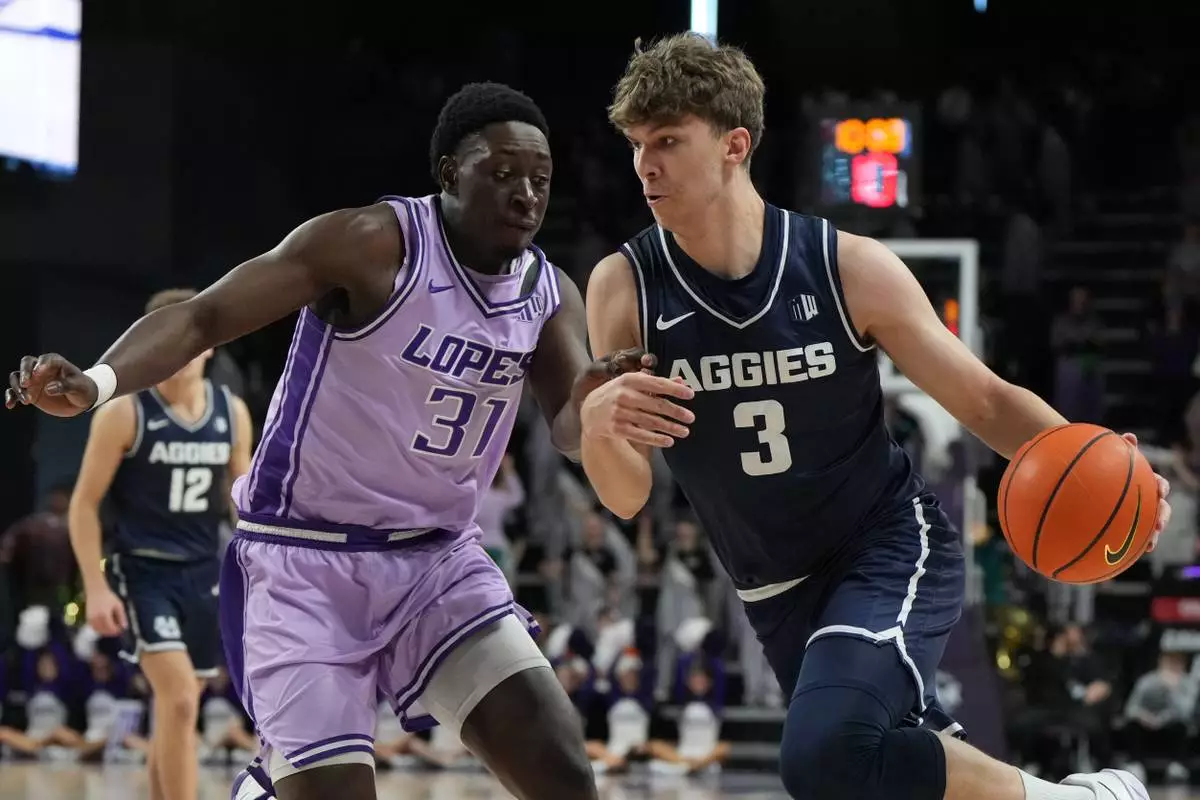
Utah State forward Tucker Anderson (3) drives on Grand Canyon forward Nana Owusu-Anane during the first half of an NCAA college basketball game, Saturday, Jan. 17, 2026, in Phoenix. (AP Photo/Rick Scuteri)
Utah State forward Tucker Anderson (3) drives on Grand Canyon forward Nana Owusu-Anane during the first half of an NCAA college basketball game, Saturday, Jan. 17, 2026, in Phoenix. (AP Photo/Rick Scuteri)
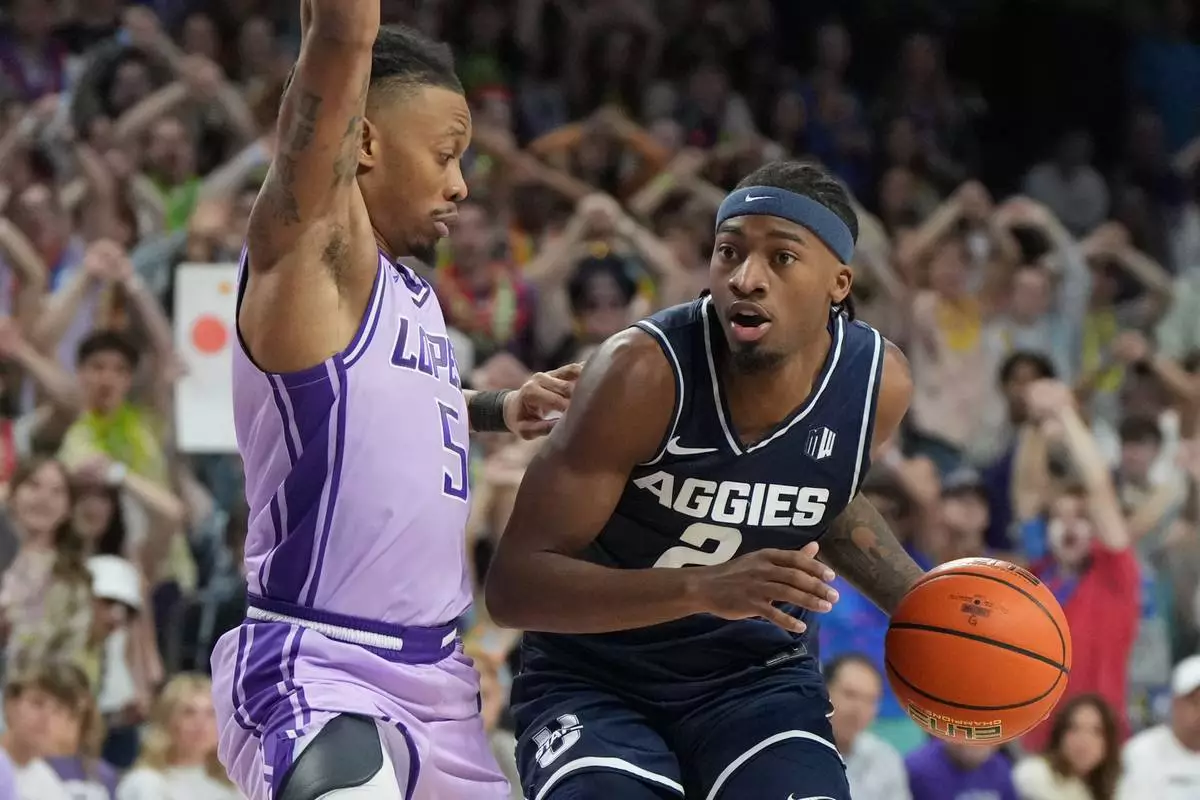
Utah State guard Mj Collins drives on Grand Canyon guard Brian Moore Jr. (5) during the first half of an NCAA college basketball game, Saturday, Jan. 17, 2026, in Phoenix. (AP Photo/Rick Scuteri)
Utah State guard Mj Collins drives on Grand Canyon guard Brian Moore Jr. (5) during the first half of an NCAA college basketball game, Saturday, Jan. 17, 2026, in Phoenix. (AP Photo/Rick Scuteri)

SEOUL, South Korea (AP) — A South Korean court ruled Wednesday that the 2024 imposition of martial law by then President Yoon Suk Yeol constituted an act of rebellion as it sentenced his prime minister to 23 years in prison for his involvement.

Ex-Prime Minister Han Duck-soo became the first Yoon administration official convicted of rebellion charges in related to Yoon’s martial law imposition in December 2024. The verdict is expected to set the stage for upcoming rulings involving Yoon and his other associates, who also face rebellion charges.

Han, who was appointed by Yoon prime minister, the No. 2 post in South Korea, served as one of the three caretaker leaders during moments of the martial law crisis that led to Yoon’s impeachment and eventually his removal from office.

Rebellion is one of the gravest charges in South Korea, with the independent counsel recently demanding the death penalty for Yoon, who was charged with masterminding a rebellion. The Seoul Central District Court is to rule on Yoon’s rebellion charges on Feb. 19.

In its televised verdict Wednesday, the Seoul court determined Yoon’s martial law decree amounted to a rebellion, viewing his dispatch of troops and police officers to Parliament and election offices as “a riot” or “a self-coup” that was meant to undermine the constitutional order and was serious enough to disrupt stability in the region.

The court sentenced Han for playing a key role in Yoon’s rebellion by trying to give procedural legitimacy to Yoon’s martial law decree by getting it passed through a Cabinet Council meeting. The court also convicted Han of falsifying the martial law proclamation and destroying it and lying under oath.

Han, who could appeal Wednesday’s ruling, has steadfastly maintained that he had told Yoon that he opposed his martial law plan. He has denied most of the other charges.

The court said Han, then prime minister, neglected his responsibilities to protect the constitution, choosing instead to take part in Yoon’s rebellion in the belief that it might succeed.

“Because of the defendant’s action, the Republic of Korea could have returned to a dark past when the basic rights of the people and the liberal democratic order were trampled upon, becoming trapped in the quagmire of dictatorships for an extended period,” judge Lee Jin-gwan said.

After the court’s ruling, Han was immediately sent to prison, according to the court. Unlike Yoon, he had not been detained before sentencing. His lengthy sentence came as a surprise as the independent counsel earlier requested 15 years in prison.

Yoon, who has already been in jail for months, faces eight criminal trials including his rebellion case over the martial law decree and other allegations. Last Friday, Yoon received a five-year prison term at the Seoul court for defying attempts to detain him, fabricating the martial law proclamation and denying some Cabinet members their rights to deliberate on his martial law decree.

Yoon, a conservative, has steadfastly denied the charges of rebellion, saying he only aimed to draw public support of his fight against the main liberal opposition party which obstructed his agenda. Speaking at Friday’s court session, Yoon denounced authorities for their rebellion investigations as “frenzied," arguing that they involved “manipulation” and “distortion.”

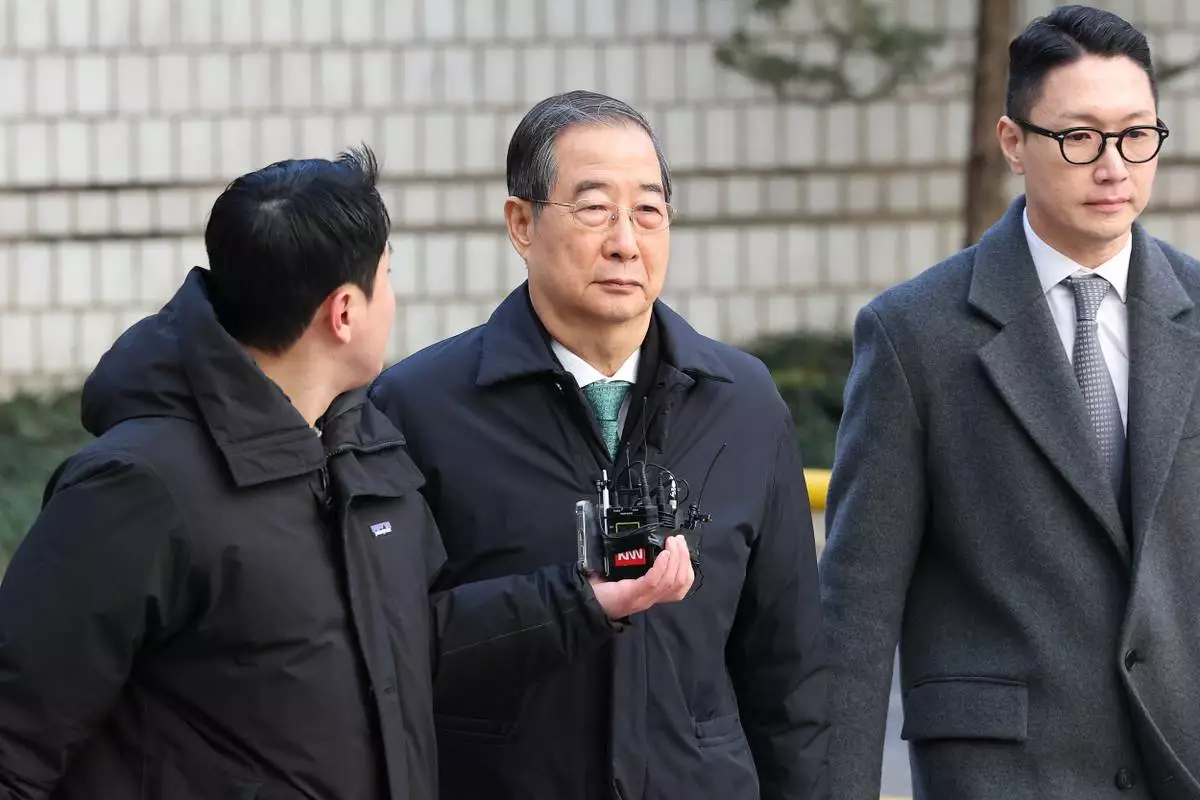
Former South Korean Prime Minister Han Duck-soo, center, arrives at the Seoul Central District Court for his first sentencing trial in the insurrection case, in Seoul Wednesday, Jan. 21, 2026. (Chung Sung-Jun/Pool Photo via AP)

Former South Korean Prime Minister Han Duck-soo, center, arrives at the Seoul Central District Court for his first sentencing trial in the insurrection case, in Seoul Wednesday, Jan. 21, 2026. (Chung Sung-Jun/Pool Photo via AP)

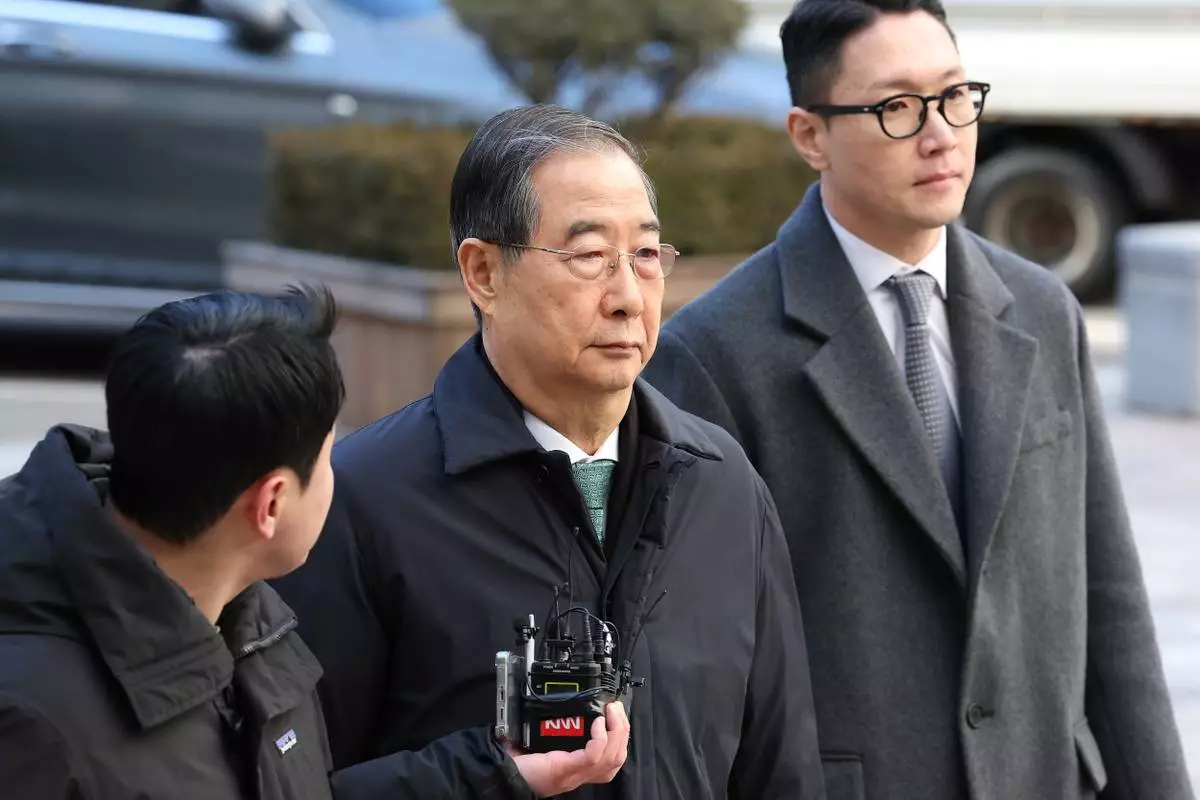
Former South Korean Prime Minister Han Duck-soo, center, arrives at the Seoul Central District Court for his first sentencing trial in the insurrection case, in Seoul Wednesday, Jan. 21, 2026. (Chung Sung-Jun/Pool Photo via AP)

Former South Korean Prime Minister Han Duck-soo, center, arrives at the Seoul Central District Court for his first sentencing trial in the insurrection case, in Seoul Wednesday, Jan. 21, 2026. (Chung Sung-Jun/Pool Photo via AP)

Recommended Articles