DUBAI, United Arab Emirates (AP) — Iran's foreign minister issued the most direct threat yet Wednesday against the United States after Tehran's bloody crackdown on protesters, warning the Islamic Republic will be “firing back with everything we have if we come under renewed attack."
The comments by Abbas Araghchi, who saw his invitation to the World Economic Forum in Davos rescinded over the killings, comes as an American aircraft carrier group moves westward toward the Middle East from Asia. American fighter jets and other equipment appears to be moving in the Mideast after a major U.S. military deployment in the Caribbean saw troops seize Venezuela's Nicolás Maduro.
Meanwhile, an Iranian Kurdish separatist group in Iraq claimed Iran targeted one of its bases in a drone and missile attack that killed at least one fighter. Iran did not immediately acknowledge the attack, which would be the first foreign operation Tehran has launched since the protests started.
Araghchi made the threat in an opinion article published by The Wall Street Journal. In it, the foreign minister contended “the violent phase of the unrest lasted less than 72 hours” and sought again to blame armed demonstrators for the violence. Videos that have slipped out of Iran despite an internet shutdown appear to show security forces repeatedly using live fire to target apparently unarmed protesters, something unaddressed by Araghchi.
“Unlike the restraint Iran showed in June 2025, our powerful armed forces have no qualms about firing back with everything we have if we come under renewed attack,” Araghchi wrote, referring to the 12-day war launched by Israel on Iran in June. “This isn’t a threat, but a reality I feel I need to convey explicitly, because as a diplomat and a veteran, I abhor war.”
He added: “An all-out confrontation will certainly be ferocious and drag on far, far longer than the fantasy timelines that Israel and its proxies are trying to peddle to the White House. It will certainly engulf the wider region and have an impact on ordinary people around the globe.”
Araghchi's comments likely refer to Iran's short- and medium-range missiles. The Islamic Republic relied on ballistic missiles to target Israel in the war and left its stockpile of the shorter-range missiles unused, something that could be fired to target American bases and interests in the Persian Gulf. Already, there have been some restrictions on U.S. diplomats traveling to American bases in both Kuwait and Qatar.
Mideast nations, particularly diplomats from Gulf Arab countries, had lobbied Trump not to attack. Last week, Iran shut its airspace, likely in anticipation of a strike.
The USS Abraham Lincoln, which had been in the South China Sea in recent days, had passed through the Strait of Malacca, a key waterway connecting the South China Sea and Indian Ocean, by Tuesday, ship-tracking data showed.
A U.S. Navy official, speaking on condition of anonymity, said the aircraft carrier and three accompanying destroyers were heading west.
While naval and other defense officials stopped short of saying the carrier strike group was headed to the Middle East, its current heading and location in the Indian Ocean means it is only days away from moving into the region. Meanwhile, U.S. military images released in recent days showed F-15E Strike Eagles arriving in the Mideast and forces in the region moving a HIMARS missile system, the type used with great success by Ukraine after Russia's full-scale invasion in the country in 2022.
The National Army of Kurdistan, the armed wing of the Kurdistan Freedom Party, or PAK, claimed Iran launched an attack against one of its bases near Irbil, some 320 kilometers (200 miles) north of Baghdad. It said one fighter had been killed, releasing mobile phone footage of a fire in the predawn darkness.
Iranian state television, which has confirmed attacks on the group in the past, did not acknowledge the assault.
A handful of Iranian Kurdish dissident or separatist groups — some with armed wings — have long found a safe haven in northern Iraq’s semiautonomous Kurdish region, where their presence has been a point of friction between the central government in Baghdad and Tehran. The PAK has claimed it launched attacks in Iran as a crackdown on the demonstrations took place, something reported by semiofficial Iranian news agencies as well.
The death toll from the protests has reached at least 4,519 people, the U.S.-based Human Rights Activists News Agency said. The agency has been accurate throughout the years on demonstrations and unrest in Iran, relying on a network of activists inside the country that confirms all reported fatalities. The Associated Press has been unable to independently assess the death toll.
The death toll exceeds that of any other round of protest or unrest in Iran in decades, and recalls the chaos surrounding the 1979 revolution that brought the Islamic Republic into being. Although there have been no protests for days, there are fears the death toll could increase significantly as information gradually emerges from a country still under a government-imposed shutdown of the internet since Jan. 8.
Iran's Supreme Leader Ayatollah Ali Khamenei said on Saturday that the protests had left “several thousand” people dead and blamed the United States. It was the first indication from an Iranian leader of the extent of the casualties.
More than 26,300 people have been arrested, according to the Human Rights Activists News Agency. Comments from officials have led to fears of some of those detained being put to death in Iran, one of the world’s top executioners. That and the killing of peaceful protesters have been two red lines laid down by Trump in the tensions.
Associated Press writers Stella Martany in Irbil, Iraq, Konstantin Toropin in Washington and Elena Becatoros contributed to this report.
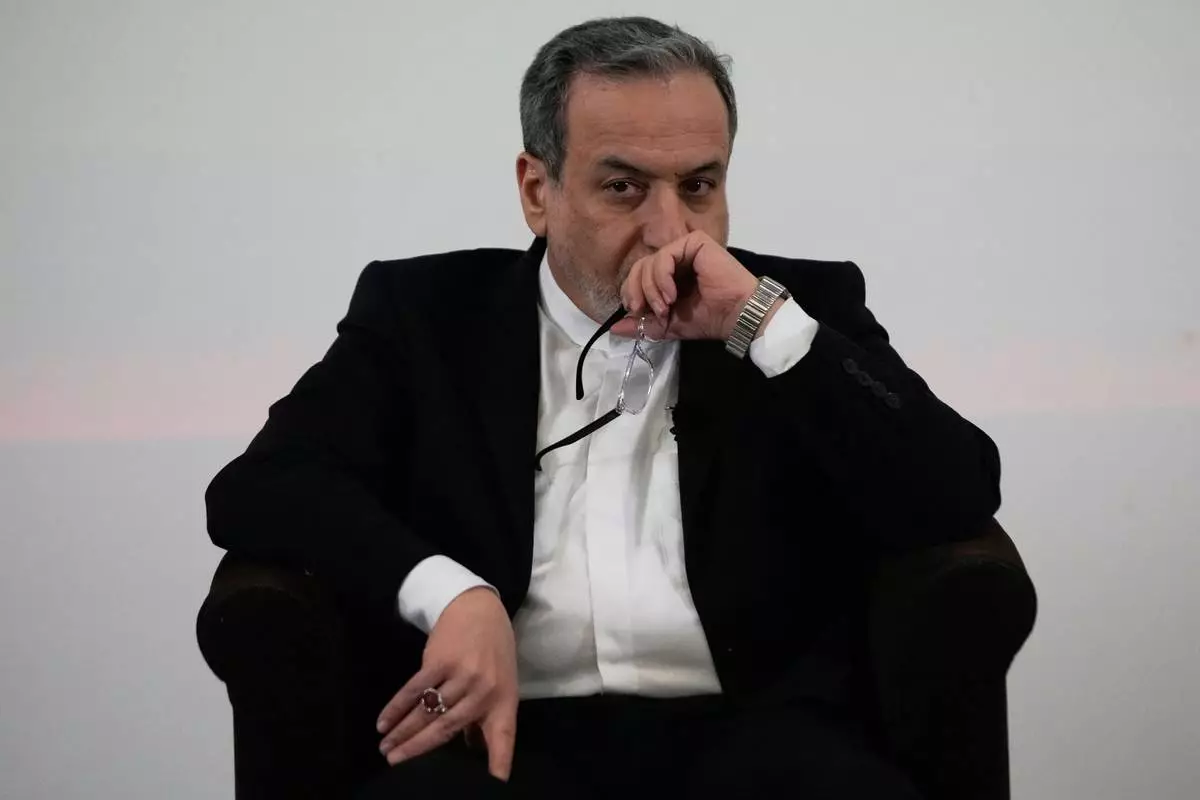
Iranian Foreign Minister Abbas Araghchi, attends a seminar in Beirut, Lebanon, Friday, Jan. 9, 2026. (AP Photo/Hussein Malla)