Skip to Content Facebook Feature Image

Historic love letters from royals, rogues and romantics go on show at Britain's National Archives

ENT

Historic love letters from royals, rogues and romantics go on show at Britain's National Archives
ENT

ENT

Historic love letters from royals, rogues and romantics go on show at Britain's National Archives

2026-01-22 01:21 Last Updated At:23:28

LONDON (AP) — Love is, famously, a many-splendored thing. It can encompass longing, loneliness, pain, jealousy, grief — and, sometimes, joy.

As Valentine’s Day approaches, the many facets of passion are going on display in “Love Letters,” a public exhibition at Britain’s National Archives that covers five centuries.

More Images
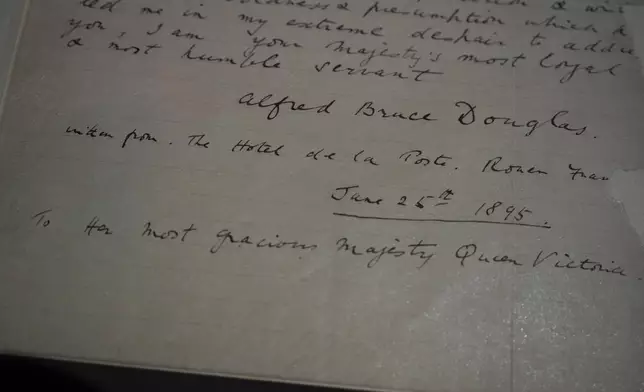
A letter written by Lord Alfred Douglas to Britain's Queen Victoria, petitioning for the release of Oscar Wilde from prison on display during a press preview of an exhibition entitled Love Letters at the National Archives in London, Wednesday, Jan. 21, 2026, Wilde was imprisoned in 1895 for gross indecency. (AP Photo/Alastair Grant)
A letter written by Lord Alfred Douglas to Britain's Queen Victoria, petitioning for the release of Oscar Wilde from prison on display during a press preview of an exhibition entitled Love Letters at the National Archives in London, Wednesday, Jan. 21, 2026, Wilde was imprisoned in 1895 for gross indecency. (AP Photo/Alastair Grant)

A general view of part of the Love Letters exhibition at the National Archives, with pictures of the writer Oscar Wilde and Lord Alfred Douglas, in London, Wednesday, Jan. 21, 2026. (AP Photo/Alastair Grant)
A general view of part of the Love Letters exhibition at the National Archives, with pictures of the writer Oscar Wilde and Lord Alfred Douglas, in London, Wednesday, Jan. 21, 2026. (AP Photo/Alastair Grant)

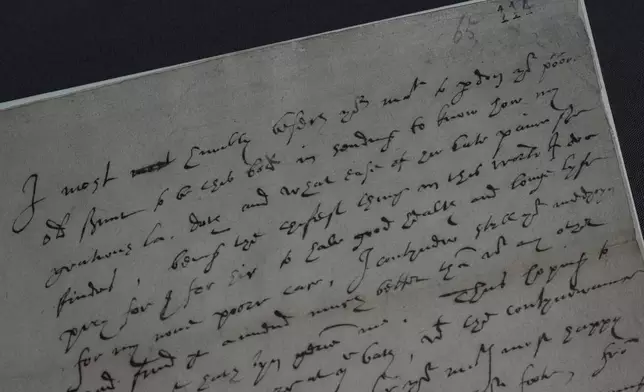
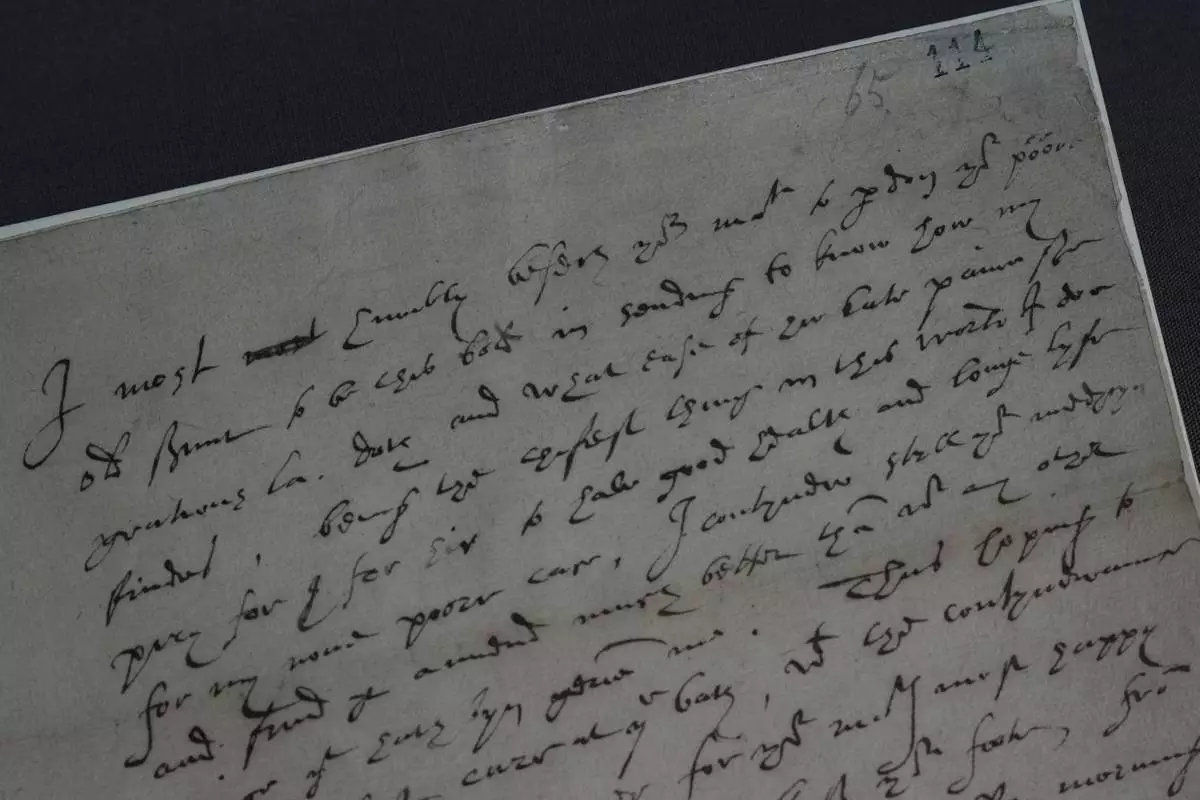
A 16th century letter written by Robert Dudley, 1st Earl of Leicester, to Queen Elizabeth I, on view during a preview of the Love Letters exhibition at the National Archives in London on Wednesday, Jan. 21, 2026, shows two dots written above the word poor, a reference to the monarch's nickname for Dudley: Eyes. (AP Photo/Alastair Grant)
A 16th century letter written by Robert Dudley, 1st Earl of Leicester, to Queen Elizabeth I, on view during a preview of the Love Letters exhibition at the National Archives in London on Wednesday, Jan. 21, 2026, shows two dots written above the word poor, a reference to the monarch's nickname for Dudley: Eyes. (AP Photo/Alastair Grant)

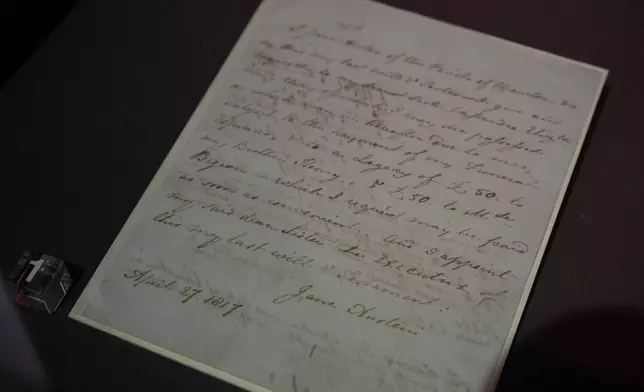
The will of British author Jane Austen on display during a preview of the Love Letter exhibition at the National Archives in London, Wednesday, Jan. 21, 2026. (AP Photo/Alastair Grant)
The will of British author Jane Austen on display during a preview of the Love Letter exhibition at the National Archives in London, Wednesday, Jan. 21, 2026. (AP Photo/Alastair Grant)

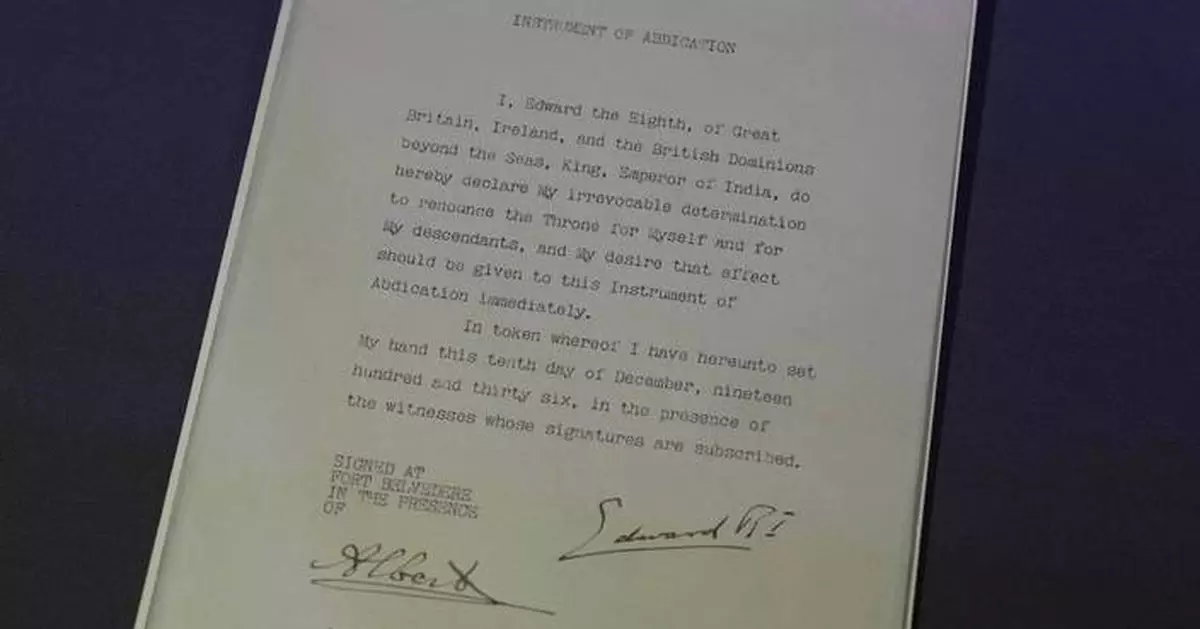
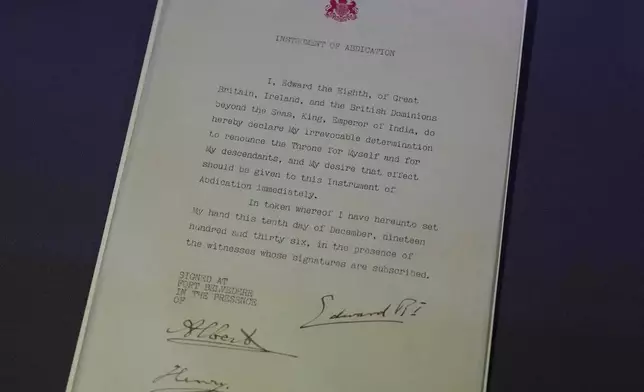
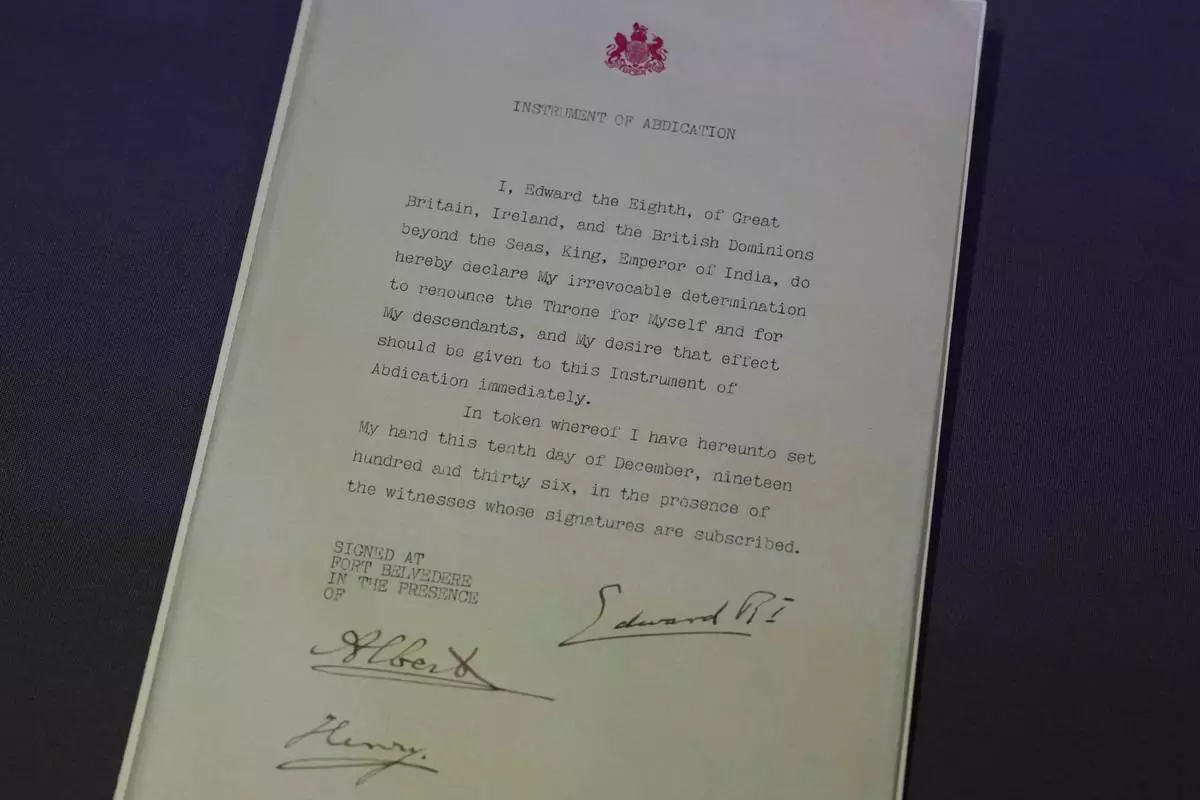
The Abdication document of Britain's King Edward VIII on display during a preview of an exhibition entitled Love Letters at the National Archives in London, Wednesday, Jan. 21, 2026, Edward abdicated on Dec. 10, 1936. (AP Photo/Alastair Grant)

The Abdication document of Britain's King Edward VIII on display during a preview of an exhibition entitled Love Letters at the National Archives in London, Wednesday, Jan. 21, 2026, Edward abdicated on Dec. 10, 1936. (AP Photo/Alastair Grant)

Curator Victoria Iglikowski-Broad said that the documents recount “legendary romances from British history” involving royalty, politicians, celebrities and spies, “alongside voices of everyday people.”

“We’re trying to open up the potential of what a love letter can be,” she told The Associated Press on Wednesday. “Expressions of love can be found in all sorts of places, and surprising places.”

They also take many forms. The exhibition ranges from early 20th-century classified ads seeking same-sex romance to sweethearts' letters to soldiers at war and a medieval song about heartbreak.

There’s also “one of our most iconic documents,” Iglikowski-Broad said, referring to a poignant letter to Queen Elizabeth I from her suitor Robert Dudley, Earl of Leicester.

Written days before Dudley’s death in 1588, it conveys the intimacy between the “Virgin Queen,” who never married, and the man who called himself “your poor old servant.”

The missive, with “his last lettar” written on the outside — spelling at the time was idiosyncratic — was found at the queen’s bedside when she died almost 15 years later.

Love, in the exhibition, doesn’t just mean romance. Family bonds are in evidence in Jane Austen’s handwritten will from 1817 leaving almost everything to her beloved sister Cassandra, and in a 1956 letter in which the father of London gangster twins Reggie and Ronnie Kray, implores a court to go easy on the brothers, because “all their concern in life is to do good to everybody.”

The letter writers range from paupers to princes. In an 1851 petition, an unemployed 71-year-old weaver named Daniel Rush begs authorities not to separate him and his wife by sending them to workhouses. It’s displayed alongside the Instrument of Abdication through which King Edward VIII gave up the throne in 1936 so that he could marry “the woman I love,” twice-divorced American Wallis Simpson.

“There is a lot of connection in these two items even though on the surface they seem very different,” Iglikowski-Broad said. “In common they have just this human feeling of love … that the sacrifice is actually worth it for love.”

Other documents tell of love lost. There is a never-before-displayed 1944 letter from young British intelligence officer John Cairncross to his former girlfriend Gloria Barraclough, reflecting on what might have been. “Would we have broken off, I wondered, if we had known what was coming?”

Some readers may think Barraclough had a lucky escape — years later, Cairncross was unmasked as a Soviet spy.

Some love stories tell of danger, heartbreak and tragedy. In one, Lord Alfred Douglas asks — in vain — for Queen Victoria to pardon his lover Oscar Wilde. The writer had been sentenced to two years in prison for gross indecency after Douglas’ outraged father revealed their relationship.

Nearby is a letter written in 1541 by Catherine Howard, fifth wife of King Henry VIII, to her secret beau Thomas Culpeper.

Archives historian Neil Johnston noted that the tone of the extraordinary letter is “restrained panic. She is warning him to be very, very careful.”

Catherine signed off the letter “yours as long as life endures.” That turned out not to be long. The king discovered the affair and both Catherine and Culpeper were executed for treason.

A letter by Queen Henrietta Maria to King Charles I – “my dear heart” – is a rarity, since Britain’s royal family guards its private papers closely.

It was found among possessions left behind by the fleeing king in 1645 after a battlefield defeat for royalist troops in England’s civil war. Charles lost the war and was tried, convicted and executed in 1649. The letter ended up in Parliament's archives, which last year was transferred to the National Archives.

“We don’t have very many intimate letters between monarchs like this,” Johnston said. “This is a little gem within the disaster of the English Civil War.”

“Love Letters” opens Saturday and runs to April 12. Admission is free.
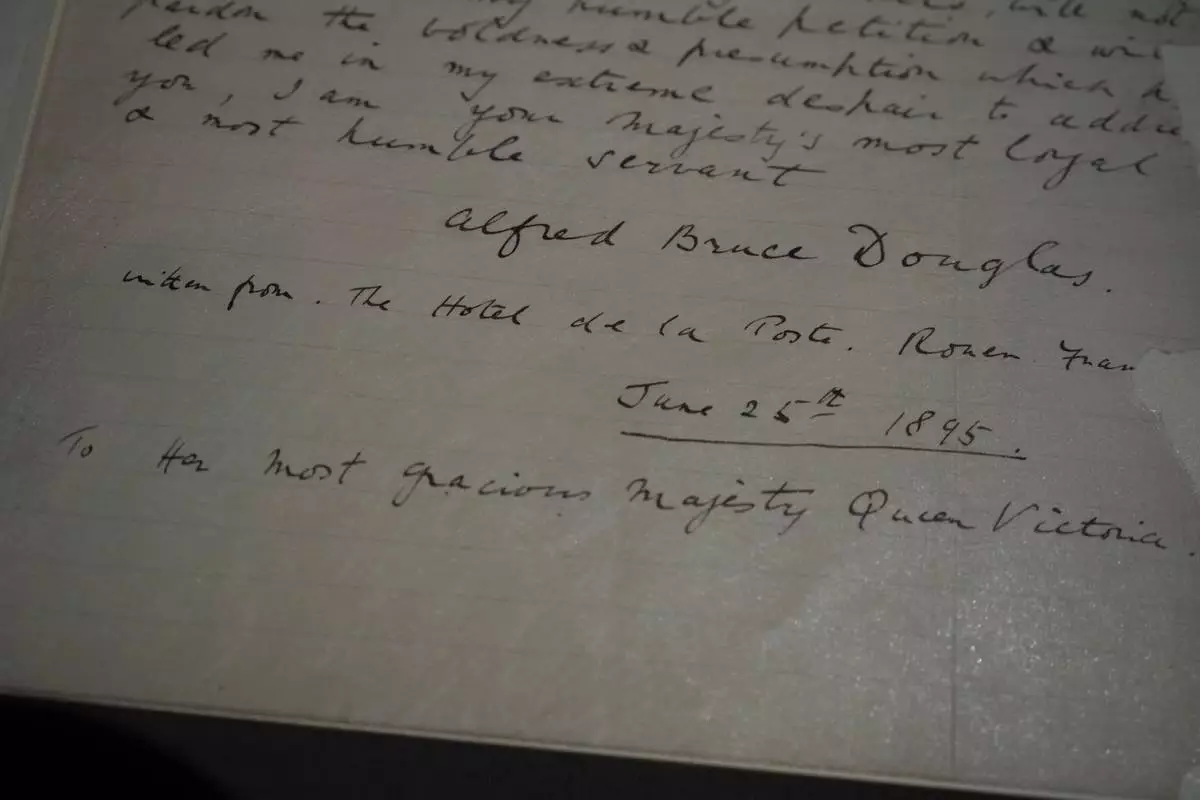
A letter written by Lord Alfred Douglas to Britain's Queen Victoria, petitioning for the release of Oscar Wilde from prison on display during a press preview of an exhibition entitled Love Letters at the National Archives in London, Wednesday, Jan. 21, 2026, Wilde was imprisoned in 1895 for gross indecency. (AP Photo/Alastair Grant)

A letter written by Lord Alfred Douglas to Britain's Queen Victoria, petitioning for the release of Oscar Wilde from prison on display during a press preview of an exhibition entitled Love Letters at the National Archives in London, Wednesday, Jan. 21, 2026, Wilde was imprisoned in 1895 for gross indecency. (AP Photo/Alastair Grant)

A general view of part of the Love Letters exhibition at the National Archives, with pictures of the writer Oscar Wilde and Lord Alfred Douglas, in London, Wednesday, Jan. 21, 2026. (AP Photo/Alastair Grant)
A general view of part of the Love Letters exhibition at the National Archives, with pictures of the writer Oscar Wilde and Lord Alfred Douglas, in London, Wednesday, Jan. 21, 2026. (AP Photo/Alastair Grant)

A 16th century letter written by Robert Dudley, 1st Earl of Leicester, to Queen Elizabeth I, on view during a preview of the Love Letters exhibition at the National Archives in London on Wednesday, Jan. 21, 2026, shows two dots written above the word poor, a reference to the monarch's nickname for Dudley: Eyes. (AP Photo/Alastair Grant)

A 16th century letter written by Robert Dudley, 1st Earl of Leicester, to Queen Elizabeth I, on view during a preview of the Love Letters exhibition at the National Archives in London on Wednesday, Jan. 21, 2026, shows two dots written above the word poor, a reference to the monarch's nickname for Dudley: Eyes. (AP Photo/Alastair Grant)

The will of British author Jane Austen on display during a preview of the Love Letter exhibition at the National Archives in London, Wednesday, Jan. 21, 2026. (AP Photo/Alastair Grant)
The will of British author Jane Austen on display during a preview of the Love Letter exhibition at the National Archives in London, Wednesday, Jan. 21, 2026. (AP Photo/Alastair Grant)

The Abdication document of Britain's King Edward VIII on display during a preview of an exhibition entitled Love Letters at the National Archives in London, Wednesday, Jan. 21, 2026, Edward abdicated on Dec. 10, 1936. (AP Photo/Alastair Grant)

The Abdication document of Britain's King Edward VIII on display during a preview of an exhibition entitled Love Letters at the National Archives in London, Wednesday, Jan. 21, 2026, Edward abdicated on Dec. 10, 1936. (AP Photo/Alastair Grant)

LONDON (AP) — British Prime Minister Keir Starmer pledged revive his struggling government but faced growing calls to resign after a disastrous set of local and regional elections for his Labour Party.

As the final results came in Saturday, Labour had lost 1,000 local council seats across England and was booted from power in Wales after 27 years. Anti-immigration party Reform UK won almost 1,300 seats across England, came second in Wales and made significant gains in Scotland.

It was a blunt verdict from voters in elections widely seen as an unofficial referendum on Starmer, whose popularity has plummeted since he led the center-left party to power less than two years ago.

Here are five things we’ve learned from the elections.

Starmer insisted he would not walk away and "plunge the country into chaos,” and the dire election results did not produce an immediate challenge to his leadership.

"The right thing to do is rebuild and show the path forward," Starmer said Saturday. “That’s what I’m going to do in the coming days.”

Starmer’s Cabinet colleagues expressed support, and none of the high-profile Labour politicians considered potential challengers has made a move. Health Secretary Wes Streeting, former Deputy Prime Minister Angela Rayner and Greater Manchester Mayor Andy Burnham are keeping quiet for now.

But a growing number of Labour lawmakers urged the prime minister to set a timetable for his departure this year. British politics allows parties to change leader midterm without the need for a new election.

“There has to be a timetable,” legislator Clive Betts told the BBC. Another lawmaker, Tony Vaughan, said there should be an “orderly transition of leadership.”

Starmer tried to demonstrate change on Saturday by bringing back two figures from past Labour governments. He made former Prime Minister Gordon Brown a special envoy on global finance, and appointed the party's ex-deputy leader Harriet Harman an adviser on women and girls.

Starmer is due to make a speech on Monday in an attempt to regain momentum, before the government sets out its legislative plans on Wednesday in a speech delivered by King Charles III at the State Opening of Parliament.

The elections were a breakthrough for Reform UK, the latest hard-right party led by the veteran nationalist politician Nigel Farage.

Running on an anti-establishment and anti-immigration message, the party won hundreds of local council seats in working-class areas in England’s north, such as Sunderland, that were solid Labour turf for decades. It also made gains from the Conservatives in areas like the county of Essex, east of London.

Farage said the results marked a “historic change in British politics.” He said he's confident that “voters who have come to us are not doing it as a short-term protest.”

Reform UK currently holds just eight of the 650 seats in Parliament and it’s unclear whether it could repeat its success in a national election.

The elections produced semiautonomous administrations in Scotland and Wales led by parties devoted to independence and the breakup of the United Kingdom — though neither has that policy on the front burner.

The Scottish National Party, which has governed in Edinburgh since 2007, won another term but fell short of a majority, meaning an independence referendum is unlikely. Labour and Reform tied in a distant second place.

Plaid Cymru (The Party of Wales) won the most seats in the Cardiff-based legislature, the Senedd. The party, which has an ambition for Wales to leave the U.K. but no plan to do so anytime soon, fell short of a majority but will likely form the new government. Reform came second and Labour a distant third in one of its most historic heartlands, with outgoing First Minister Eluned Morgan losing her seat.

The economy lies at the heart of Labour’s troubles, as it does for many incumbent governments.

Since ending 14 years of Conservative rule roiled by austerity and the COVID-19 pandemic, Labour has struggled to ease the cost of living and jump-start a sluggish economy against the tough economic backdrop of war in Ukraine and, more recently, Iran. Starmer also has angered supporters with attempts to cut welfare spending, some of which were reversed after Labour revolts.

Some in Labour say the government's achievements, including protections for renters and a higher minimum wage, are going unnoticed. Many blame Starmer, an uninspiring leader distracted by scandals including his disastrous decision to appoint Peter Mandelson, a scandal-tarnished friend of Jeffrey Epstein, as Britain’s ambassador to Washington.

But Stephen Houghton, the outgoing leader of Barnsley council in northern England, where Labour lost to Reform, said the problem “goes deeper than the prime minister.”

“This has been coming for 30 years around the country, in post-industrial communities, coastal communities, that have been left behind,” he said. “You can change prime ministers all day long. If you don’t change policy, it’s not going to charge.”

The results reflect a fragmentation of U.K. politics after decades of domination by Labour and the Conservative Party, which also suffered major losses on Thursday.

The elections offered voters a rainbow of choices, including the centrist Liberal Democrats and the nationalist parties in Scotland and Wales.

But the big winners were populist insurgents, Reform UK and the Green Party, whose focus has expanded from the environment to social justice and the Palestinian cause under self-described “eco populist” leader Zack Polanski. The Greens won hundreds of council seats from Labour in urban centers and university towns and took control of several local authorities.

Tony Travers, professor of government at the London School of Economics, said the results suggest the next national election, due by 2029, won’t produce a majority for any party.

“So then you’re in the world of, after the election, two or three big minority parties trying to work out how they would govern,” he said — something traditionally considered “very un-British.”

British Prime Minister Sir Keir Starmer speaking to the media after meeting Labour Party members during a visit to AFC Wimbledon in south London, Saturday May 9, 2026. (Maja Smiejkowska/PA via AP)

British Prime Minister Sir Keir Starmer speaking to the media after meeting Labour Party members during a visit to AFC Wimbledon in south London, Saturday May 9, 2026. (Maja Smiejkowska/PA via AP)

First Minister and SNP leader John Swinney with some of the newly elected SNP MSPs in Edinburgh, Saturday May 9, 2026, following the 2026 Holyrood elections. (Jane Barlow/PA via AP)

First Minister and SNP leader John Swinney with some of the newly elected SNP MSPs in Edinburgh, Saturday May 9, 2026, following the 2026 Holyrood elections. (Jane Barlow/PA via AP)

British Prime Minister Sir Keir Starmer and Foreign Secretary David Lammy meeting Labour Party members during a visit to AFC Wimbledon in south London, Saturday May 9, 2026. (Maja Smiejkowska/PA via AP)

British Prime Minister Sir Keir Starmer and Foreign Secretary David Lammy meeting Labour Party members during a visit to AFC Wimbledon in south London, Saturday May 9, 2026. (Maja Smiejkowska/PA via AP)

British Prime Minister Sir Keir Starmer speaking to the media after meeting Labour Party members during a visit to AFC Wimbledon in south London, Saturday May 9, 2026. (Maja Smiejkowska/PA via AP)

British Prime Minister Sir Keir Starmer speaking to the media after meeting Labour Party members during a visit to AFC Wimbledon in south London, Saturday May 9, 2026. (Maja Smiejkowska/PA via AP)

Observers from the Scottish National Party (SNP) watch as votes are counted for the 2026 Holyrood elections, at Dewars Centre in Perth, Scotland, Friday May 8, 2026. (Jane Barlow/PA via AP)

Observers from the Scottish National Party (SNP) watch as votes are counted for the 2026 Holyrood elections, at Dewars Centre in Perth, Scotland, Friday May 8, 2026. (Jane Barlow/PA via AP)

Reform UK leader Nigel Farage speaks to supporters at Chelmsford City Racecourse, Friday May 8, 2026, in Essex, England, following the 2026 local election results. (Jordan Pettitt/PA via AP)

Reform UK leader Nigel Farage speaks to supporters at Chelmsford City Racecourse, Friday May 8, 2026, in Essex, England, following the 2026 local election results. (Jordan Pettitt/PA via AP)

Britain's Prime Minister Sir Keir Starmer speaks to Labour Party members at Kingsdown Methodist Church Hall, in Ealing, west London, Friday May 8, 2026, a day after the local elections. (Stefan Rousseau/PA via AP)

Britain's Prime Minister Sir Keir Starmer speaks to Labour Party members at Kingsdown Methodist Church Hall, in Ealing, west London, Friday May 8, 2026, a day after the local elections. (Stefan Rousseau/PA via AP)

Recommended Articles