Skip to Content Facebook Feature Image

Mexico's president says it was 'sovereign decision' to send cartel members to US

News

Mexico's president says it was 'sovereign decision' to send cartel members to US
News

News

Mexico's president says it was 'sovereign decision' to send cartel members to US

2026-01-22 05:47 Last Updated At:05:50

MEXICO CITY (AP) — Mexico sent 37 cartel members to the United States at the request of the U.S. Justice Department, with President Claudia Sheinbaum saying Wednesday that it was a “sovereign decision” by her government.

Sheinbaum responded to criticism from analysts and opponents who said that the transfers on Tuesday were the result of mounting pressure from Washington. U.S. President Donald Trump has threatened to take military action on cartels.

Sheinbaum said that although the transfers were made at the request of the U.S. government, the decision was taken by the National Security Council after analyzing what was “convenient for Mexico” and in terms of its “national security.”

“Mexico is put first above all else, even if they ask for whatever they have to ask for. It is a sovereign decision,” she said at her regular morning news briefing.

Sheinbaum, who has been praised for her level-headed management of relations with Trump, has been forced to walk a fine line between making concessions to the Trump administration and projecting strength both domestically and internationally.

Observers say that the Mexican government has used the transfers as a sort of pressure valve to offset demands by Trump and show authorities are cracking down on criminal groups. Tension has only mounted since the U.S. carried out a military operation in Venezuela to capture then President Nicolás Maduro to face charges in the United States in an extraordinary use of force that set leaders across Latin America on edge.

Those sent to the U.S. on Tuesday were alleged members of the powerful Jalisco New Generation Cartel, known by its Spanish acronym CJNG, and the Sinaloa Cartel, which Washington has designated as terrorist organizations, and a number of other groups. It’s the third such transfer of capos over the past year. Mexico’s government said it has sent 92 people in total to the U.S. in total.

U.S. Attorney General Pam Bondi on Wednesday said that the transfer was a “landmark achievement in the Trump administration’s mission to destroy the cartels.”

The U.S. Justice Department said that the move was an “important step” by Mexico's government and that collaboration was in both countries' shared interest.

“These 37 cartel members — including terrorists from the Sinaloa Cartel, CJNG, and others – will now pay for their crimes against the American people on American soil,” Bondi said in a statement with other U.S. Justice Department officials.

On Tuesday, the U.S. Justice Department said it had already indicted at least one of the people transferred, Armando Gómez Núñez, who was accused of being a senior leader of CJNG. He is charged with drug offenses and the possession of weapons like machine guns and “explosive devices.”

In August, Mexico's security minister acknowledged that some of the cartel leaders sent to the United States at that time were continuing criminal operations from prison and that their transfer was agreed upon because there was a risk they could be released because of judicial rulings.

Matthew Lee contributed to this report from Washington.

Follow AP’s coverage of Latin America and the Caribbean at https://apnews.com/hub/latin-america
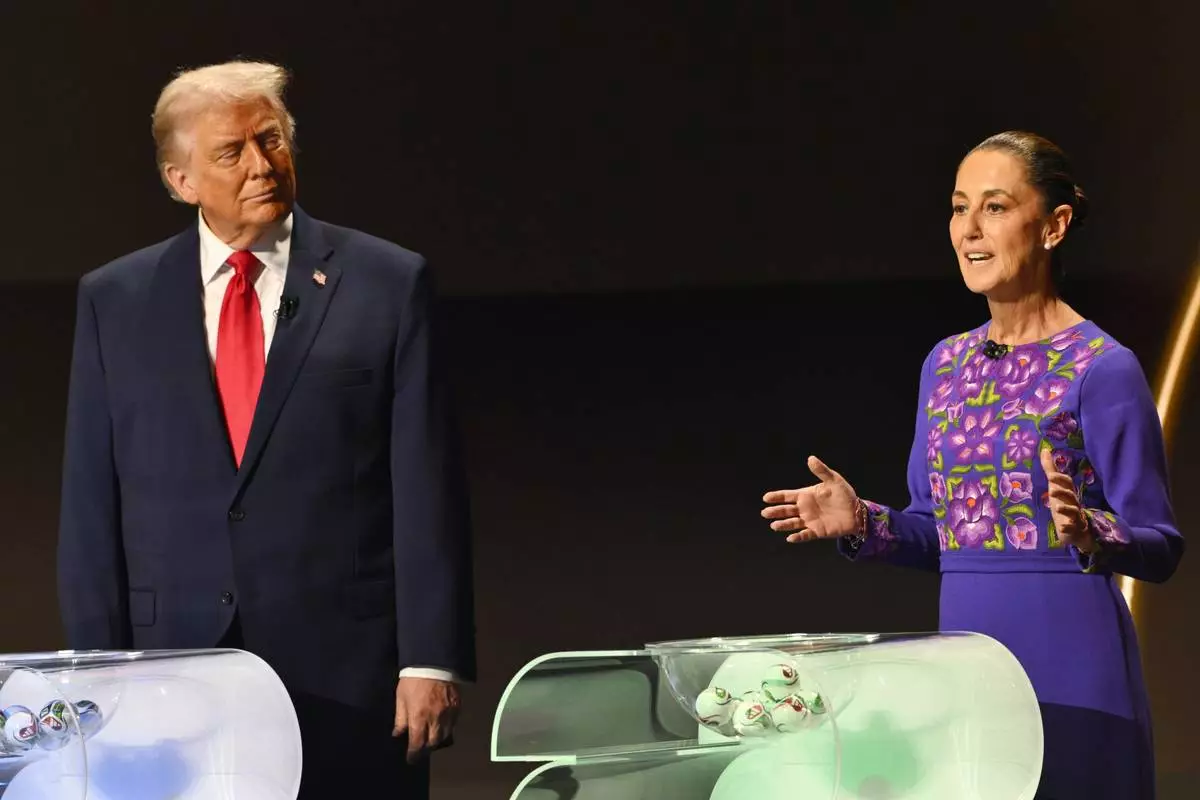
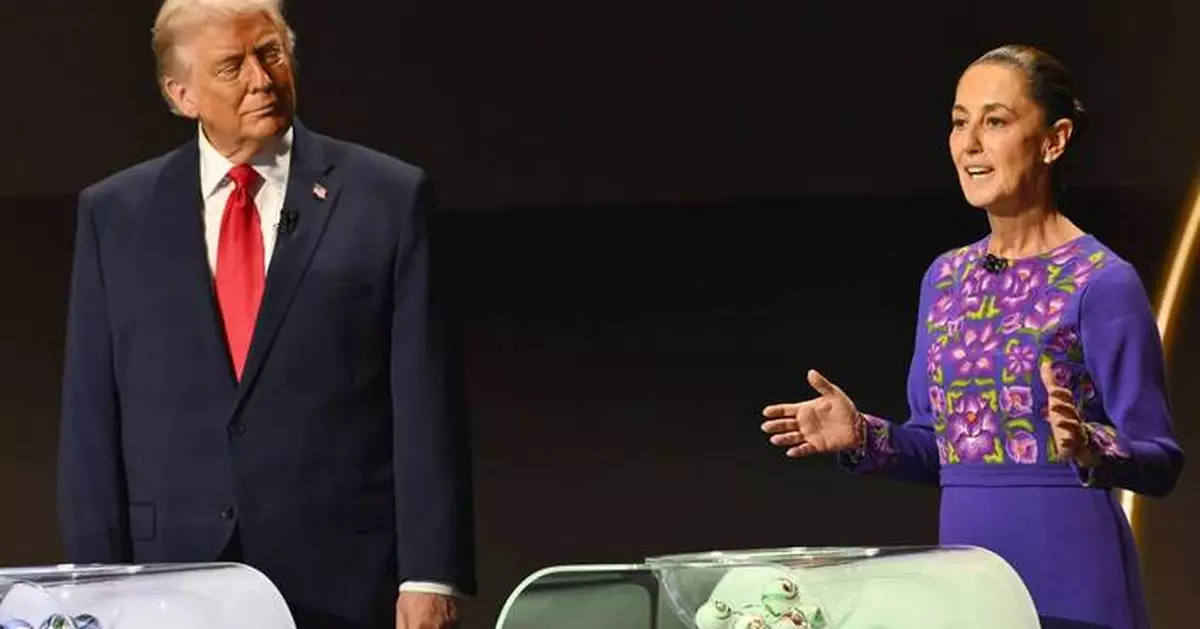
FILE - U.S. President Donald Trump looks on as Mexican President Claudia Sheinbaum speaks on stage at the draw for the 2026 soccer World Cup at the Kennedy Center in Washington, Dec. 5, 2025. (Mandel Ngan/Pool Photo via AP, File)
FILE - U.S. President Donald Trump looks on as Mexican President Claudia Sheinbaum speaks on stage at the draw for the 2026 soccer World Cup at the Kennedy Center in Washington, Dec. 5, 2025. (Mandel Ngan/Pool Photo via AP, File)
COPENHAGEN, Denmark (AP) — Denmark’s prime minister insisted that her country can’t negotiate on its sovereignty on Thursday after U.S. President Donald Trump said he agreed a “framework of a future deal” on Arctic security with the head of NATO, and said she has been “informed that this has not been the case.”

Trump on Wednesday abruptly scrapped the tariffs he had threatened to impose on eight European nations to press for U.S. control over Greenland, a semiautonomous territory of NATO ally Denmark. It was a dramatic reversal hours after he insisted he wanted to get the island “including right, title and ownership” — though he also said he would not use force.

He said “additional discussions” on Greenland were being held concerning the Golden Dome missile defense program, a multilayered, $175 billion system that for the first time will put U.S. weapons in space. Trump offered few details, saying they were still being worked out.

Danish Prime Minister Mette Frederiksen said in a statement Thursday that security in the Arctic is a matter for all of NATO, and it is “good and natural” that it be discussed between the U.S. president and NATO Secretary General Mark Rutte. She said that she had spoken with Rutte “on an ongoing basis,” including before and after he met Trump in Davos.

She wrote that NATO is fully aware of the kingdom of Denmark's position that anything political can be negotiated on, including security, investment and economic issues — “but we cannot negotiate on our sovereignty.”

“I have been informed that this has not been the case,” she said, adding that only Denmark and Greenland can make decisions on issues concerning Denmark and Greenland.

Frederiksen said that Denmark wants to continue engaging in constructive dialogue with allies on how to strengthen security in the Arctic, including the U.S. Golden Dome program, “provided that this is done with respect for our territorial integrity.”

Asked in an interview with Fox News whether Greenland would remain part of the kingdom of Denmark under the framework deal Trump announced, Rutte replied that “that issue did not come up any more in my conversations tonight with the president.”

“He’s very much focused on what do we need to do to make sure that that huge Arctic region, where change is taking place at the moment, where the Chinese and Russians are more and more active, how we can protect it,” he said. “That was really the focus of our discussions.”

On the streets of Copenhagen, some were skeptical about Trump’s switch.

“I think the man has said many things and done a lot of different things to what he says,” said Louise Pedersen, 22, who works with a startup company. “I have a hard time believing it. I think it’s terrifying that we stand here in 2026.”

She said it’s for Greenlanders to decide what happens with their land — “not Donald Trump.”

“I don’t really trust anything Mr. Trump is saying,” said Poul Bjoern Strand, 70, an advertising worker.

On the possibility of ceding territory, he said: “That’s not what the Greenlanders want, that’s not what the Danish people want, and ... I cannot believe that Danes are going to follow that.”

Chancellor Friedrich Merz of Germany, one of the European countries that had faced Trump's threat of tariffs over Greenland, underlined the need for European NATO allies to do more to secure the Arctic region and stressed that it is “a common trans-Atlantic interest.”

“We will protect Denmark, Greenland, the north from the threat posed by Russia,” he said at the World Economic Forum meeting in Davos, Switzerland. “We will uphold the principles on which the trans-Atlantic partnership is founded, namely sovereignty and territorial integrity.”

“We support talks between Denmark, Greenland (and) the United States on the basis of these principles,” aiming for closer cooperation, Merz said. “It is good news that we are making steps into that right direction. I welcome President Trump's remarks from last night — this is the right way to go.”

Moulson reported from Berlin.

An Aurora Borealis is seen in the sky above Nuuk, Greenland, on Tuesday, Jan. 20, 2026. (AP Photo/Evgeniy Maloletka)

An Aurora Borealis is seen in the sky above Nuuk, Greenland, on Tuesday, Jan. 20, 2026. (AP Photo/Evgeniy Maloletka)

President Donald Trump talks to media after a meeting about Greenland during the Annual Meeting of the World Economic Forum in Davos, Switzerland, Wednesday, Jan. 21, 2026. (AP Photo/Markus Schreiber)

President Donald Trump talks to media after a meeting about Greenland during the Annual Meeting of the World Economic Forum in Davos, Switzerland, Wednesday, Jan. 21, 2026. (AP Photo/Markus Schreiber)

Danish Prime Minister Mette Frederiksen after a meeting in the Foreign Policy Committee at Christiansborg in Copenhagen, Denmark, Tuesday, Jan. 20, 2026./ (Thomas Traasdahl/Ritzau Scanpix via AP)

Danish Prime Minister Mette Frederiksen after a meeting in the Foreign Policy Committee at Christiansborg in Copenhagen, Denmark, Tuesday, Jan. 20, 2026./ (Thomas Traasdahl/Ritzau Scanpix via AP)

Recommended Articles