SAN JUAN, Puerto Rico (AP) — The U.S. warned the transitional council in charge of Haiti against making changes to the troubled country’s government late Wednesday, as pressure mounts for the unelected body to move toward elections for the first time in a decade.
In a statement posted on X, the U.S. Embassy in Haiti wrote that “The United States would consider that any person who supports such a destabilizing initiative, which favors the gangs, would be acting against the interests of the United States, the region, and the Haitian people, and will take appropriate measures accordingly."
The U.S. Embassy added that such a maneuver would undermine efforts to establish “a minimal level of security and stability” in Haiti, where gang violence is surging and poverty deepening.
The statement came as some members of the council are at odds with Haitian Prime Minister Alix Didier Fils-Aimé, although it wasn’t immediately clear why. The council met behind closed doors earlier Wednesday and again on Thursday.
The U.S. Bureau of Western Hemisphere Affairs wrote on X Thursday night that Haiti's chronic instability is a result of “corrupt Haitian politicians who use gangs and other armed groups to create chaos in the streets and then insist on a role in government to turn down the chaos they themselves have created.”
“Real stability will come when political leaders get their power from the support of voters rather than their ability to sow chaos. The members of the (council) who have followed this path are not Haitian patriots. They are criminals like the gangs they conspire with,” the bureau wrote.
A spokesman for the prime minister’s office said he could not comment on the situation. The council’s seven members with voting powers did not return messages asking for comment.
Meanwhile, Laurent Saint-Cyr, the council's leader, said in a statement that he opposes any push to undermine government stability ahead of Feb. 7, when the council is provisionally scheduled to step down.
“As major institutional deadlines for the Nation approach, any initiative likely to fuel instability, confusion or a breakdown of trust carries serious risks for the country," he wrote. “Haiti cannot afford to make unilateral decisions or engage in short-sighted political calculations that would compromise the stability and continuity of the State, as well as the well-being of the already sorely tested population.”
It's the latest episode in years of political chaos that erupted after Haiti's last elected president, Jovenel Moïse, was slain at his home in July 2021.
The council has been one of the country's top authorities since April 2024. It was created with the help of Caribbean leaders after powerful gangs forced the closure of Haiti’s main international airport and targeted key state infrastructure in a series of unprecedented attacks that eventually led former Prime Minister Ariel Henry to resign.
The council was charged with selecting Haiti’s prime minister in a bid to quickly bring some stability to the beleaguered country.
Fils-Aimé is the third person chosen by the council. A businessman and former head of Haiti's Chamber of Commerce and Industry, he was appointed in November 2025 after the council fired previous leader Garry Conille.
The council is supposed to step down by Feb. 7, but it’s unclear if that will happen. Critics say some council members are trying to stay in power longer, and many fear the move could unleash a fresh round of violent protests.
The Feb. 7 deadline was approved in early 2024 on the assumption that Haiti would have held general elections to elect a new president. Gang violence has prevented officials from holding elections so far, although they are tentatively set for August, with a runoff to be held in December.
A new U.N. report released Wednesday noted that “national stakeholders remain divided over the transitional governance architecture that is to lead the country to elections.”
Earlier on Wednesday, the U.N. Security Council met to discuss the unraveling situation in Haiti.
“Haiti has entered a critical phase in its process of restoring democratic institutions,” said Carlos Ruiz-Massieu, special representative of the U.N. Secretary General in Haiti. “The country no longer has time to waste in prolonged infighting.”
Panamanian Ambassador Eloy Alfaro de Alba noted at the meeting that Haiti is at a “critical juncture,” with only 18 days left for the transitional presidential council’s mandate to end.
“The persistent nature of violence … remains of utmost concern,” he said.
Several U.N. Security Council members noted that Haiti needs to quickly move toward a democratic transition as gangs continue to seize control of more territory.
“There’s a need to approach this deadline with a sense of responsibility … to sustain continuity of state and avoid any disruptions that may undermine the operation of national institutions,” said Ericq Pierre, permanent representative of Haiti to the United Nations.
Gangs control an estimated 90% of Port-au-Prince, Haiti’s capital, and they have seized swaths of land in the country’s central region.
More than 8,100 killings were reported across Haiti from January to November last year, “with figures likely underreported owing to limited access to gang-controlled areas,” according to the U.N. report.
Haiti’s National Police has been trying to quell gang violence with help from a U.N.-backed mission led by Kenyan police that remains understaffed and underfunded.
The mission is transitioning into a so-called “gang suppression force” that would have the power to arrest suspected gang members.
Haiti’s government also has been working with a private military contractor to launch drone strikes targeting suspected gang members, but which have also killed civilians. The strikes killed more than 970 people from March to December last year, including 39 civilians, 16 of them children, according to the Office of the United Nations High Commissioner for Human Rights.
A previous version of this report incorrect described Garry Conille as the first person chosen as prime minister by the transitional council. He was the second.
Associated Press reporter Evens Sanon in Port-au-Prince, Haiti contributed to this report.
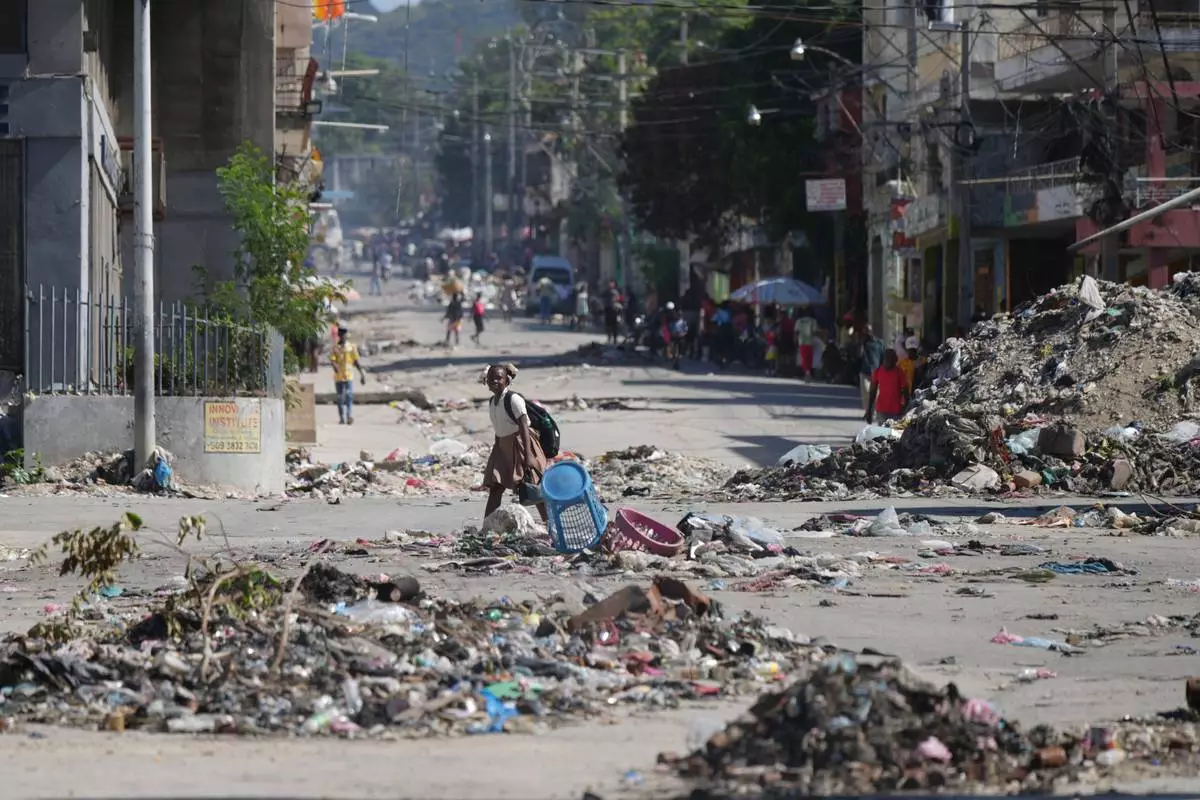
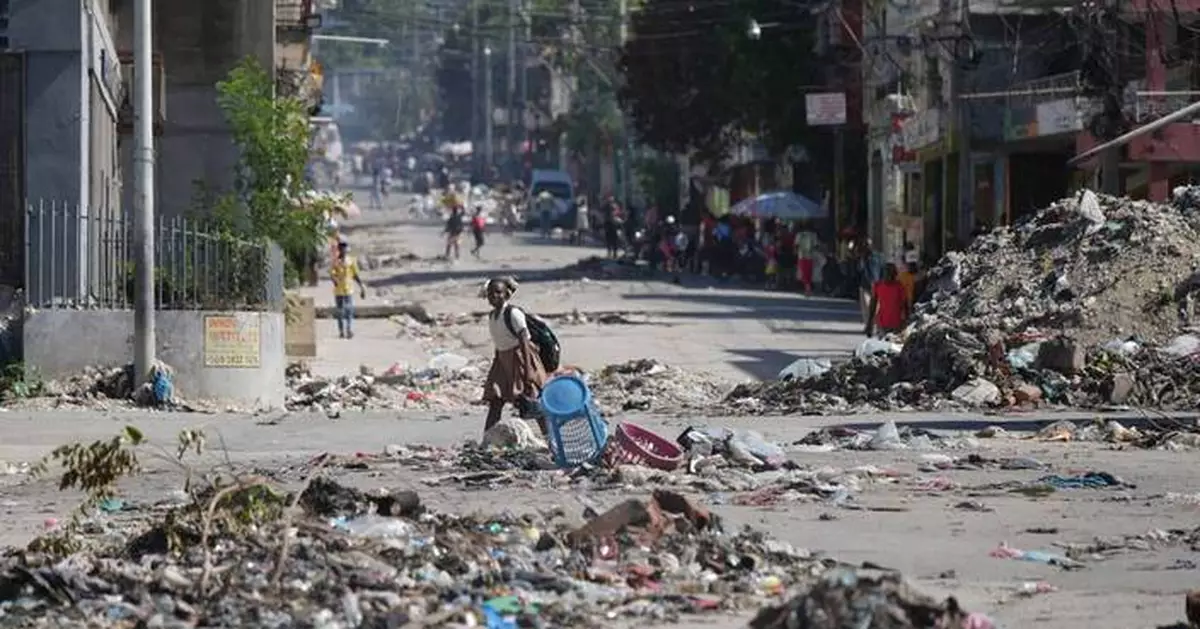
A youth crosses a street littered with garbage in downtown in Port-au-Prince, Haiti, Tuesday, Jan. 20, 2026. (AP Photo/Odelyn Joseph)
WASHINGTON (AP) — The White House publicly asked for U.S. Ambassador to Greece Kimberly Guilfoyle's resignation on Tuesday as she faced mounting accusations of improper conduct, and she announced within two hours that she was quitting, ending days of talk and speculation about her professional fate. Guilfoyle insisted that she would “vigorously defend” herself.
President Donald Trump's administration had said earlier Tuesday it had asked Guilfoyle to leave her post after she faced severe criticism over allegations she engaged in improper and possibly illegal conduct before and during her tenure in Athens.
That revelation came in response to a question to freshly minted White House press secretary Katie Zacharia at her first media briefing Tuesday morning. Zacharia said Guilfoyle “has been a wonderful asset to the team, and we wish her well.”
"She went to Greece. She was doing a good job, but we didn’t like what we were reading," Trump said just after Guilfoyle's resignation, which was posted on her X account. He said he had not spoken to her but "she will not be there.”
Guilfoyle’s departure comes after its possibility was previewed to The Associated Press over the weekend and Trump registered his unhappiness on Monday at reports about her alleged conduct. Those comments came a day after the AP, citing a senior U.S. official, reported that Trump and Secretary of State Marco Rubio were “extremely pissed off” by Guilfoyle’s reported conduct.
In a series of stories dating to late last month, The Wall Street Journal has reported questionable conduct by Guilfoyle, including an alleged threat to a host country official, accepting improper gifts and services and offering to use her influence inside the Republican administration in return for the payment of a large credit card bill.
Guilfoyle addressed the accusations directly in her resignation post on X, saying, “These allegations are false, and I intend to vigorously defend my name, my reputation, and my integrity.”
“I have dedicated my professional life to fighting for justice, standing up for what is right, and defending the values that make America exceptional,” she said. “I will not allow false accusations to define my decades of public service.”
In a statement released late Sunday, Guilfoyle's lawyers denied that she had done anything wrong and claimed that the money she was seeking from a Trump donor was payment for services — public appearances and speaking engagements that predate her ambassadorial nomination — that had not been paid.
The lawyers, David Schwartz and Jesse Binnall, also rejected allegations of impropriety related to Guilfoyle’s travel on private planes, saying that before every such trip she “sought, obtained and followed State Department guidance and followed the Department’s travel regulations."
They did not immediately return calls Tuesday.
After defending Guilfoyle following the first report, Rubio declined to comment publicly on the growing allegations. Last week, Rubio said: “Our ambassador has been a strong ambassador here.”
But after another report appeared later, Rubio — speaking Thursday before leaving Athens — berated journalists for asking about the allegations. He said that he didn’t know if they were true and that he would not respond if he could not confirm them.
“You guys walk around thinking that because some source told you something and you reported it, it’s the gospel. It’s not the gospel. It’s not the gospel for me. That’s not the way we do things,” Rubio said at the foot of his plane as Guilfoyle, who was there to see him depart, looked on.
A second U.S. official, who also spoke on the condition of anonymity to discuss personnel matters, said the State Department’s inspector general was looking into the allegations, which first began surfacing in the Journal late last month and have since multiplied.
The second official could not say if a formal IG probe had begun. Inspectors general often conduct informal inquiries into complaints against staffers, and many times those inquiries do not result in a full-on investigation, which can result in disciplinary action up to and including dismissal. The State Department has declined to comment on a potential IG investigation.
There was no immediate response to Zacharia's statement from the Greek government or Cabinet members.
Ahead of Tuesday’s announcement, Greek opposition parties had called on the Foreign Ministry to summon Guilfoyle to respond to the allegations made against her. “This, most importantly, is an issue of national dignity,” Sia Anagnostopoulou, a former deputy foreign minister, said in parliament Friday. Foreign Minister Giorgos Gerapetritis responded that Guilfoyle had been treated “the same way as every other ambassador” and argued that an official summons had not been necessary.
Hours earlier, Guilfoyle had posted photos of her meeting this week with the Spanish ambassador to Athens as well as birthday wishes for Lara Trump, the president's daughter-in-law, accompanied by Dua Lipa’s “Dance the Night,” from the 2023 soundtrack of the movie “Barbie.”
Greece has taken on an increasingly important and influential role because of its geographic location in Southeastern Europe and the Eastern Mediterranean, particularly on energy issues as the war with Iran has spiked global oil prices. Besides the vast number of Greek-registered oil tankers that regularly ply the Strait of Hormuz and the Red Sea, Greece is well positioned to be a pipeline conduit for liquefied natural gas imports into the Balkans and beyond.
As the U.S. ambassador to Greece, Guilfoyle had put an emphasis on energy issues, although her close association with executives in that sector was part of what got her into trouble.
The top two Democrats on the House Foreign Affairs and Senate Foreign Relations committees, Rep. Gregory Meeks of New York and Sen. Jeanne Shaheen of New Hampshire, as well as the ranking member on the House Committee for Oversight and Government Reform, Rep. Robert Garcia, D-Calif., have already called for an investigation into Guilfoyle.
Since late September, the Journal has detailed numerous accounts of questionable conduct by Guilfoyle. Its first report said that she had told guests at a reception that the United States could undermine the Greek government if it chose to, promoted the business interests of one particular Greek construction and energy company and allowed its lobbyist into private diplomatic meetings.
While Rubio was in Athens, the Journal reported — citing text messages — that Guilfoyle had asked a Trump donor and supporter to pay a $100,000 credit card bill just before her confirmation hearing, promising him access to administration officials if he did.
The Journal then reported that Guilfoyle had been enraged about not being invited to a Greek-themed event at the World Economic Forum in Davos, Switzerland, earlier this year and demanded to attend while boasting about luxury travel to France with energy company executives.
Another report, from the British tabloid The Daily Mail, said that Guilfoyle had alienated staff at the U.S. Embassy in Athens and had pushed the bounds of behavior appropriate for the top representative of the U.S. government to Greece.
Guilfoyle is a former Fox News Channel host and California prosecutor who was married to Democrat Gavin Newsom when he was San Francisco's mayor, before he became California's governor. She later was engaged to Trump’s son Donald Trump Jr.
AP journalists Derek Gatopoulos in Athens and Darlene Superville at the White House contributed.
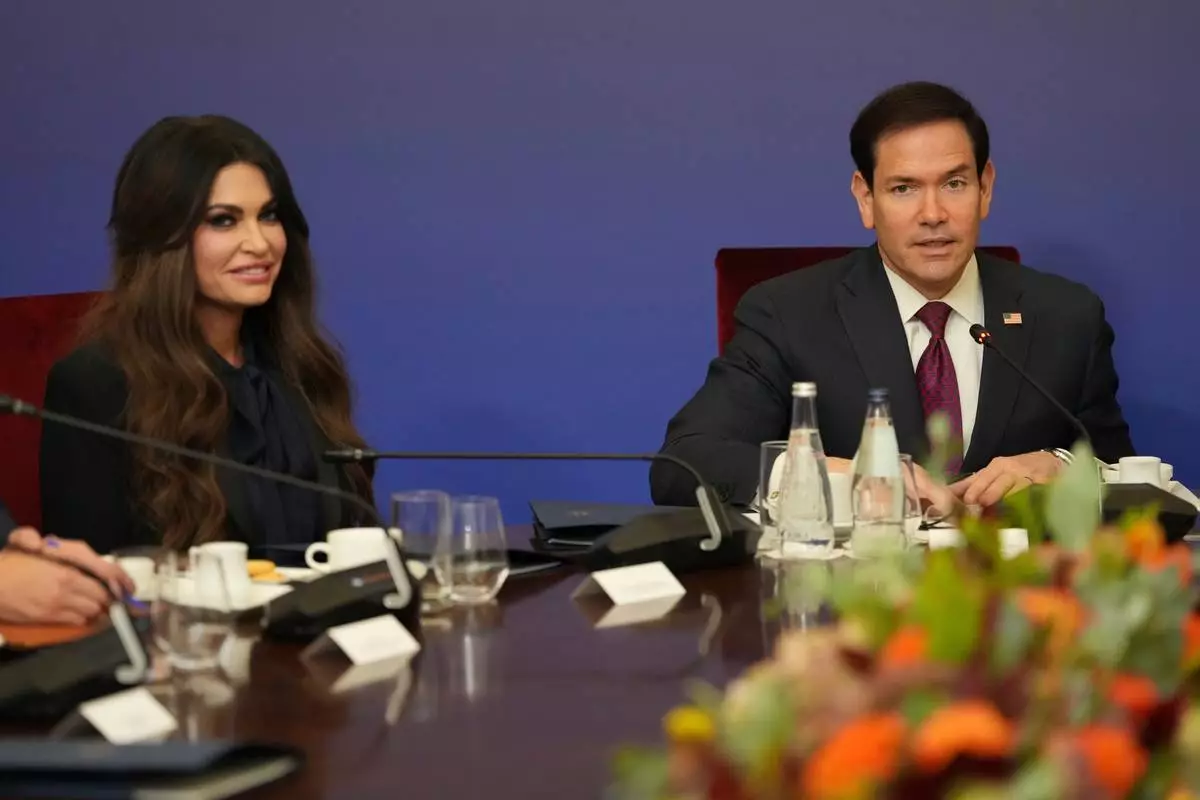
U.S. Secretary of State Marco Rubio, speaks during the opening Session of the U.S.-Greece Strategic Dialogue next to U.S. Ambassador to Greece Kimberly Guilfoyle at the Ministry of Foreign Affairs in Athens, Wednesday, Oct. 7, 2026. (AP Photo/Mark Schiefelbein, Pool)
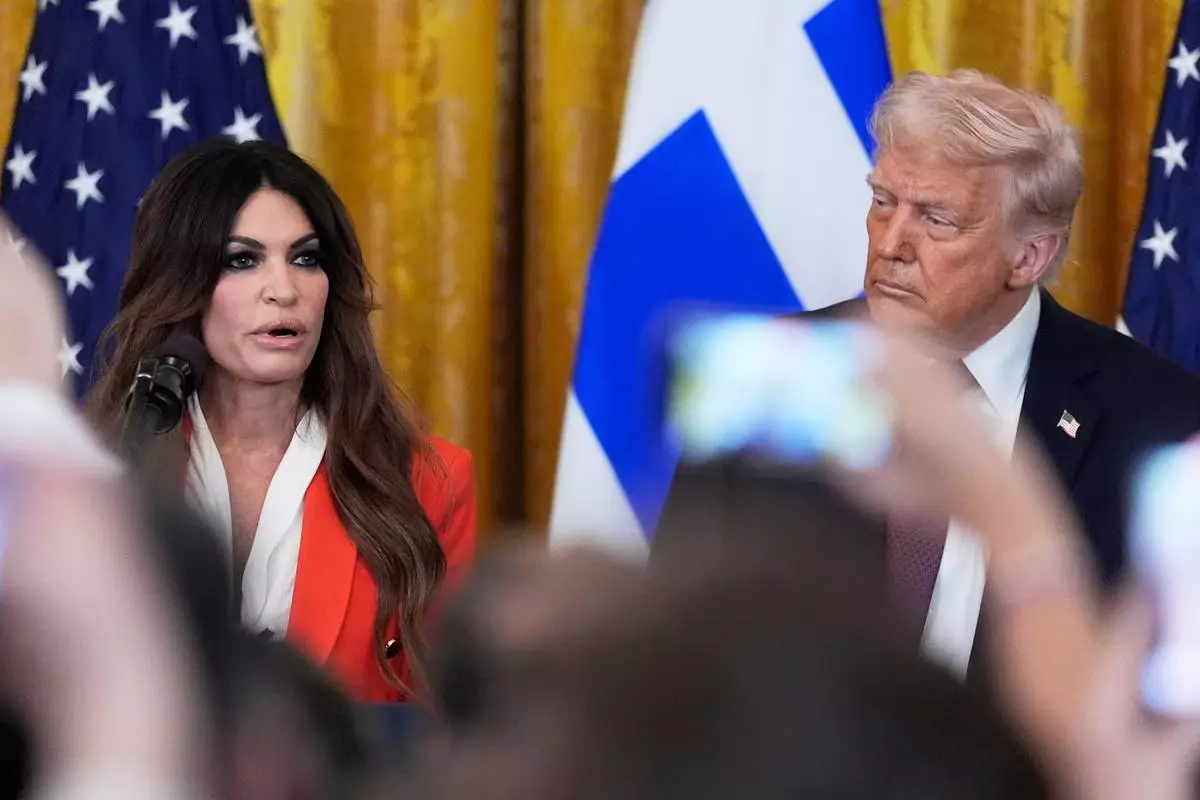
FILE - Kimberly Guilfoyle speaks as President Donald Trump listens at a reception celebrating Greek Independence Day in the East Room of the White House, March 24, 2025, in Washington. (AP Photo/Mark Schiefelbein, File)
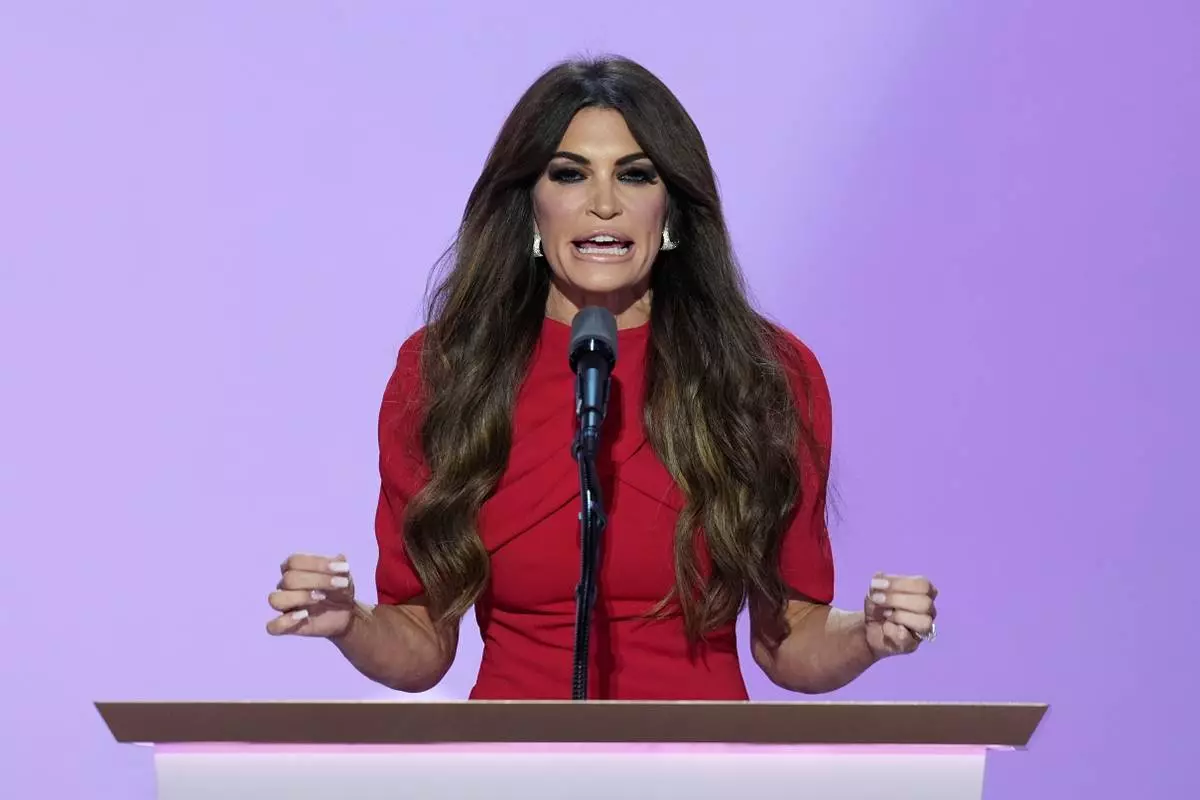
FILE - Kimberly Guilfoyle speaks during the Republican National Convention, July 17, 2024, in Milwaukee. (AP Photo/J. Scott Applewhite, File)
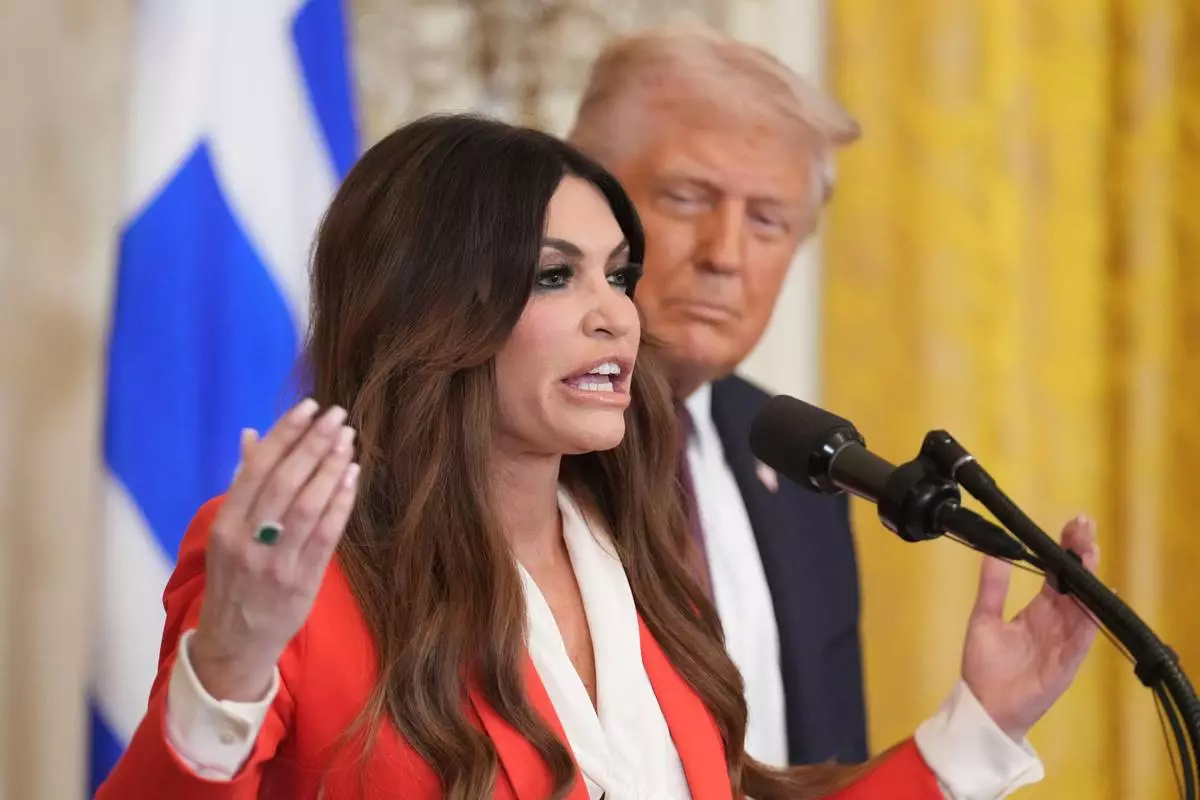
FILE - Kimberly Guilfoyle speaks as President Donald Trump listens at a reception celebrating Greek Independence Day in the East Room of the White House, March 24, 2025, in Washington. (AP Photo/Jacquelyn Martin, File)
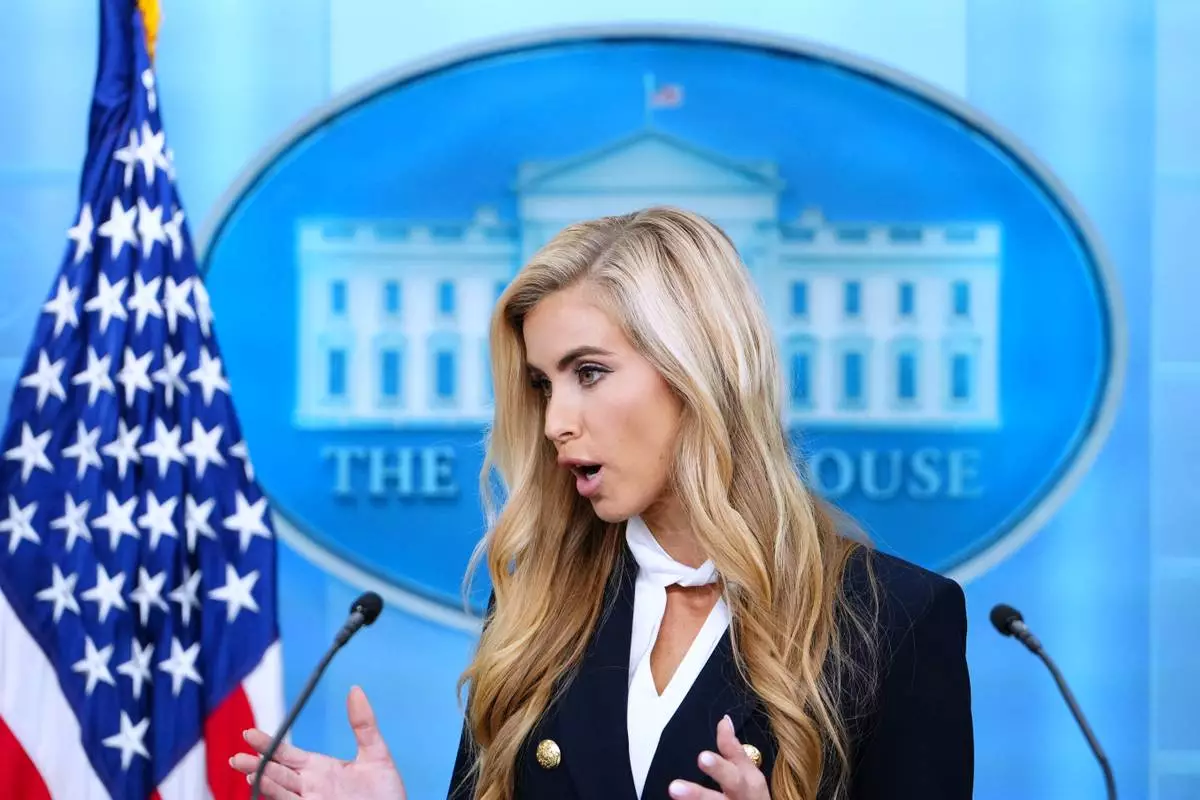
White House press secretary Katie Zacharia speaks with reporters in the James Brady Press Briefing Room at the White House, Tuesday, Oct. 13, 2026, in Washington. (AP Photo/Julia Demaree Nikhinson)
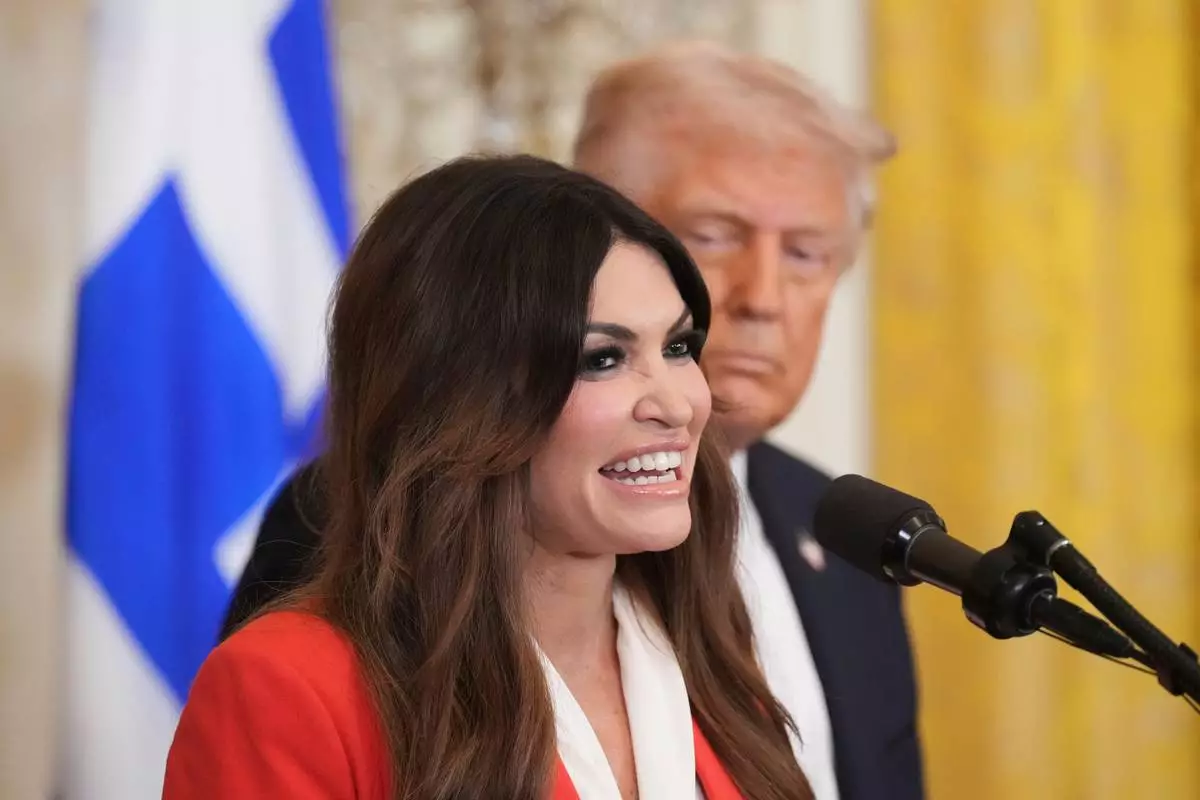
FILE - Kimberly Guilfoyle speaks as President Donald Trump listens at a reception celebrating Greek Independence Day in the East Room of the White House, March 24, 2025, in Washington. (AP Photo/Jacquelyn Martin, File)
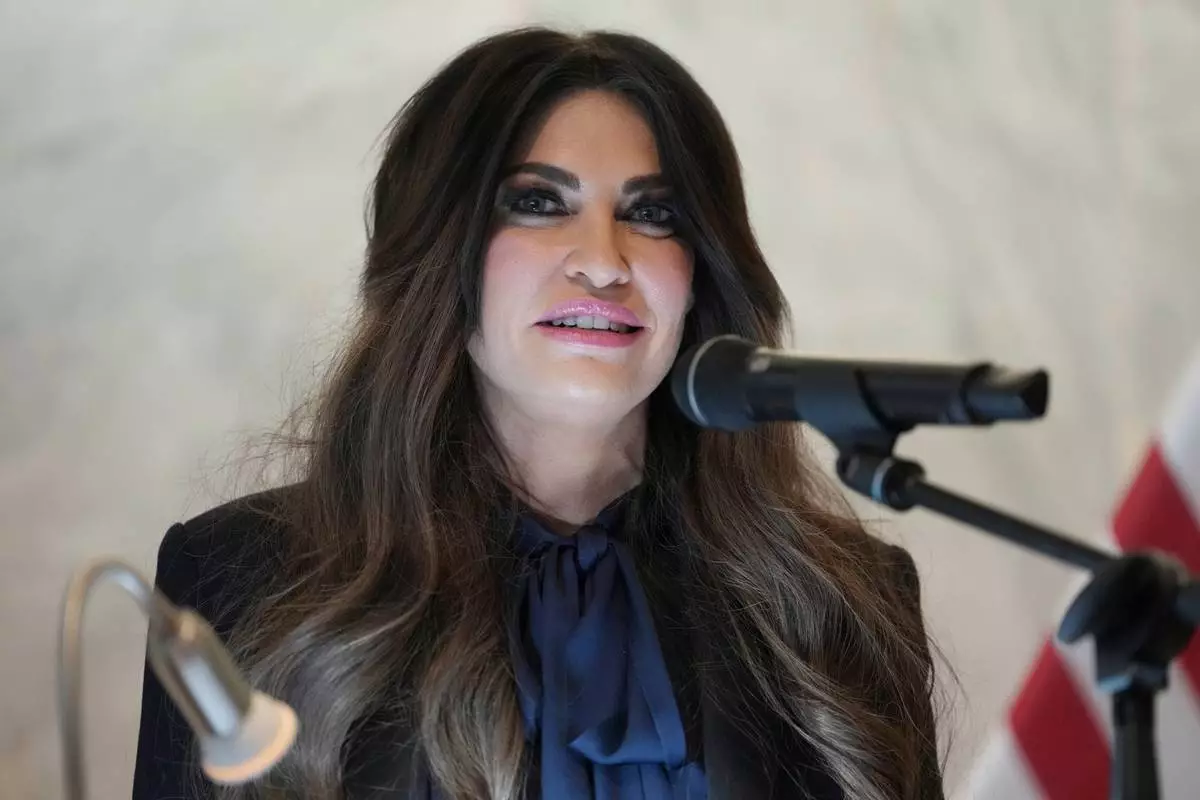
U.S. Ambassador to Greece Kimberly Guilfoyle speak during a dedication ceremony at the chancery of the U.S. Embassy, Wednesday, Oct. 7, 2026, in Athens, Greece. (AP Photo/Mark Schiefelbein, Pool)