WASHINGTON (AP) — Former Justice Department special counsel Jack Smith defended his investigations of President Donald Trump at a congressional hearing Thursday in which he insisted that he had acted without regard to politics and had no second thoughts about the criminal charges he brought.
“No one should be above the law in our country, and the law required that he be held to account. So that is what I did,” Smith said of Trump.
Click to Gallery
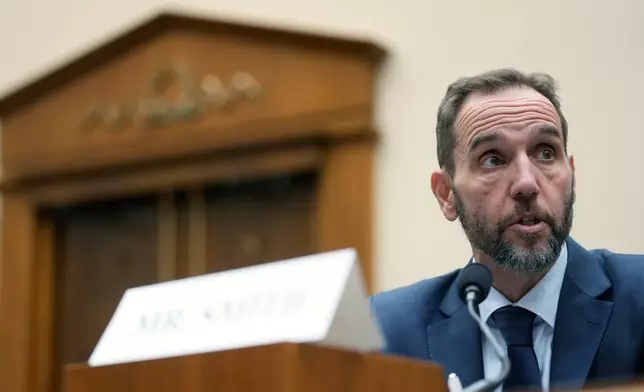
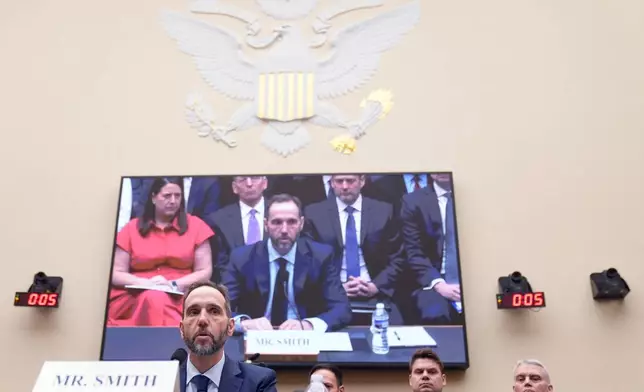
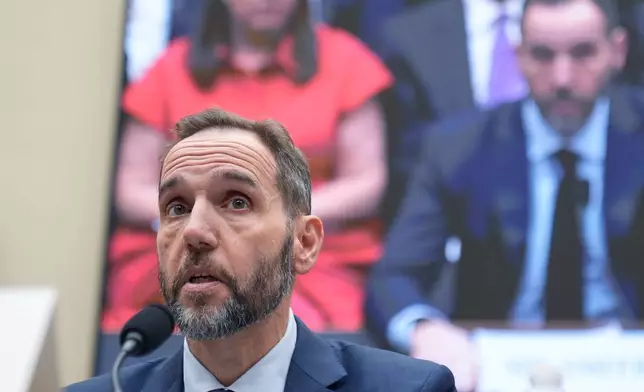
Former Justice Department special counsel Jack Smith testifies before the House Judiciary Committee at the Capitol in Washington, Thursday, Jan. 22, 2026. (AP Photo/Mark Schiefelbein)
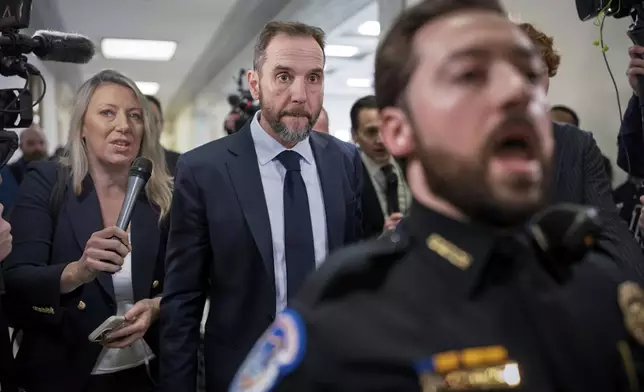
Former Justice Department special counsel Jack Smith, center, is escorted by Capitol Police through a crush of reporters as he arrives to testify before the House Judiciary Committee about his investigations into President Donald Trump, Thursday, Jan. 22, 2026 at the Capitol in Washington. (AP Photo/J. Scott Applewhite)
Former Justice Department special counsel Jack Smith testifies before the House Judiciary Committee about his investigations into President Donald Trump at the Capitol in Washington, Thursday, Jan. 22, 2026. (AP Photo/Mark Schiefelbein)
Former Justice Department special counsel Jack Smith testifies before the House Judiciary Committee about his investigations into President Donald Trump at the Capitol in Washington, Thursday, Jan. 22, 2026. (AP Photo/Mark Schiefelbein)
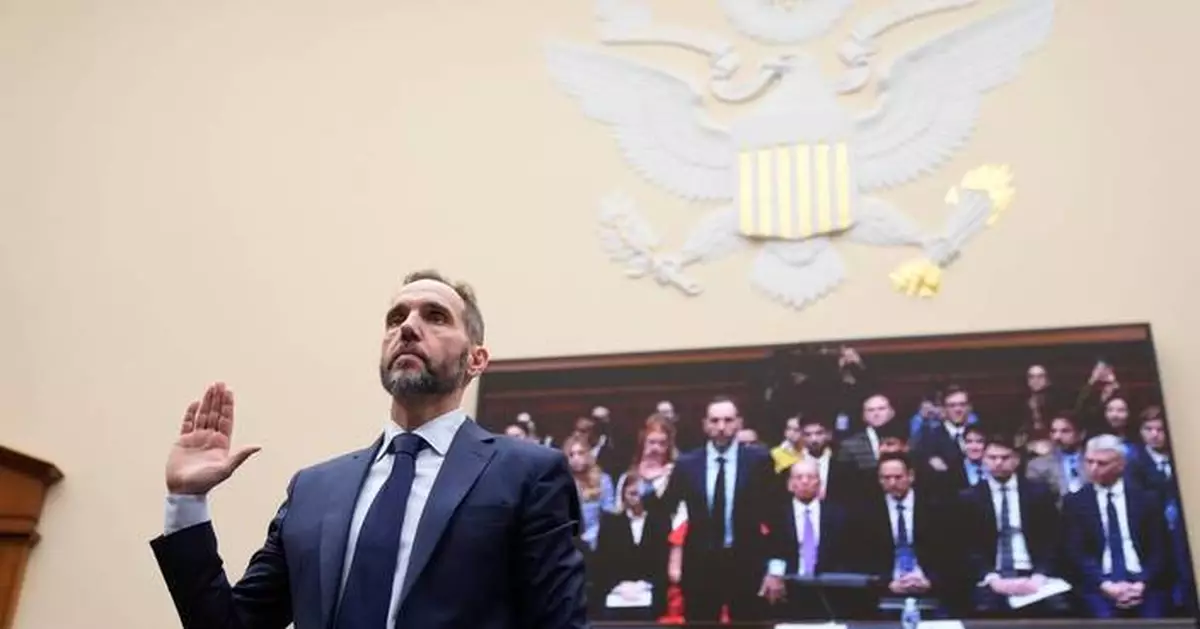
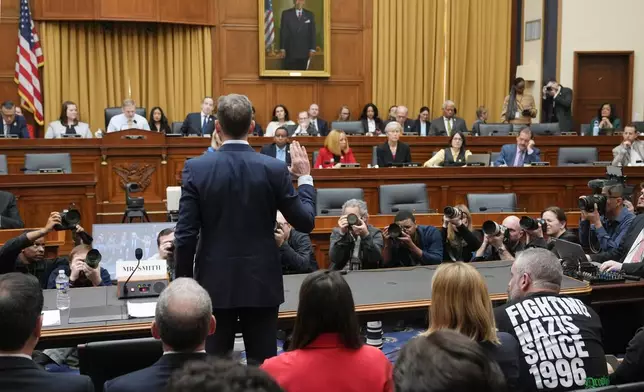
Former Justice Department special counsel Jack Smith, left standing, takes an oath before the House Judiciary Committee, as former Washington Metropolitan Police Department officer Michael Fanone, right seated, looks on, Thursday, Jan. 22, 2026 at the Capitol in Washington. (AP Photo/Jacquelyn Martin)
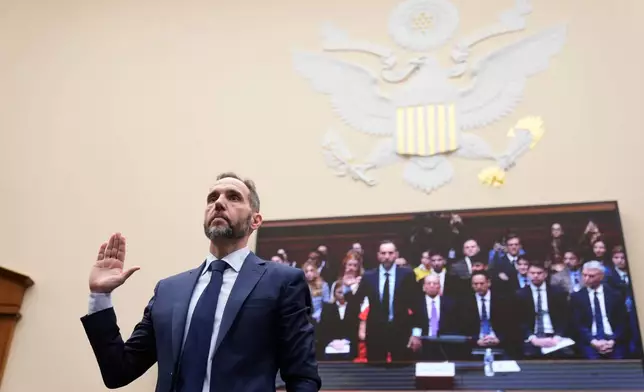
Former Justice Department special counsel Jack Smith takes an oath before the House Judiciary Committee at the Capitol in Washington, Thursday, Jan. 22, 2026. (AP Photo/Mark Schiefelbein)
Smith testified behind closed doors last month but returned to the House Judiciary Committee for a public hearing that provided the prosecutor with a forum to address Congress and the country more generally about the breadth of evidence he collected during investigations that shadowed Trump during the 2024 presidential campaign and resulted in indictments. The hourslong hearing immediately split along partisan lines as Republican lawmakers sought to undermine the former Justice Department official while Democrats tried to elicit damaging testimony about Trump's conduct and accused their GOP counterparts of attempting to rewrite history.
“It was always about politics,” said Rep. Jim Jordan of Ohio, the committee's Republican chairman.
“Maybe for them,” retorted Democratic Rep. Jamie Raskin, referring to Republicans. “But, for us, it’s all about the rule of law.”
The hearing was on the mind of Trump himself as he traveled back from the World Economic Forum in Davos, Switzerland, with the president posting on his Truth Social account that “Deranged Jack Smith should be prosecuted for his actions” and asserting without any evidence that the prosecutor had committed perjury.
Smith told lawmakers that he stood behind his decisions as special counsel to bring charges against Trump in separate cases that accused the Republican of conspiring to overturn the 2020 presidential election after he lost to Democrat Joe Biden and hoarding classified documents at his Mar-a-Lago estate in Palm Beach, Florida, after he left the White House.
“Our investigation developed proof beyond a reasonable doubt that President Trump engaged in criminal activity,” Smith said. “If asked whether to prosecute a former president based on the same facts today, I would do so regardless of whether that president was a Republican or a Democrat.”
Republicans from the outset sought to portray Smith as an overly aggressive, hard-charging prosecutor who had to be “reined in” by higher-ups and the courts as he investigated Trump. They seized on revelations that the Smith team had subpoenaed the phone records of a group of Republican lawmakers.
The records revealed the incoming and outgoing phone numbers as well as the duration of the calls but not the content of the communications, but Rep. Brandon Gill, a Texas Republican, said the episode showed how Smith had “walked all over the Constitution.”
Smith has repeatedly justified the move as necessary to document any contact that Trump or surrogates may have had with lawmakers on Jan. 6, 2021 —the day Trump’s supporters stormed the Capitol — as he beseeched them to halt the certification of the election results.
“My office didn’t spy on anyone,” Smith said, explaining that collecting phone records is a common prosecutorial tactic and was essential in this instance to help prosecutors understand the scope of the conspiracy.
Under questioning, Smith described what he said was a wide-ranging conspiracy to overturn the results of the election and recounted how the Republican refused to listen to advisers who told him that the contest had in fact not been stolen. After he was charged, Smith said, Trump tried to silence and intimidate potential witnesses against him.
Smith said one reason he felt confident in the strength of the case that prosecutors had prepared to take to trial was the extent to which it relied on Republican supporters of Trump.
“Some of the most powerful witnesses were witnesses who, in fact, were fellow Republicans who had voted for Donald Trump, who had campaigned for him and who wanted him to win the election,” Smith said.
Smith was appointed in 2022 by Biden’s Justice Department to oversee investigations into Trump, who has denied any wrongdoing. Both investigations produced indictments against Trump, but the cases were abandoned by Smith and his team after Trump won back the White House because of longstanding Justice Department legal opinions that say sitting presidents cannot be indicted.
The hearing unfolded against the backdrop of an ongoing Trump administration retribution campaign targeting the investigators who scrutinized the Republican president and amid mounting alarm that the Justice Department's institutional independence is eroding under the sway of the president.
In a nod to those concerns, Smith said, “My belief is that if we do not hold the most powerful people in our society to the same standards — the rule of law — it can be catastrophic because, if they don't have to follow the law, it's very easy for people to understand why they don't have to follow the law."
Rep. Becca Balint, a Vermont Democrat, also asked Smith at one point if he was concerned the Trump administration would try to prosecute him.
Smith responded: “I believe they will do everything in their power to do that because they’ve been ordered to by the president.”
Republicans, for their part, repeatedly denounced Smith, with Rep. Kevin Kiley of California accusing him of seeking “maximum litigation advantage at every turn” and “circumventing constitutional limitations to the point that you had to be reined in again and again throughout the process.”
Another Republican lawmaker, Rep. Ben Cline of Virginia, challenged Smith on his team's requested court order to restrict Trump from making incendiary comments about prosecutors, potential witnesses and other people involved in the case. Smith said the order was necessary because of Trump's efforts to intimidate witnesses, but Cline asserted that it was meant to silence Trump in the heat of the presidential campaign.
And Jordan, the committee chairman, advanced a frequent Trump talking point that the investigation was driven by a desire to derail Trump's candidacy.
“We should never forget what took place, what they did to the guy we, the people, elected twice,” Jordan said.
Smith vigorously rejected those suggestions and said the evidence placed Trump’s actions squarely at the heart of a criminal conspiracy to undo the 2020 election.
“Our investigation revealed that Donald Trump is the person who caused Jan. 6, it was foreseeable to him and that he sought to exploit the violence," he said.
Associated Press writer Joey Cappelletti in Washington contributed to this report.
Follow the AP's coverage for former special counsel Jack Smith at https://apnews.com/hub/jack-smith.
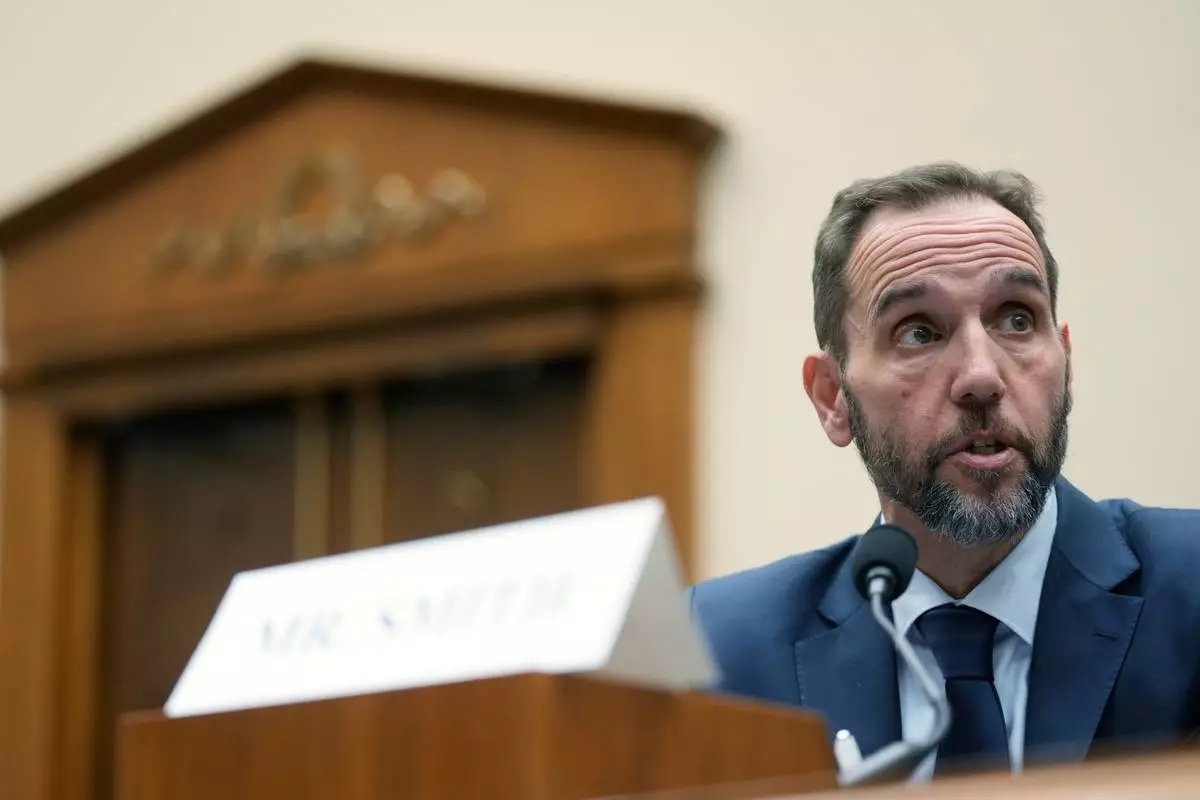
Former Justice Department special counsel Jack Smith testifies before the House Judiciary Committee at the Capitol in Washington, Thursday, Jan. 22, 2026. (AP Photo/Mark Schiefelbein)
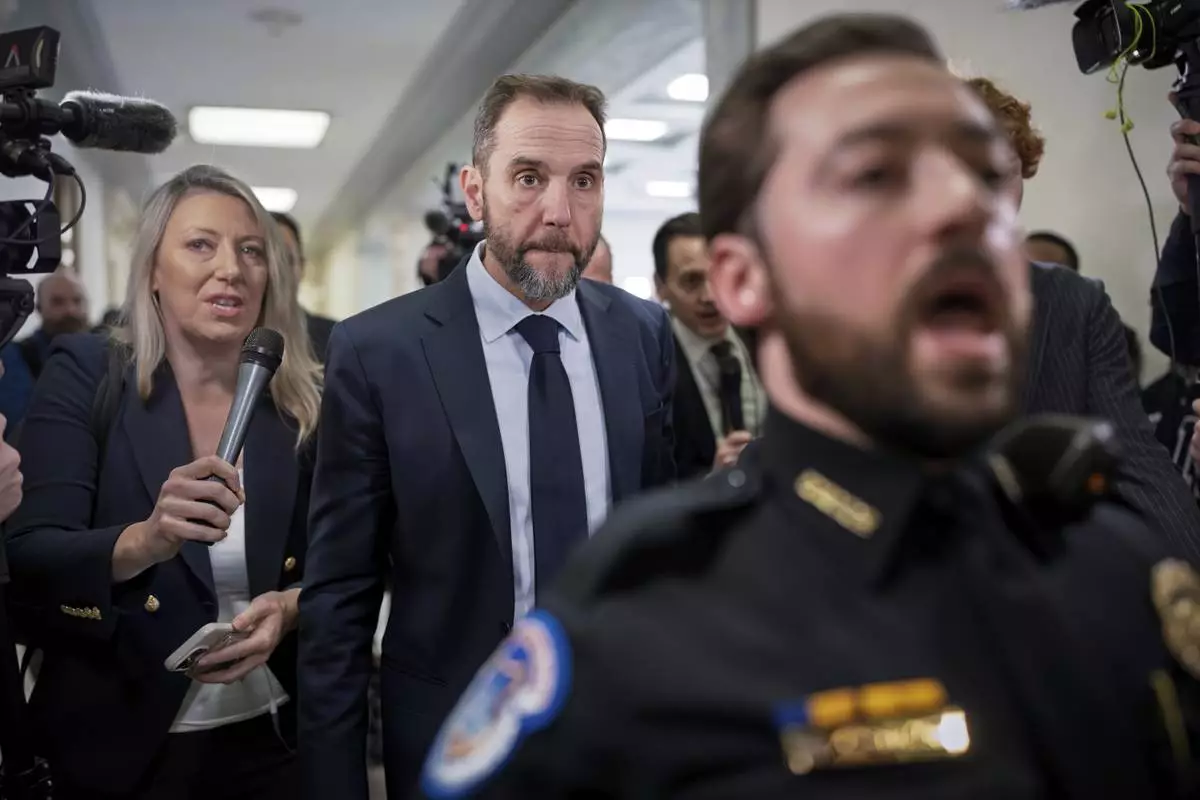
Former Justice Department special counsel Jack Smith, center, is escorted by Capitol Police through a crush of reporters as he arrives to testify before the House Judiciary Committee about his investigations into President Donald Trump, Thursday, Jan. 22, 2026 at the Capitol in Washington. (AP Photo/J. Scott Applewhite)
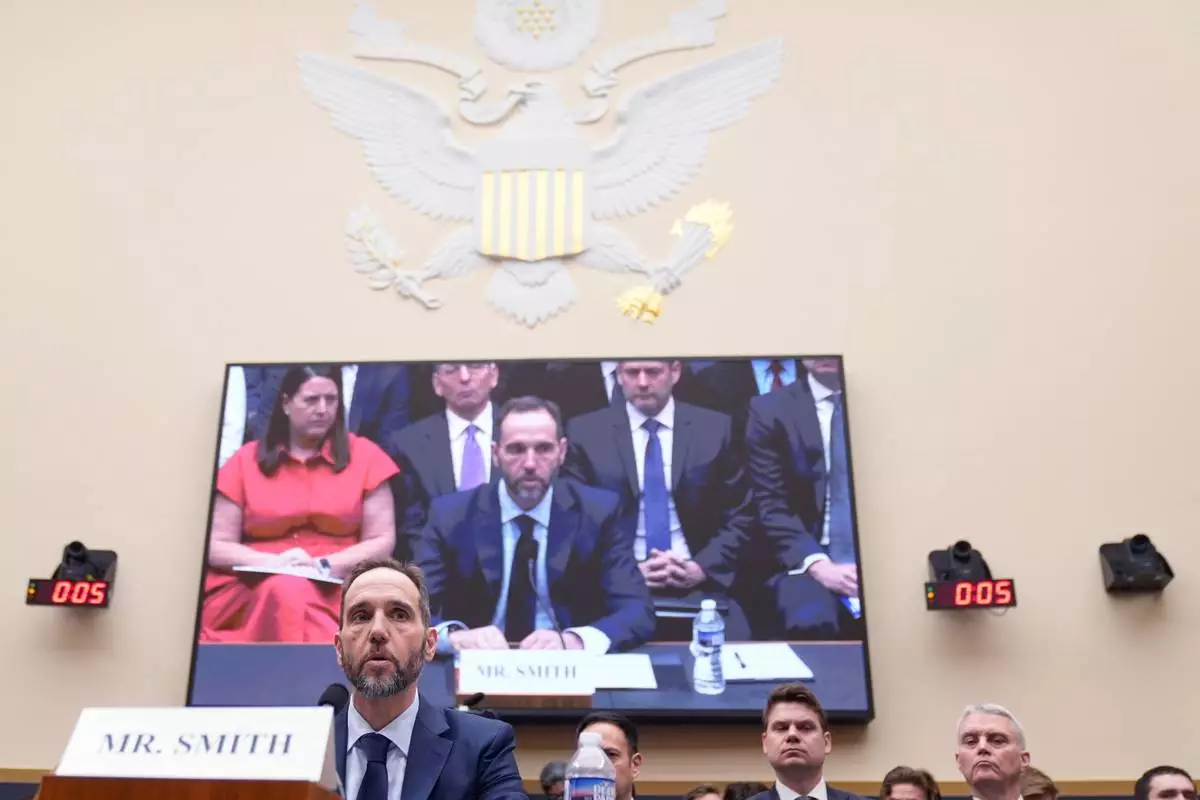
Former Justice Department special counsel Jack Smith testifies before the House Judiciary Committee about his investigations into President Donald Trump at the Capitol in Washington, Thursday, Jan. 22, 2026. (AP Photo/Mark Schiefelbein)
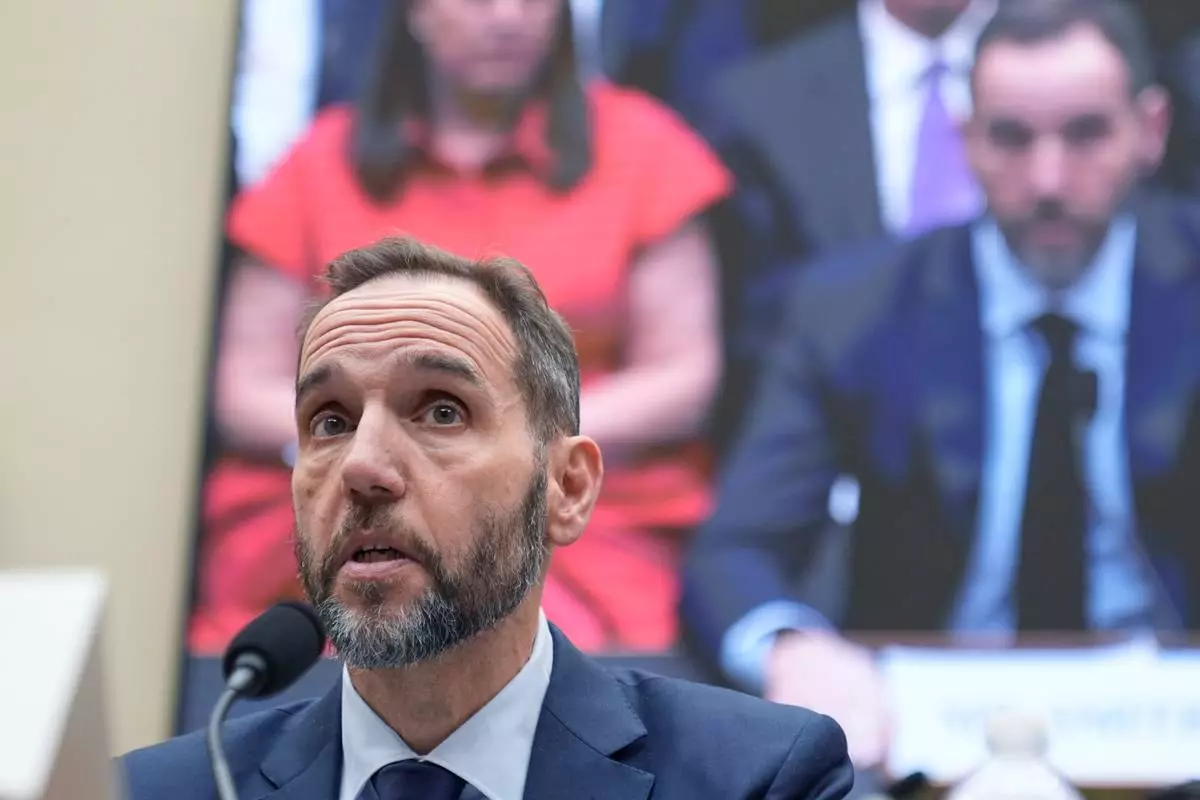
Former Justice Department special counsel Jack Smith testifies before the House Judiciary Committee about his investigations into President Donald Trump at the Capitol in Washington, Thursday, Jan. 22, 2026. (AP Photo/Mark Schiefelbein)
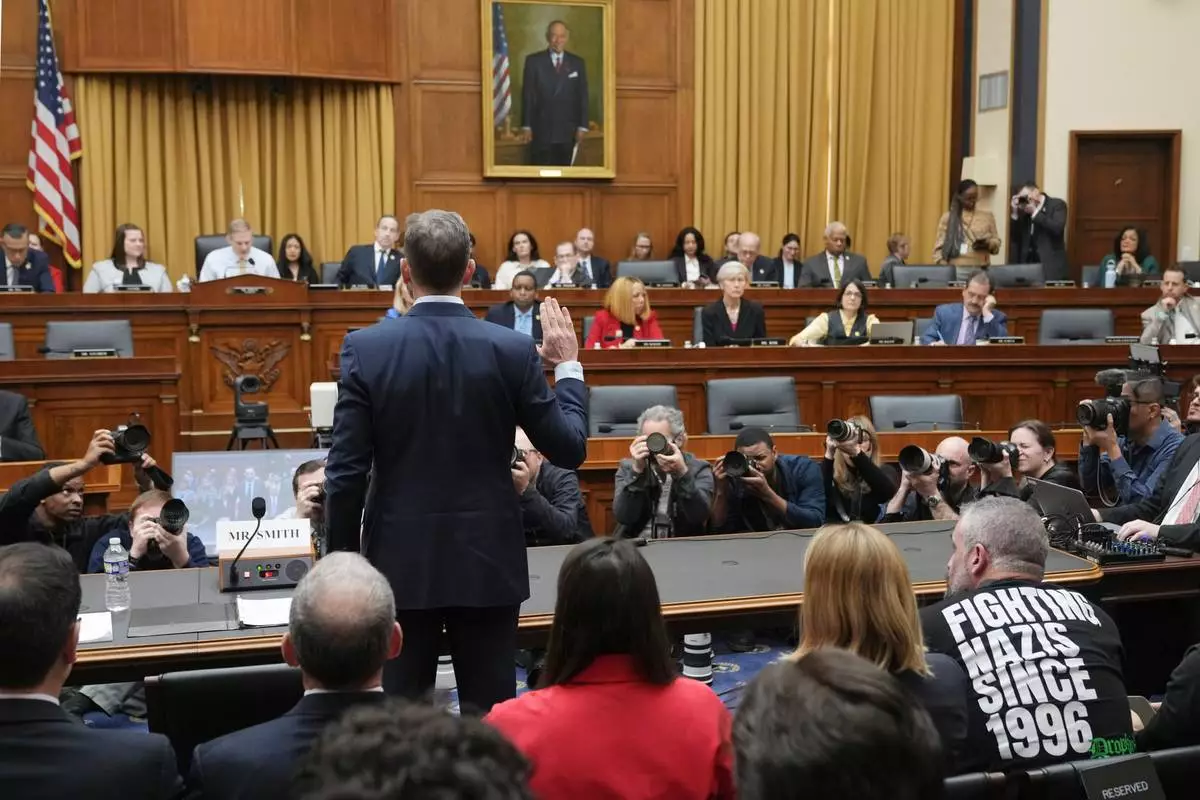
Former Justice Department special counsel Jack Smith, left standing, takes an oath before the House Judiciary Committee, as former Washington Metropolitan Police Department officer Michael Fanone, right seated, looks on, Thursday, Jan. 22, 2026 at the Capitol in Washington. (AP Photo/Jacquelyn Martin)
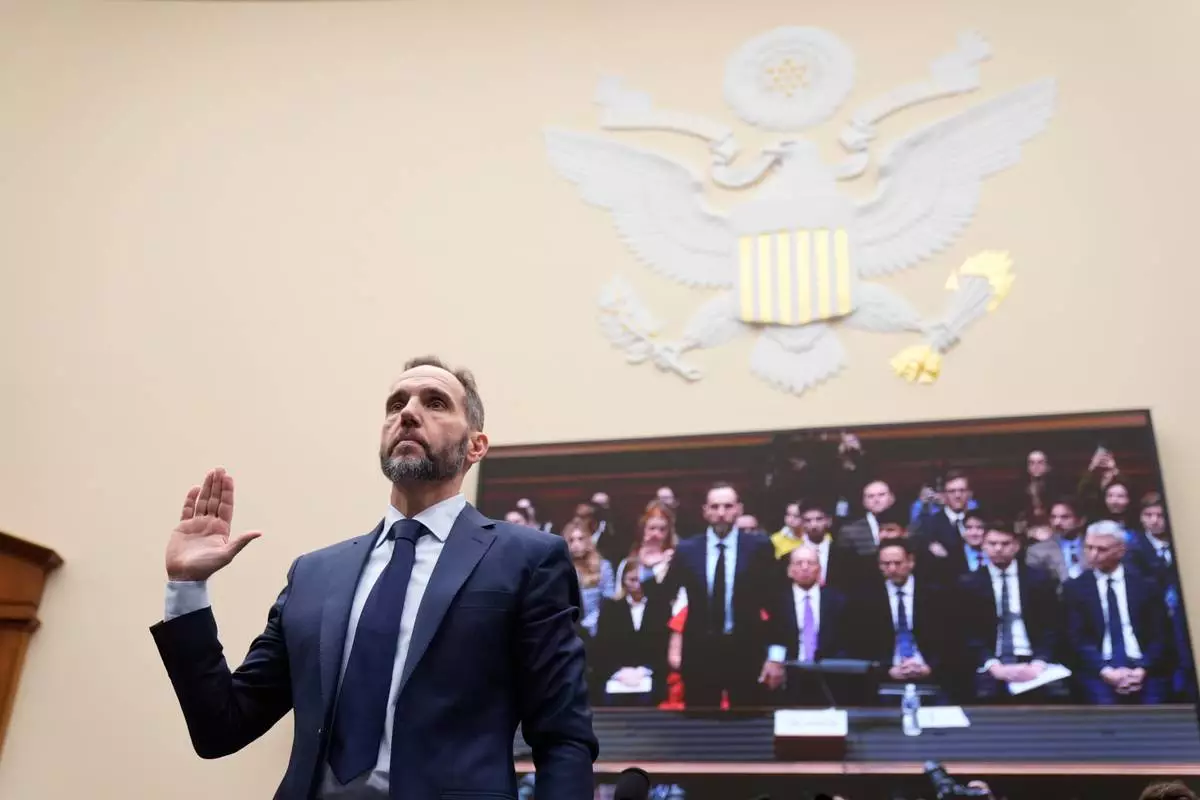
Former Justice Department special counsel Jack Smith takes an oath before the House Judiciary Committee at the Capitol in Washington, Thursday, Jan. 22, 2026. (AP Photo/Mark Schiefelbein)
ABOARD AIR FORCE ONE (AP) — President Donald Trump on Thursday inaugurated his Board of Peace to lead efforts at maintaining a ceasefire in Israel's war with Hamas, insisting “everyone wants to be a part” of the body he said could eventually rival the United Nations — despite many U.S. allies opting not to participate.
In a speech at the World Economic Forum in Davos, Switzerland, Trump sought to create momentum for a project to map out a future of the war-torn Gaza Strip that has been overshadowed this week, first by his threats to seize Greenland, then by a dramatic retreat from that push.
“This isn’t the United States, this is for the world,” he said, adding, “I think we can spread it out to other things as we succeed in Gaza.”
The event featured Ali Shaath, the head of a new, future technocratic government in Gaza, announcing that the Rafah border crossing will open in both directions next week. But there was no confirmation of that from Israel, which said only that it would consider the matter next week. The Gaza side of the crossing, which runs between Gaza and Egypt, is currently under Israeli military control.
The new peace board was initially envisioned as a small group of world leaders overseeing the ceasefire, but it has morphed into something far more ambitious — and skepticism about its membership and mandate has led some countries usually closest to Washington to take a pass.
In his remarks, Trump said 59 countries had been involved with his Gaza ceasefire. Afterward, he told reporters “we're going to have, I think, over 50” countries sign on to the Board of Peace. But only 19 countries were represented at the event. He told the group, ranging from Azerbaijan to Paraguay to Hungary, “You’re the most powerful people in the world.”
Flying back to Washington from Davos, Trump told reporters that some leaders have told him they want to join but first require approval from their parliaments, specifically naming Italian Prime Minister Giorgia Meloni and Polish President Karol Nawrocki.
Trump has spoken about the board replacing some U.N. functions, but in his Thursday speech he said the two bodies would work together, even as he denigrated the U.N. for doing what he said wasn't enough to calm some conflicts around the globe.
Some countries have raised questions about invitations Trump extended to Russian President Vladimir Putin and other authoritarian leaders. Britain’s foreign secretary Yvette Cooper told the BBC that her country wasn’t signing on, noting “concerns about President Putin being part of something which is talking about peace, when we have still not seen any signs from Putin that there will be a commitment to peace in Ukraine.”
As for Putin, he said his country is still consulting with Moscow’s “strategic partners” before deciding to commit. The Russian was hosting Palestinian President Mahmoud Abbas on Thursday in Moscow.
The Kremlin said Thursday that Putin plans to discuss his proposal to send $1 billion to the Board of Peace and use it for humanitarian purposes during his talks with Abbas — if Russia can use assets the U.S. had previously blocked. Asked about that idea by reporters, Trump said, “If he’s using his money, that’s great.”
The launch of the board came the same week that Trump rattled European allies with threats to acquire Greenland and punish allies with tariffs — then later backing away. Norway and Sweden have indicated they won’t participate in the board. Canada is uncommitted. France declined, citing concerns the board could seek to replace the U.N.
The idea for the Board of Peace was first laid out in Trump’s 20-point Gaza ceasefire plan and even was endorsed by the U.N. Security Council.
But an Arab diplomat in a European capital said that Middle Eastern governments coordinated their response to Trump's invitation to join the Board of Peace and that it was crafted to limit the acceptance to the Gaza plan as mandated by the U.N. Security Council.
Speaking on the condition of anonymity to discuss the matter more freely, the diplomat said the announced acceptance is “preliminary” and that the charter presented by the U.S. administration contradicts in some parts the United Nations' mission. The diplomat also said that other major powers are unlikely to support the board in its current form.
Trump's push for peace comes after he threatened military action this month against Iran as it carried out a violent crackdown against some of the largest street protests in years, killing thousands of people.
Trump, for the time being, has signaled he won't carry out any new strikes on Iran after he said he received assurances that the Islamic government would not carry out the planned hangings of more than 800 protesters.
But Trump also made the case that his tough approach to Tehran — including strikes on Iran's nuclear facilities in June last year — was critical to the Israel-Hamas ceasefire deal coalescing.
He said Thursday that the U.S. is moving a fleet of ships toward Iran “just in case” it wants to take action against the country over its crackdown on protesters.
And he said he was keeping in place a threat to slap 25% tariffs on countries doing business with Iran. “We’re doing that,” he said. The White House has not yet provided details on that plan, which Trump had announced more than a week ago.
Trump also met privately Thursday for about an hour with Ukrainian President Volodymyr Zelenskyy, but was circumspect about how it went. “I had a good meeting — but I’ve had numerous good meetings with President Zelenskyy and it doesn’t seem to happen,” Trump said.
He expressed some sympathy for Ukrainians struggling without heat in the winter because of Russian attacks on infrastructure, but also frustration that he has not been able to broker a deal to end the war, noting “the same things that have been holding it up for the past year” continue to be sticking points.
Trump's special envoy Steve Witkoff and his son-in-law Jared Kushner are now in Moscow for talks with Putin.
Zelenskyy on Thursday said there would be two days of trilateral meetings involving the U.S., Ukraine and Russia in the United Arab Emirates starting Friday, following the U.S. talks in Moscow.
“Russians have to be ready for compromises because, you know, everybody has to be ready, not only Ukraine, and this is important for us,” Zelenskyy said.
Trump said Zelenskyy told him in the meeting that he'd like to make a deal.
“There were times when Putin didn't want to make a deal, times when Zelenskyy didn't want to make deal, and it was like opposite times,” he said. “Now I think they both want to make a deal — but we'll find out.”
This story has been corrected to fix Trump’s references to the number of countries involved in his Board of Peace. Trump said 59 countries had been involved with the ceasefire he brokered for Gaza. He did not say that 59 countries had signed on to the Board of Peace.
Madhani and Weissert reported from Washington. Associated Press writers Ali Swenson in Washington and Samy Magdy in Cairo contributed.
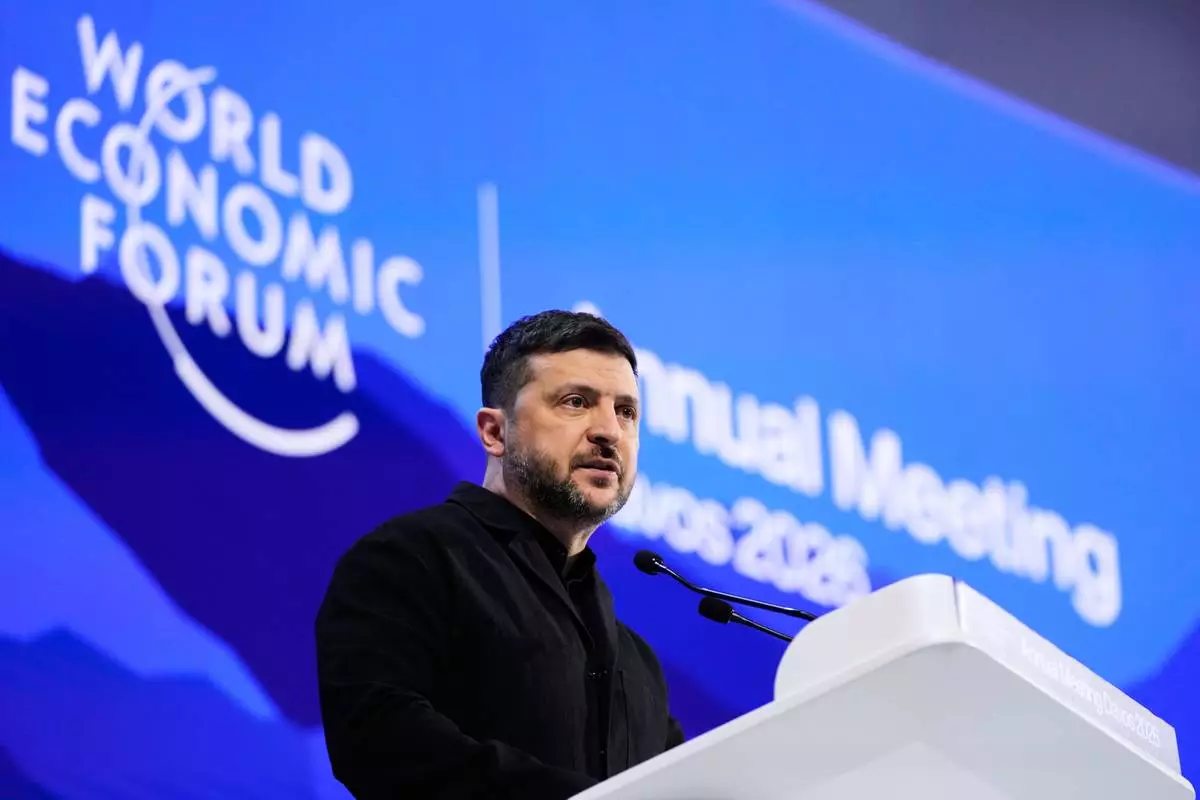
Ukraine's President Volodymyr Zelenskyy delivers a speech at the Annual Meeting of the World Economic Forum in Davos, Switzerland, Thursday, Jan. 22, 2026. (AP Photo/Markus Schreiber)
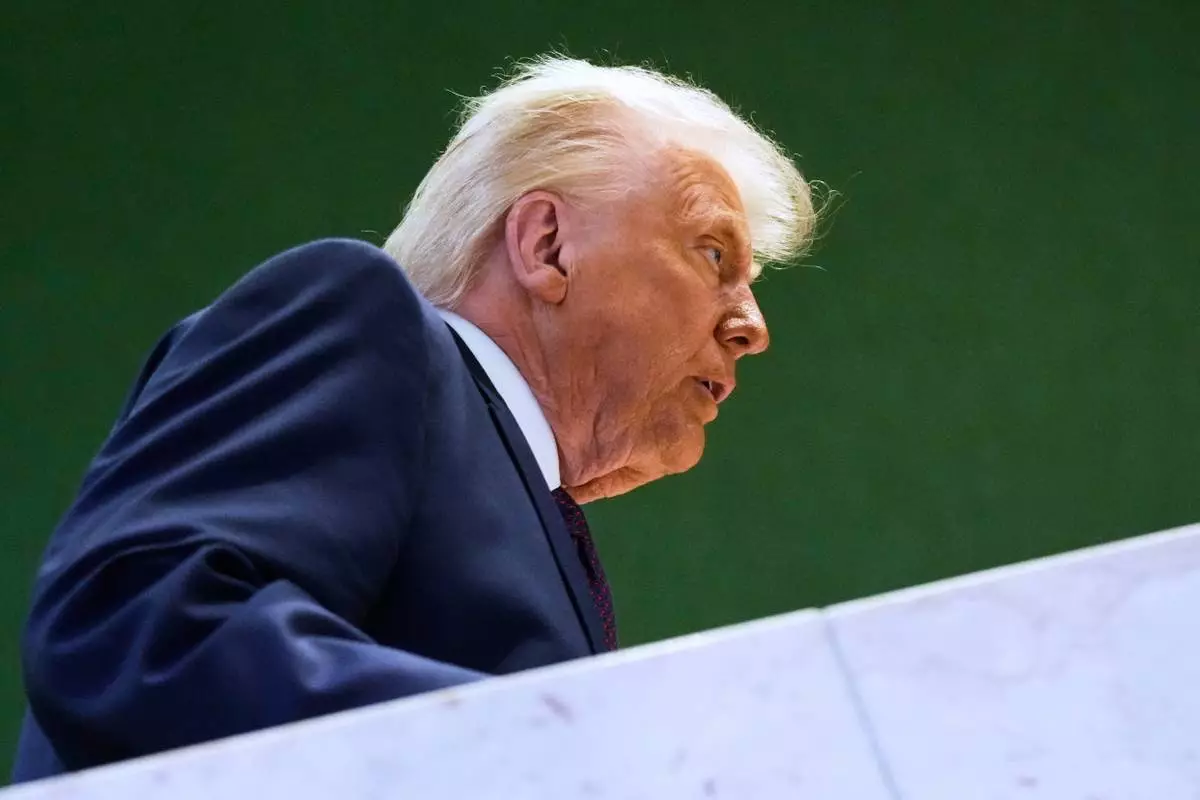
US President Donald Trump leaves after a signing ceremony of his Board of Peace initiative at the Annual Meeting of the World Economic Forum in Davos, Switzerland, Thursday, Jan. 22, 2026. (AP Photo/Markus Schreiber)
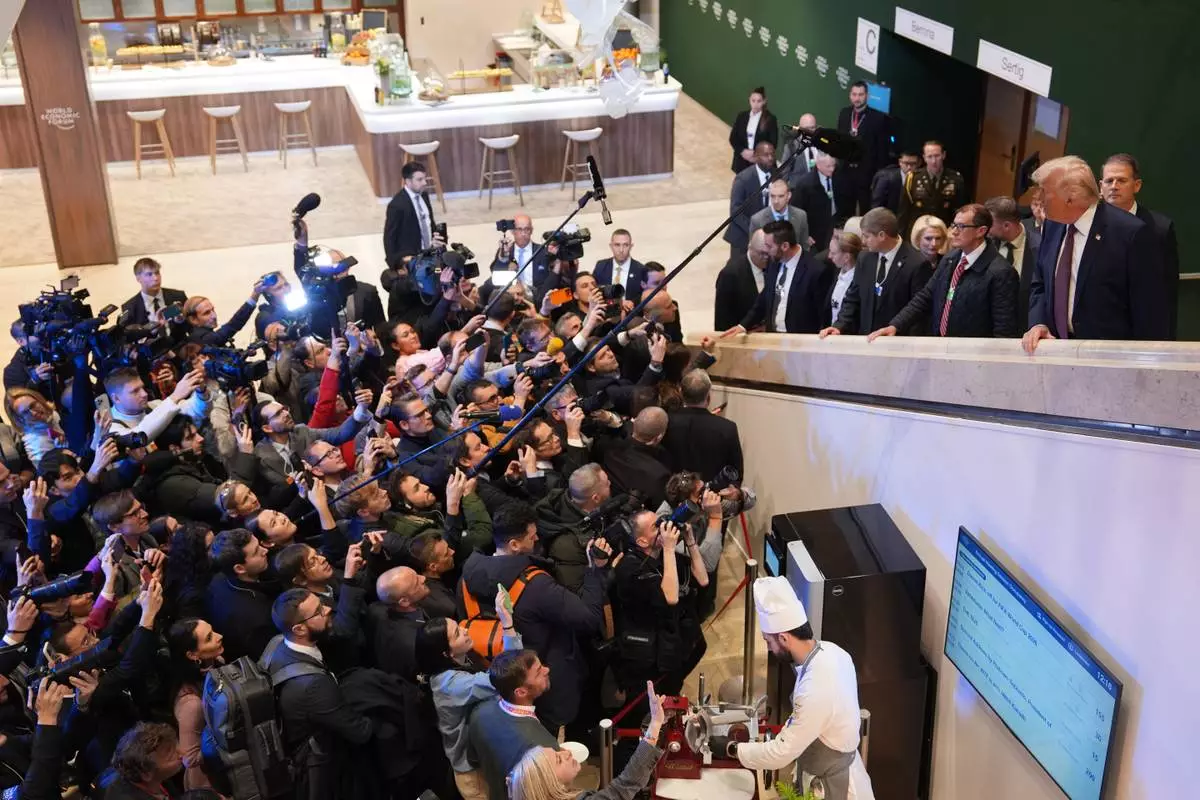
Journalist ask questions to President Donald Trump, right, as he walks up a stairwell during the Annual Meeting of the World Economic Forum in Davos, Switzerland, Thursday, Jan. 22, 2026. (AP Photo/Evan Vucci)
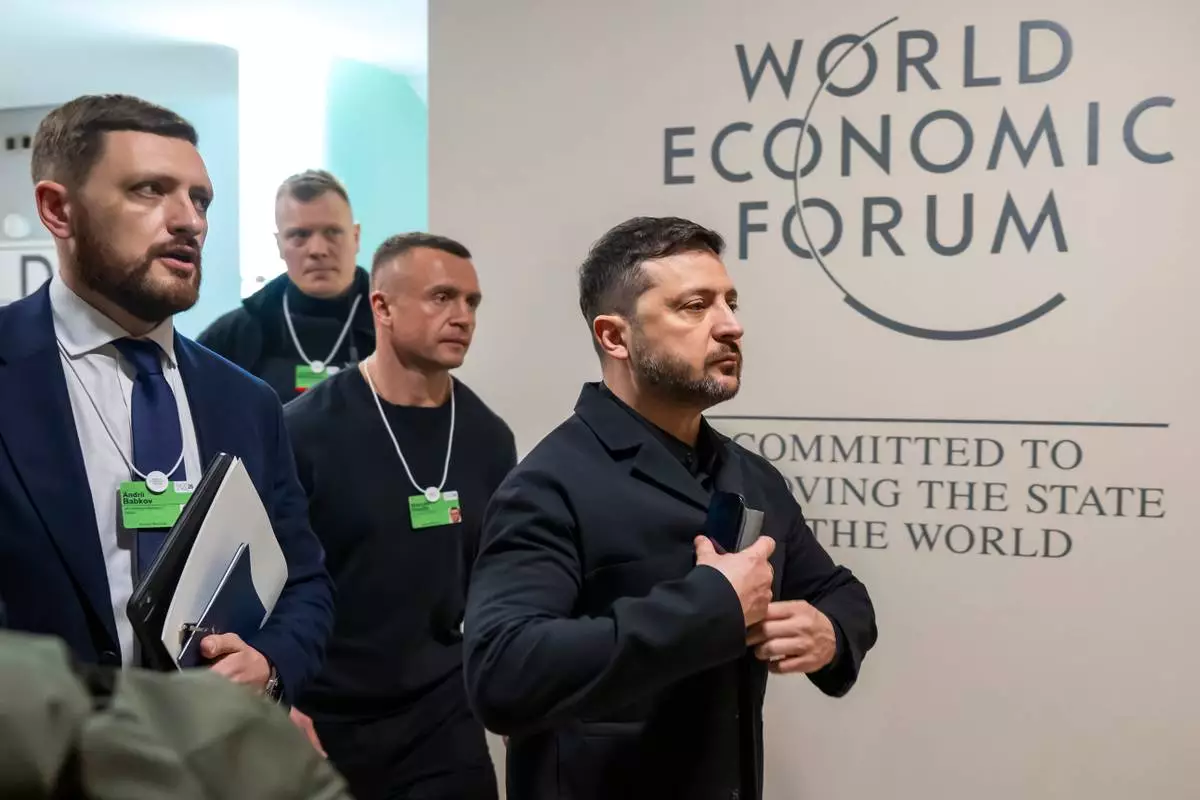
Ukraine's President Volodymyr Zelenskyy, right, arrives for the Annual Meeting of the World Economic Forum in Davos, Switzerland, Thursday, Jan. 22, 2026. (Laurent Gillieron/Keystone via AP)
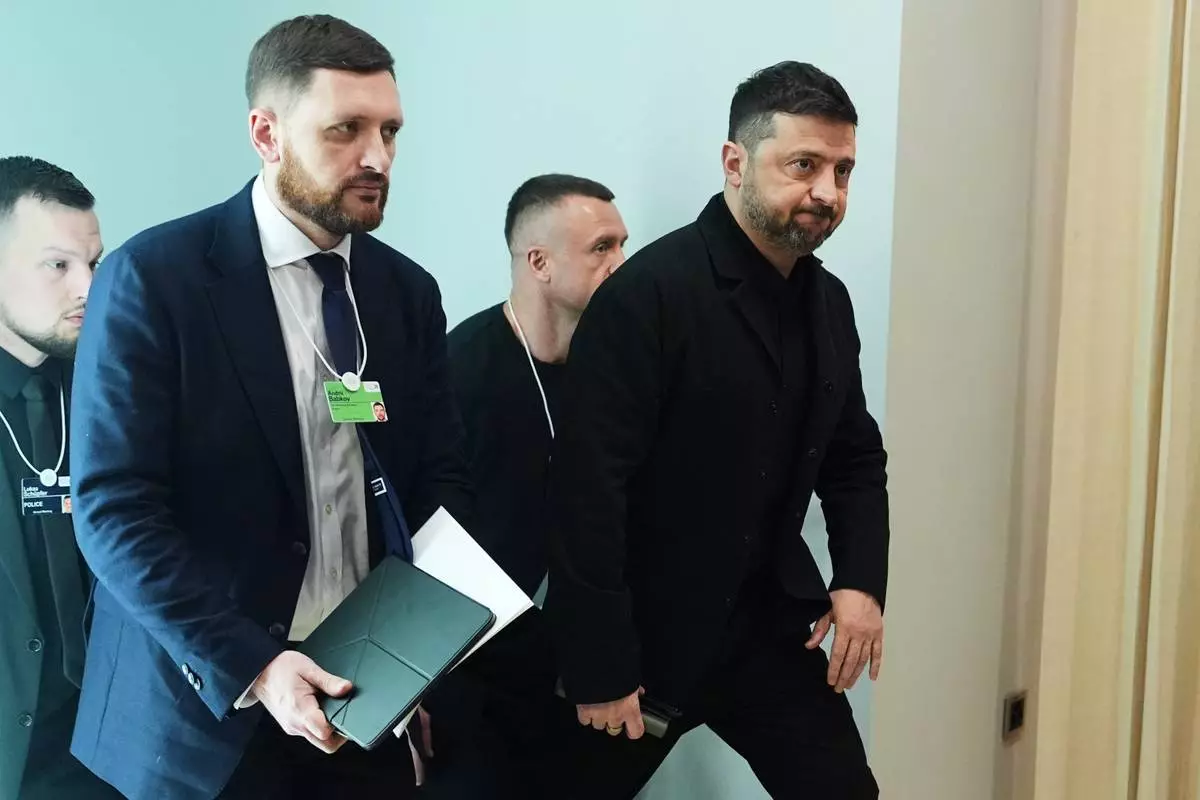
Ukraine's President Volodymyr Zelenskyy arrives for a meeting on the sidelines of the Annual Meeting of the World Economic Forum in Davos, Switzerland, Thursday, Jan. 22, 2026. (AP Photo/Evan Vucci)
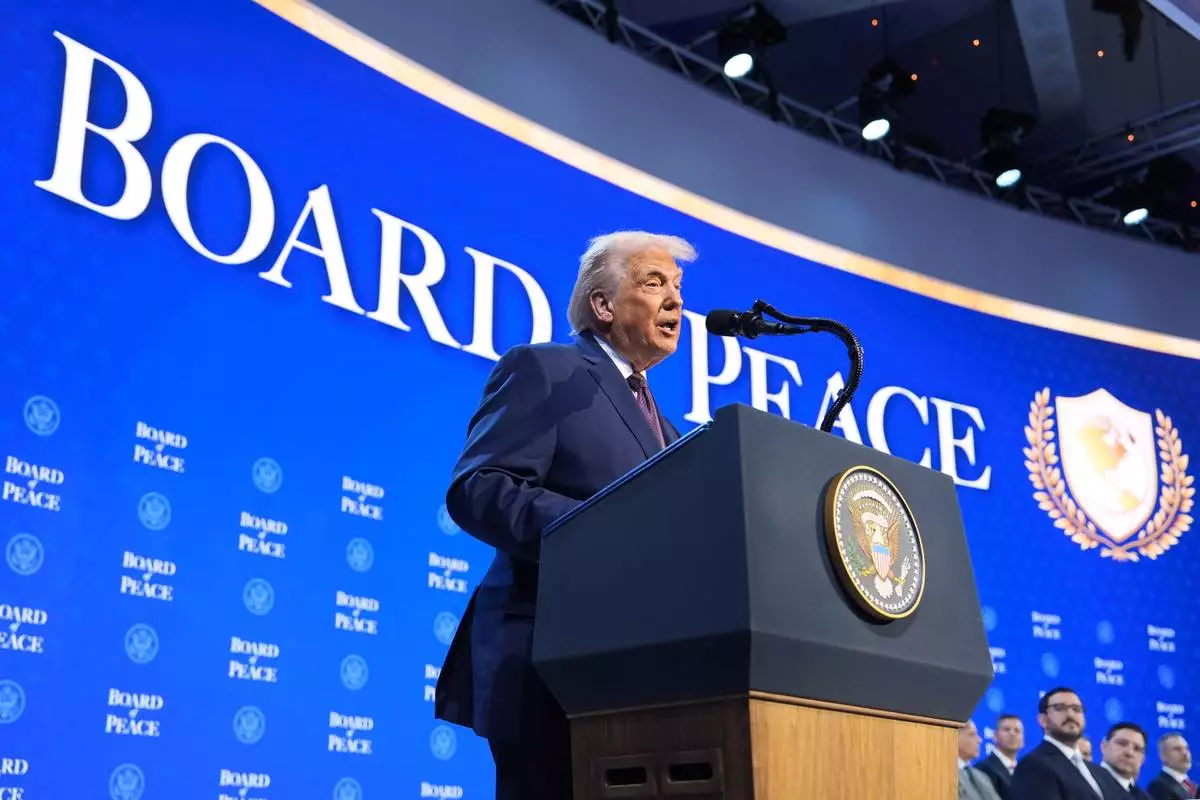
President Donald Trump speaks during a Board of Peace charter announcement during the Annual Meeting of the World Economic Forum in Davos, Switzerland, Thursday, Jan. 22, 2026. (AP Photo/Evan Vucci)
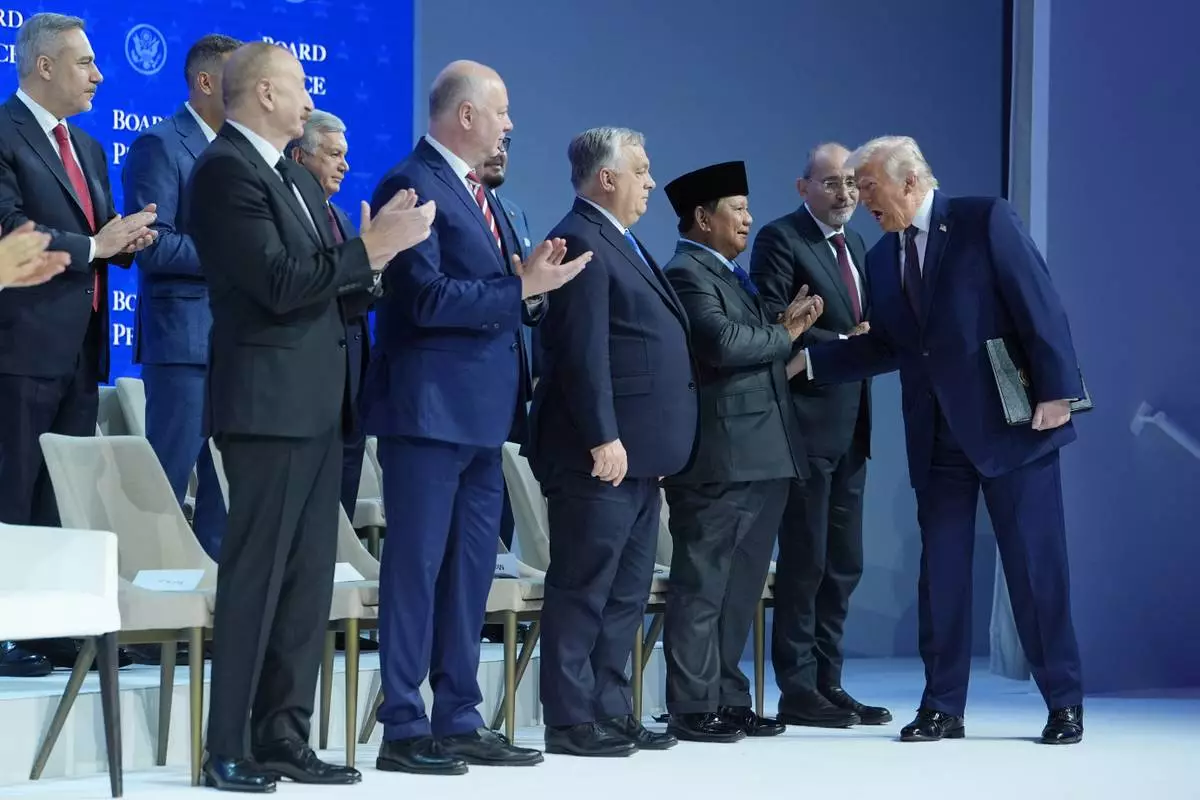
President Donald Trump, right, greets leaders as he arrives for a Board of Peace charter announcement during the Annual Meeting of the World Economic Forum in Davos, Switzerland, Thursday, Jan. 22, 2026. (AP Photo/Evan Vucci)
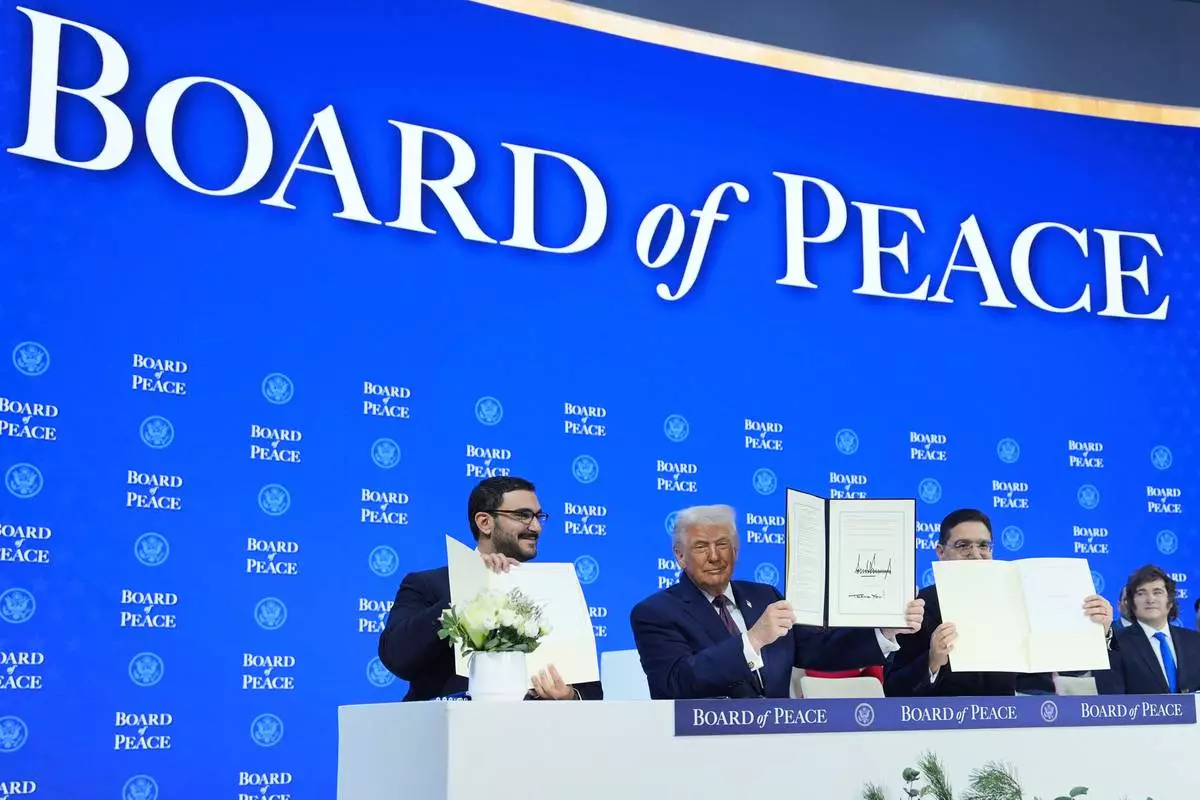
President Donald Trump, center, holds up a signed Board of Peace charter during the Annual Meeting of the World Economic Forum in Davos, Switzerland, Thursday, Jan. 22, 2026. (AP Photo/Evan Vucci)
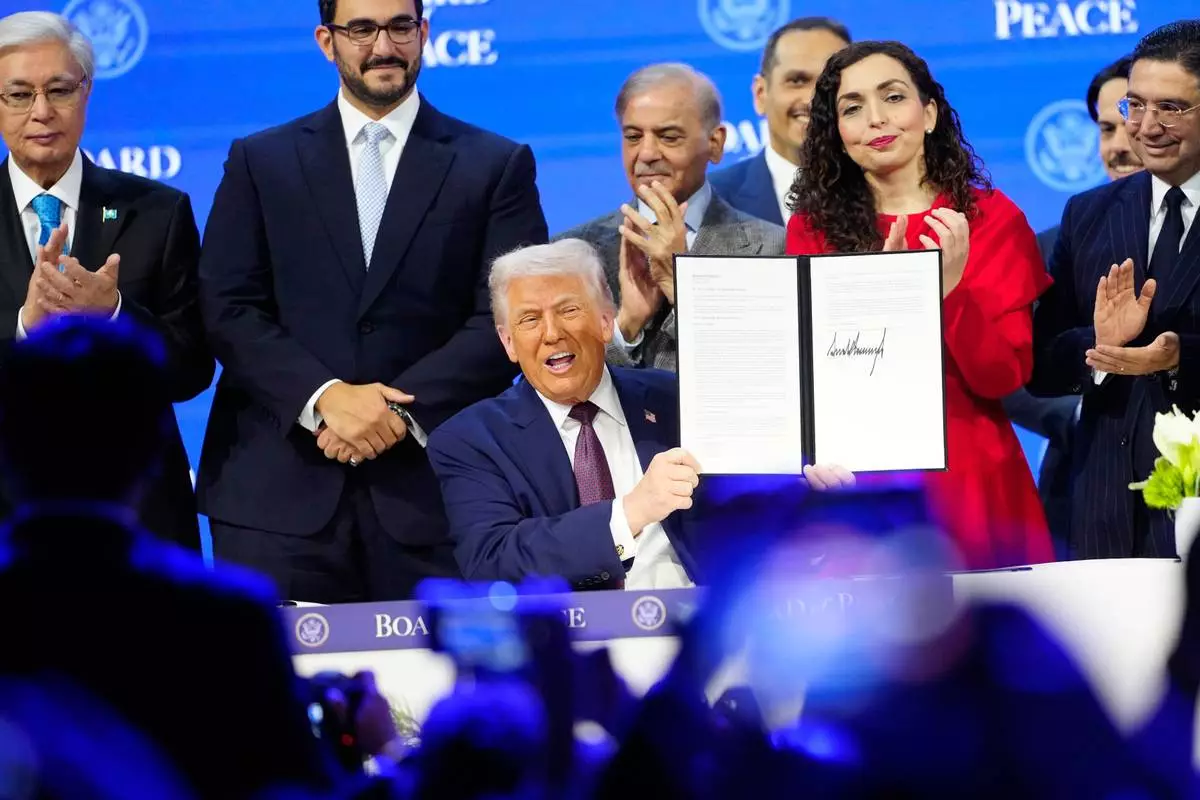
President Donald Trump holds the charter during a signing ceremony on his Board of Peace initiative at the Annual Meeting of the World Economic Forum in Davos, Switzerland, Thursday, Jan. 22, 2026. (AP Photo/Markus Schreiber)
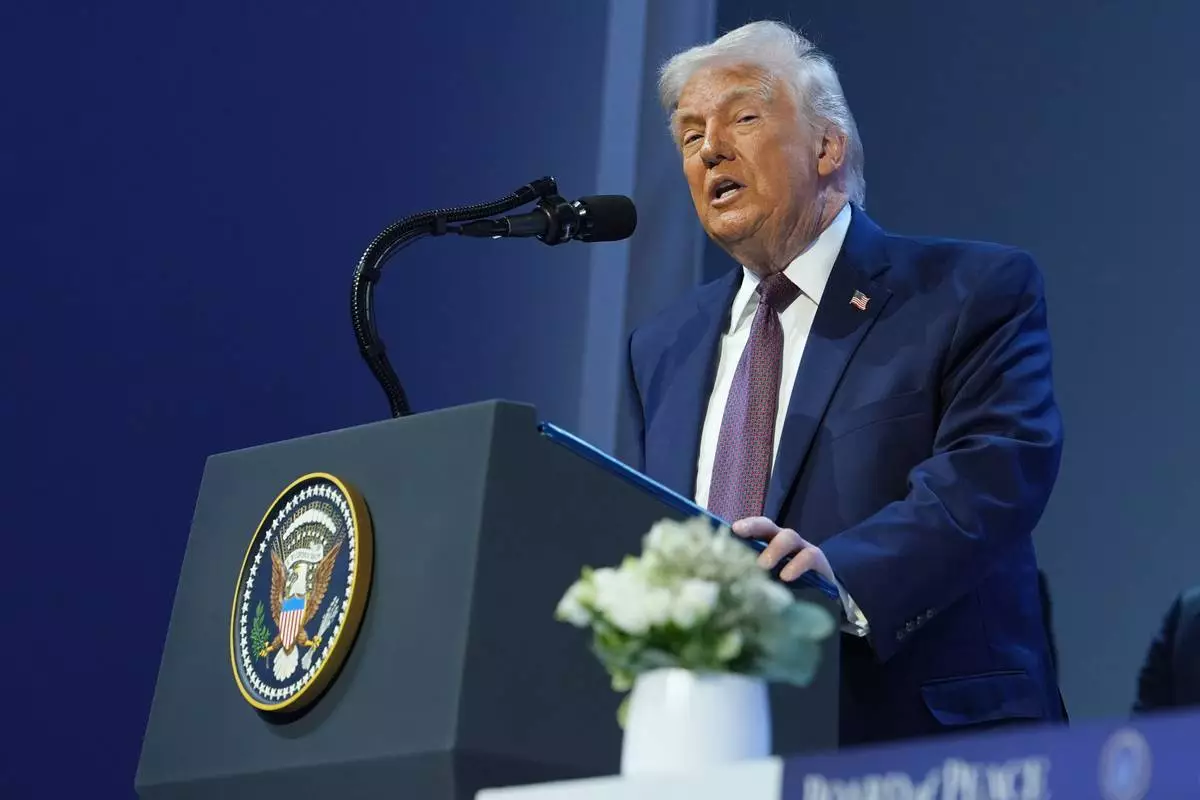
President Donald Trump speaks after the signing of a Board of Peace charter during the Annual Meeting of the World Economic Forum in Davos, Switzerland, Thursday, Jan. 22, 2026. (AP Photo/Evan Vucci)
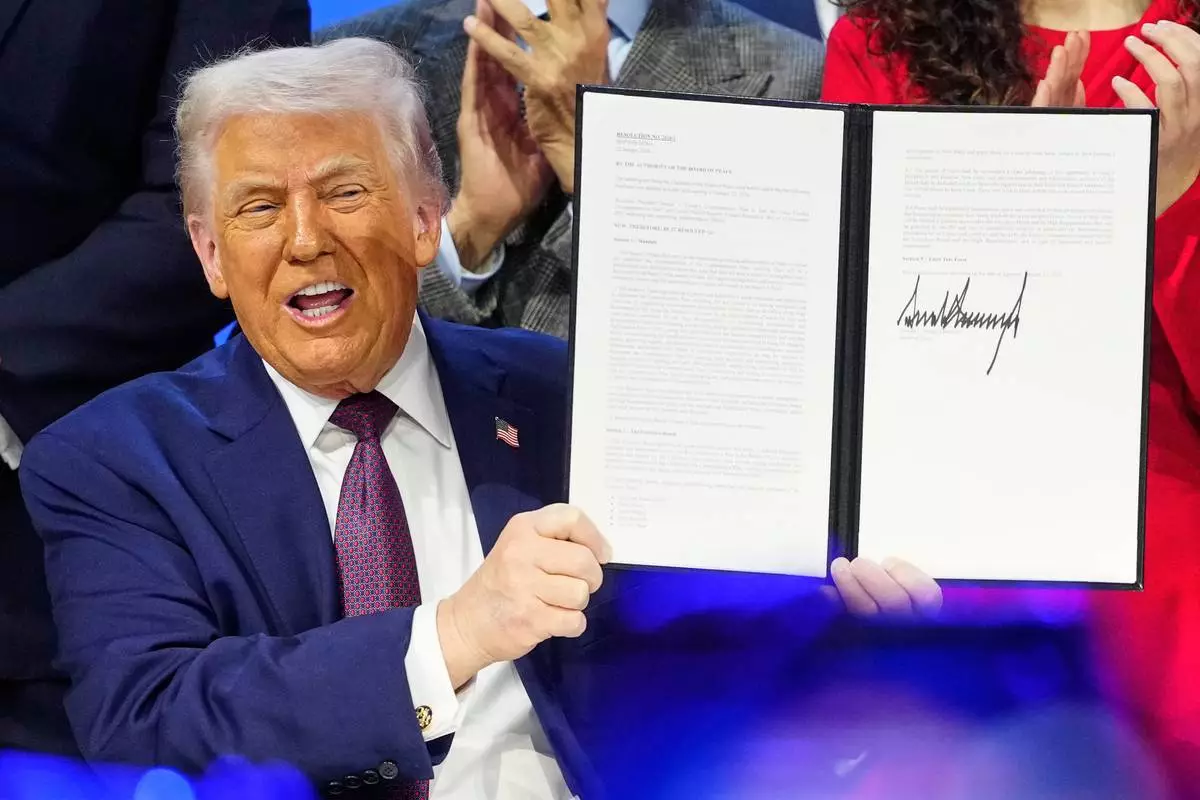
President Donald Trump holds the charter during a signing ceremony on his Board of Peace initiative at the Annual Meeting of the World Economic Forum in Davos, Switzerland, Thursday, Jan. 22, 2026. (AP Photo/Markus Schreiber)
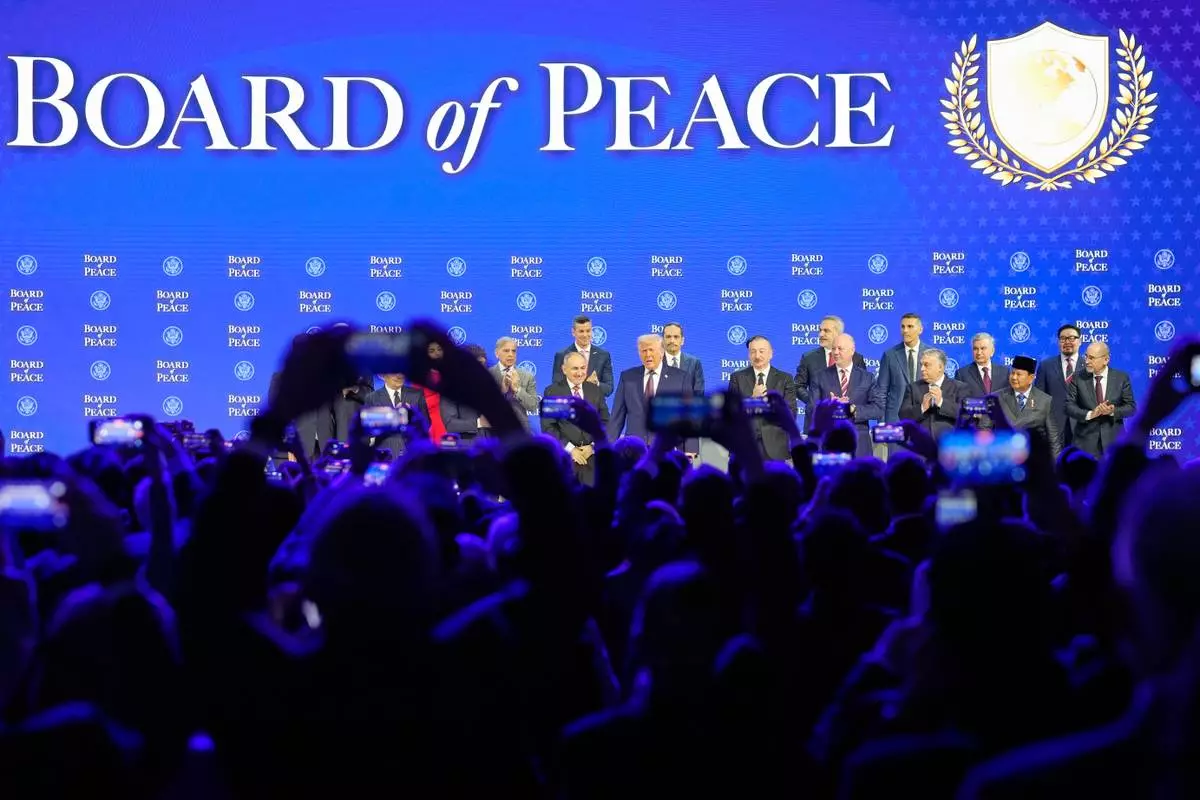
President Trump stands on the podium at the beginning a session on the Board of Peace initiative of US President Donald Trump at the Annual Meeting of the World Economic Forum in Davos, Switzerland, Thursday, Jan. 22, 2026. (AP Photo/Markus Schreiber)
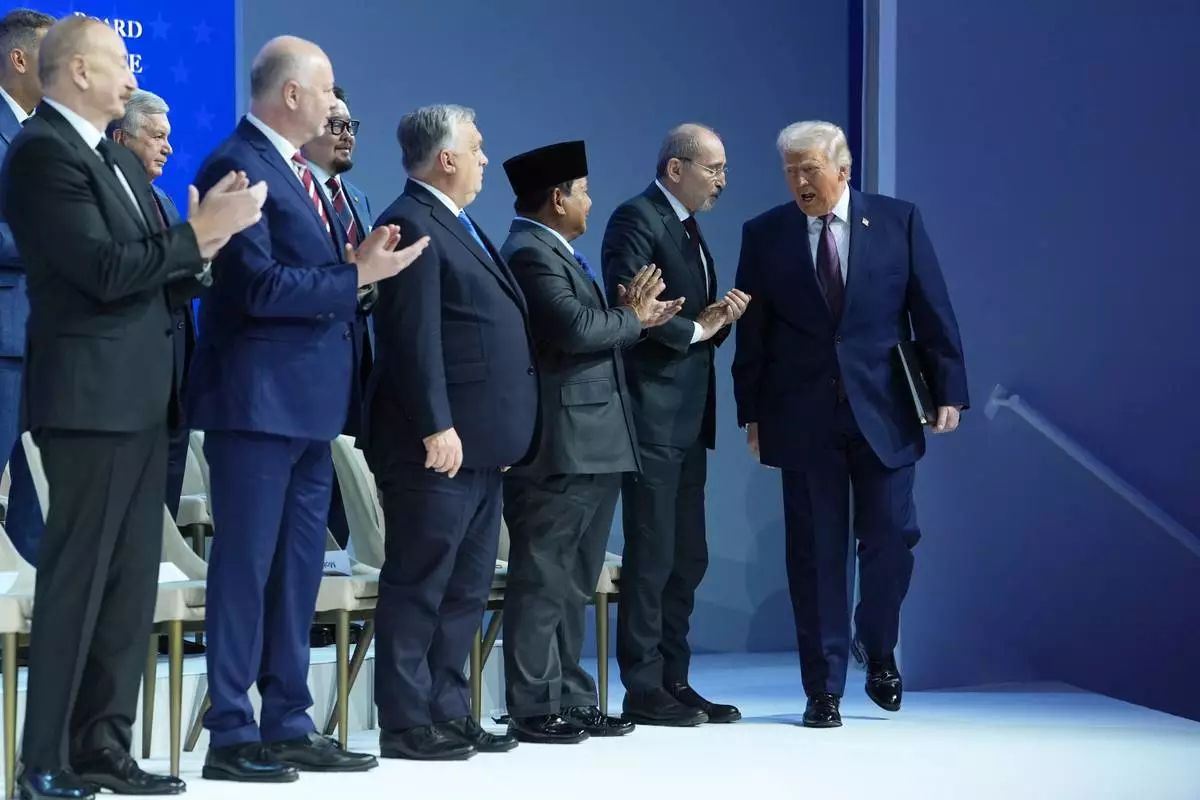
President Donald Trump arrives for a Board of Peace charter announcement during the Annual Meeting of the World Economic Forum in Davos, Switzerland, Thursday, Jan. 22, 2026. (AP Photo/Evan Vucci)
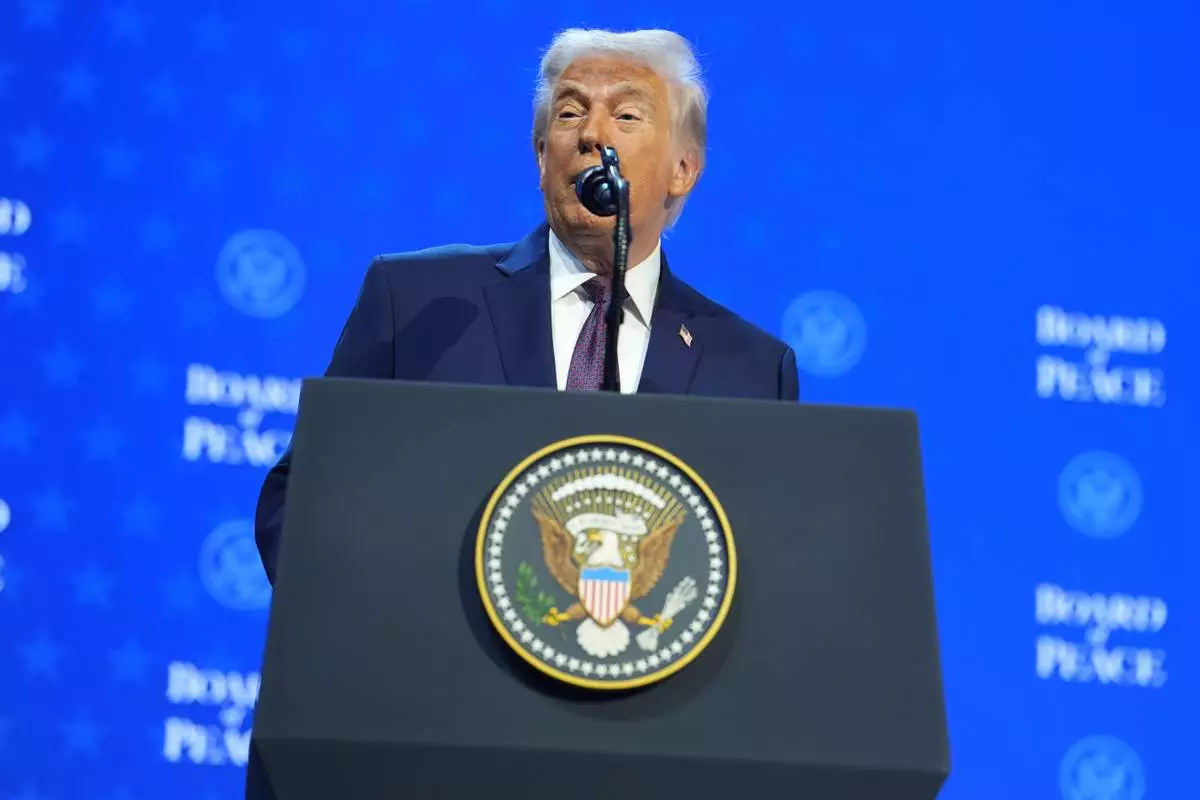
President Donald Trump speaks during a Board of Peace charter announcement during the Annual Meeting of the World Economic Forum in Davos, Switzerland, Thursday, Jan. 22, 2026. (AP Photo/Evan Vucci)
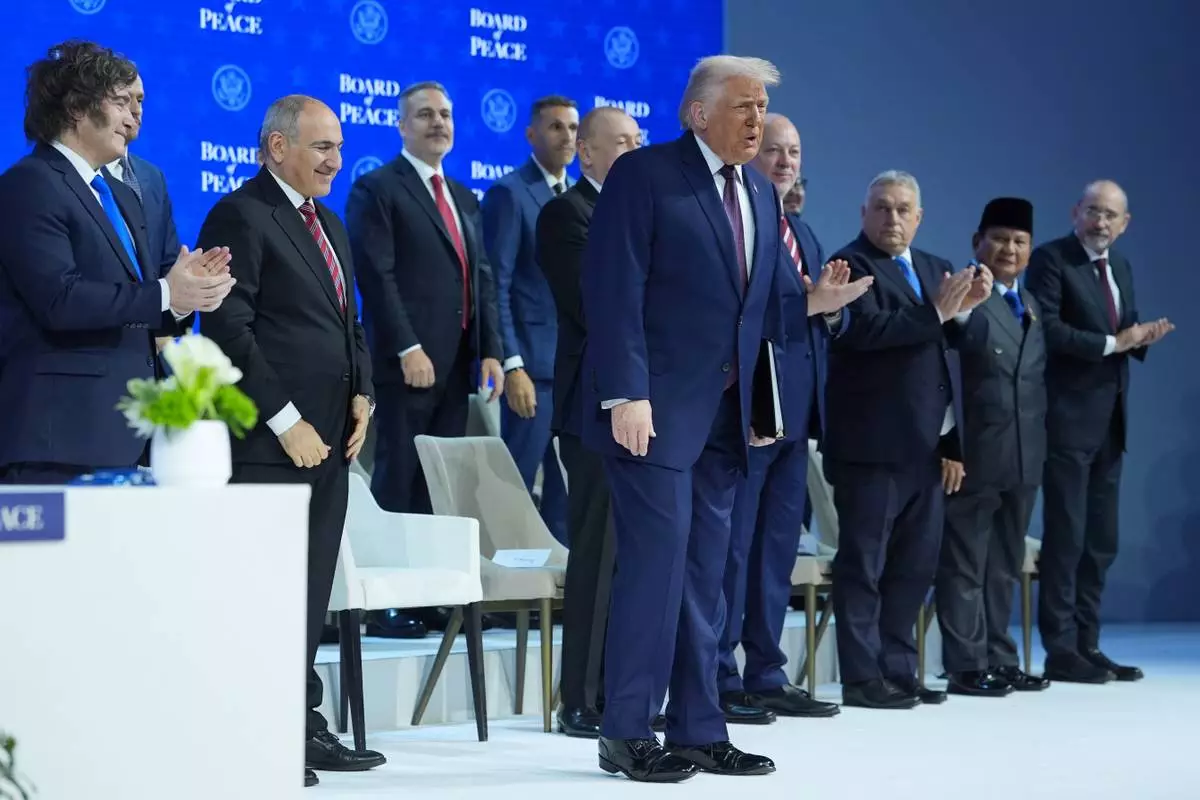
From right, Ayman Al Safadi, Deputy PM of of Jordan, Prabowo Subinato, President of Indonesia, Hungary's Prime Minister Viktor Orban, Bulgaria's Prime Minister Rossen Jeliazkov, Ilham Aliyev, President Donald Trump President of Azerbaijan, Turkish Foreign Minister Hakan Fidan, Nikol Pashinyan, Prime Minister of Armenia and Javier Milei, President of Argentina pose during a Board of Peace charter announcement during the Annual Meeting of the World Economic Forum in Davos, Switzerland, Thursday, Jan. 22, 2026. (AP Photo/Evan Vucci)
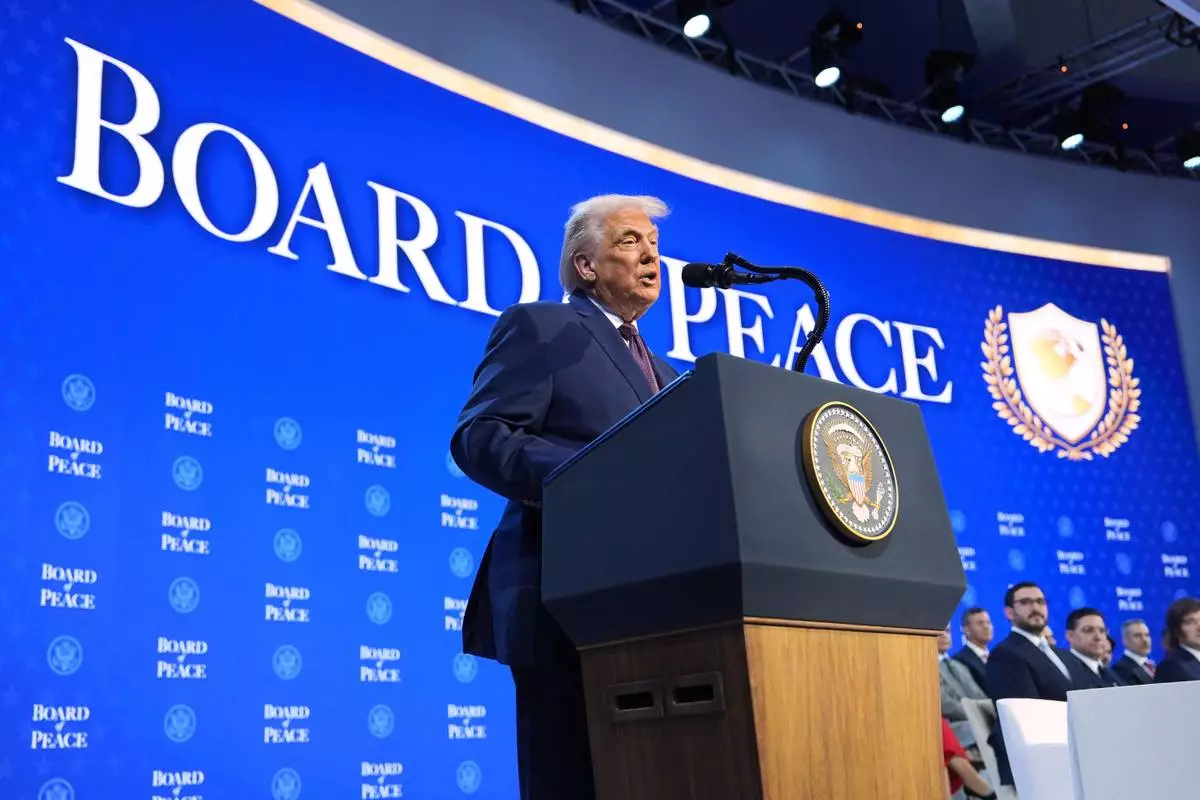
President Donald Trump speaks during a Board of Peace charter announcement during the Annual Meeting of the World Economic Forum in Davos, Switzerland, Thursday, Jan. 22, 2026. (AP Photo/Evan Vucci)
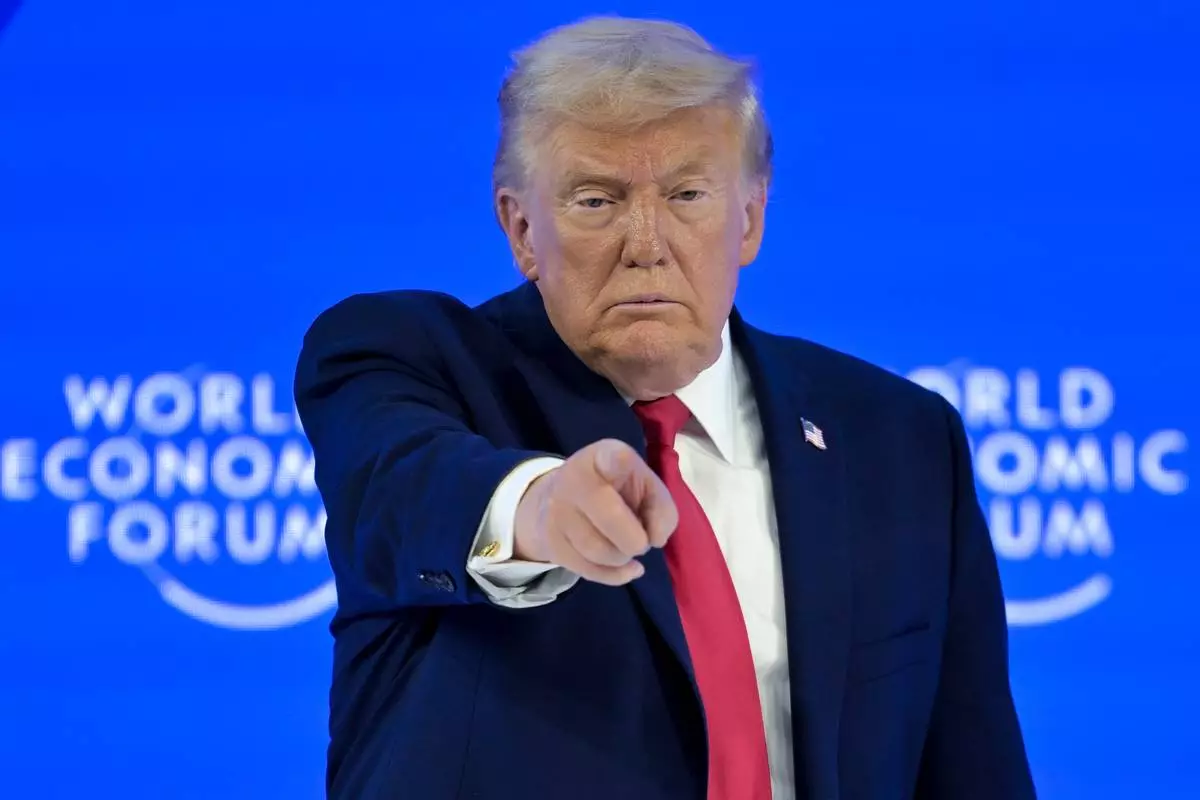
President Donald Trump gestures after his special address during the 56th annual meeting of the World Economic Forum, WEF, in Davos, Switzerland, Wednesday, Jan. 21, 2026. (Gian Ehrenzeller/Keystone via AP)