Skip to Content Facebook Feature Image

Ukraine, Russia, US discuss fraught issue of territorial concessions in Abu Dhabi

News

Ukraine, Russia, US discuss fraught issue of territorial concessions in Abu Dhabi
News

News

Ukraine, Russia, US discuss fraught issue of territorial concessions in Abu Dhabi

2026-01-24 09:48 Last Updated At:09:50

Ukrainian President Volodymyr Zelenskyy said the future of Ukraine’s eastern Donbas region would be a key focus as negotiators from Ukraine, Russia and the United States meet in Abu Dhabi for talks to end Russia’s nearly four-year full-scale invasion.

The UAE’s foreign ministry said the talks, which commenced on Friday and were scheduled to continue Saturday, were part of efforts "to promote dialogue and identify political solutions to the crisis.” The White House described the talks as productive.

More Images
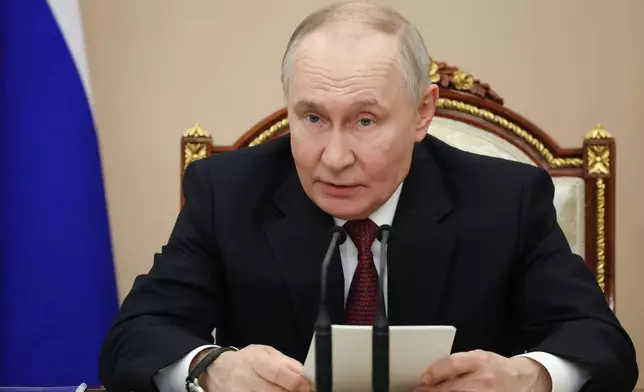
Russian President Vladimir Putin speaks during a meeting on the development of domestic integrated electronics at the Kremlin in Moscow, Thursday, Jan. 22, 2026. (Vyacheslav Prokofyev/Sputnik, Kremlin Pool Photo via AP)
Russian President Vladimir Putin speaks during a meeting on the development of domestic integrated electronics at the Kremlin in Moscow, Thursday, Jan. 22, 2026. (Vyacheslav Prokofyev/Sputnik, Kremlin Pool Photo via AP)

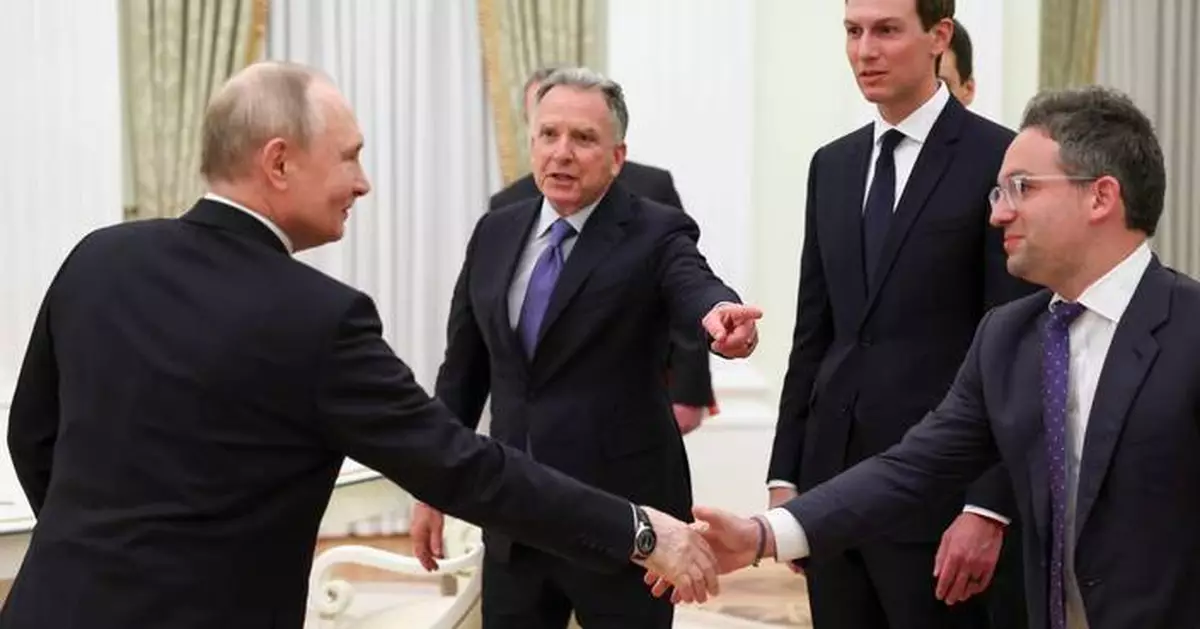
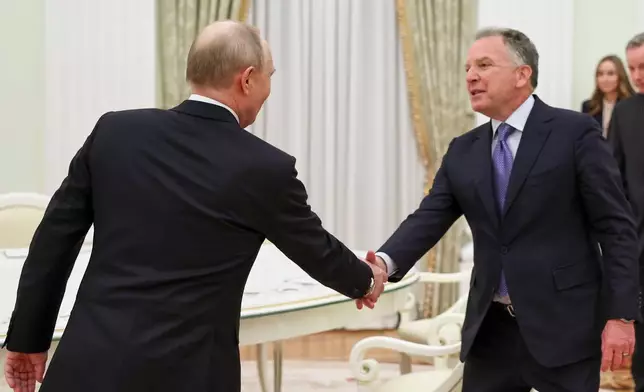
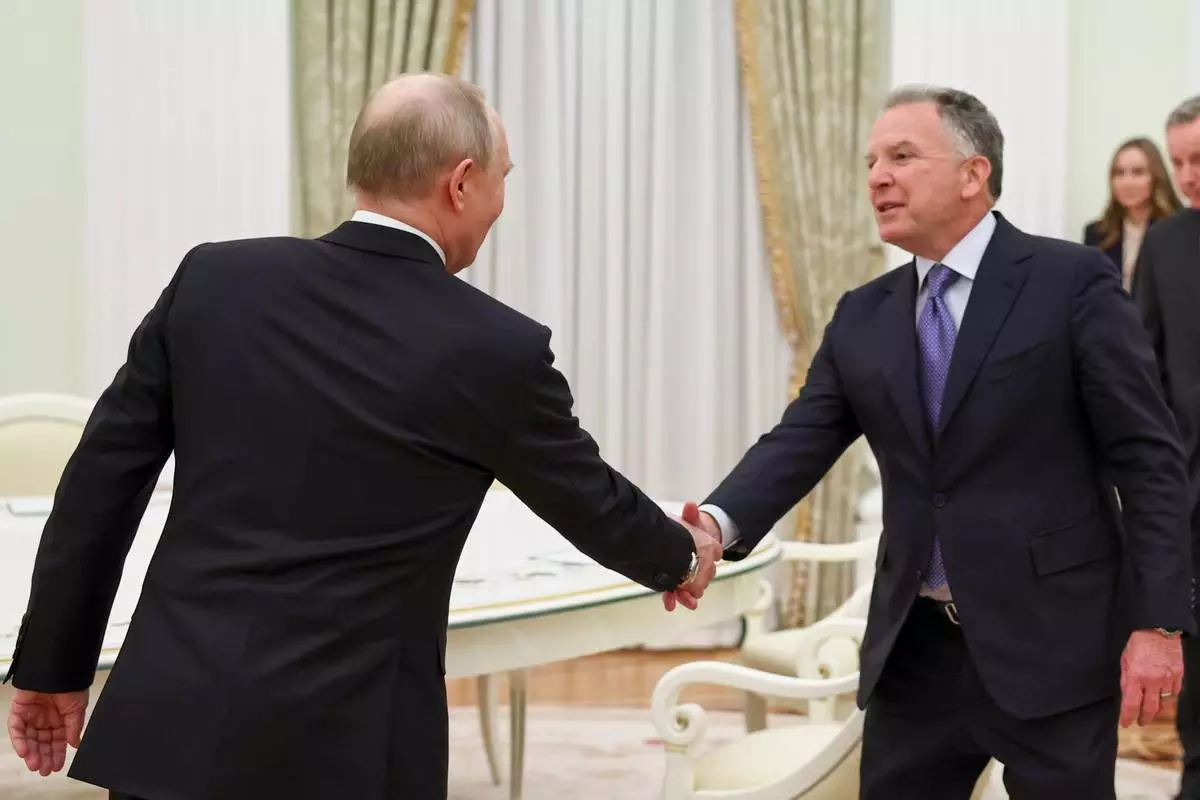
Russian President Vladimir Putin, left, greets U.S. President Donald Trump's envoys Steve Witkoff at the Senate Palace of the Kremlin, in Moscow, Thursday, Jan. 22, 2026. (Alexander Kazakov/Sputnik, Kremlin Pool Photo via AP)
Russian President Vladimir Putin, left, greets U.S. President Donald Trump's envoys Steve Witkoff at the Senate Palace of the Kremlin, in Moscow, Thursday, Jan. 22, 2026. (Alexander Kazakov/Sputnik, Kremlin Pool Photo via AP)
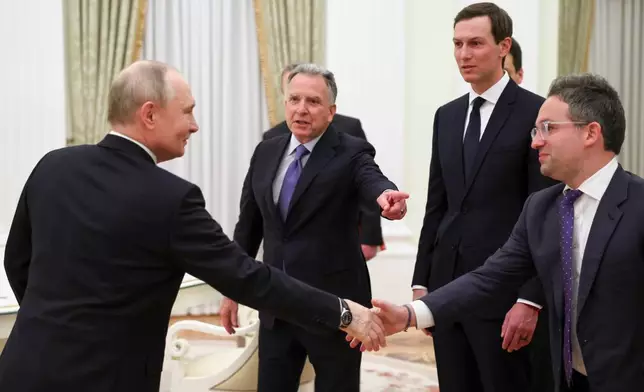
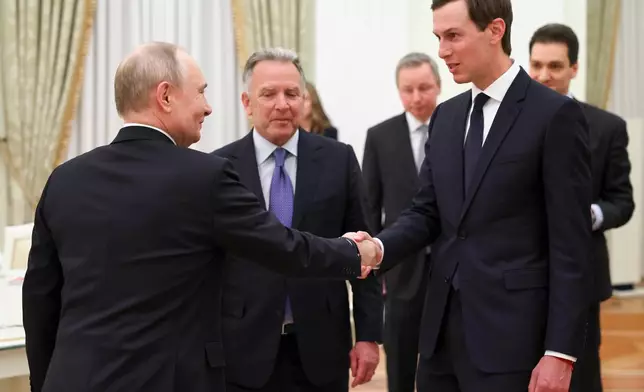
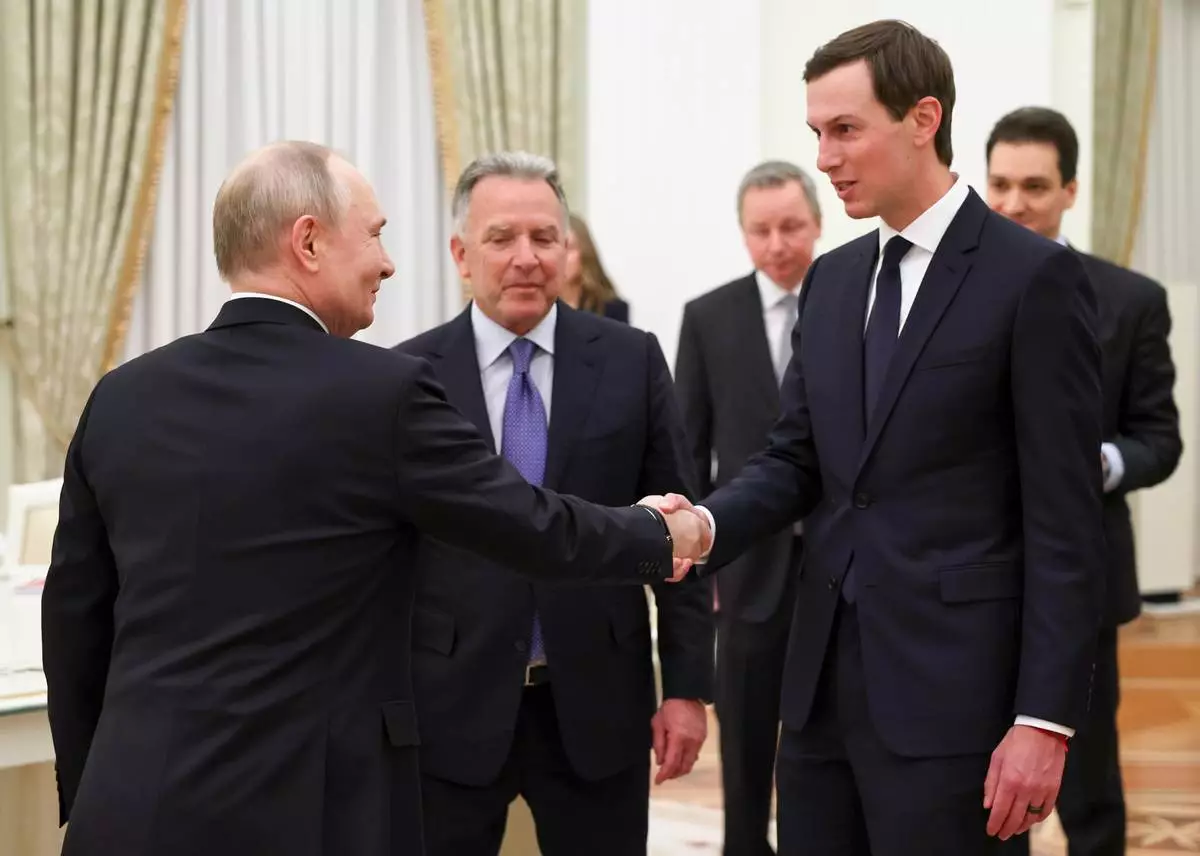
Russian President Vladimir Putin, left, greets U.S. President Donald Trump's envoys Steve Witkoff, center, and Jared Kushner at the Senate Palace of the Kremlin, in Moscow, Thursday, Jan. 22, 2026. (Alexander Kazakov/Sputnik, Kremlin Pool Photo via AP)

Russian President Vladimir Putin, left, greets U.S. President Donald Trump's envoys Steve Witkoff, center, and Jared Kushner at the Senate Palace of the Kremlin, in Moscow, Thursday, Jan. 22, 2026. (Alexander Kazakov/Sputnik, Kremlin Pool Photo via AP)

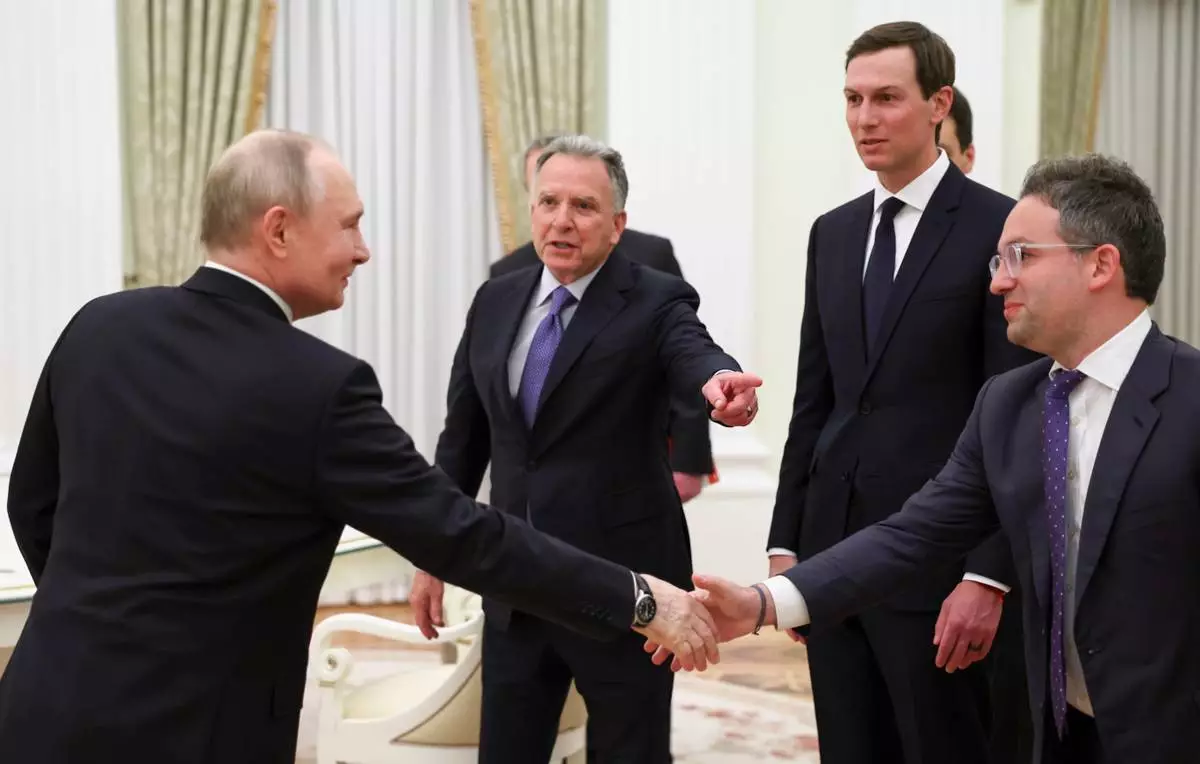
Russian President Vladimir Putin, left, greet U.S. President Donald Trump's envoys Steve Witkoff, centre left, Jared Kushner, second right, and Josh Gruenbaum, the head of the Federal Acquisition Service at the General Services Administration, at the Senate Palace of the Kremlin, in Moscow, Thursday, Jan. 22, 2026. (Alexander Kazakov/Sputnik, Kremlin Pool Photo via AP)

Russian President Vladimir Putin, left, greet U.S. President Donald Trump's envoys Steve Witkoff, centre left, Jared Kushner, second right, and Josh Gruenbaum, the head of the Federal Acquisition Service at the General Services Administration, at the Senate Palace of the Kremlin, in Moscow, Thursday, Jan. 22, 2026. (Alexander Kazakov/Sputnik, Kremlin Pool Photo via AP)

Just hours before the three-way talks began, Russian President Vladimir Putin discussed a Ukraine settlement with U.S. President Donald Trump’s envoys Steve Witkoff and Jared Kushner during marathon overnight talks. The Kremlin insisted that to reach a peace deal, Kyiv must withdraw its troops from the areas in the east that Russia illegally annexed but has not fully captured.

Zelenskyy said after meeting with Trump on Thursday in Davos, Switzerland, that while the future status of land in eastern Ukraine currently occupied by Russia remains unresolved, the peace proposals are “nearly ready.”

He also reiterated his openness to establishing a free trade zone under Ukraine’s control in the country’s east, adding that he discussed the proposal with Trump. “I think it will be positive for our business," Zelenskyy told reporters.

Friday is the first known time that officials from the Trump administration simultaneously met with negotiators from both Ukraine and Russia. While it’s unclear how the talks will unfold and many obstacles to peace remain, some see it as a sign that the parties are making headway in closing a deal.

Speaking in his evening address to the nation late Friday, Zelenskyy said the Ukrainian delegation at the talks reported to him “almost every hour.”

“They are discussing the parameters for ending the war," Zelenskyy said. "Now, they should at least get some answers from Russia, and the most important thing is that Russia should be ready to end this war, which it itself started.”

He added that it was too early to draw conclusions about Friday's talks and he would see how they go on Saturday.

"It’s not just about Ukraine’s desire to end this war and achieve full security — it’s also about Russia somehow developing a similar desire,” Zelenskyy said.

The Kremlin offered little detail beyond calling Friday’s meeting a “working group on security issues.”

Kremlin spokesman Dmitry Peskov reaffirmed that Russia's demand for the Ukrainian troops' withdrawal from the eastern Donbas region is an “important condition,” adding that there are other “nuances” on the agenda that he wouldn't specify.

Kremlin foreign affairs adviser Yuri Ushakov, who participated in Putin’s meeting with Witkoff and Kushner, said “it was reaffirmed that reaching a long-term settlement can’t be expected without solving the territorial issue.” He described the talks with the U.S. as “frank, constructive” and “fruitful.”

Russia’s state Tass news agency reported that the discussions included possible buffer zones and control measures.

Peskov told reporters that the Russian delegation, headed by Adm. Igor Kostyukov, is comprised of military officials. Separately, Putin’s envoy Kirill Dmitriev will hold talks with Witkoff on economic issues, Peskov added.

The U.S. has confirmed Witkoff and Kushner are attending the talks in Abu Dhabi along with Army Secretary Dan Driscoll and NATO’s top general, U.S. Air Force Gen. Alexus Grynkewich.

The Ukrainian team includes Rustem Umerov, head of Ukraine’s national security and defense council; Andrii Hnatov, chief of the general staff; and Kyrylo Budanov, head of the presidential office.

Hours before the Kremin talks, Zelenskyy met with Trump behind closed doors for about an hour at the World Economic Forum in Davos, describing the meeting as “productive and meaningful.”

Speaking to reporters aboard Air Force One as he flew back to Washington, Trump said the meeting went well, adding that both Putin and Zelenskyy want to reach a deal and that “everyone’s making concessions” to try to end the war.

He said the sticking points remain the same as they’ve been during talks held during the past six or seven months, noting “boundaries” was a key issue. “The main hold-up is the same things that’s been holding it up for the last year,” he said.

Russia’s bigger army has managed to capture about 20% of Ukraine since hostilities began in 2014 and its full-scale invasion of 2022. But the battlefield gains along the roughly 1,000-kilometer (600-mile) front line have been costly for Moscow, and the Russian economy is feeling the consequences of the war and international sanctions.

Ukraine is short of money and, despite significantly boosting its own arms manufacturing, still needs Western weaponry. It is also short-handed on the front line. Its defense minister last week reported some 200,000 troop desertions, and draft-dodging by about 2 million Ukrainians.

Addressing the World Economic Forum on Thursday after meeting with Trump, Zelenskyy listed a litany of grievances and criticisms of Europe.

He chided Europe for being slow to act on key decisions, spending too little on defense, failing to stop Russia’s ”shadow fleet” of oil tankers that are breaking international sanctions, and balking at using its frozen assets in Europe to finance Ukraine, among other things.

“Europe looks lost,” Zelenskyy said in his speech, urging the continent to become a global force. He contrasted Europe’s response with Washington’s bold steps in Venezuela and Iran.

The former comic actor referred to the movie “Groundhog Day,” in which the main character must relive the same day over and over again.

“Just last year, here in Davos, I ended my speech with the words: Europe needs to know how to defend itself. A year has passed. And nothing has changed. We are still in a situation where I must say the same words again,” Zelenskyy said.

Hrabchuk reported from Kyiv, Ukraine, and Manenkov from Davos, Switzerland. Josh Boak on Air Force One, Meg Kinnard in Houston and Aamer Madhani, Konstantin Toropin and Ali Swenson in Washington contributed to this report.

Follow AP’s coverage of the war in Ukraine at https://apnews.com/hub/russia-ukraine
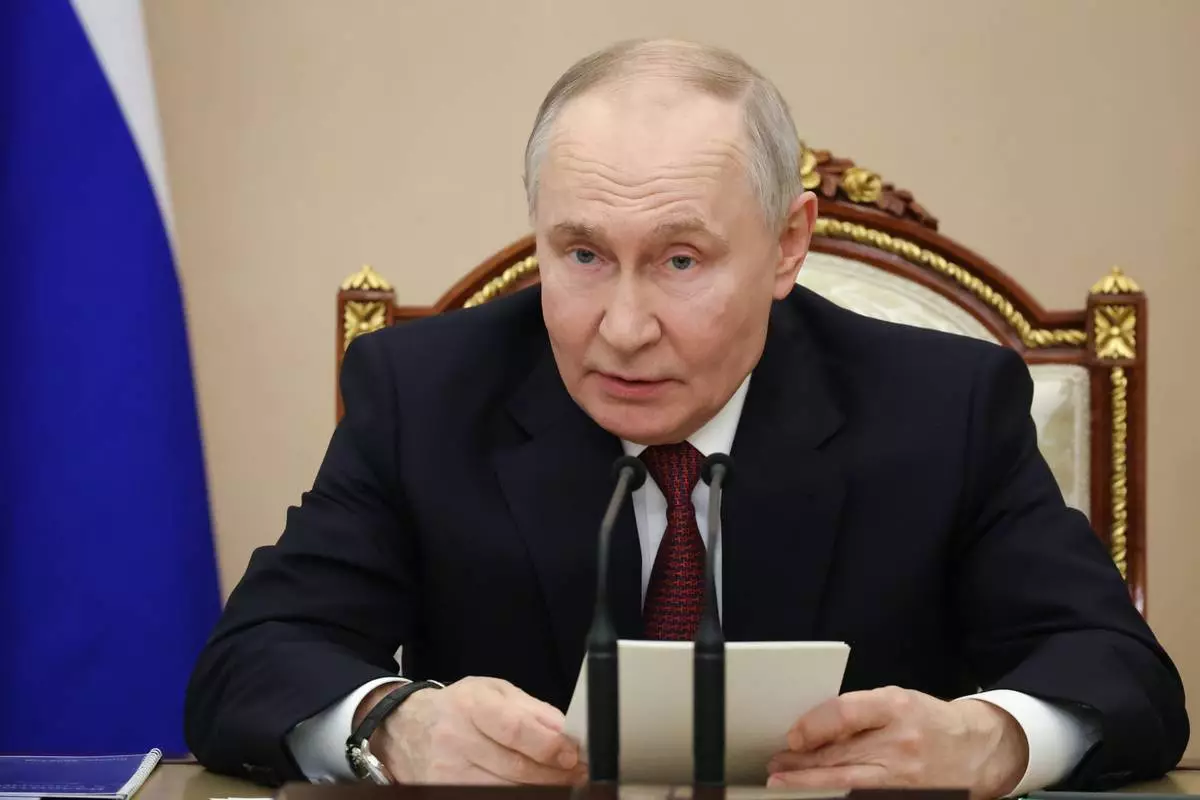
Russian President Vladimir Putin speaks during a meeting on the development of domestic integrated electronics at the Kremlin in Moscow, Thursday, Jan. 22, 2026. (Vyacheslav Prokofyev/Sputnik, Kremlin Pool Photo via AP)
Russian President Vladimir Putin speaks during a meeting on the development of domestic integrated electronics at the Kremlin in Moscow, Thursday, Jan. 22, 2026. (Vyacheslav Prokofyev/Sputnik, Kremlin Pool Photo via AP)

Russian President Vladimir Putin, left, greets U.S. President Donald Trump's envoys Steve Witkoff at the Senate Palace of the Kremlin, in Moscow, Thursday, Jan. 22, 2026. (Alexander Kazakov/Sputnik, Kremlin Pool Photo via AP)
Russian President Vladimir Putin, left, greets U.S. President Donald Trump's envoys Steve Witkoff at the Senate Palace of the Kremlin, in Moscow, Thursday, Jan. 22, 2026. (Alexander Kazakov/Sputnik, Kremlin Pool Photo via AP)
Russian President Vladimir Putin, left, greets U.S. President Donald Trump's envoys Steve Witkoff, center, and Jared Kushner at the Senate Palace of the Kremlin, in Moscow, Thursday, Jan. 22, 2026. (Alexander Kazakov/Sputnik, Kremlin Pool Photo via AP)

Russian President Vladimir Putin, left, greets U.S. President Donald Trump's envoys Steve Witkoff, center, and Jared Kushner at the Senate Palace of the Kremlin, in Moscow, Thursday, Jan. 22, 2026. (Alexander Kazakov/Sputnik, Kremlin Pool Photo via AP)
Russian President Vladimir Putin, left, greet U.S. President Donald Trump's envoys Steve Witkoff, centre left, Jared Kushner, second right, and Josh Gruenbaum, the head of the Federal Acquisition Service at the General Services Administration, at the Senate Palace of the Kremlin, in Moscow, Thursday, Jan. 22, 2026. (Alexander Kazakov/Sputnik, Kremlin Pool Photo via AP)
Russian President Vladimir Putin, left, greet U.S. President Donald Trump's envoys Steve Witkoff, centre left, Jared Kushner, second right, and Josh Gruenbaum, the head of the Federal Acquisition Service at the General Services Administration, at the Senate Palace of the Kremlin, in Moscow, Thursday, Jan. 22, 2026. (Alexander Kazakov/Sputnik, Kremlin Pool Photo via AP)
DUBAI, United Arab Emirates (AP) — Israel and Iran exchanged fire early Wednesday as Tehran kept up its pressure on the region's oil industry, hitting a ship in the Strait of Hormuz and targeting infrastructure as concerns grew of a global energy crisis.

Iran has effectively stopped shipping traffic through the narrow strait off its coast, through which about a fifth of the world's oil is shipped from the Persian Gulf toward the Indian Ocean. It has also been targeting oil fields and refineries in Gulf Arab nations as part of a strategy that appeared to be aimed at generating enough global economic pain to pressure the United States and Israel to end their strikes.

Early Wednesday, Kuwait said its defenses had downed eight Iranian drones over the oil-rich nation and Saudi Arabia said it had intercepted five drones heading toward the kingdom's vast Shaybah oil field. A projectile hit a container ship off the coast of the United Arab Emirates in the Strait of Hormuz.

Israel, which launched the war with the United States on Feb. 28, said it had had begun a new wave of attacks on Tehran, following multiple strikes the day before that residents described as some of the heaviest during the war. Explosions were also heard in Beirut and in southern Lebanon after Israel said it had started a new assault on targets related to the Iran-linked militia Hezbollah.

The attacks set a building ablaze in central Beirut in the densely populated Aicha Bakkar area, engulfing the top two floors of the multistory structure in flames. There were no immediate reports of casualties from the strike, which came without warning.

An earlier Israeli strike in southern Lebanon killed five people in the Nabatieh district, while two more were killed in strikes in the Tyre district and the Bint Jbeil district, Lebanon's Health Ministry said. A Red Cross worker also died early Wednesday of wounds sustained Monday, when his team was hit by an Israeli strike while they were rescuing people from an earlier attack.

Nearly 500 people have been killed so far in Lebanon since Hezbollah triggered the latest round of fighting with Israel when it fired rockets into the country’s north after the American and Israeli attacks on Iran started.

Israel warned of three Iranian attacks across the country early Wednesday, with sirens heard in Tel Aviv and elsewhere but no immediate reports of casualties.

In addition to targeting Saudi Arabia's oil fields, the kingdom's defense ministry said it had destroyed six ballistic missiles launched toward Prince Sultan Air Base, a major U.S.- and Saudi-operated air facility in eastern Saudi Arabia. The ministry also said it intercepted and destroyed two drones over Hafar al-Batin, a major city in the eastern province.

In the Strait of Hormuz, Iran hit a container ship with a projectile off Ras al-Khaimah, the UAE’s northern-most emirate on the strait, according to a monitoring site run by the British military.

It said the “extent of the damage is currently unknown but under investigation by the crew.”

The United Arab Emirates said early Wednesday that its air defenses were working to intercept incoming Iranian fire. The wealthy Gulf nation — home to the business and travel hub of Dubai — said Iranian attacks have killed six people and wounded 122 others there.

Bahrain sounded sirens early Wednesday, warning of an incoming Iranian attack. The warnings came a day after an Iranian attack hit a residential building in the capital, Manama, and killed a 29-year-old woman and wounding eight people.

Oil prices remained well below the peaks hit on Monday but the price of Brent crude, the international standard, was still up some 20% Wednesday from when the war began, and consumers around the world are already feeling the pain at the pump.

The spike in oil prices has been rocking financial markets worldwide because of worries that the war could block the global flow of oil and natural gas for a long time.

Amin Nasser, the president and CEO of Saudi Arabia’s oil giant Aramco, warned on Tuesday that if oil tankers continue to be unable to transit the strait “that will have a serious impact on the global economy.”

The U.S. military said Tuesday it had destroyed 16 Iranian minelayers near the Strait of Hormuz, though U.S. President Donald Trump said in social media posts that there were no reports yet of Iran mining the passage, a prospect that experts warned of in the buildup to the war.

In addition to the nearly 500 people killed in Lebanon, Iran has said more than 1,300 people have been killed there and Israel has reported 12 people dead.

The U.S. has lost seven soldiers while another eight have suffered severe injuries.

Many foreign nationals have been getting out of the Persian Gulf region since the war began, including over 45,000 U.K. citizens, the British Foreign Office said. Some 40,000 people returned to the United States, according to the State Department.

Magdy reported from Cairo, and Rising from Bangkok. Associated Press writers Sally Abou AIJoud in Beirut, Giovanna Dell’Orto in Miami, Julie Watson in San Diego,

People take shelter in an underground metro station as air raid sirens warn of incoming Iranian missile strike, in Ramat Gan, Israel, Tuesday, March 10, 2026. (AP Photo/Oded Balilty)

People take shelter in an underground metro station as air raid sirens warn of incoming Iranian missile strike, in Ramat Gan, Israel, Tuesday, March 10, 2026. (AP Photo/Oded Balilty)

A man passes in front of a destroyed building that housed a branch of Al-Qard Al-Hassan, a non-bank financial institution run by Hezbollah, which was hit by an Israeli airstrike in Dahiyeh, Beirut's southern suburbs, Lebanon, Tuesday, March 10, 2026. (AP Photo/Hussein Malla)

A man passes in front of a destroyed building that housed a branch of Al-Qard Al-Hassan, a non-bank financial institution run by Hezbollah, which was hit by an Israeli airstrike in Dahiyeh, Beirut's southern suburbs, Lebanon, Tuesday, March 10, 2026. (AP Photo/Hussein Malla)

People walk past closed shops at the nearly empty traditional main bazaar in Tehran, Iran, Tuesday, March 10, 2026. (AP Photo/Vahid Salemi)

People walk past closed shops at the nearly empty traditional main bazaar in Tehran, Iran, Tuesday, March 10, 2026. (AP Photo/Vahid Salemi)

Motorbikes drive past a billboard depicting Iran’s late Supreme Leader Ayatollah Ali Khamenei, center, handing the country’s flag to his son and successor Ayatollah Mojtaba Khamenei, right, as the late revolutionary founder Ayatollah Ruhollah Khomeini stands at left, in a square in downtown Tehran, Iran, Tuesday, March 10, 2026. (AP Photo/Vahid Salemi)

Motorbikes drive past a billboard depicting Iran’s late Supreme Leader Ayatollah Ali Khamenei, center, handing the country’s flag to his son and successor Ayatollah Mojtaba Khamenei, right, as the late revolutionary founder Ayatollah Ruhollah Khomeini stands at left, in a square in downtown Tehran, Iran, Tuesday, March 10, 2026. (AP Photo/Vahid Salemi)

Smoke rises from an Israeli airstrike in Dahiyeh, Beirut's southern suburbs, Lebanon, Tuesday, March 10, 2026. (AP Photo/Bilal Hussein)

Smoke rises from an Israeli airstrike in Dahiyeh, Beirut's southern suburbs, Lebanon, Tuesday, March 10, 2026. (AP Photo/Bilal Hussein)

Recommended Articles