LOS ANGELES, Jan. 24, 2026 /PRNewswire/ -- At CES 2026, VR filmmaker and educator Hugh Hou led a live spatial computing demonstration inside the GIGABYTE suite, showing how immersive video is created in real production environments, not in theory or controlled lab conditions.
The session gave attendees a close look at a complete spatial filmmaking pipeline, from capture through post-production and final playback. Instead of relying on pre-rendered content, the workflow was executed live on the show floor, reflecting the same processes used in commercial XR projects and placing clear demands on system stability, performance consistency, and thermal reliability. The experience culminated with attendees viewing a two-minute spatial film trailer across Meta Quest, Apple Vision Pro, and the newly launched Galaxy XR headsets, alongside a 3D tablet display offering an additional 180-degree viewing option.
Where AI Fits Into Real Creative Workflows
AI was presented not as a feature highlight, but as a practical tool embedded into everyday editing tasks. During the demo, AI-assisted enhancement, tracking, and preview processes helped speed up iteration without interrupting creative flow.
Footage captured on cinema-grade immersive cameras moved through industry-standard software including Adobe Premiere Pro and DaVinci Resolve. AI-based upscaling, noise reduction, and detail refinement were applied to meet the visual requirements of immersive VR, where any artifact or softness becomes immediately noticeable across a 360-degree viewing environment.
Why Platform Design Matters for Spatial Computing
Supporting the entire workflow was a custom-built GIGABYTE AI PC designed specifically for sustained spatial video workloads. The system combined an AMD Ryzen™ 7 9800X3D processor with a Radeon™ AI PRO R9700 AI TOP GPU, providing the memory bandwidth and continuous AI performance required for real-time 8K spatial video playback and rendering. Equally critical, the X870E AORUS MASTER X3D ICE motherboard delivered stable power and signal integrity, allowing the workflow to run predictably throughout the live demonstration.
The experience concluded with attendees viewing a finished spatial film trailer across Meta Quest, Apple Vision Pro, and Galaxy XR devices.
By enabling a demanding spatial filmmaking workflow to operate live and repeatedly at CES, GIGABYTE demonstrated how platform-level system design turns complex immersive production into something creators can rely on, not just experiment with.
** The press release content is from PR Newswire. Bastille Post is not involved in its creation. **

Inside the Computing Power Behind Spatial Filmmaking: Hugh Hou Goes Hands-On at GIGABYTE Suite During CES 2026
Highlighting the breadth of what WALL-B can enable and the depth of performance it can sustain in the physical world.
BEIJING, Aug. 25, 2026 /PRNewswire/ -- X Square Robot, a Shenzhen-based embodied AI company, concluded its participation at the 2026 World Robot Conference (WRC) in Beijing, putting its "one model, many applications" approach to practice across multiple robotic platforms and real-world tasks. Powered by WALL-B, the company brought this approach into a range of physical environments, while extending its first logistics livestream on Aug 12 into a five-hour challenge during WRC.
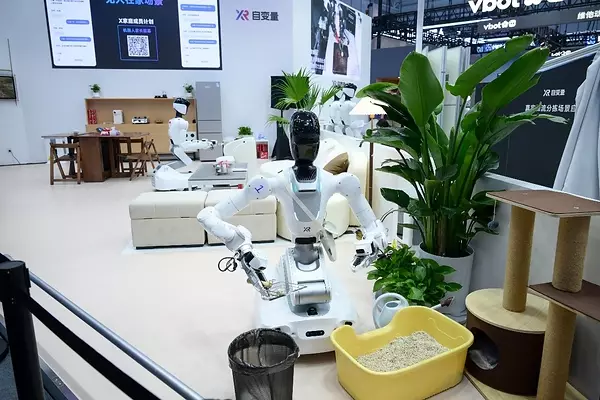
At the conference, X Square showcased its WALL-B technology across several robotic platforms. In a home environment, two wheeled humanoid robots responded to spoken commands. It performed tasks including organizing household items, retrieving and delivering objects, cleaning, watering plants and handling pet-related chores. Using coordinated two-arm manipulation and obstacle avoidance, the robot moved between rooms and carried out the requested tasks.
The exhibition demonstration formed part of X Square's broader effort to deploy robots in real homes. In March, the company partnered with Chinese local-services platform 58.com to launch a home-cleaning service, with robots working alongside professional cleaners during household visits. In May, X Square began placing robots with participating households for extended in-home service through its "X Family Member Program."
Elsewhere at the conference, a 22-degree-of-freedom, five-fingered dexterous hand completed a multi-stage fan-unboxing task powered by WALL-B. With its view partially obstructed by the box, the system opened the packaging, removed the fan from a confined space, placed it on a table, turned the fan on and visually verified that it was running. A separate dual-arm system responded to visitors' natural-language requests by selecting flowers of the specified color and arranging them in a vase. It adjusted its grip and positioning to handle flexible stems and deformable flowers, and replanned its movements when the flower basket or vase was moved during the task.
X Square extended its focus on real-world deployment into logistics. The WALL-B-powered system is already operating on a live parcel-sorting line and is designed to support continuous, round-the-clock operation. The WRC demonstration provided a public test of that capability. During the challenge, the WALL-B-powered system sorted 10,000 parcels in 5 hours, 14 minutes and 1 second, translating into an average throughput of 1,911 parcels an hour, or about 1.88 seconds per parcel.
During the challenge, the robots handled parcels that varied in size, shape, material and position. The system had to repeatedly identify, grasp, orient and sort the items, while correcting unsuccessful actions and responding to changes on the conveyor. Maintaining its throughput over thousands of parcels offered a measure of the consistency and endurance required in commercial logistics operations.
"Embodied AI requires a foundation model built specifically for the physical world, in parallel with the foundation models developed for the digital world. At X Square, our aim is to develop a common intelligence foundation that can operate across different robots, tasks and physical environments, while continuing to improve through real-world deployment," said Wang Qian, founder and CEO of X Square Robot.
Taken together, the demonstrations reflected X Square's broader view that embodied intelligence should not be tied to a single robot, task or environment. The company said it will continue integrating models and robotic hardware as it expands into additional home, logistics and industrial applications.
For more information, visit https://x2robot.com/.
About X Square Robot
X Square Robot focuses on developing its own general-purpose embodied AI models and robotic hardware. As a leading Chinese company in the field, it has pioneered the deployment of general-purpose embodied AI in real-world settings such as homes and logistics.
** This press release is distributed by PR Newswire through automated distribution system, for which the client assumes full responsibility. **
X Square Robot showcases the Power of "One Model, Many Applications" at WRC 2026