YANGON, Myanmar (AP) — Voting was held Sunday in Myanmar in the final round of a three-stage general election, capping a nearly monthlong process that has already ensured the country’s military rulers and their allies will command a parliamentary majority to form a new government.
Critics say the polls were neither free nor fair, and were designed to legitimize the power of the military after it ousted the elected civilian government of Aung San Suu Kyi in February 2021.
Click to Gallery
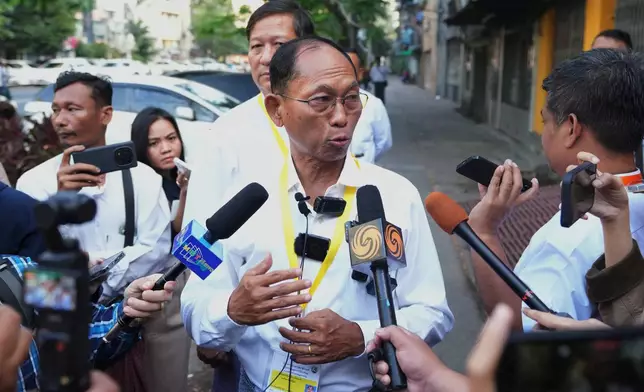
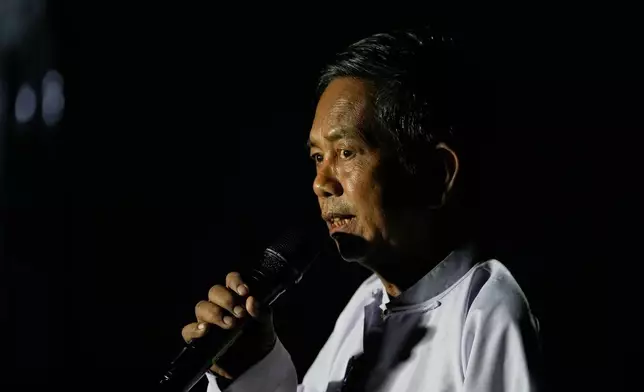
Ko Ko Gyi, chairman of the People's Party and leader of Myanmar's 1988 pro-democracy uprising, talks to journalists after casting his ballot at a polling station during the final round of general election Sunday, Jan. 25, 2026, in Yangon, Myanmar. (AP Photo/Thein Zaw)
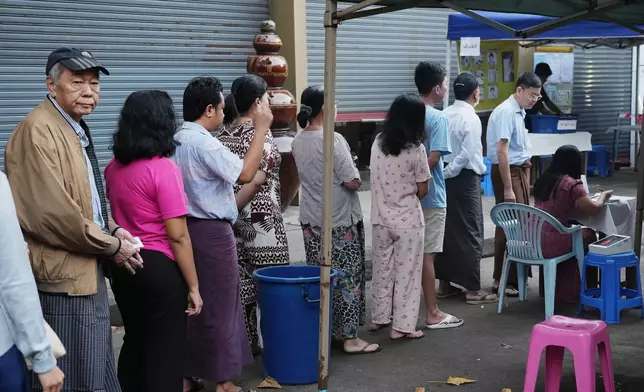
Voters line up to cast ballots at a polling station during the final round of general election Sunday, Jan. 25, 2026, in Yangon, Myanmar. (AP Photo/Thein Zaw)
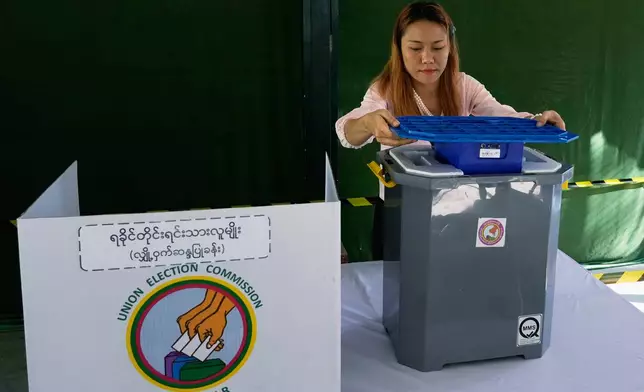
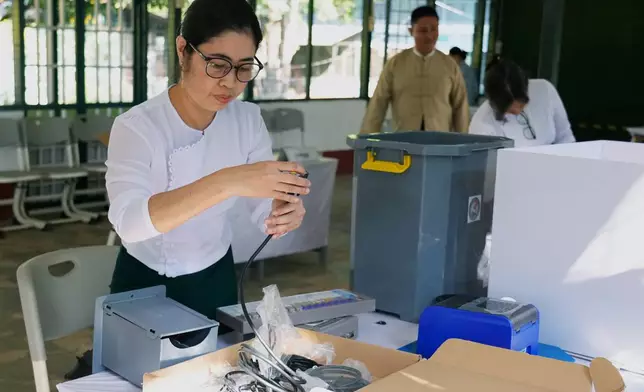
A official of the Union Election Commission prepares a voting booth at a polling station, one day ahead of the third phase of the general election, in Yangon, Myanmar, Saturday, Jan. 24, 2026. (AP Photo/Thein Zaw)
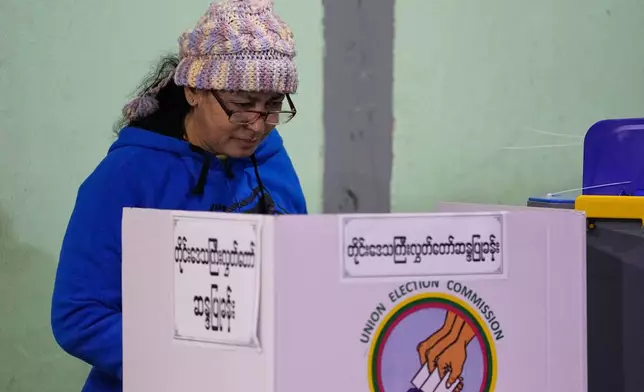
A voter casts her ballot at a polling station during the third phase of general election in Mandalay, central Myanmar, Sunday, Jan. 25, 2026. (AP Photo/Aung Shine Oo)
An official of the Union Election Commission sets up an electronic voting machine at a polling station, one day ahead of the third phase of the general election, in Yangon, Myanmar, Saturday, Jan. 24, 2026. (AP Photo/Thein Zaw)
An official of the Union Election Commission announces the open of a polling station during the third phase of general election in Mandalay, central Myanmar, Sunday, Jan. 25, 2026. (AP Photo/Aung Shine Oo)
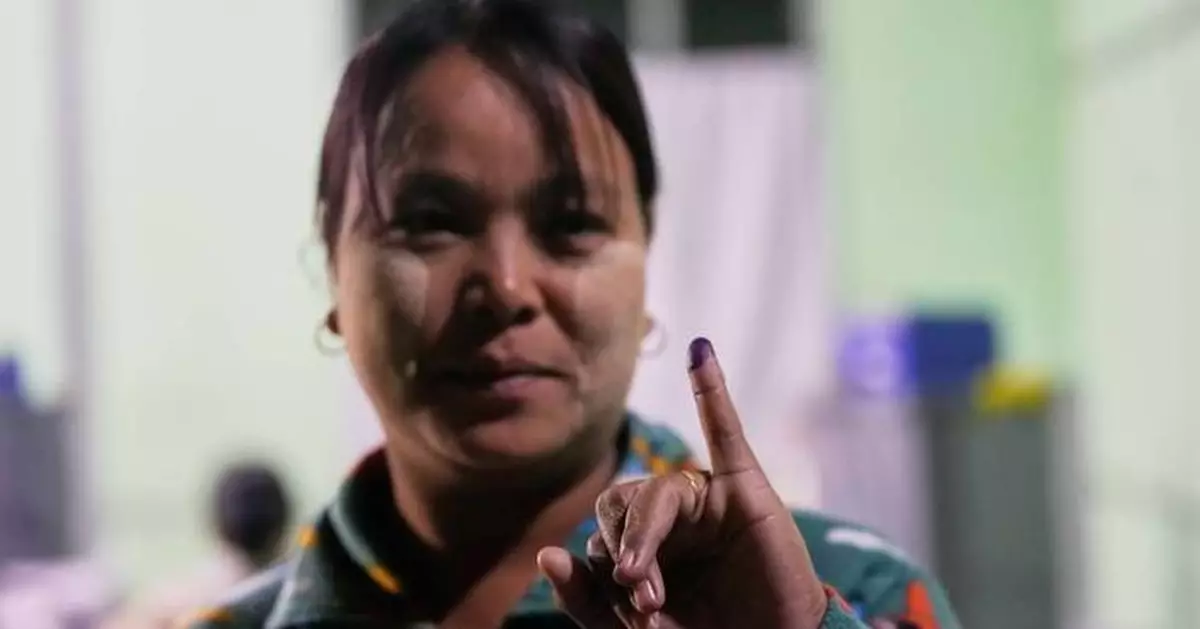
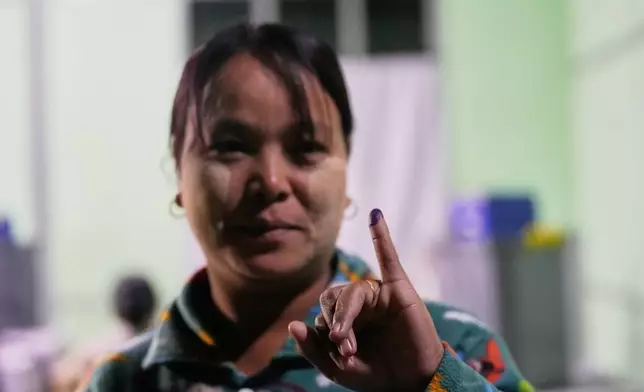
A voter holds up her finger marked with ink indicating she voted at a polling station during the third phase of general election in Mandalay, central Myanmar, Sunday, Jan. 25, 2026. (AP Photo/Aung Shine Oo)
The army-backed Union Solidarity and Development Party, or USDP, had already won most of the seats contested in the first two rounds of voting. Twenty-five percent of the seats in the upper and lower houses of the national Parliament are reserved for the military, guaranteeing it and its allies control of the legislature.
Senior Gen. Min Aung Hlaing, who heads the current military government, is widely expected by both supporters and opponents to assume the presidency when the new Parliament meets.
The army's 2021 takeover triggered widespread opposition that dragged Myanmar into a civil war. Security concerns engendered by the fighting meant voting was not held in more than one-fifth of the country’s 330 townships, another reason the process was described as neither free nor fair.
Malaysian Foreign Minister Mohamad Hasan on Tuesday said the Association of Southeast Asian Nations, of which Myanmar is a member, did not send observers and would not certify the election, citing concerns over the lack of inclusive and free participation.
Min Aung Hlaing pushed back against critics of the polls on Sunday, declaring that “the people who live in Myanmar are the ones who vote. Not those from outside."
“We are not concerned whether this is recognized by foreign countries or not. We recognize the people’s vote. It should be like that,” he told journalists after inspecting a polling station in Mandalay, the country’s second-largest city.
Asked if he intended to take part in the new government, he declined to comment, noting the president would be selected when Parliament meets.
Suu Kyi, Myanmar’s 80-year-old former leader, and her party did not participate in the polls. She is serving a 27-year prison term on charges widely viewed as spurious and politically motivated. Her party, the National League for Democracy, won landslide victories in the 2020 and 2015 elections, but was forced to dissolve in 2023 after refusing to register under new military rules.
Other parties also refused to register or declined to run under conditions they deem unfair, while opposition groups called for a voter boycott.
A new Election Protection Law imposed harsh penalties for most public criticism of the polls, with the authorities charging more than 400 people recently for activities such as leafleting or online activity.
Voting began on Sunday at 6 a.m. and ended at 4 p.m. in 61 townships across six regions and three states, including many areas that have seen clashes in recent months.
At the polling station in Dagon township in Yangon, the country’s largest city, 86-year-old Soe Tint said he cast his ballot because he wants the country to be peaceful and develop “in all sectors, including education.”
At the same station, Lae Lae Yi, 62, was less hopeful.
“I’m not expecting anything at all, because there is no motivation,” she said.
Fighting was reported in at least one township holding polls, with five people injured on Sunday, independent online media, including the Irrawaddy, reported.
The previous two rounds of voting were disrupted by armed groups opposed to military rule carrying out attacks on polling stations and government buildings in several townships, killing at least two administrative officials, according to the military government.
The election was held in three phases due to the armed conflict. The first two rounds took place on Dec. 28 and Jan. 11 in 202 of the country’s 330 townships. A total of 67 townships — mostly areas controlled by armed opposing groups — did not participate, reducing the original seats in the 664-member national parliament to 586.
Final results for all parliament seats are expected to be announced later this week. The military government has announced that Parliament will be convened in March, and the new government will take up its duties in April.
The party with a majority in the combined upper and lower houses of Parliament can select the new president, who in turn names a Cabinet and forms a new government.
More than 4,800 candidates from 57 political parties are competing for seats in national and regional legislatures, though only six are contesting nationwide. Seventeen other parties aside from the USDP have won a small number of seats in the legislature, ranging from one to 10.
Ko Ko Gyi, chairman of the People’s Party, which has won a seat in the national parliament, told journalists that checks and balances would be weakened if only a single party dominated the legislature.
“Since the government is chosen solely by parliament here, if a single party comes to dominate the legislature, the political system becomes one in which the winning party dominates the government,” said Ko Ko Gyi after casting a vote.
The military government said there are more than 24 million eligible voters, about 35% fewer than in 2020. The turnout in the first two rounds of voting was between 50% and 60%, it announced.
Peck reported from Bangkok.
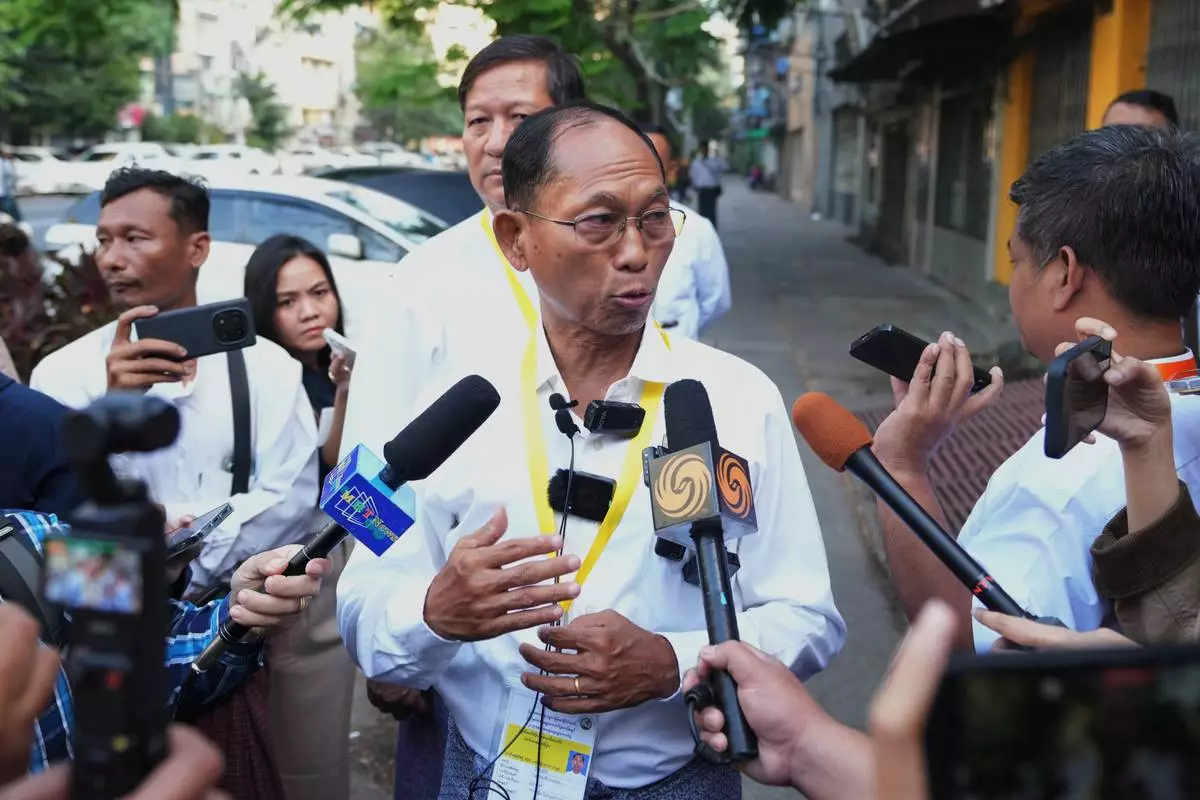
Ko Ko Gyi, chairman of the People's Party and leader of Myanmar's 1988 pro-democracy uprising, talks to journalists after casting his ballot at a polling station during the final round of general election Sunday, Jan. 25, 2026, in Yangon, Myanmar. (AP Photo/Thein Zaw)
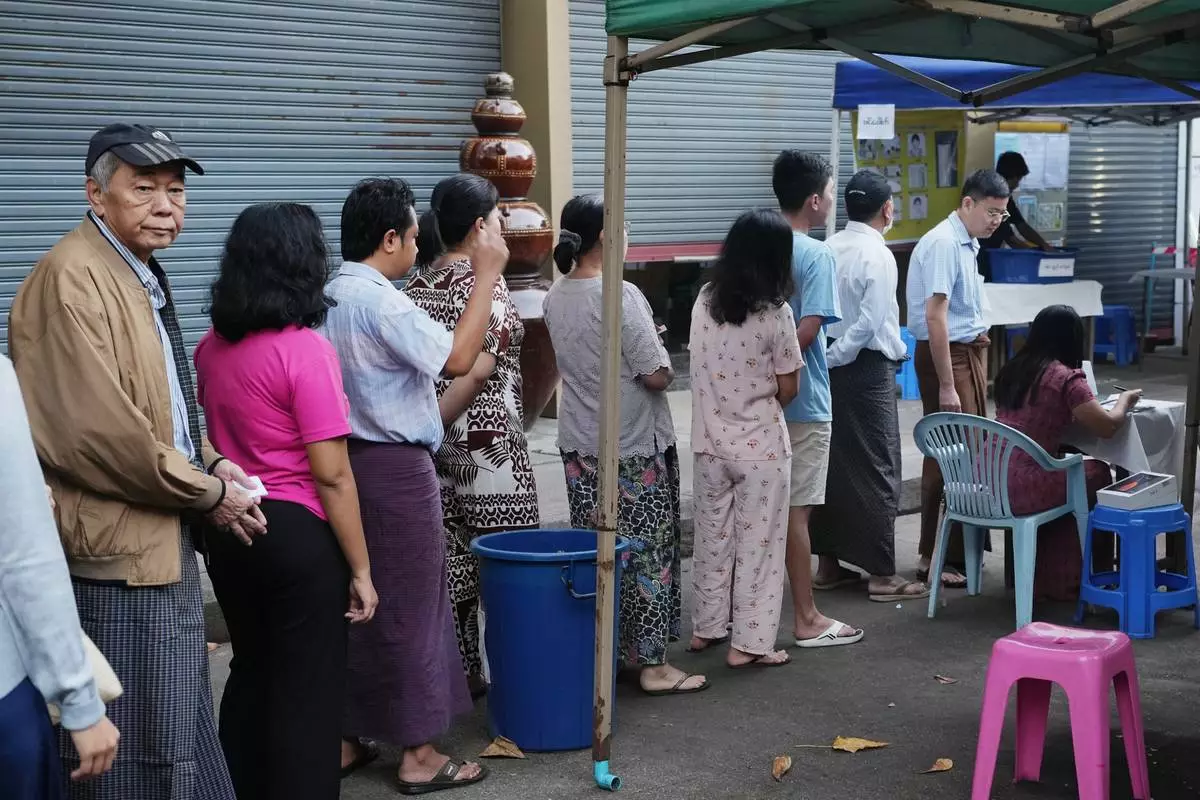
Voters line up to cast ballots at a polling station during the final round of general election Sunday, Jan. 25, 2026, in Yangon, Myanmar. (AP Photo/Thein Zaw)
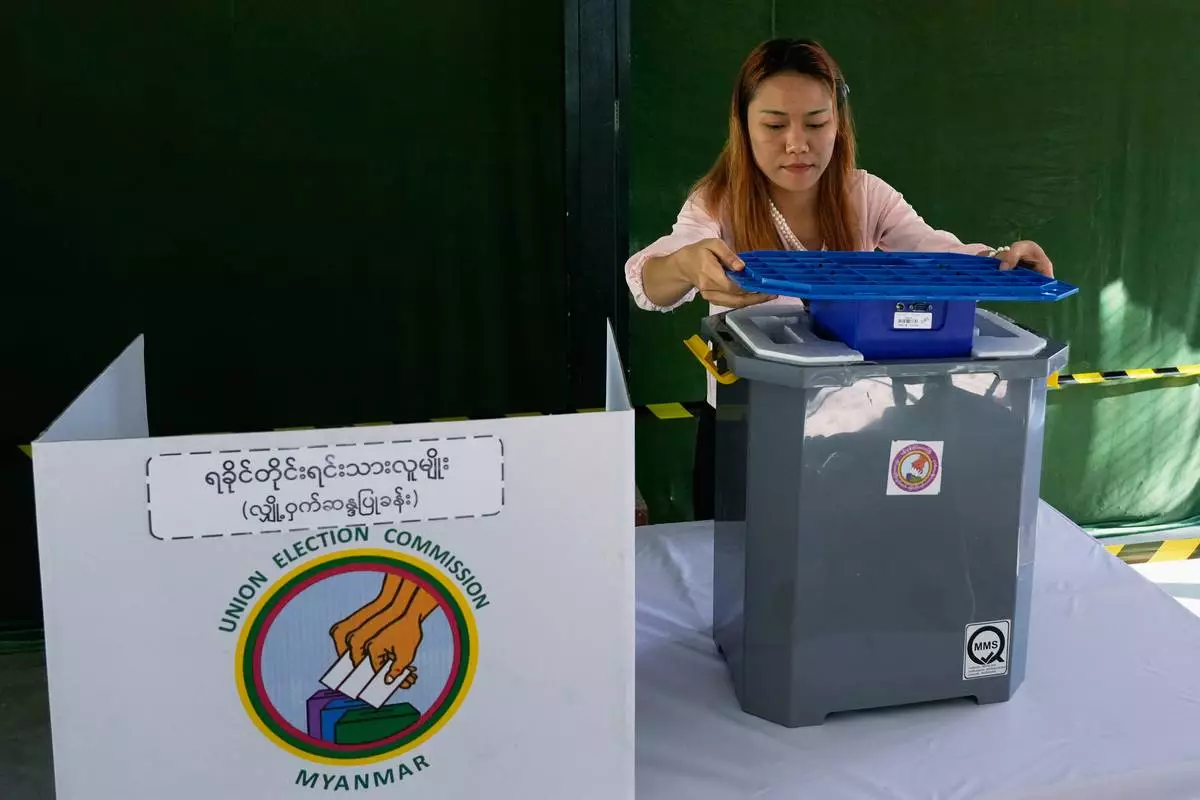
A official of the Union Election Commission prepares a voting booth at a polling station, one day ahead of the third phase of the general election, in Yangon, Myanmar, Saturday, Jan. 24, 2026. (AP Photo/Thein Zaw)
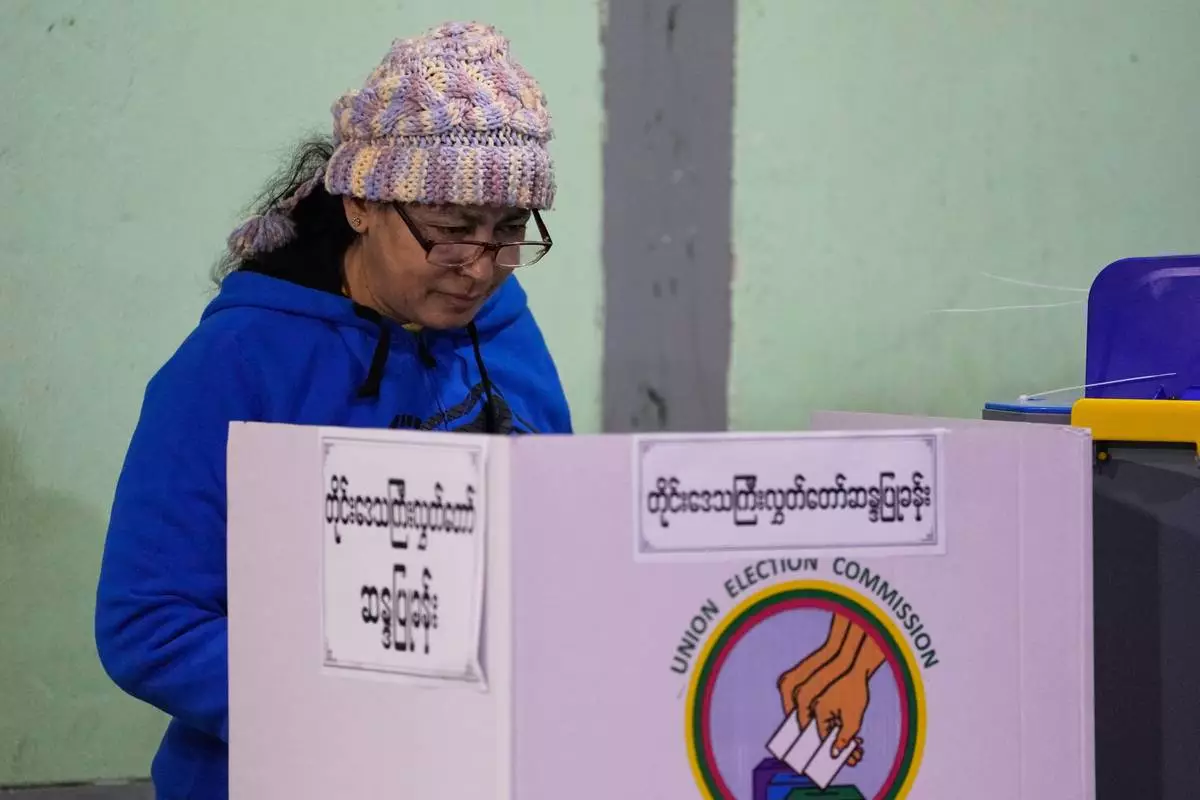
A voter casts her ballot at a polling station during the third phase of general election in Mandalay, central Myanmar, Sunday, Jan. 25, 2026. (AP Photo/Aung Shine Oo)
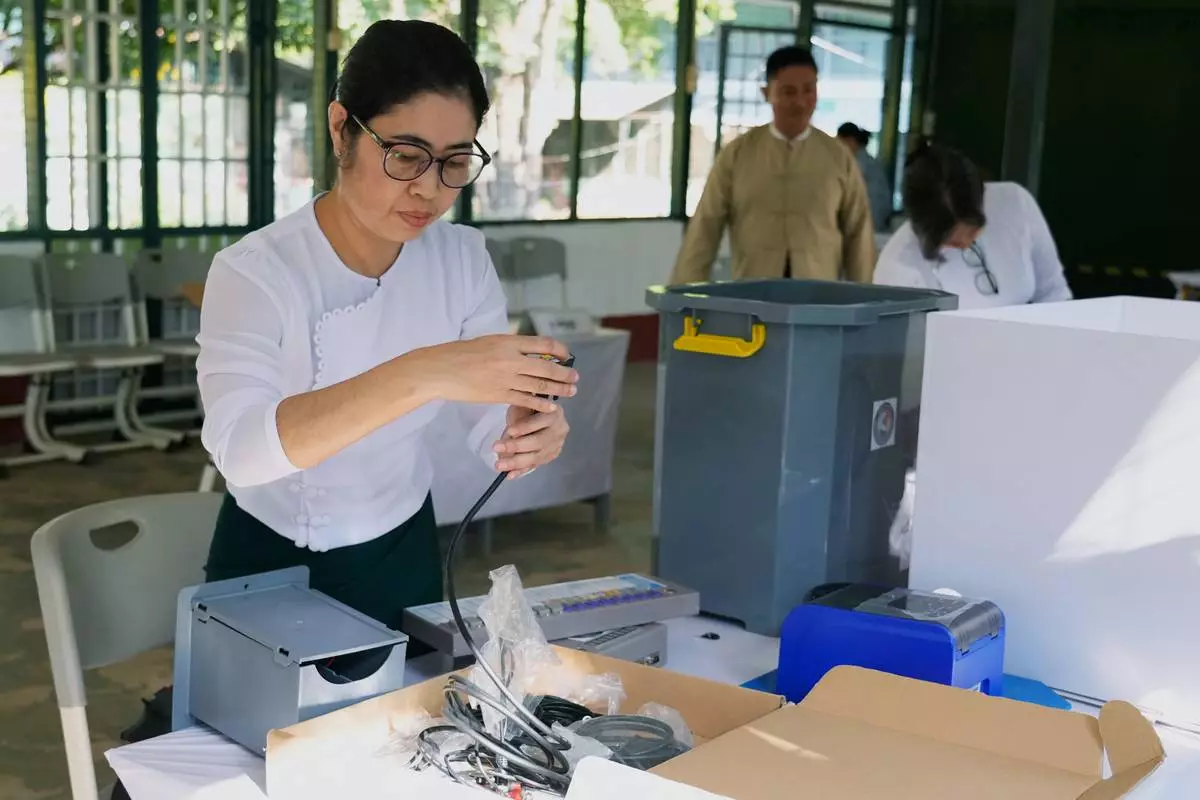
An official of the Union Election Commission sets up an electronic voting machine at a polling station, one day ahead of the third phase of the general election, in Yangon, Myanmar, Saturday, Jan. 24, 2026. (AP Photo/Thein Zaw)
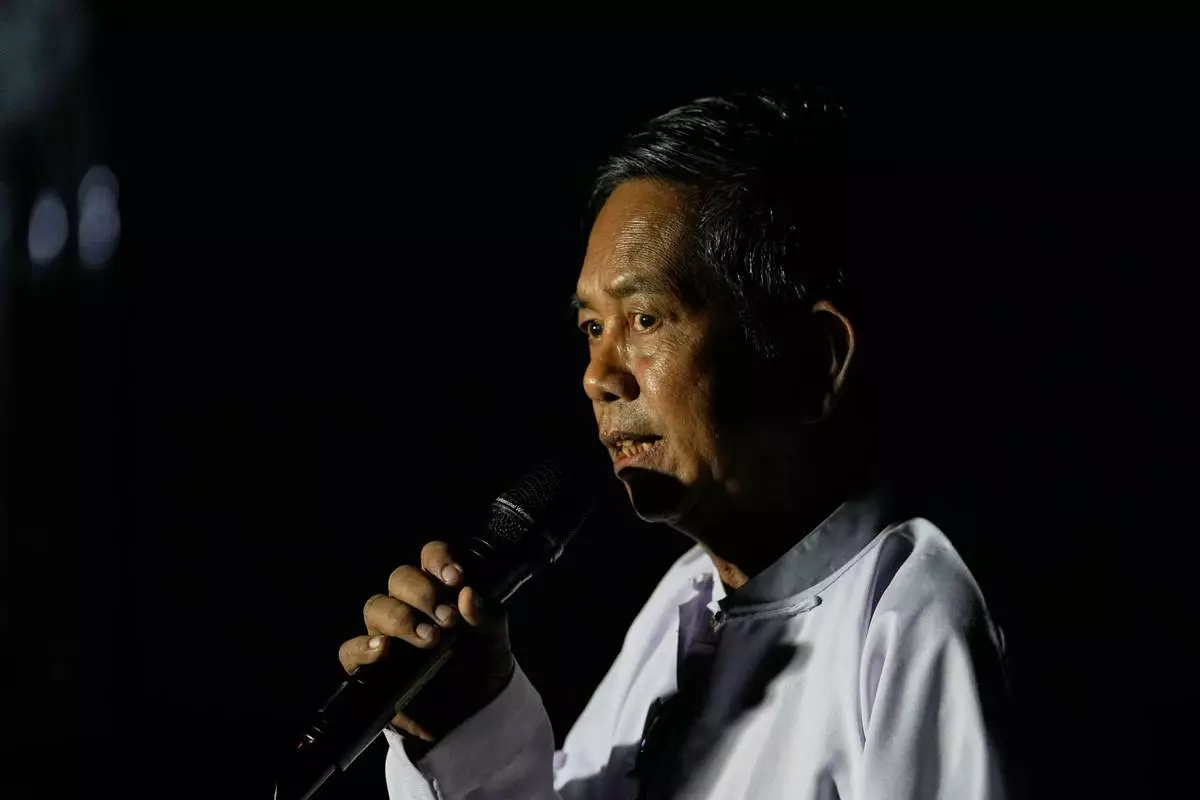
An official of the Union Election Commission announces the open of a polling station during the third phase of general election in Mandalay, central Myanmar, Sunday, Jan. 25, 2026. (AP Photo/Aung Shine Oo)
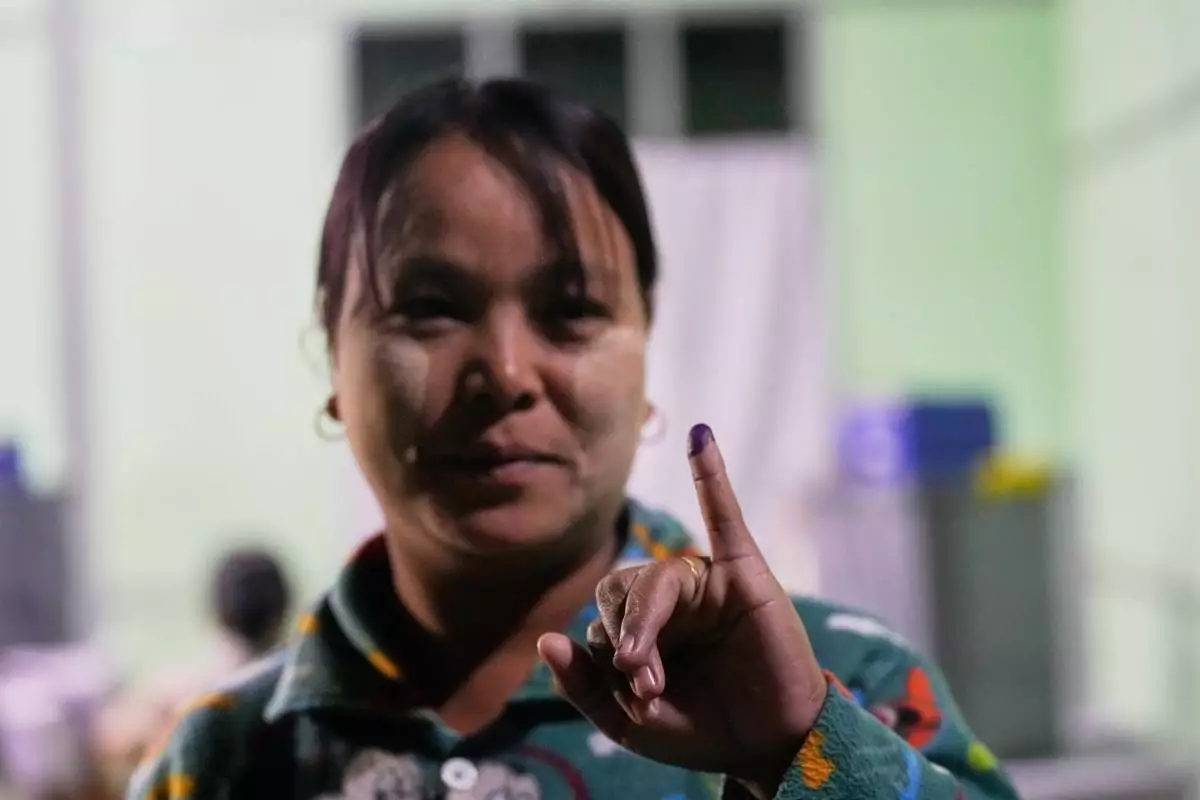
A voter holds up her finger marked with ink indicating she voted at a polling station during the third phase of general election in Mandalay, central Myanmar, Sunday, Jan. 25, 2026. (AP Photo/Aung Shine Oo)
DUBAI, United Arab Emirates (AP) — The U.S. Treasury Department announced Thursday it was taking steps to further ease sanctions on Russian oil as crude prices surge during the Iran war.
The agency said that it was granting a license that authorizes the delivery and sale of some sanctioned Russia crude oil and petroleum products for the next month.
Trump signaled earlier this week that he would take further action to ease restrictions on sanctioned oil to help make for the loss of oil flowing on the market because of the effective closure of the Strait of Hormuz.
The move follows the Trump administration granting temporary permission for India to buy Russian oil.
THIS IS A BREAKING NEWS UPDATE. AP’s earlier story follows below.
DUBAI, United Arab Emirates (AP) — Iran’s secretive new leader issued his first public statements Thursday, resolving to keep fighting, promising more pain for Gulf Arab states and threatening to open “other fronts” in a war that has already disrupted world energy supplies, the global economy and international travel.
The hard-line stance revealed by Supreme Leader Ayatollah Mojtaba Khamenei came as Israeli Prime Minister Benjamin Netanyahu said his country's attacks were creating conditions for the Iranian population to topple the government.
“It is in your hands,” Netanyahu said at a news conference, addressing the Iranian people. “We are creating the optimal conditions for the fall of the regime.”
Since the start of the war, U.S. and Israeli strikes have targeted security checkpoints in Iran to undermine the government’s ability to suppress dissent, according to Armed Conflict Location and Event Data, the U.S-based independent monitoring group known as ACLED.
Netanyahu denounced Khamenei as a “puppet of the Revolutionary Guards."
Khamenei is close to Iran’s paramilitary Revolutionary Guard and is widely seen as even less compromising than his father, Ayatollah Ali Khamenei. His location is unknown, and he is likely a prime target for the U.S. and Israel.
Khamenei said in a statement read by a state TV news anchor that he was keeping a “file of revenge.” He did not appear on camera and has not been seen since his father and wife were killed in the war’s opening salvo, which also wounded him, according to an Iranian ambassador.
The war continued to escalate on its 13th day as oil prices spiraled up again to $100 per barrel, and stocks sank worldwide over fears that the conflict could drag on longer than hoped.
Iran has made clear it plans to keep up attacks on energy infrastructure across the region and use the effective closure of the strategic Strait of Hormuz as leverage against the United States and Israel.
At a news conference Thursday, Iran’s ambassador to Tunisia, Mir Masoud Hosseinian, said Iranian naval forces “have established full control” over the strait and “carried out precise strikes in response to attacks on our oil infrastructure.” A fifth of the world’s traded oil flows through the waterway leading from the Persian Gulf toward the Indian Ocean.
“Global energy security is contingent on respect for Iran’s sovereignty,” he said.
He told The Associated Press the new supreme leader was wounded in the attack on his family’s home, but “it is not serious.” The hope is he will attend the massive, state-organized Eid prayer next week that his father traditionally led.
Hosseinian added that Iran’s strikes on Gulf nations have also been strategic.
“Even when we targeted hotels, we had precise information that they were hosting American and Israeli soldiers,” he said.
Khamenei called on Gulf Arabs to “shut down” U.S. bases in the region, saying protection promised by Washington was “nothing more than a lie.”
He also said Iran has studied “opening other fronts in which the enemy has little experience and would be highly vulnerable” if the war continues. He did not elaborate, but Iran has been linked to previous attacks on U.S., Israeli and Jewish targets around the world.
U.S. President Donald Trump said in a social media post Thursday that ensuring Iran does not develop a nuclear weapon was a higher priority than soaring oil prices.
Hours later, Netanyahu announced Israeli attacks had killed a top Iranian nuclear scientist and hit others but gave few details.
Israel said earlier it struck a nuclear facility in Iran in recent days that it had destroyed with an airstrike in October 2024. Earlier this year, satellite photos raised concerns that Iran was working to restore the facility.
As Netanyahu spoke, the Israeli military said it had detected a new barrage of missiles launched from Iran toward Israel.
The U.S. military said American forces have now struck more than 6,000 targets since the operation against Iran began, including more than 30 minelaying vessels.
British officials said several U.S. personnel suffered minor injuries Wednesday night when drone strikes in northern Iraq hit a base in Irbil that houses both British and American troops.
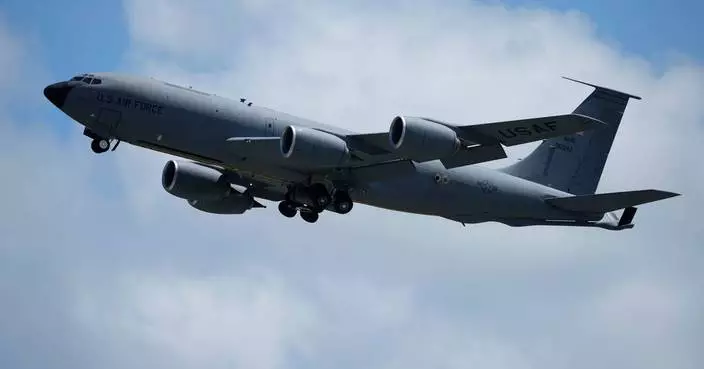
And on Thursday in western Iraq, rescue efforts were underway after an American military refueling plane went down. U.S. Central Command, which oversees the Middle East, said in a statement that the mishap involved two aircraft, including one that landed safely, and that the cause was not related to hostilities.
Israeli warplanes pummeled Lebanon, targeting even the busy heart of Beirut, in response to missiles from Iran-backed Hezbollah fighters launched into Israel. One strike hit in a neighborhood that is close to Lebanon’s parliament, United Nations offices and international embassies.
Israeli military spokesperson Avichay Adraee said forces were targeting a “facility affiliated with Hezbollah.”
An Israeli strike also hit in the vicinity of Lebanon’s only public university, killing a professor and the director of the science faculty at the campus in Hadath, on the outskirts of Beirut’s southern suburbs. There was no immediate comment from Israel.
An Israeli strike on a village in southern Lebanon killed nine people, including five children, the Lebanese Health Ministry said, adding that seven others were wounded. An AP photographer who visited the scene found several buildings flattened and widespread destruction, while rescue workers searched through the rubble.
Two other Israeli strikes on separate towns in southern Lebanon killed six more people, the health ministry said.
The U.N. refugee agency said up to 3.2 million people in Iran have been displaced by the ongoing war. It said most have fled from Tehran and other major cities toward the north of the country or rural areas. Around 800,000 people have been internally displaced in Lebanon, prompting fears of a humanitarian crisis.
Ben Mbarek reported from Tunis, Tunisia. El-Deeb reported from Beirut. Watson reported from San Diego. Associated Press writers David Rising in Bangkok; Mike Corder in The Hague, Netherlands; Natalie Melzer in Mitzpe Hila, Israel; Koral Saeed in Herzliya, Israel; Sally Abou AlJoud and Kareem Chehayeb in Beirut; Luena Rodriguez-Feo Vileira and Ben Finley in Washington; and Jill Lawless in London contributed to this report.
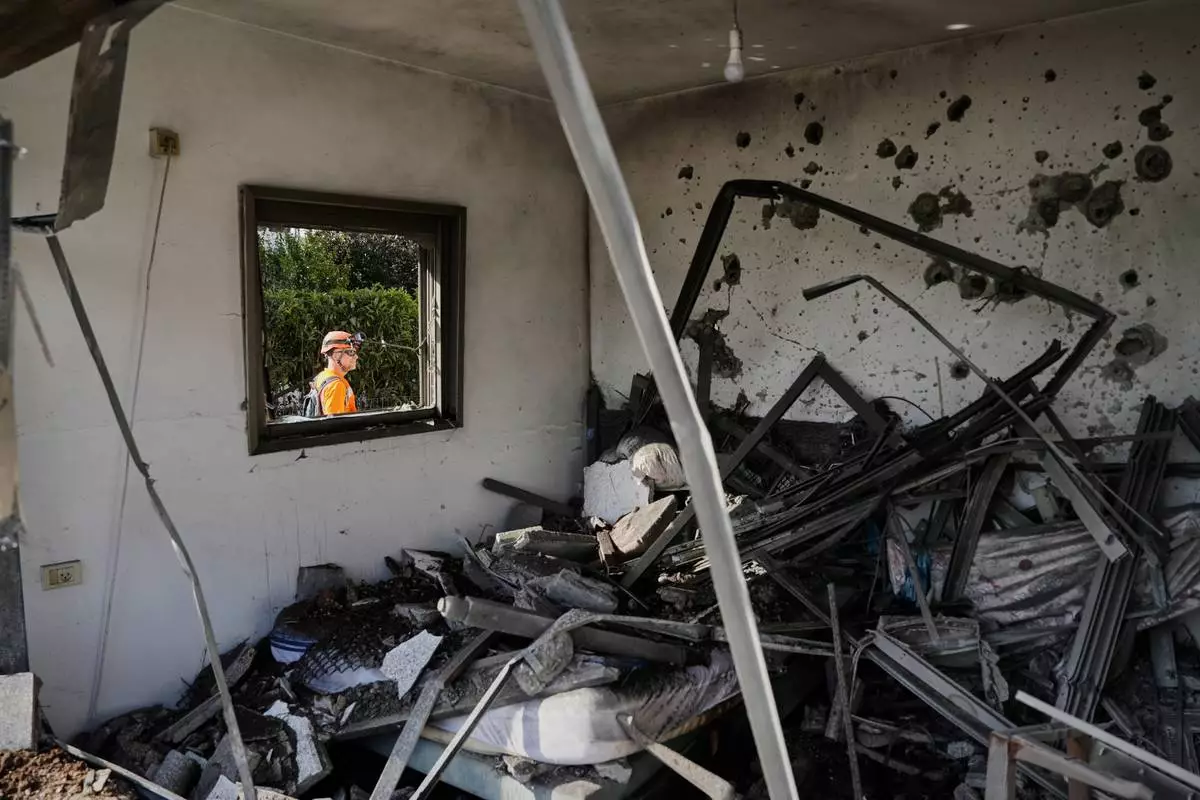
Israeli authorities inspect homes damaged by a projectile launched from Lebanon, in Haniel, central Israel, Thursday, March 12, 2026. (AP Photo/Baz Ratner)
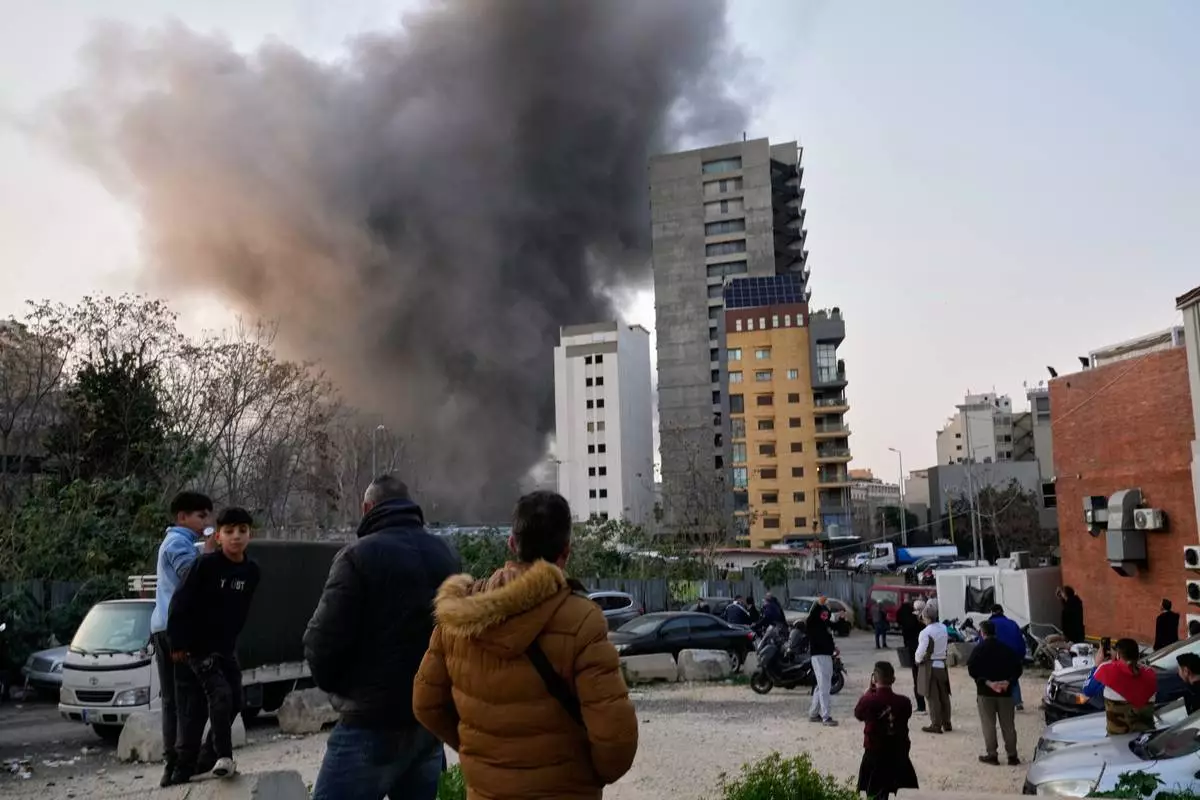
Residents watch as smoke rises from a nearby building during an Israeli strike in central Beirut, Lebanon, Thursday, March 12, 2026. (AP Photo/Hussein Malla)
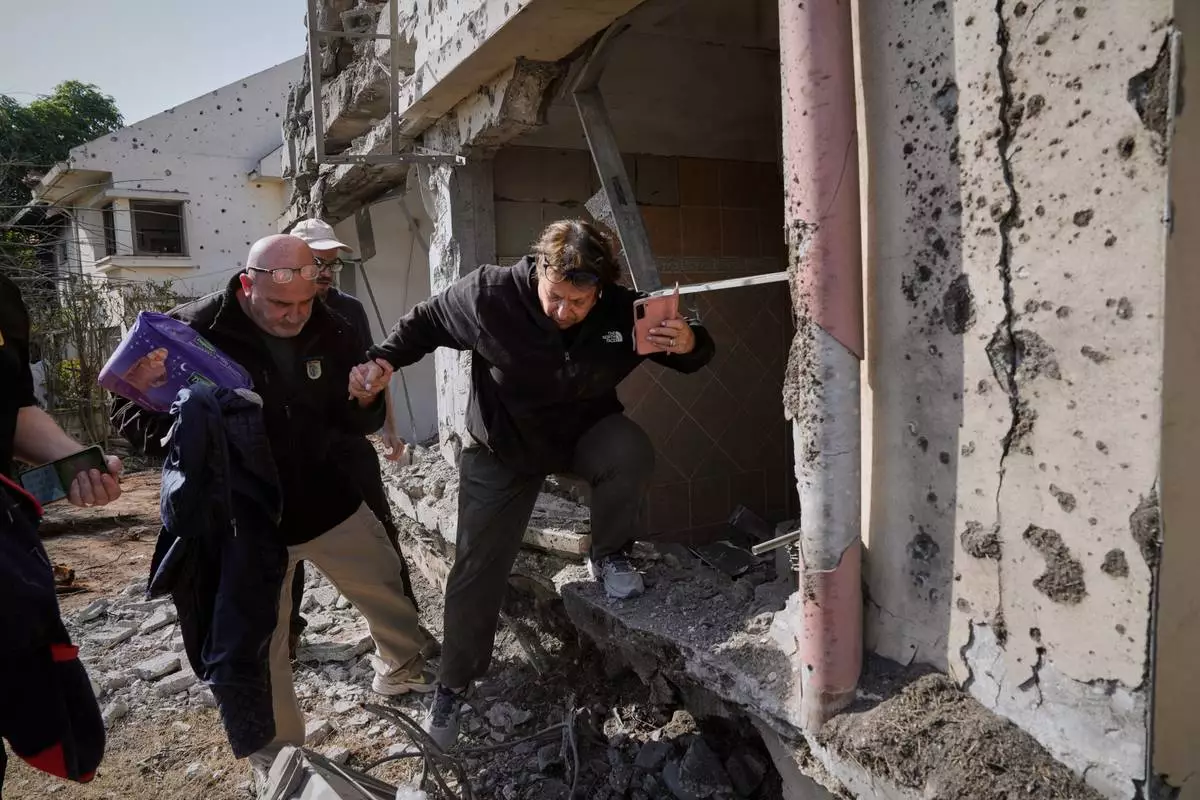
A woman gathers belongings from her family's home after it was damaged by a projectile launched from Lebanon, in Haniel, central Israel, Thursday, March 12, 2026. (AP Photo/Baz Ratner)
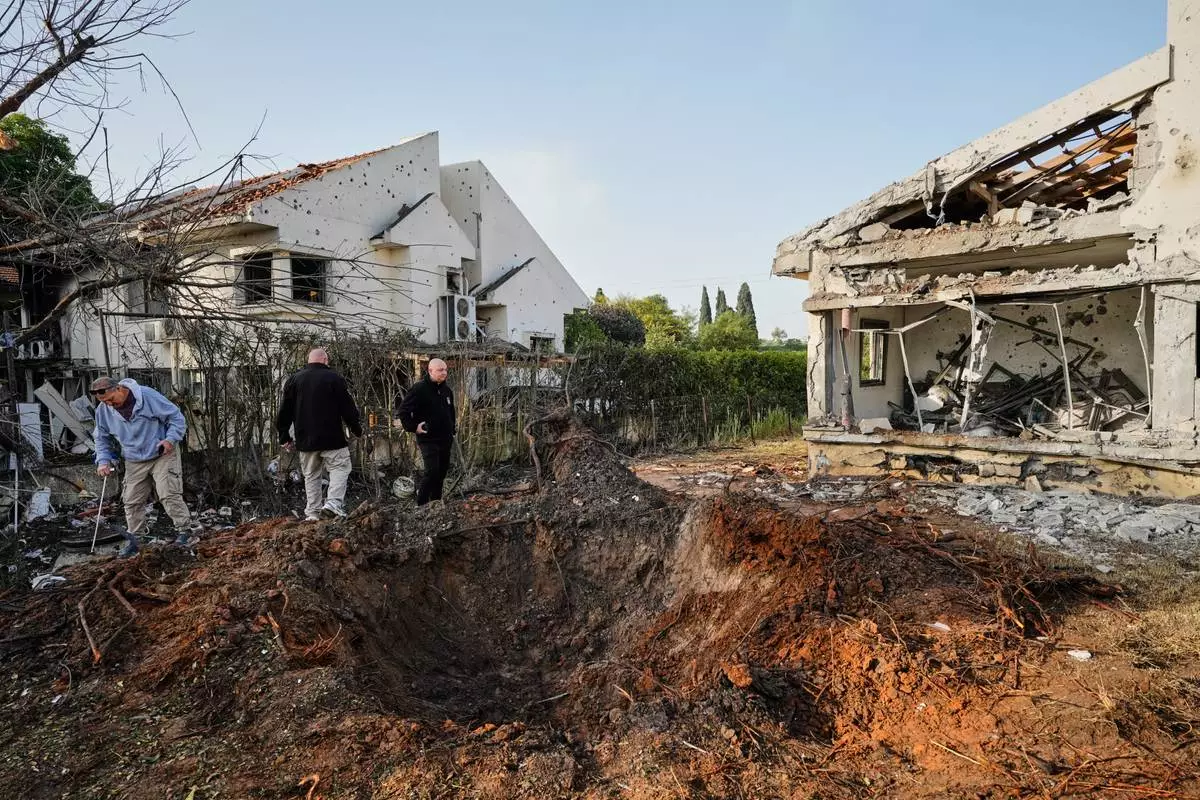
People inspect homes damaged by a projectile launched from Lebanon, in Haniel central Israel, Thursday, March 12, 2026. (AP Photo/Baz Ratner)
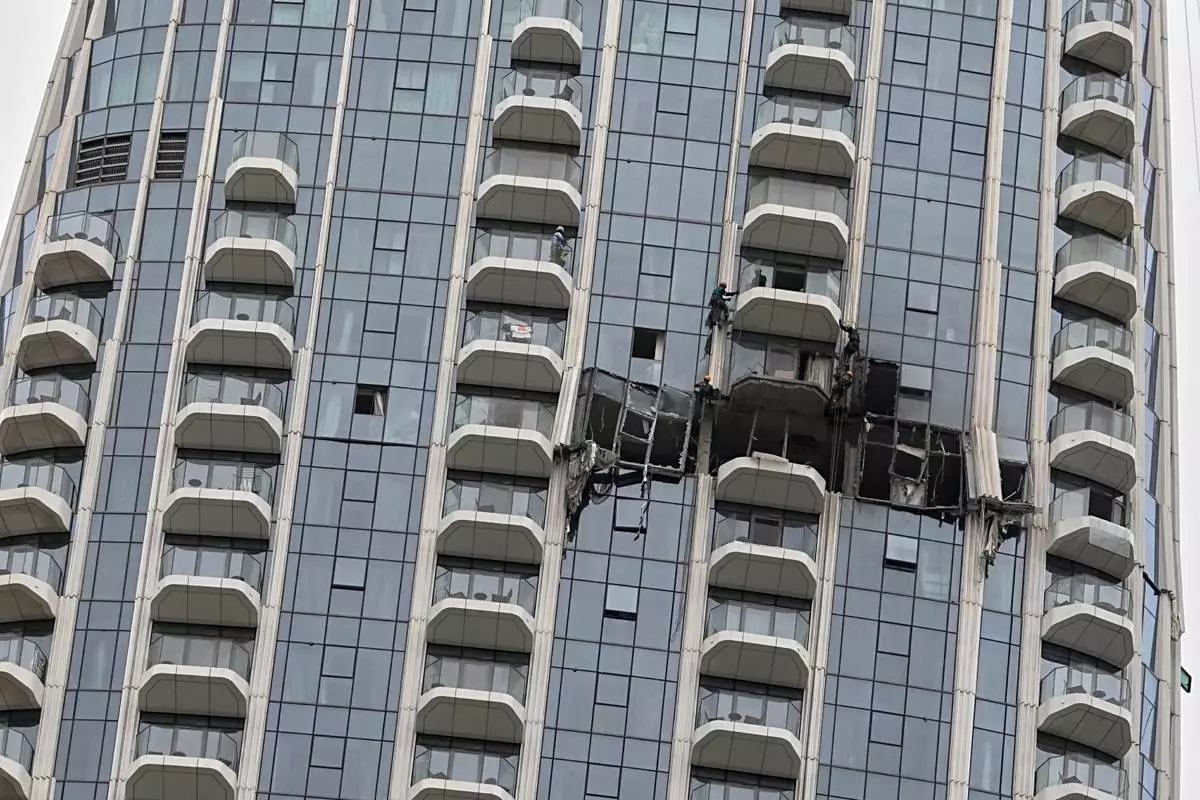
Workers inspect damage caused by a drone strike overnight at the Address Creek Harbour hotel in Dubai, United Arab Emirates, March 12, 2026. (AP Photo/Fatima Shbair)
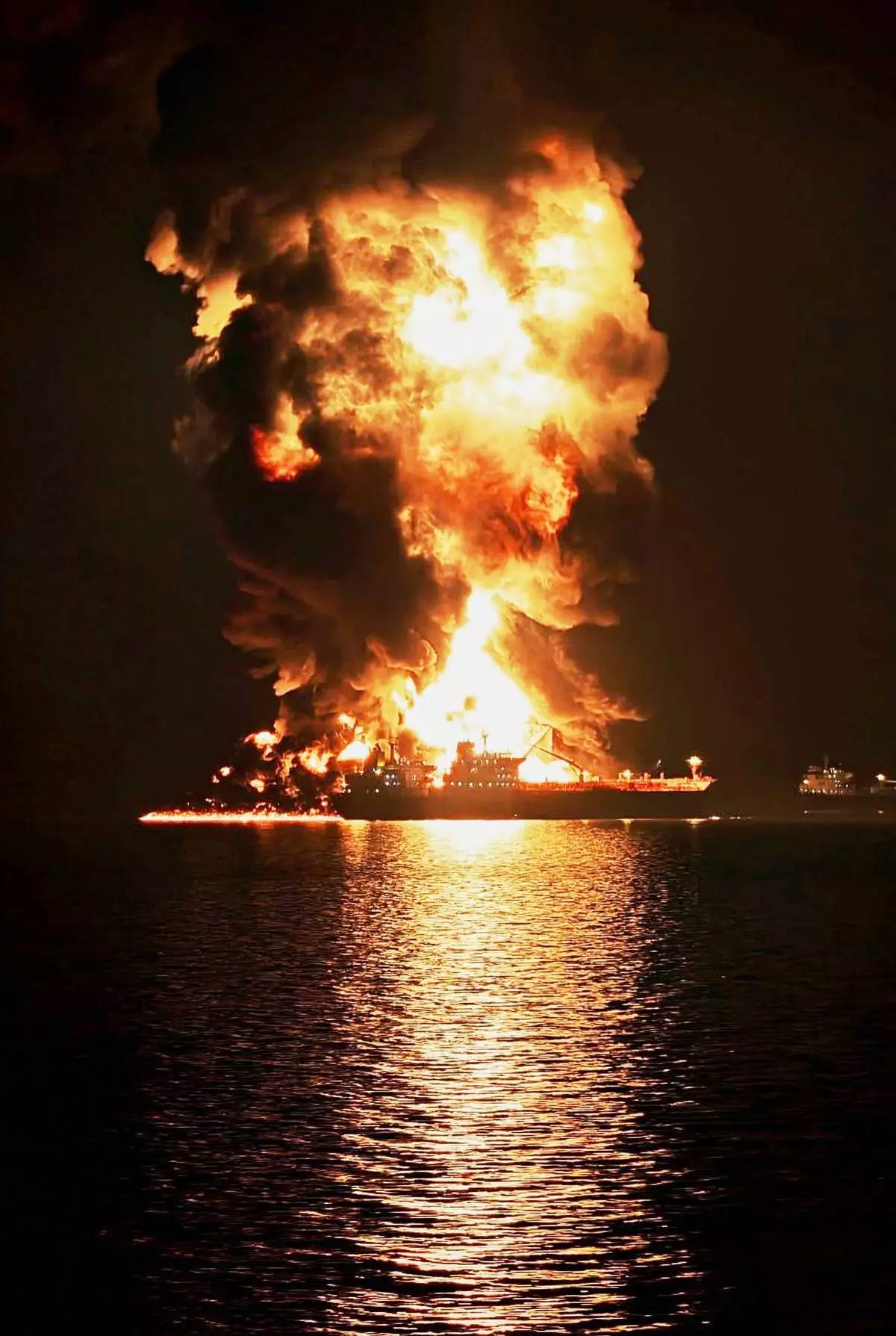
An oil tanker burns after being hit by an Iranian strike in the ship-to-ship transfer zone at Khor al-Zubair port near Basra, Iraq, late Wednesday, March 11, 2026. (AP Photo)
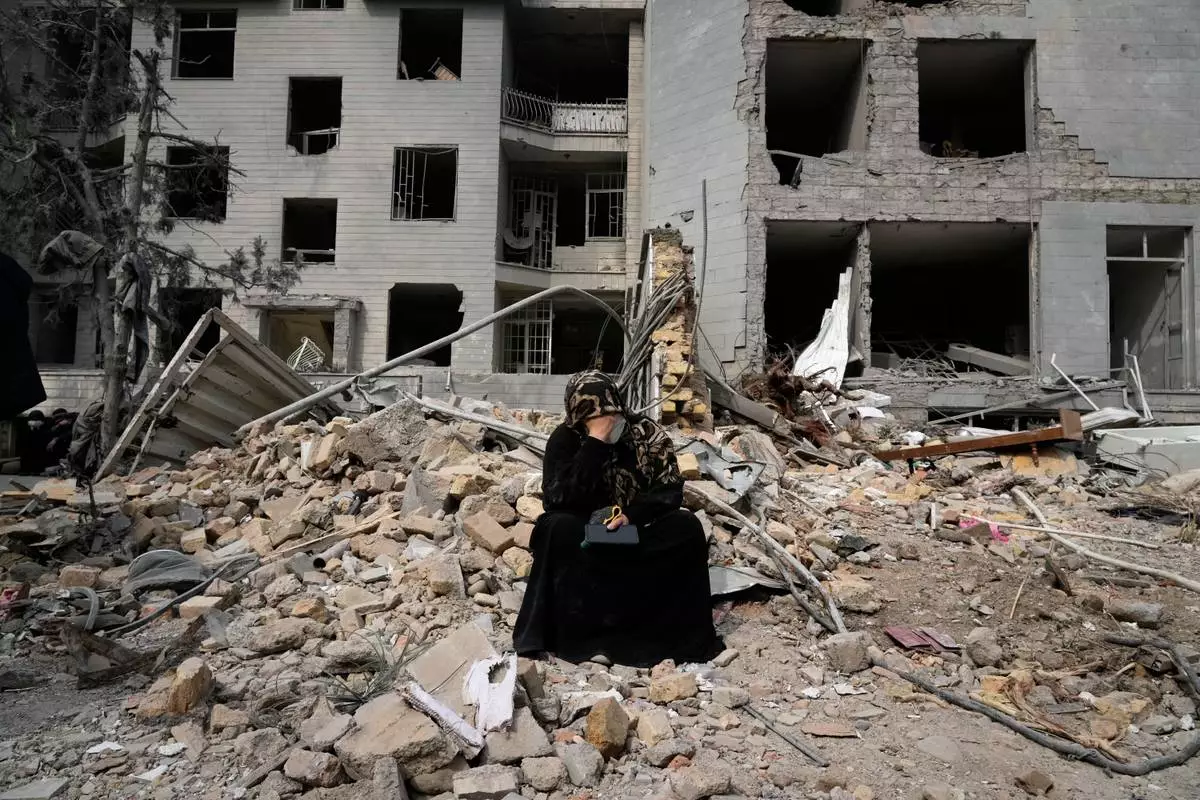
A woman sits on rubble across from a residential building damaged last Monday during the U.S.-Israeli air campaign in Tehran, Iran, Thursday, March 12, 2026. (AP Photo/Vahid Salemi)
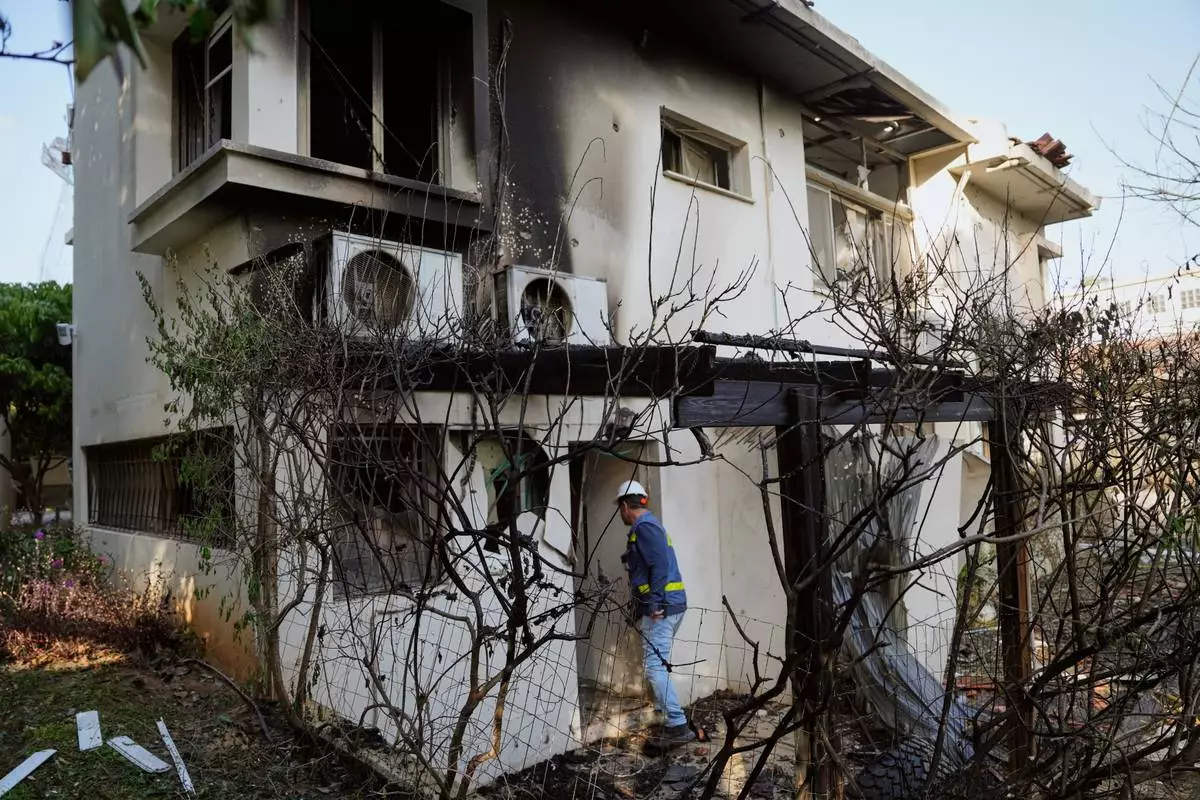
Israeli authorities inspect homes damaged by a projectile launched from Lebanon, in Haniel central Israel, Thursday, March 12, 2026. (AP Photo/Baz Ratner)
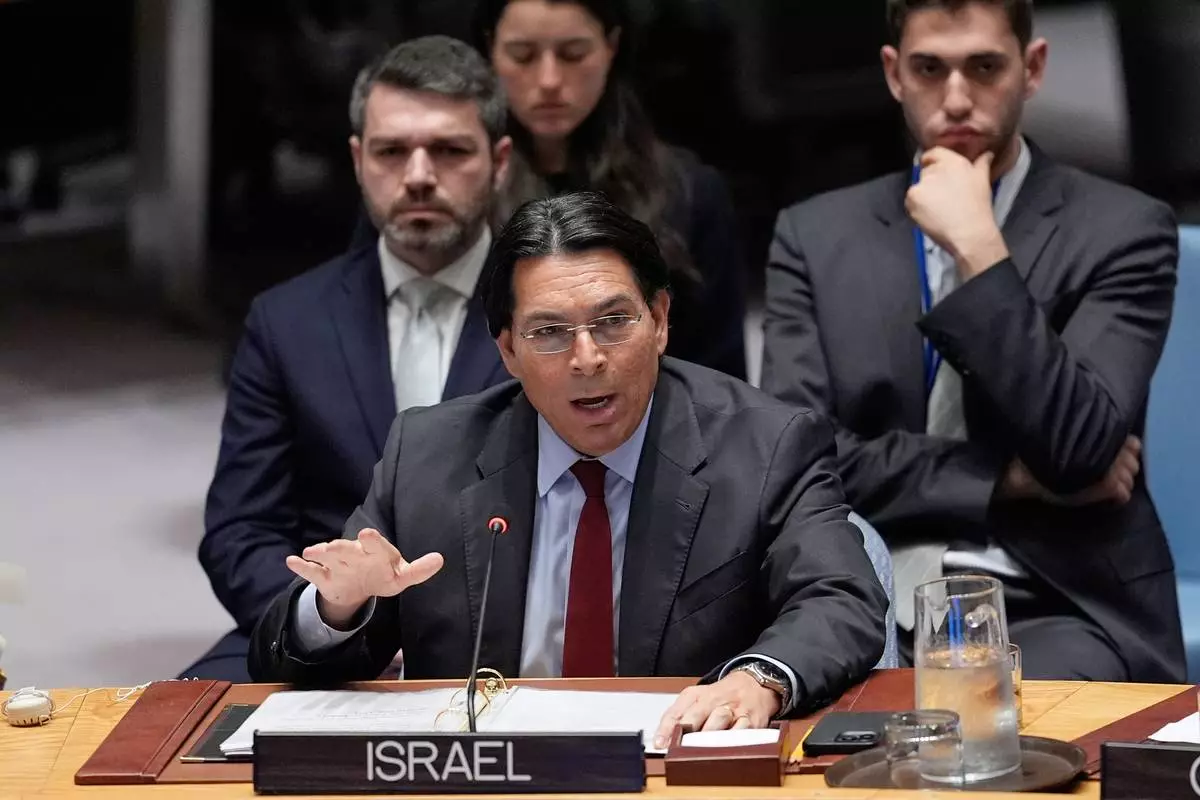
Israel Ambassador to the United Nations Danny Danon speaks during a meeting of the Security Council at U.N. headquarters, Wednesday, March 11, 2026. (AP Photo/Seth Wenig)
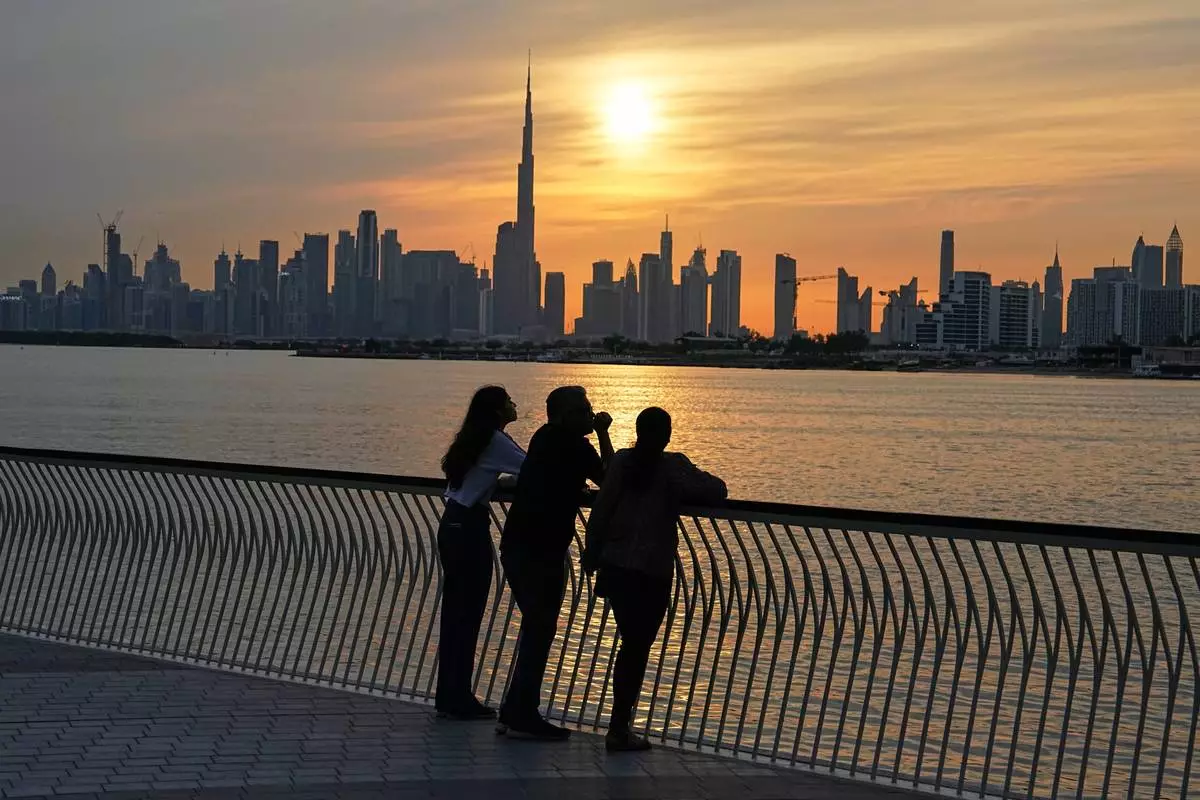
A family enjoys the sunset with the view of the city skyline and Burj Khalifa, at Dubai Creek Harbour in Dubai, United Arab Emirates, Wednesday, March 11, 2026. (AP Photo/Fatima Shbair)
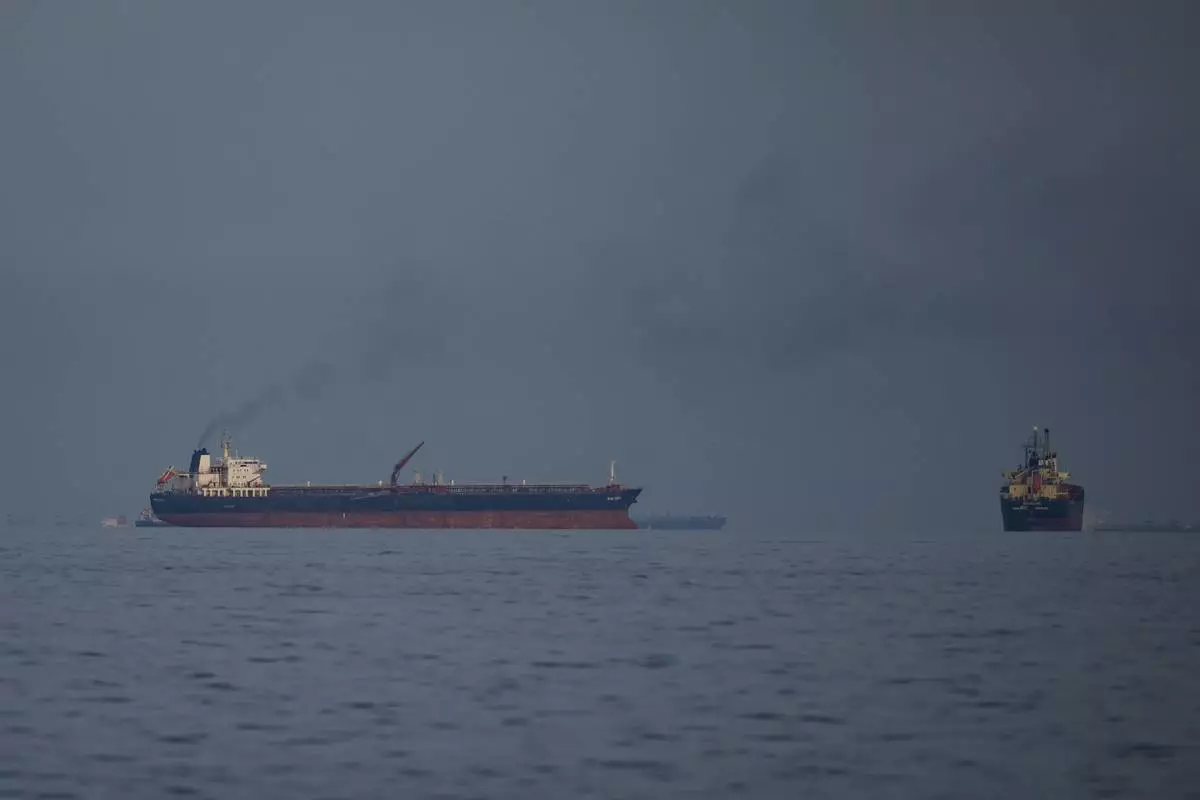
Oil tankers and cargo ships line up in the Strait of Hormuz as seen from Khor Fakkan, United Arab Emirates, Wednesday, March 11, 2026. (AP Photo/Altaf Qadri)
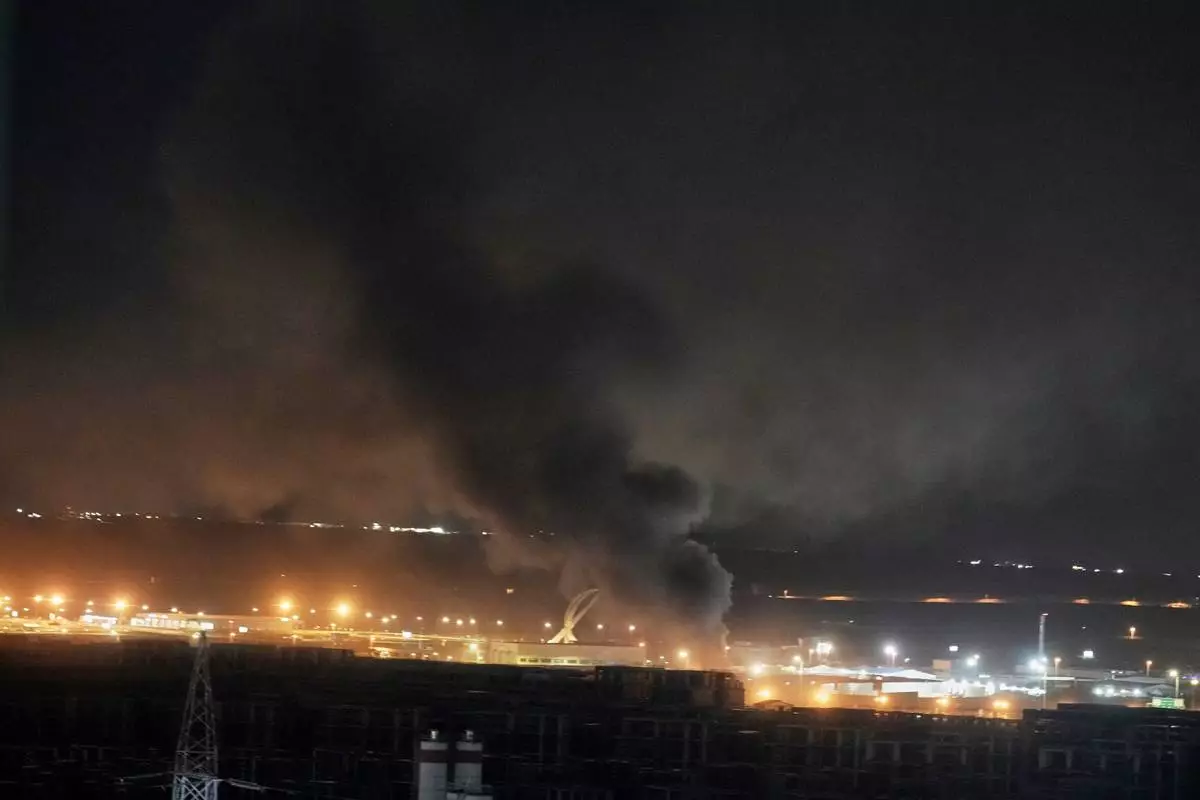
Smoke rises after an explosion at the airport in Irbil, Iraq, late Wednesday, March 11, 2026. (AP Photo/Leo Correa)

A man inspects a car damaged in an Israeli airstrike at the Ramlet al-Baida public beach in Beirut, Lebanon, early Thursday, March 12, 2026. (AP Photo/Bilal Hussein)