Skip to Content Facebook Feature Image

Federal judge dismisses Justice Department lawsuit seeking Oregon's voter rolls

News

Federal judge dismisses Justice Department lawsuit seeking Oregon's voter rolls
News

News

Federal judge dismisses Justice Department lawsuit seeking Oregon's voter rolls

2026-01-27 11:14 Last Updated At:11:40

PORTLAND, Ore. (AP) — A federal judge in Oregon dismissed a Justice Department lawsuit seeking Oregon's unredacted voter rolls on Monday in another setback to wide-ranging efforts by President Donald Trump's administration to get detailed voter data from states.

In a hearing, U.S. District Judge Mustafa Kasubhai said he would dismiss the suit and issue a final written opinion in the coming days. The updated docket for the case showed that Oregon's move to dismiss the case was granted.

Oregon Attorney General Dan Rayfield welcomed the move.

“The court dismissed this case because the federal government never met the legal standard to get these records in the first place,” he said in an emailed statement. "Oregonians deserve to know that voting laws can’t be used as a backdoor to grab their personal information.”

The Justice Department declined to comment.

Kasubhai scheduled the hearing after U.S. Attorney General Pam Bondi sent a letter to Minnesota Gov. Tim Walz dated Saturday, the same day federal immigration agents fatally shot 37-year-old ICU nurse Alex Pretti in Minneapolis, which has seen widespread protests over increased immigration enforcement and the previous killing of Renee Good by an immigration officer.

In her letter, Bondi asked the Democratic governor to support immigration officers and shared three “simple steps” to “help bring back law and order" — including by giving the Justice Department the ability to “access voter rolls to confirm that Minnesota's voter registration practices comply with federal law.”

Bondi also asked for the state's records of its Medicaid and food assistance programs, and for the repeal of sanctuary policies that limit local officials from cooperating with federal immigration authorities.

The Justice Department has been seeking detailed voter data that includes names, dates of birth, residential addresses, driver’s license numbers and partial Social Security numbers. Officials in many states have said turning over such information would violate both state and federal privacy laws.

The Justice Department has filed lawsuits against at least 23 states and the District of Columbia as part of its effort to collect such data. Last week a federal judge in Georgia dismissed such a suit after ruling the federal government had sued in the wrong city, and earlier this month a federal judge in California dismissed a suit there after finding the government’s request was “unprecedented and illegal.”

The department has said it needs to access detailed voter data to ensure election officials are following federal election laws. Election officials have disputed that and raised concerns that federal officials are trying to use the sensitive data for other purposes, such as searching for potential noncitizens on the rolls.

In a July letter, the department asked Oregon for an electronic copy of its statewide registration list and details on the steps it has taken to remove ineligible voters, court filings show. It sent another letter in August saying it needed the voter list to assess compliance with federal law, and that the list must include information such as full names, birth dates, driver’s license numbers or partial Social Security numbers.

Oregon officials responded in August that the department lacked the authority to request the list and offered to provide the publicly available list, court filings show. The department argued it has the authority to request the data under multiple federal laws and is complying with privacy laws.

Kasubhai called for the Monday hearing in Oregon's lawsuit so that attorneys on both sides could provide additional arguments on how Bondi's letter was relevant in interpreting the “basis and purpose” of the department's request for voter data.

The department argued it had authority under the Civil Rights Act of 1960 to request voter records, as the law says such records are to be made available to the U.S. Attorney General upon a demand in writing that states the basis and purpose of the request. Yet Kasubhai said the department's August letter did not satisfy the law's requirement for stating a basis and purpose when requesting voter records. He added that he read the congressional record of the time when the law was passed, and found it was “unequivocal” on the release of records being associated with investigations involving discrimination in elections.

The Justice Department’s outreach has raised alarm among some election officials because the agency doesn’t have the constitutional authority to run elections. That power is granted to states and Congress. Federal law also protects the sharing of individual data with the federal government.
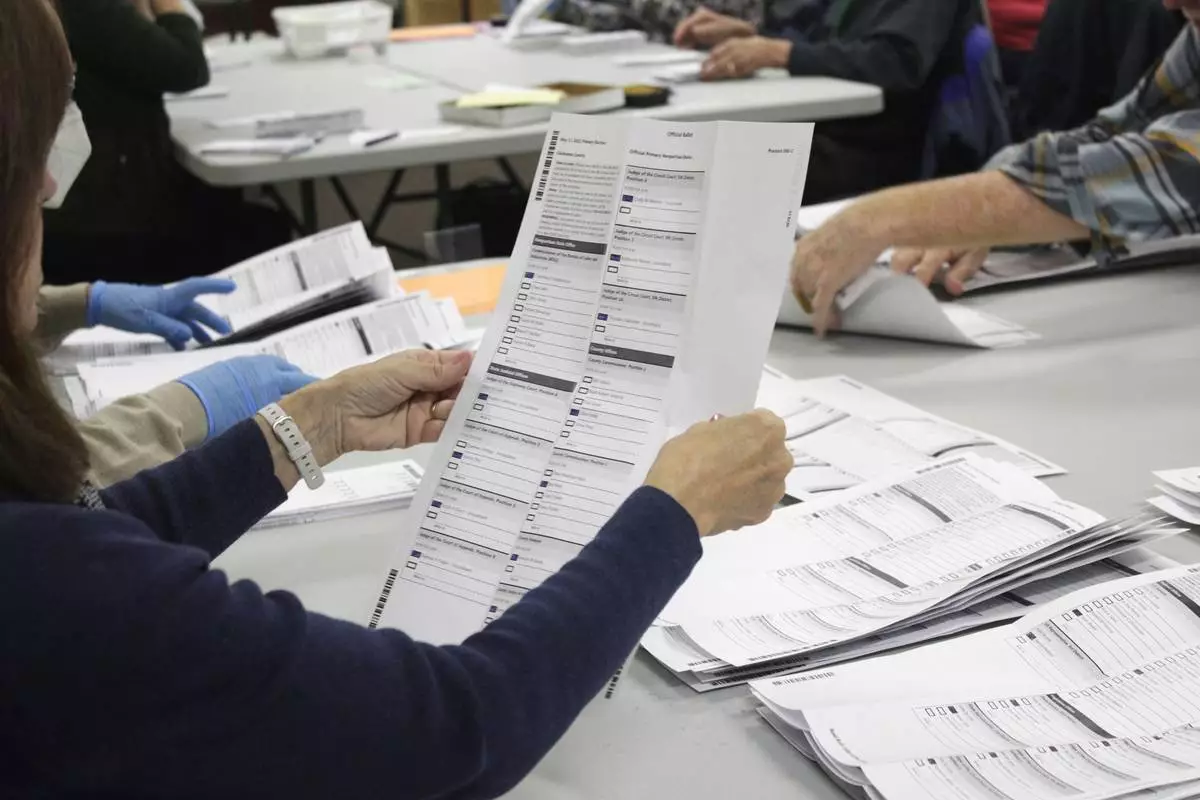
FILE - An election worker examines a ballot at the Clackamas County Elections office May 19, 2022, Oregon City, Ore. (AP Photo/Gillian Flaccus, File)
FILE - An election worker examines a ballot at the Clackamas County Elections office May 19, 2022, Oregon City, Ore. (AP Photo/Gillian Flaccus, File)
TORONTO (AP) — Canadian Prime Minister Mark Carney said Monday some of U.S. President Donald Trump’s threats should be viewed as prepositioning ahead of negotiations to renew the free trade pact between the two large trading partners.

Carney noted they are entering a review of the United States–Mexico–Canada Agreement this year and said he expects a "robust review.”

“The president is a strong negotiator, and some of these comments and positioning should be viewed in the broader context of that,” Carney said.

Trump threatened this past weekend to impose a 100% tariff on goods imported from Canada if America’s northern neighbor went ahead with a trade deal with Beijing, though Carney has said Canada has no interest in negotiating a comprehensive trade deal with Beijing.

U.S. Treasury Secretary Scott Bessent said Carney spoke to Trump on Monday and Bessent told Fox News that Carney “was very aggressively walking back some of the unfortunate remarks he made at Davos.”

Dominic LeBlanc, Canada’s minister responsible for Canada-U.S. trade, said he spoke with U.S. Trade Representative Jamieson Greer on Sunday and made it clear that the Canadians are negotiating a “narrow trade arrangement” with China that mostly deals with just “a few sectors of our economy.”

He compared that to an agreement Trump made with Chinese leader Xi Jinping in South Korea last summer in which the U.S. cut some tariffs on China while Beijing moved to allow rare earth exports and lift a pause on purchasing U.S. soy.

LeBlanc also said upcoming talks were a review of the United States-Mexico-Canada Agreement and not a full-scale renegotiation of trade as happened during Trump's first term.

“It’s not six years ago We talked about that. This is a review,” LeBlanc said. “It was built into the agreement. It’s not a renegotiation."

LeBlanc said Canada is ready to move quickly.

In 2024, Canada mirrored the United States by putting a 100% tariff on electric vehicles from Beijing and a 25% tariff on steel and aluminum. China had responded by imposing 100% import taxes on Canadian canola oil and meal and 25% on pork and seafood.

Breaking with the United States this month during a visit to Beijing, Carney cut its 100% tariff on Chinese electric cars in return for lower tariffs on those Canadian products.

“Last week’s new strategic partnership with China will make available tens of thousands affordable electric vehicles in Canada,” Carney said Monday.

Carney has said there would be an initial annual cap of 49,000 vehicles on Chinese EV exports coming into Canada at a tariff rate of 6.1%, growing to about 70,000 over five years.

He also has said the initial cap on Chinese EV imports was about 3% of the 1.8 million vehicles sold in Canada annually and that, in exchange, China is expected to begin investing in the Canadian auto industry within three years.

Trump’s tariff threat came amid an escalating war of words with Carney as the Republican president’s push to acquire Greenland strained the NATO alliance.

Carney has emerged as a spokesman for a movement for countries to find ways to link up and counter the U.S. under Trump. Speaking in Davos before Trump, Carney said, “Middle powers must act together because if you are not at the table, you are on the menu." The prime minister received widespread praise and attention for his remarks, upstaging Trump at the World Economic Forum.

Trump’s push to acquire Greenland has come after he has repeatedly needled Canada over its sovereignty and suggested it also be absorbed into the United States as a 51st state. He posted an altered image on social media last week showing a map of the United States that included Canada, Venezuela, Greenland and Cuba as part of its territory.

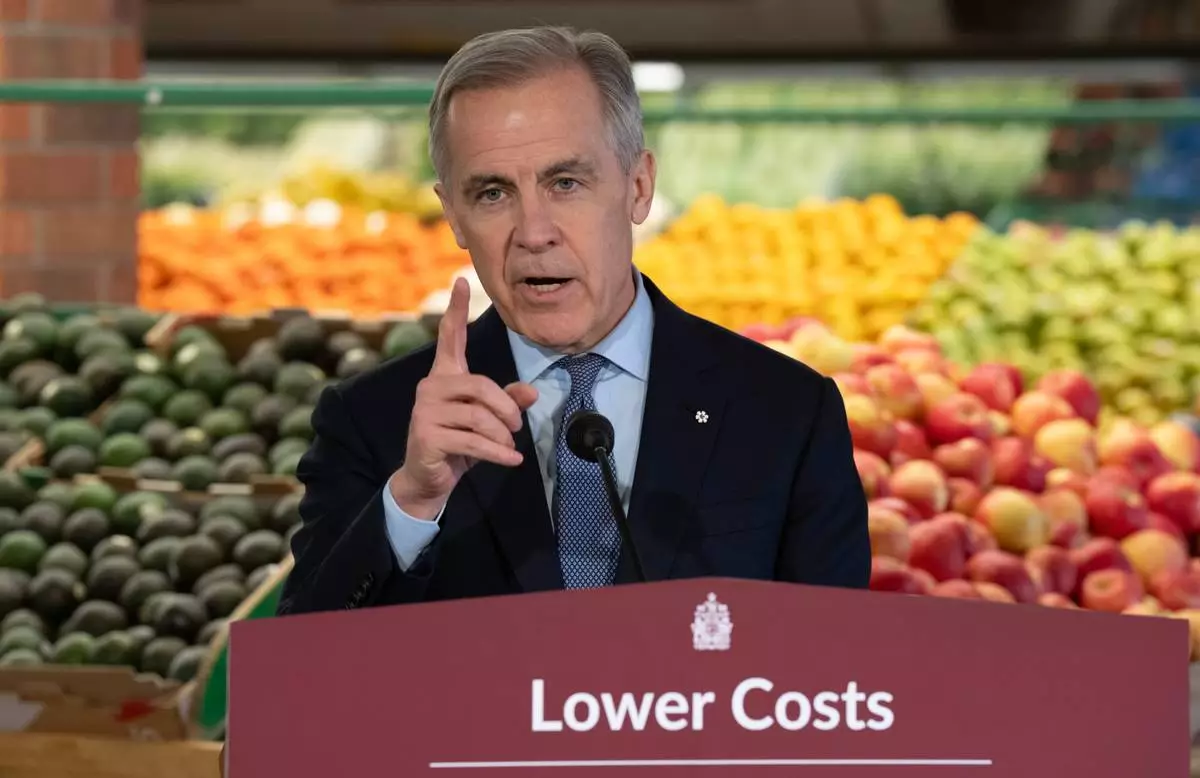
Canadian Prime Minister Mark Carney makes a point as he answers a question from media during an event at a grocery store in Ottawa on Monday, Jan. 26, 2026. (Adrian Wyld/The Canadian Press via AP)

Canadian Prime Minister Mark Carney makes a point as he answers a question from media during an event at a grocery store in Ottawa on Monday, Jan. 26, 2026. (Adrian Wyld/The Canadian Press via AP)

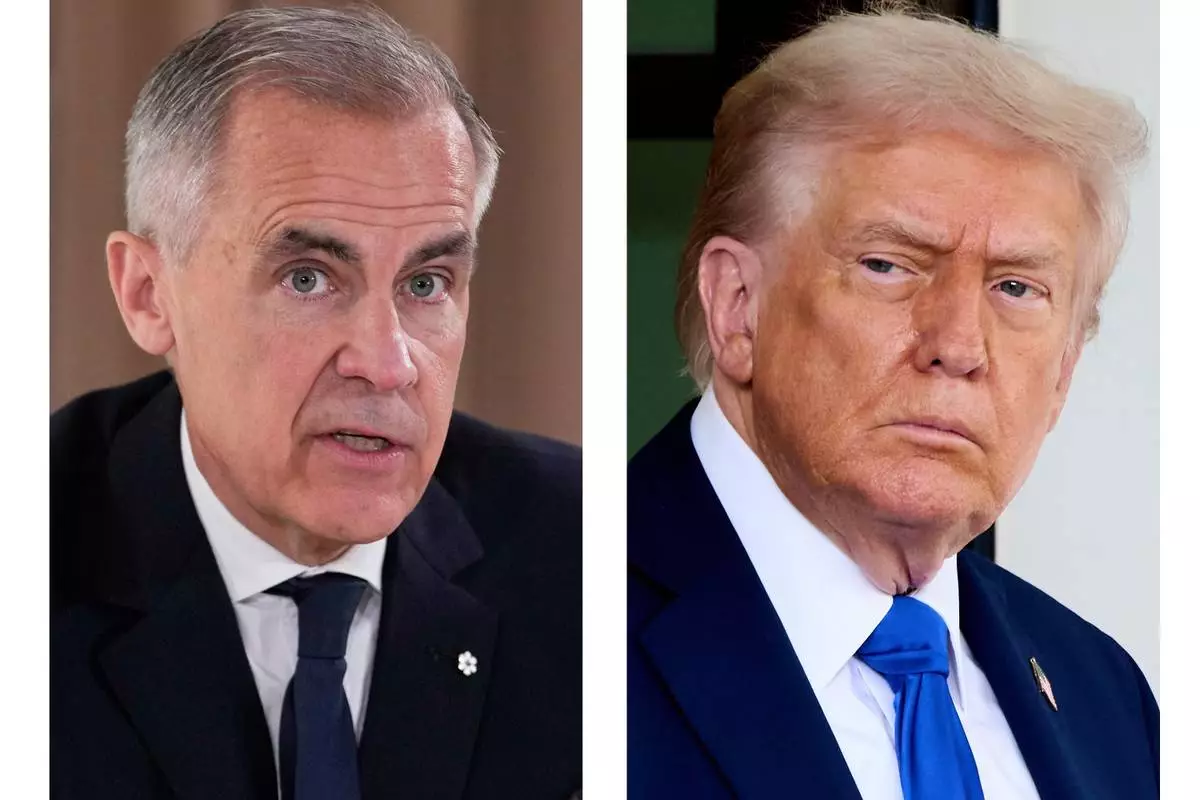
This combination of images shows Canada's Prime Minister Mark Carney on June 16, 2025, in Kananaskis, Canada, left, and President Donald Trump on Oct. 7, 2025, in Washington. (AP Photo/Mark Schiefelbein, left, Jacquelyn Martin)

This combination of images shows Canada's Prime Minister Mark Carney on June 16, 2025, in Kananaskis, Canada, left, and President Donald Trump on Oct. 7, 2025, in Washington. (AP Photo/Mark Schiefelbein, left, Jacquelyn Martin)

Recommended Articles