The death toll from a landslide in Cisarua, West Bandung Regency, West Java, rose to 34 on Monday as Indonesian rescue teams were stepping up their efforts to search for dozens of people still believed to be trapped under thick mud and debris.
According to the disaster management agency in West Bandung, more than 300 rescue personnel have been currently deployed in the disaster area, including teams from West Java's emergency services, the military and the police.
Additional rescuers have also been dispatched from neighboring provinces to support the search operations.
"With the increase in the number of rescue and search personnel today, we hope the rescue efforts can go deeper and become more effective. Meanwhile, the national search and rescue agency has dispatched additional teams from Yogyakarta, while rescuers from Central Java have also joined the operation," said Asep Sehabudin, head of the West Bandung disaster management agency.
Family members of the victims and local volunteers have also joined forces in the rescue and search efforts, hoping to assist the authorities in any way they can.
Villager Asep Heri said he had lost four relatives, his uncle and aunt, as well as their children, in the disaster. He was among the volunteers trying to find his daughter.
"I will continue searching until my child is found. No matter the circumstances, I will stay here and keep searching. The bodies of my uncle and aunt have already been found and buried," he said.
Local volunteers said the disaster had gravely affected nearby communities.
"My school is just about two kilometers from the landslide site. Several students and their family members, as well as the relatives of school staff, were among those killed. Helping in the rescue is what we, as volunteers, must do," said a volunteer named Muhamad Yunus Bahtiar.
The landslide on Saturday was triggered by heavy rainfall over two consecutive nights, which saturated steep slopes in the mountainous Cisarua area. Torrents of earth, rocks and uprooted trees swept through residential areas, plantations and forest land.
Indonesia frequently suffers from floods and landslides during the rainy season, which typically lasts from October to March.

Landslide death toll from Indonesia's West Java rises to 26 amid intensified search operations

Landslide death toll from Indonesia's West Java rises to 26 amid intensified search operations
China's two major power grid operators -- the State Grid Corporation of China (State Grid) and China Southern Power Grid (CSG) -- reported a surge in investment in the first quarter of 2026, underscoring efforts to strengthen infrastructure construction and support high-quality socioeconomic development in China.
The State Grid said it completed fixed-asset investment worth 129 billion yuan (about 18.77 billion U.S. dollars) in the first three months of this year, up 37 percent the corresponding period of the previous year. The spending has driven more than 250 billion yuan (36 billion U.S. dollars) of investment across the wider industrial chain.
Key projects such as the Panxi ultra-high-voltage (UHV) alternating current (AC) line and the Anhui-Hubei back-to-back direct current (DC) project have seen ground broken for their construction, while several west-to-east power transmission projects have been upgraded.
Investment in connecting renewable energy generation to the grid was reported to have exceeded 10 billion yuan (1.45 billion U.S. dollars) from January to March, a year-on-year rise of more than 50 percent.
The CSG also reported robust growth in investment in the three-month period, with fixed-asset investment reaching 38.45 billion yuan (5.58 billion U.S. dollars), up about 50 percent from a year earlier.
Among its achievements, the company completed and commissioned 80 key projects, including the 220 kV cross-sea power grid interconnection project, which was officially put into operation on March 20. The project ended years of grid isolation on the Weizhou Island in south China by linking it to the main power system of the Guangxi Zhuang Autonomous Region.
The construction of 17 other major energy projects, including one linking the power grid of the Xizang Autonomous Region in southwest China with that of Guangdong Province in south China, is advancing rapidly. These projects are expected to bolster regional industries, the maritime economy, digital collaboration and the transition to green energy.
"By accelerating major project construction, investment during the 15th Five-Year Plan period (2026-2030) is expected to approach 1 trillion yuan (145 billion U.S. dollars), driving a further 2 trillion yuan (290 billion U.S. dollars) of investment across upstream and downstream industries," said Dong Yanle, deputy general manager of the Engineering Construction Department under the China Southern Power Grid.
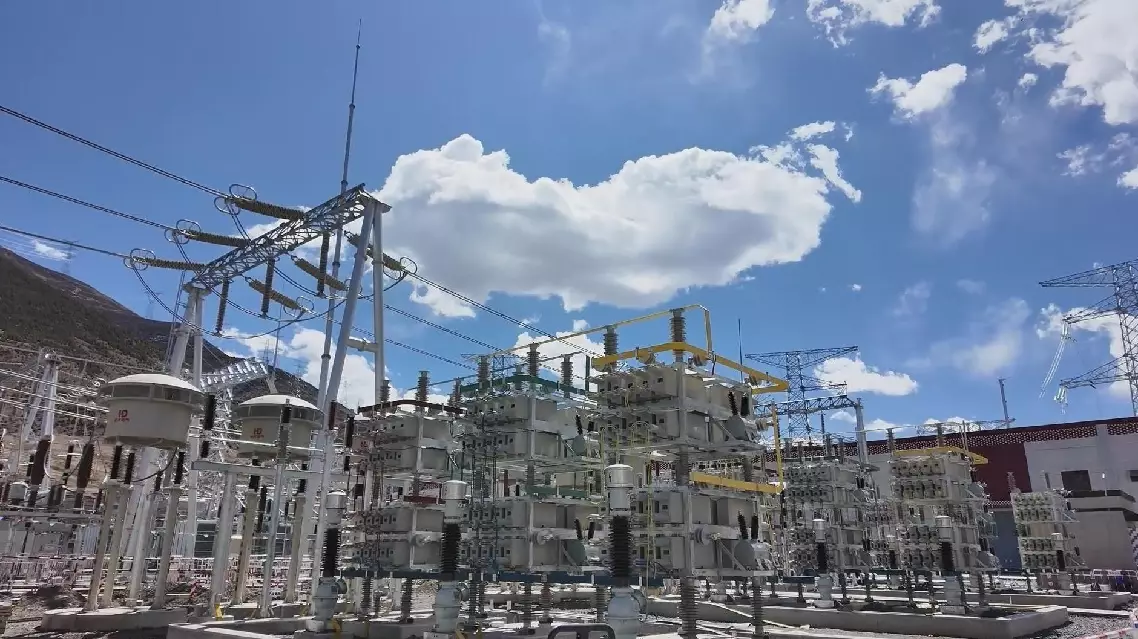
China ramps up power grid investment in January-March to boost growth