WASHINGTON (AP) — After two weeks of intense political and legal scrutiny, the Federal Reserve will seek to make this week's meeting about interest rates as straightforward and uneventful as possible, though President Donald Trump probably still won't like the result.
The central bank's interest rate-setting committee is almost certain to keep its key short-term rate unchanged at about 3.6%, after three straight quarter-point cuts last year. Fed Chair Jerome Powell said after December's meeting that they were “well positioned to wait to see how the economy evolves” before making any further moves.
When the Fed lowers its short-term rate, it can over time influence other borrowing costs for things like mortgages, auto loans and business borrowing, though those rates are also affected by market forces.
This week's meeting — one of eight the Fed holds each year — will be overshadowed by the bombshell revelation earlier this month that the Justice Department has subpoenaed the Fed as part of a criminal investigation into testimony Powell gave last June about a $2.5 billion building renovation. It's the first time a sitting Fed chair has been investigated, and prompted an unusually public rebuke from Powell.
Now, Powell will have to shift from a dispute with the White House to emphasizing that the Fed's decisions around interest rates are driven by economic concerns, not politics. Powell said Jan. 11 that the subpoenas were “pretexts” to punish the Fed for not cutting rates as sharply as Trump wants.
Powell will be "under even more pressure to underscore, ‘everything we’re doing here ... is all about the economics,’” said Claudia Sahm, a former Fed economist and chief economist at New Century Advisors. "'We didn’t think about the politics.'”
Michael Gapen, chief U.S. economist at Morgan Stanley and also a former Fed staffer, said that despite the scrutiny, the Fed can be expected to consider its interest rate policies like it always does.
“The meetings have a regular flow to them,” he said. "There are presentations that are made, there are discussions that have to be had. ... Some of these other broader-based attacks on the Fed don't really come up."
Not long after the Justice Department's subpoenas, the Supreme Court last week considered whether Trump can fire Fed governor Lisa Cook over allegations of mortgage fraud, which she denies. No president has fired a governor in the Fed's 112-year history. During an oral argument, the justices appeared to be leaning toward allowing her to stay in her job until the case is resolved.
Other Fed officials have also signaled the central bank is likely to keep rates unchanged at their two-day meeting that ends Wednesday. The Fed's three rate cuts last year were intended to bolster the economy after hiring slowed sharply over the summer and fall in the wake of Trump's April tariffs on dozens of countries.
Yet the unemployment rate ticked lower in December, after picking up for much of last year, and there are other signs the job market may be stabilizing. The number of people seeking unemployment benefits has stayed historically low, a sign layoffs haven't spiked.
Meanwhile, inflation remains elevated and actually ticked higher last year, according to the Fed's preferred measure. Prices rose 2.8% in November from a year earlier, the latest data available. That is up from 2.6% in November 2024.
Unless businesses start cutting jobs or the unemployment rate rises, the Fed is unlikely to cut rates again for at least a few months, economists say. If inflation slowly declines this year, as economists expect, the Fed may cut again in the spring or summer. Wall Street investors expect just two quarter-point rate reductions this year, according to futures prices.
Many economists expect growth could pick up in the coming months, which would be another reason to forego rate cuts. Gapen estimates that tax refunds could be about 20% higher this spring than last year as the Trump administration's tax cuts take effect. Refunds could average $3,500, Gapen said.
The economy expanded at a 4.4% annual rate in last year's July-September quarter and may have grown at a similarly healthy pace in the final three months of last year. If such solid growth continues, Fed officials will likely wait to see if hiring picks up as well, further reducing the need for more rate cuts.
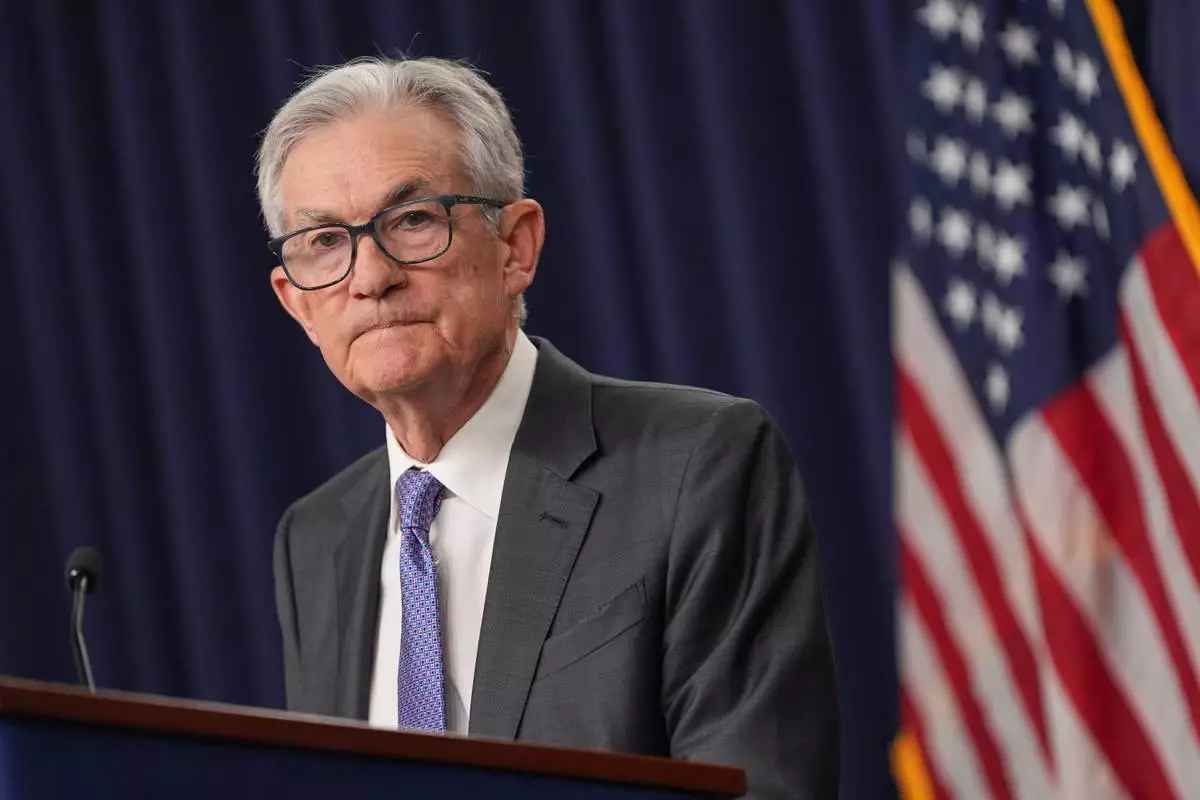
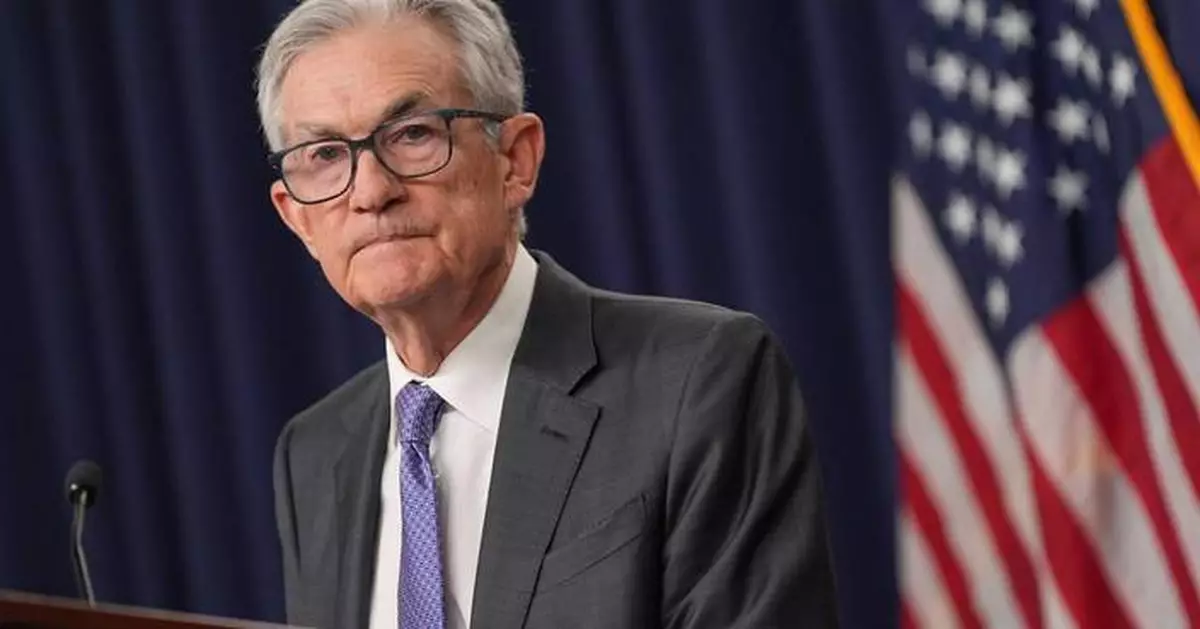
FILE - Federal Reserve Chair Jerome Powell speaks at the Federal Reserve, Wednesday, Dec. 10, 2025, in Washington. (AP Photo/Jacquelyn Martin, file)
MELBOURNE, Australia (AP) — Wearable fitness trackers will likely be OK for players to use in future editions of the Australian Open, where leading players Carlos Alcaraz, Jannik Sinner and Aryna Sabalenka have been asked to remove their devices in matches this year.
Sabalenka wants the ban overturned now. The top-ranked player in women's tennis, aiming for a third Australian title in four years, said after her quarterfinal win Tuesday that the Australian Open and other three majors are out of step with the rest of tennis.
Alcaraz and Sinner, who have split the last eight major men's singles titles between them, were approached by chair umpires during the fourth round on Sunday and Monday to take off the straps they usually wear on their wrists.
Video of the interactions drew attention to a conflict between regular tournaments and the four majors.
The devices are widely used in elite sports to collect physiological data that provides insights about health and performance in training, competition, recovery and sleep.
The technology is approved for use by the International Tennis Federation and by the men's and women's tours. So far, the approval hasn't extended to the four Grand Slam tournaments which include the Australian, French and U.S. Opens and Wimbledon.
So, that's why the chair umpire approached top-ranked Alcaraz during his fourth-round match against Tommy Paul and asked him to take it off. The 22-year-old Alcaraz immediately complied, taking off his sweatband and removing the strap.
“Wearables are currently not permitted at Grand Slams,” Tennis Australia said in a statement. “The Australian Open is involved in ongoing discussions on how this situation could change.”
Tennis Australia said some wearables provide athletes with an indication of internal load — measures such as heart rate — “which can give them a 360-degree view of the work they’re doing and how their bodies’ respond.”
Tournament organizers said players had access to data at the Australian Open that helped them monitor “key external load measures” such as distance covered, changes of direction, high acceleration events and speed and spin of shots.
The technology provider, WHOOP, describes it as “your 24/7 wearable coach designed to help you improve your health, fitness, and longevity.”
In a social media post, the company said the technology is “performance-enhancing — by design. That’s the whole point."
“Taking that insight away is like asking athletes to play blind.”
Sabalenka said she received an email that the devices had approval from the ITF and “I didn’t know that the Grand Slams didn’t come to the same conclusion.”
“I don’t understand why because the whole year we are wearing them in WTA tournaments, all the tournaments I play," she said. "I don’t understand why the Grand Slams are not allowing us to wear it and I really hope that they will reconsider the decision and let their players track their health monitor.”
Sinner, the two-time Australian Open winner, said the data collected from his wrist device during matches helps with recovery and preparation for future matches.
“There is certain data what we would like to track a little bit on court. It’s not for the live thing,” he said. "It’s more about you can see after the match. These are data we would like to use also in practice sessions because from that you can practice on with the heart rate, how much calories you burn, all these kind of things."
After his fourth-round win over fellow Italian Luciano Darderi, Sinner said he also accepted the umpire's decision immediately.
“It’s fine. There are other things we could use — (like) the vest. But it’s a bit for me uncomfortable — you feel like you have something on the shoulders. It’s a bit different,” he said. “But rules are rules. I understand. I won’t use it again.”
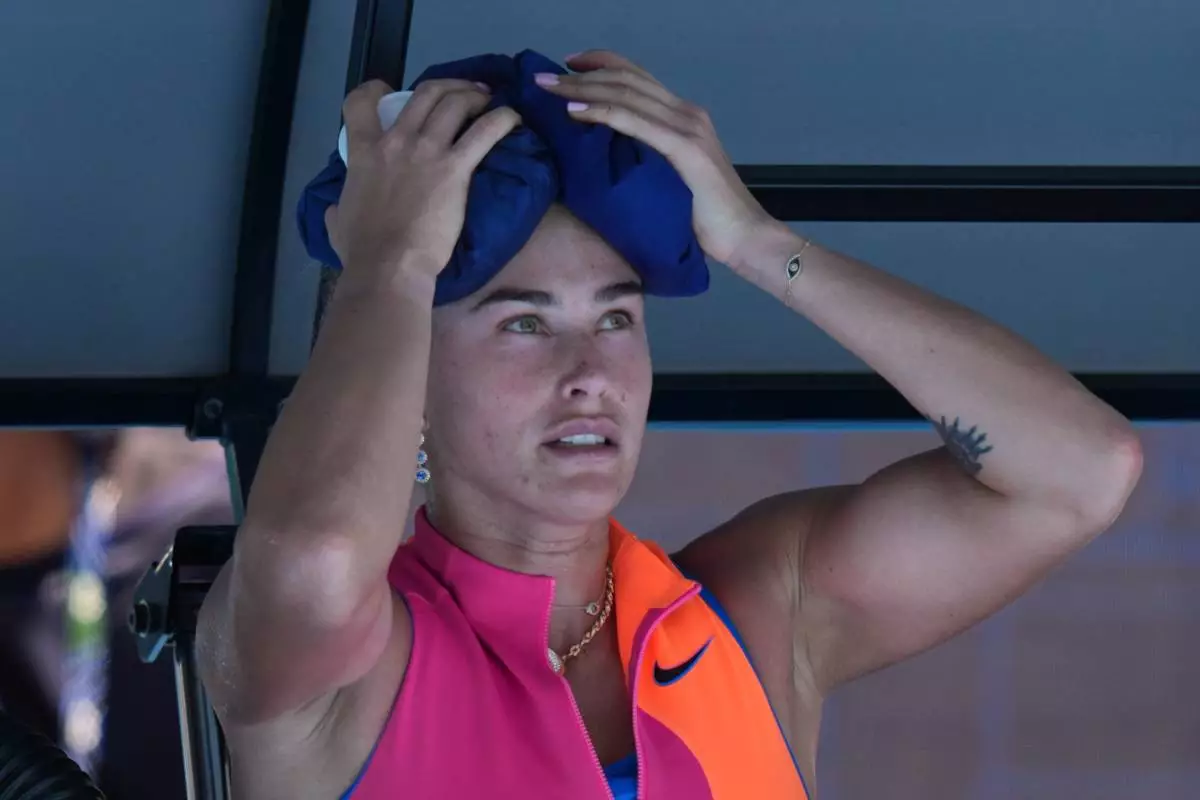
Aryna Sabalenka of Belarus places an ice pack to her head during her quarterfinal match against Iva Jovic of the U.S. during their quarterfinal match at the Australian Open tennis championship in Melbourne, Australia, Tuesday, Jan. 27, 2026. (AP Photo/Aaron Favila)
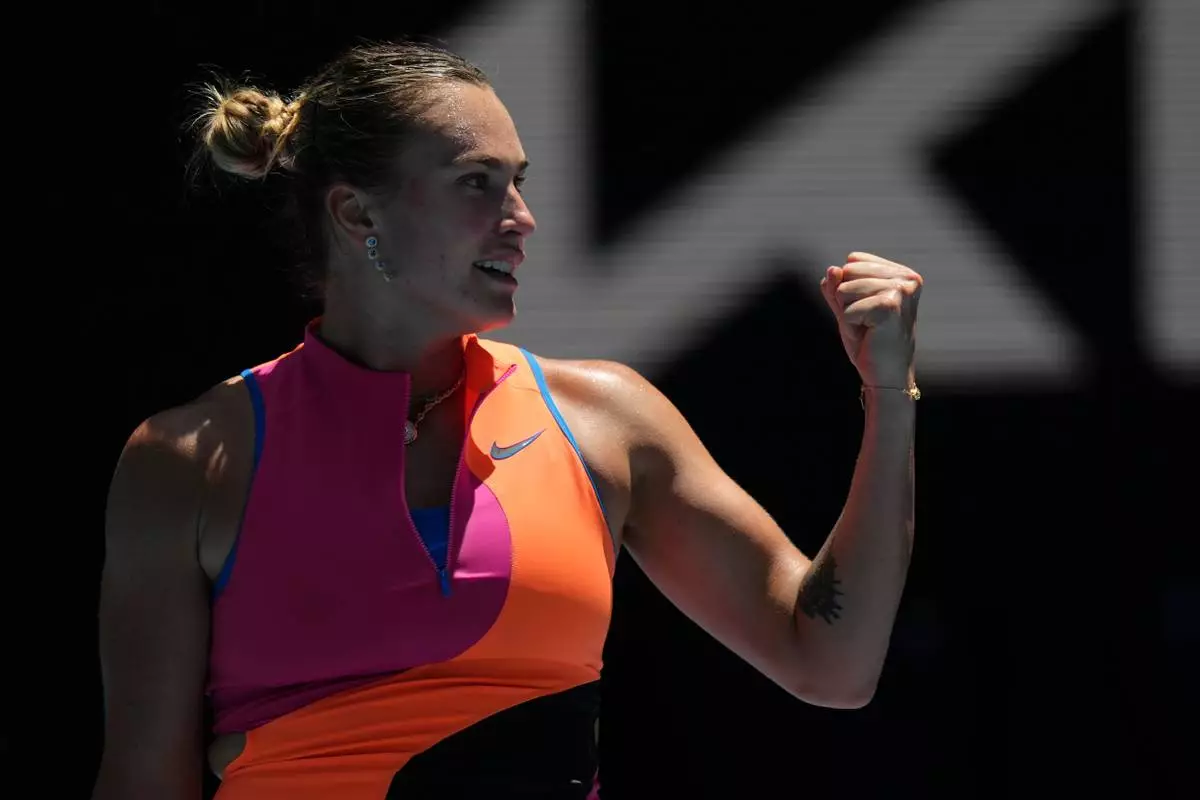
Aryna Sabalenka of Belarus reacts after defeating Iva Jovic of the U.S. in their quarterfinal match at the Australian Open tennis championship in Melbourne, Australia, Tuesday, Jan. 27, 2026. (AP Photo/Aaron Favila)
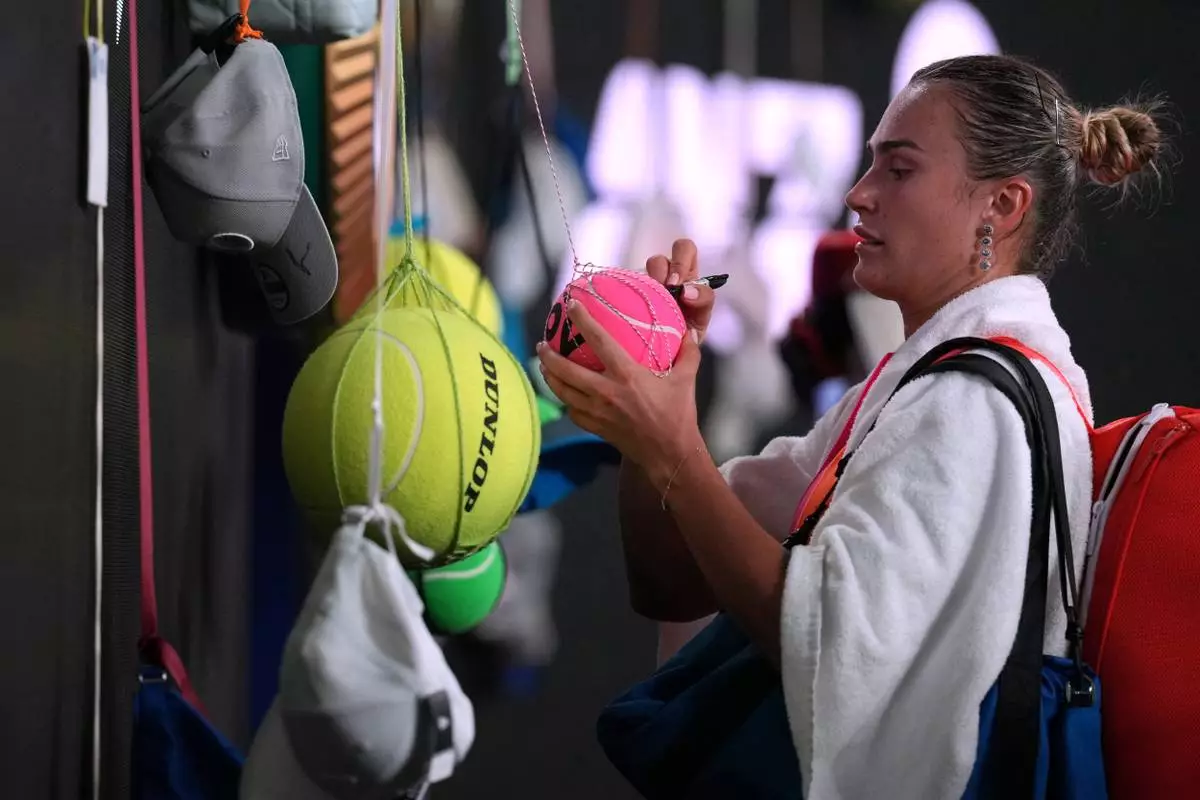
Aryna Sabalenka of Belarus signs autographs after defeating to Iva Jovic of the U.S. in their quarterfinal match at the Australian Open tennis championship in Melbourne, Australia, Tuesday, Jan. 27, 2026. (AP Photo/Dita Alangkara)
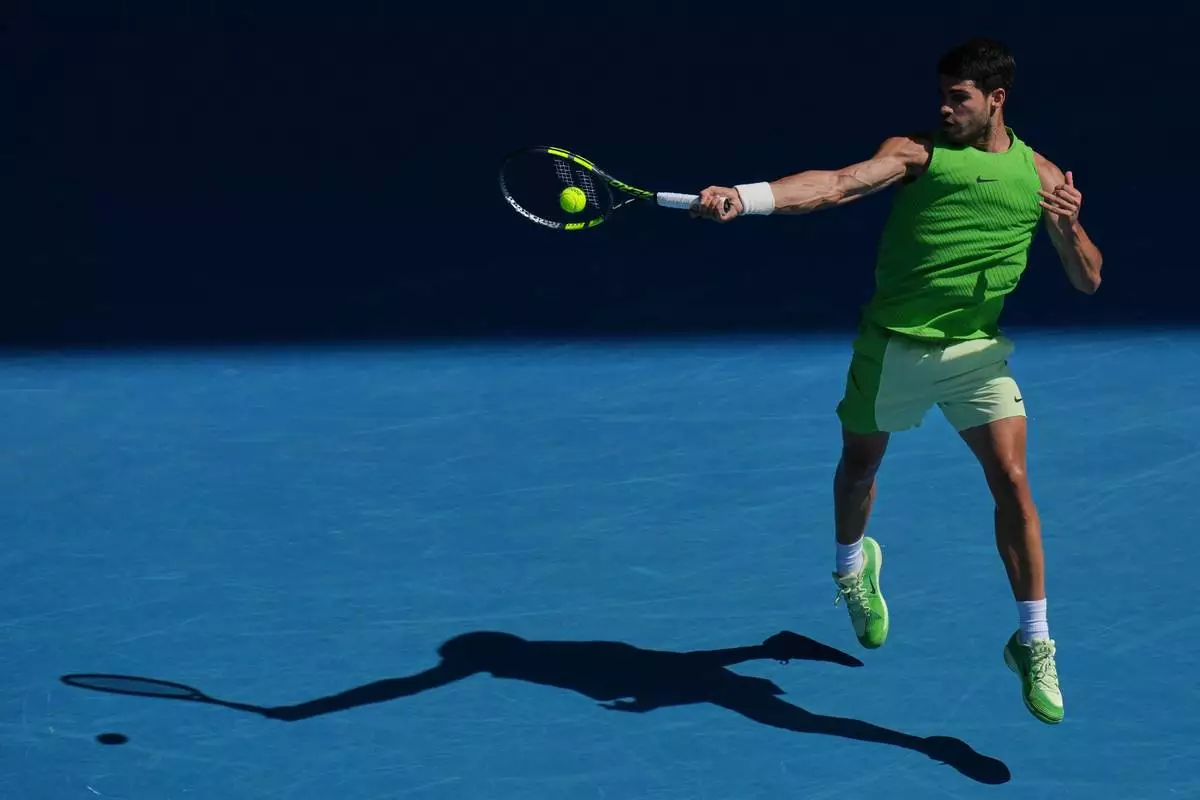
Carlos Alcaraz of Spain plays a forehand return to Tommy Paul of the U.S.during their fourth round match at the Australian Open tennis championship in Melbourne, Australia, Sunday, Jan. 25, 2026. (AP Photo/Dar Yasin)
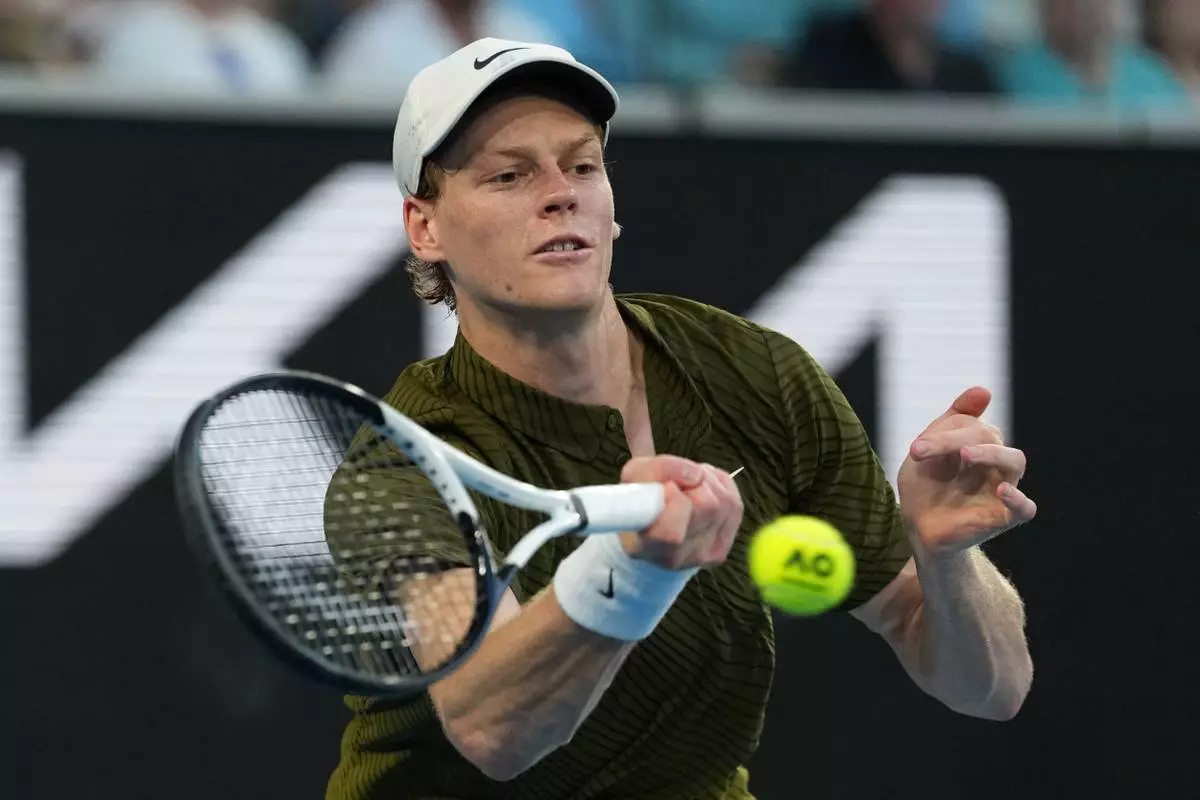
Jannik Sinner of Italy plays a forehand return to his compatriot Luciano Darderi during their fourth round match at the Australian Open tennis championship in Melbourne, Australia, Monday, Jan. 26, 2026. (AP Photo/Dar Yasin)