Skip to Content Facebook Feature Image

Ant Group Subsidiary Robbyant Unveils Spatial Perception AI Model LingBot-Depth

News

Ant Group Subsidiary Robbyant Unveils Spatial Perception AI Model LingBot-Depth
News

News

Ant Group Subsidiary Robbyant Unveils Spatial Perception AI Model LingBot-Depth

2026-01-27 14:02 Last Updated At:14:50

SHANGHAI--(BUSINESS WIRE)--Jan 27, 2026--

Robbyant, an embodied AI company within Ant Group, today open-sourced LingBot-Depth, a high-precision spatial perception model designed to enhance robots’ depth sensing and 3D environmental understanding capabilities in complex real-world environments.

This press release features multimedia. View the full release here: https://www.businesswire.com/news/home/20260126215468/en/

In parallel, Robbyant announced a plan to form a strategic partnership with Orbbec, a leading provider of robotics and AI vision. As part of this collaboration, Orbbec will integrate LingBot-Depth into its next-generation depth cameras tailored for embodied intelligence applications.

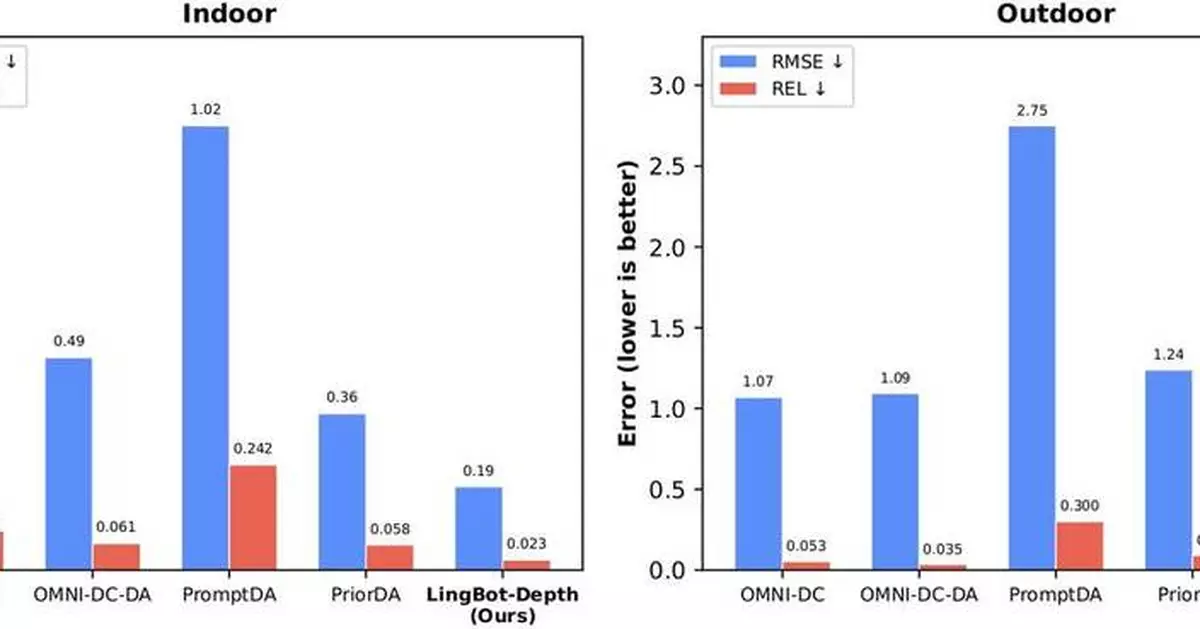
In benchmark evaluations on NYUv2 and ETH3D, LingBot-Depth outperforms major models such as PromptDA and PriorDA, achieving a relative error (REL) reduction of over 70% in indoor scenes and reducing RMSE by approximately 47% on the challenging sparse Structure-from-Motion (SfM) task.

Depth sensing systems often struggle to capture reliable depth data from transparent or highly reflective surfaces, such as glass, mirrors, and polished metal, due to inherent limitations of optical physics. These surfaces frequently result in missing depth information or severe noise, causing robots to miss objects or miscalculate distances—potentially leading to operational failures or safety risks.

Robbyant developed Masked Depth Modeling (MDM) to address this industry-wide challenge. When depth inputs from a sensor are incomplete or corrupted, LingBot-Depth can analyze RGB image features, including texture, object contours, and scene context, to infer and reconstruct missing regions, producing denser, more accurate, and sharper 3D depth maps.

LingBot-Depth demonstrates strong compatibility with existing hardware, and its performance gains are achieved without requiring any changes to current sensor form factors. This underscores the value of integrating high-quality, chip-level depth data with perception algorithms specifically designed for real-world challenges.

The development of LingBot-Depth was closely supported by Orbbec, which contributed key hardware resources and technical expertise. The model was co-optimized on Orbbec’s platforms, with its performance validated by Orbbec’s Depth Vision Laboratory.

Leveraging chip-level raw depth data from Orbbec’s Gemini 330 stereo 3D cameras, LingBot-Depth intelligently reconstructs missing information, significantly improving robots’ perception robustness and task success rates in complex optical environments. Gemini 330 was also used for data collection, training, and validation, with LingBot-Depth fine-tuned on high-quality RGB-depth pairs directly output by Gemini 330 cameras.

At the heart of the Gemini 330 is Orbbec’s proprietary MX6800 depth engine chip, which combine active and passive imaging to deliver reliable 3D data across extreme lighting conditions from darkness to direct sunlight. On-device depth computation and precise sensor synchronization further reduce system latency and host compute requirements.

To train LingBot-Depth, Robbyant collected approximately 10 million raw samples and curated a high-quality dataset of 2 million RGB-depth pairs, specifically optimized for extreme and ambiguous conditions. Robbyant also plans to open-source this dataset in the near future to accelerate community-driven innovations in spatial perception for complex environments.

Zhu Xing, Chief Executive Officer of Robbyant, noted, “Reliable 3D vision is critical to the advancement of embodied AI. By open-sourcing LingBot-Depth and collaborating with hardware pioneers like Orbbec, we aim to lower the barrier to advanced spatial perception and accelerate the adoption of embodied intelligence across homes, factories, warehouses, and beyond.”

"Robbyant's work in spatial intelligence models and algorithms complements Orbbec's expertise in 3D vision chips and robotic vision systems," said Len Zhong, Head of Product Management of Orbbec. "In this collaboration, the chip-level depth data provided by the Gemini 330 delivers a stable, high-fidelity, and physically grounded data foundation for the LingBot-Depth model. It's a great example that demonstrates close coupling between a robot's sensing hardware and its perception intelligence."

Looking ahead, Robbyant plans to share its spatial perception capabilities with a broader ecosystem of hardware partners, to support the real-world deployment of intelligent robots in complex, dynamic settings.

To learn more about LingBot-Depth, please visit:

About Robbyant

Robbyant is an embodied intelligence company within Ant Group, dedicated to advancing embodied intelligence through cutting-edge software and hardware technologies. Robbyant independently develops foundational large models for embodied AI and actively explores next-generation intelligent devices, aiming to create robotic companions and caregivers that truly understand and enhance people’s everyday lives and deliver reliable intelligent services across key use cases, such as elderly care, medical assistance, and household tasks.

To learn more about Robbyant, please visit: www.robbyant.com

About Orbbec

Founded in 2013, Orbbec is a leading provider of robotics and AI Vision. The company delivers full-stack 3D vision solutions spanning structured light, stereo vision, ToF, and LiDAR technologies, serving over 3,000 customers across nearly 100 countries and regions. The company continues to sharpen its focus on robotic "eye" core technology in the AI era, advancing "hand-eye-brain" integration and multi-sensor fusion perception to empower the robotics industry toward more intelligent, versatile horizons.
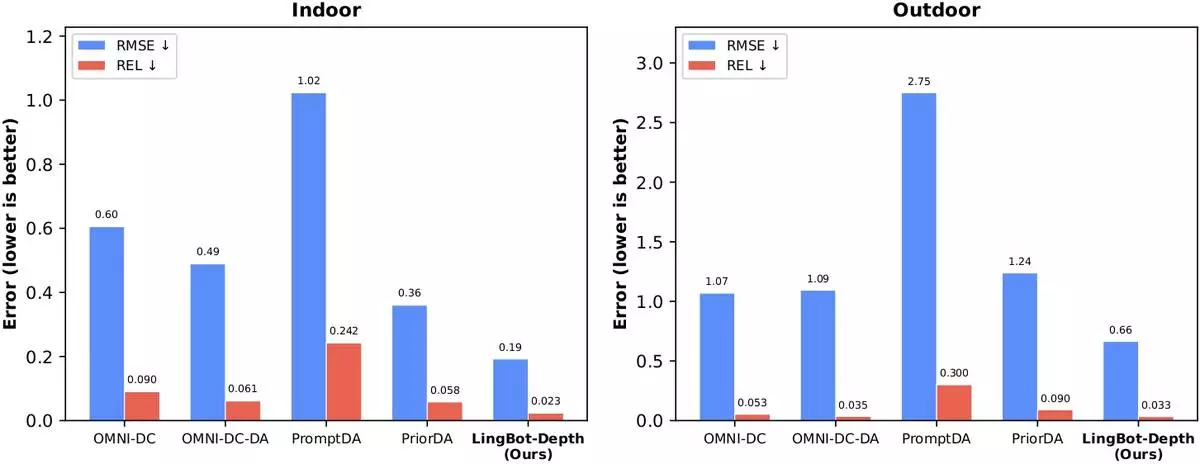
LingBot-Depth outperforms major models on the most challenging sparse depth completion task

LingBot-Depth outperforms major models on the most challenging sparse depth completion task

WASHINGTON (AP) — President Donald Trump said Monday he is increasing tariffs on South Korean goods because the country’s legislature has yet to approve the trade framework announced last year.

Trump said on social media that import taxes would be raised on autos, lumber and pharmaceutical drugs from South Korea with the rate on other goods going from 15% to 25%. The U.S. president previously imposed the tariffs by declaring an economic emergency and bypassing Congress, while South Korea needed legislative approval for the framework announced in July and affirmed during Trump's October visit to the country.

“Our Trade Deals are very important to America. In each of these Deals, we have acted swiftly to reduce our TARIFFS in line with the Transaction agreed to,” Trump said. “We, of course, expect our Trading Partners to do the same.”

The threat was a reminder that the tariff drama unleashed last year by Trump is likely to be repeated again and again this year. The global economy and U.S. voters might find the world's trade structure constantly being subject to disruption and new negotiations as Trump has already sought to levy tariffs in order to bend other nations to his will.

Trump has in the past tied his tariffs to commitments by South Korea to invest $350 billion in the U.S. economy over several years, including efforts to revitalize American shipyards. But the Trump administration's relations with South Korea have at times been rocky with the raid last year by immigration officials at a Hyundai manufacturing site in Georgia in which 475 people were detained.

South Korea’s presidential office responded after a meeting of top South Korean officials that it will convey its commitment to implementing last year's deal to the U.S.

The presidential office said that South Korea's Industry Minister Kim Jung-Kwan will travel to the U.S. for talks with Secretary of Commerce Howard Lutnick, while Trade Minister Yeo Han-koo will travel separately to meet with Trade Representative Jamieson Greer. Kim was on a visit to Canada.

South Korean lawmakers have submitted five bills on implementing South Korea's proposed $350 billion investment package to the National Assembly. The bills are currently before the assembly's finance committee.

Kim Hyun-jung, a spokesperson for South Korea's governing Democratic Party, said his party will coordinate with the government to organize swift debate and action on the bills.

Assembly officials said the five bills will likely be incorporated into a single proposed law, which will need approval from the finance and judiciary committees before it can go to a floor vote.

Trump's announcement of new tariffs fits a pattern in which Trump plans to continue to deploy tariffs, possibly to the detriment of relations with other countries.

Just last week, the president threatened tariffs on eight European nations unless the U.S. gained control of Greenland, only to pull back on his ultimatum after meetings at the World Economic Forum in Davos, Switzerland. Trump on Saturday said he would put a 100% tax on goods from Canada if it followed through with plans to bolster trade with China.

Trump has bragged about his trade frameworks as drawing in new investment to the U.S., yet many of his heavily hyped deals have yet to be finalized. The European Parliament has yet to approve a trade deal pushed by Trump that would put a 15% tax on the majority of goods exported by the EU's 27 member states.

The United States is poised this year to renegotiate its amended 2020 trade pact with Canada and Mexico. There are also ongoing Section 232 investigations under the 1962 Trade Expansion Act, as well as an upcoming Supreme Court decision on whether Trump exceeded his authority by declaring tariffs under the 1977 International Emergency Economic Powers Act.

Kim reported from Seoul, South Korea.

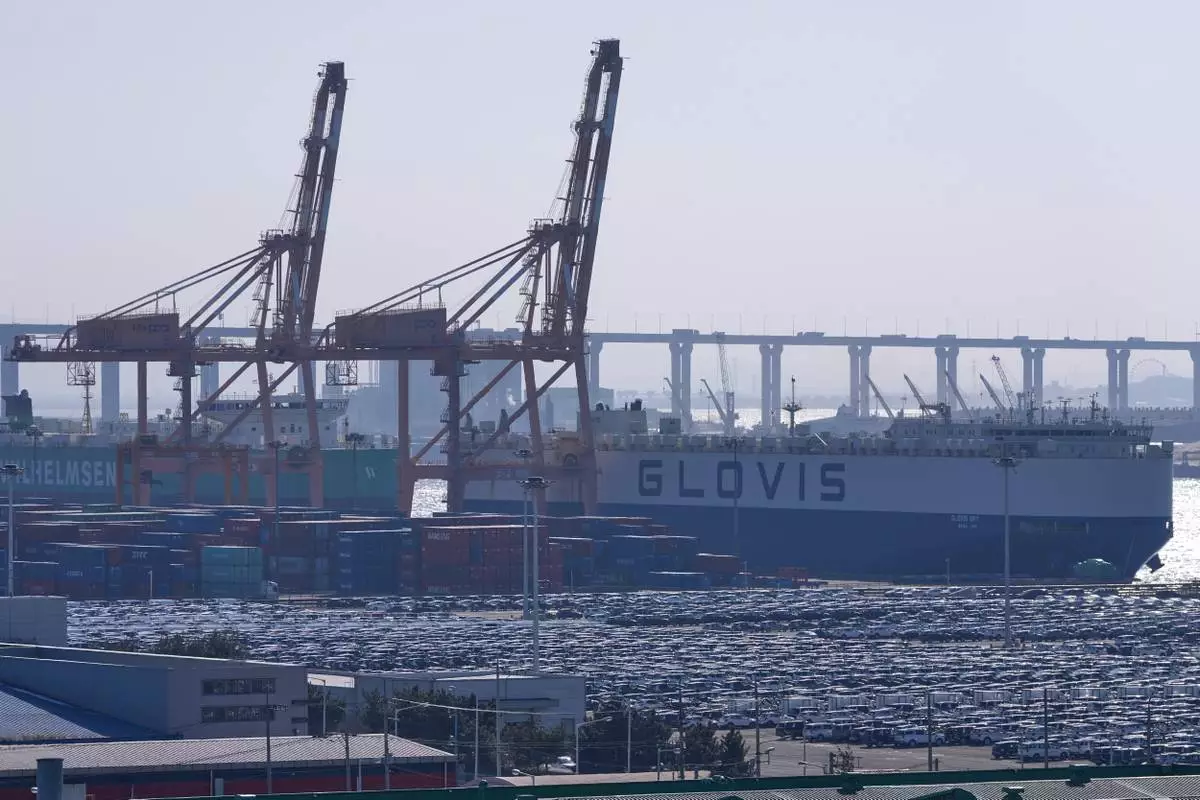
Vehicles for export are parked at a port in Pyeongtaek, South Korea, Tuesday, Jan. 27, 2026. (AP Photo/Lee Jin-man)

Vehicles for export are parked at a port in Pyeongtaek, South Korea, Tuesday, Jan. 27, 2026. (AP Photo/Lee Jin-man)

Vehicles for export are parked and shipping containers are seen at a port in Pyeongtaek, South Korea, Tuesday, Jan. 27, 2026. (AP Photo/Lee Jin-man)

Vehicles for export are parked and shipping containers are seen at a port in Pyeongtaek, South Korea, Tuesday, Jan. 27, 2026. (AP Photo/Lee Jin-man)

Vehicles for export are parked at a port in Pyeongtaek, South Korea, Tuesday, Jan. 27, 2026. (AP Photo/Lee Jin-man)

Vehicles for export are parked at a port in Pyeongtaek, South Korea, Tuesday, Jan. 27, 2026. (AP Photo/Lee Jin-man)

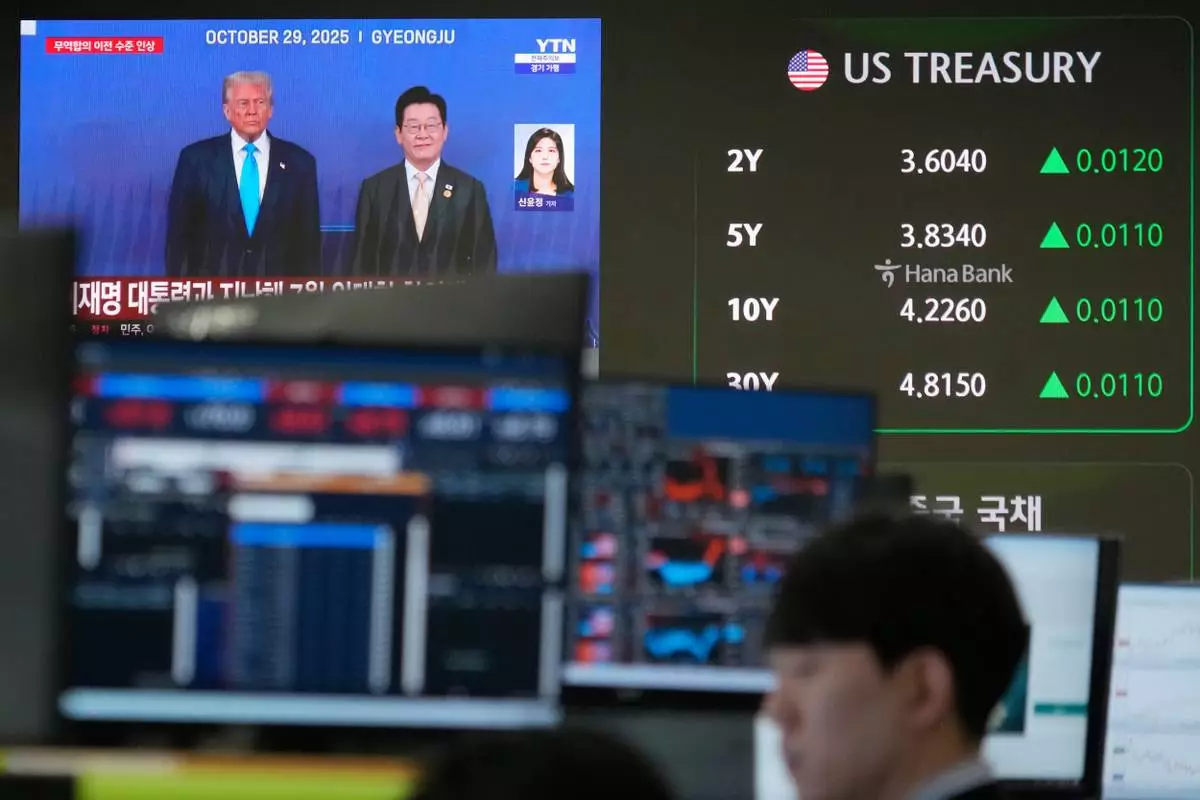
U.S. President Donald Trump, left, and South Korean President Lee Jae Myung are seen on a screen at the foreign exchange dealing room of the Hana Bank headquarters in Seoul, South Korea, Tuesday, Jan. 27, 2026. (AP Photo/Ahn Young-joon)

U.S. President Donald Trump, left, and South Korean President Lee Jae Myung are seen on a screen at the foreign exchange dealing room of the Hana Bank headquarters in Seoul, South Korea, Tuesday, Jan. 27, 2026. (AP Photo/Ahn Young-joon)

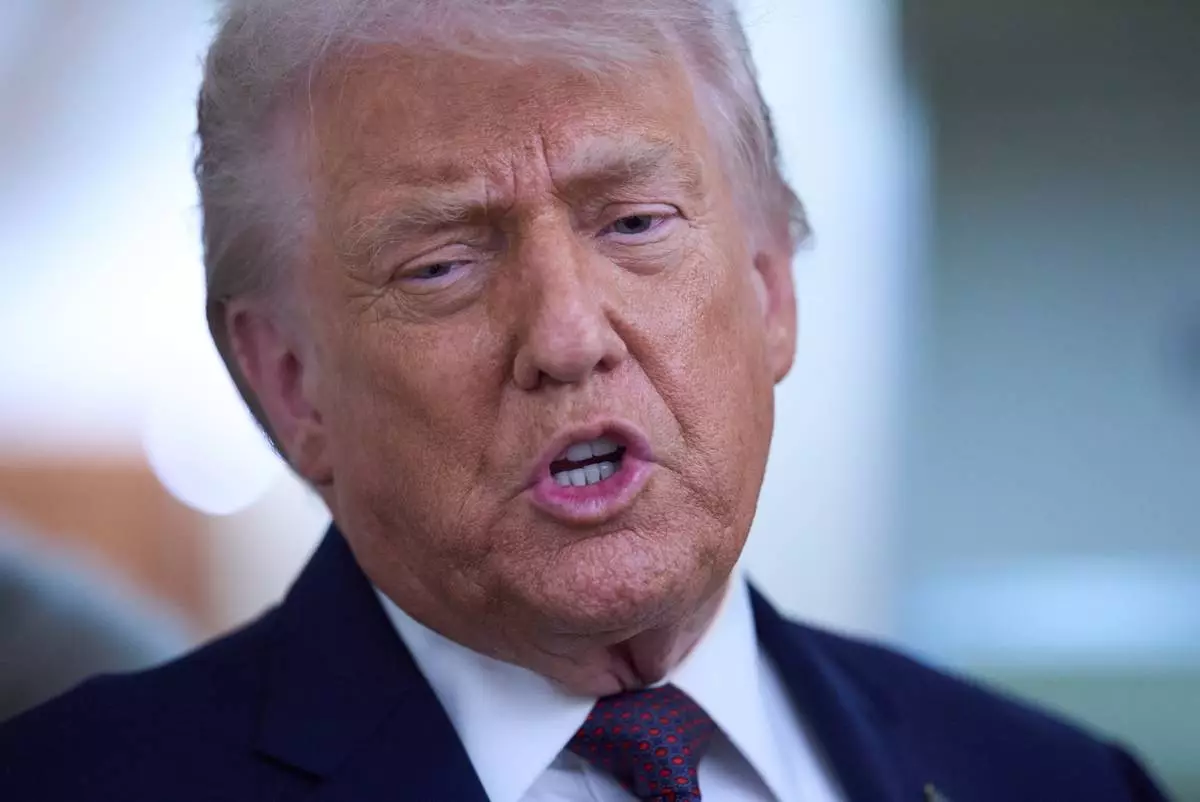
President Donald Trump speaks with reporters aboard Air Force One after leaving the World Economic Forum in Davos for Washington, Thursday, Jan. 22, 2026. (AP Photo/Evan Vucci)

President Donald Trump speaks with reporters aboard Air Force One after leaving the World Economic Forum in Davos for Washington, Thursday, Jan. 22, 2026. (AP Photo/Evan Vucci)

Recommended Articles