NEW YORK--(BUSINESS WIRE)--Jan 27, 2026--
1Money, a full-stack stablecoin infrastructure company, today announced the launch of a custom stablecoin issuance offering powered by M0, the universal stablecoin platform.
This press release features multimedia. View the full release here: https://www.businesswire.com/news/home/20260127522384/en/
In the new offering, 1Money issues fully reserved digital dollars, providing fintech builders with the infrastructure to launch and integrate customized, interoperable stablecoins at scale.
1Money brings a deep regulatory footprint in digital assets and holds one of the largest U.S. money-transmitter licensing footprints among stablecoin infrastructure providers, positioning itself as a trusted partner for businesses navigating stablecoin adoption. With today’s announcement, 1Money is extending that regulated infrastructure into stablecoin issuance, enabling businesses to access custom stablecoin capabilities through a comprehensive, regulated issuance model.
“Enterprises want stablecoins, but they want them with regulatory clarity, banking access, and operational control,” said Brian Shroder, Co-Founder and CEO of 1Money. “Building our issuance capabilities powered by M0 technology lets us deliver all three, without forcing clients into closed ecosystems or single-provider risk. We're bringing extensive U.S. licensing to a platform designed for competition, interoperability, and choice.” Shroder previously served as CEO of Binance.US and held executive roles at Ant Group and Uber.
1Money becomes the latest stablecoin infrastructure provider to build an issuance service based on M0 technology. M0 offers a universal platform that allows financial institutions to quickly incorporate sophisticated stablecoin issuance capabilities. Separately, application developers interested in integrating custom stablecoin infrastructure (brands such as MetaMask, Kast and Noble) build on M0’s stablecoin standards, allowing them to seamlessly work with issuers powered by the M0 technology stack.
“To unlock the next phase of digital money, the industry needs a rich ecosystem of trusted service providers that can offer reliable, interoperable digital money infrastructure for application developers,” said Luca Prosperi, CEO of M0.“When 1Money integrates with M0’s digital money operating system, it combines regulatory depth and operational maturity with standard, interoperable technology, giving fintech builders exactly what they need.”
About 1Money
1Money is the first vertically integrated, full-stack infrastructure company providing a unified technology layer across the lifecycle of stablecoins and real-world assets (RWAs). The 1Money ecosystem consists of three synergistic pillars:
Operating through fully regulated entities and holding more U.S. money-transmitter licenses than most major stablecoin competitors, 1Money combines the rigor of traditional finance with the always-on speed and efficiency of Web3. This foundation enables faster settlement, lower costs, and enterprise-grade compliance, making 1Money the trusted infrastructure layer for global money movement.
About M0
M0 is the universal platform powering builders of application-specific stablecoins. With M0, developers can build safe, programmable and interoperable digital dollars. Learn more at m0.org

1Money Partners With M0 to Launch “1Money Issuance”
DUBAI, United Arab Emirates (AP) — Iran's bloody crackdown on nationwide protests has killed at least 6,159 people while many others still are feared dead, activists said Tuesday, as a U.S. aircraft carrier group arrived in the Middle East to lead any American military response to the crisis. Iran's currency, the rial, meanwhile fell to a record low of 1.5 million to $1.
The arrival of the USS Abraham Lincoln aircraft carrier and guided missile destroyers accompanying it provide the U.S. the ability to strike Iran, particularly as Gulf Arab states have signaled they want to stay out of any attack despite hosting American military personnel.
Two Iranian-backed militias in the Mideast have signaled their willingness to launch new attacks, likely trying to back Iran after U.S. President Donald Trump threatened military action over the killing of peaceful protesters or Tehran launching mass executions in the wake of the demonstrations.
Iran has repeatedly threatened to drag the entire Mideast into a war, though its air defenses and military are still reeling after the June war launched by Israel against the country. But the pressure on its economy may spark new unrest as everyday goods slowly go out of reach of its people — particularly if Trump chooses to attack.
Ambrey, a private security firm, issued a notice Tuesday saying it assessed that the U.S. “has positioned sufficient military capability to conduct kinetic operations against Iran while maintaining the ability to defend itself and regional allies from reciprocal action.”
“Supporting or avenging Iranian protesters in punitive strikes is assessed as insufficient justification for sustained military conflict,” Ambrey wrote. “However, alternative objectives, such as the degradation of Iranian military capabilities, may increase the likelihood of limited U.S. intervention.”
Tuesday's new figures came from the U.S.-based Human Rights Activists News Agency, which has been accurate in multiple rounds of unrest in Iran. The group verifies each death with a network of activists on the ground in Iran.
It said the 6,159 dead included at least 5,804 protesters, 214 government-affiliated forces, 92 children and 49 civilians who weren't demonstrating. The crackdown has seen over 41,800 arrests, it added.
The Associated Press has been unable to independently assess the death toll given authorities cutting off the internet and disrupting calls into the Islamic Republic.
Iran’s government has put the death toll at a far lower 3,117, saying 2,427 were civilians and security forces, and labeled the rest “terrorists.” In the past, Iran’s theocracy has undercounted or not reported fatalities from unrest.
That death toll exceeds that of any other round of protest or unrest there in decades, and recalls the chaos surrounding Iran’s 1979 Islamic Revolution.
The protests in Iran began on Dec. 28, sparked by the fall of the Iranian currency, the rial, and quickly spread across the country. They were met by a violent crackdown by Iran’s theocracy, the scale of which is only starting to become clear as the country has faced more than two weeks of internet blackout — the most comprehensive in its history.
Iran’s U.N. ambassador told a U.N. Security Council meeting late Monday that Trump’s repeated threats to use military force against the country “are neither ambiguous nor misinterpreted.” Amir Saeid Iravani also repeated allegations that the U.S. leader incited violence by “armed terrorist groups” supported by the United States and Israel, but gave no evidence to support his claims.
Iranian state media has tried to accuse forces abroad for the protests as the theocracy remains broadly unable to address the country's ailing economy, which is still squeezed by international sanctions, particularly over its nuclear program.
On Tuesday, exchange shops offered the record-low rial-to-dollar rate in Tehran. Traders declined to speak publicly on the matter, with several responding angrily to the situation.
Already, Iran has vastly limited its subsidized currency rates to cut down on corruption. It also has offered the equivalent of $7 a month to most people in the country to cover rising costs. However, Iran's people have seen the rial fall from a rate of 32,000 to $1 just a decade ago — which has devoured the value of their savings.
Iran projected its power across the Mideast through the “Axis of Resistance,” a network of proxy militant groups in Gaza, Lebanon, Yemen, Syria and Iraq, and other places. It was also seen as a defensive buffer, intended to keep conflict away from Iranian borders. But it has collapsed after Israel targeted Hamas, Hezbollah in Lebanon and others during the Gaza war. Meanwhile, rebels in 2024 overthrew Syria’s Bashar Assad after a yearslong, bloody war in which Iran backed his rule.
Yemen's Houthi rebels, backed by Iran, have repeatedly warned they could resume fire if needed on shipping in the Red Sea, releasing old footage of a previous attack Monday. Ahmad “Abu Hussein” al-Hamidawi, the leader of Iraq's Kataib Hezbollah militia, warned "the enemies that the war on the (Islamic) Republic will not be a picnic; rather, you will taste the bitterest forms of death, and nothing will remain of you in our region.”
The Lebanese militant group Hezbollah, one of Iran’s staunchest allies, refused to say how it planned to react in the case of a possible attack.
“During the past two months, several parties have asked me a clear and frank question: If Israel and America go to war against Iran, will Hezbollah intervene or not?” Hezbollah leader Sheikh Naim Kassem said in a video address.
He said the group is preparing for “possible aggression and is determined to defend” against it. But as to how it would act, he said, “these details will be determined by the battle and we will determine them according to the interests that are present.”
Associated Press writers Edith Lederer at the United Nations and Abby Sewell in Beirut contributed to this report.
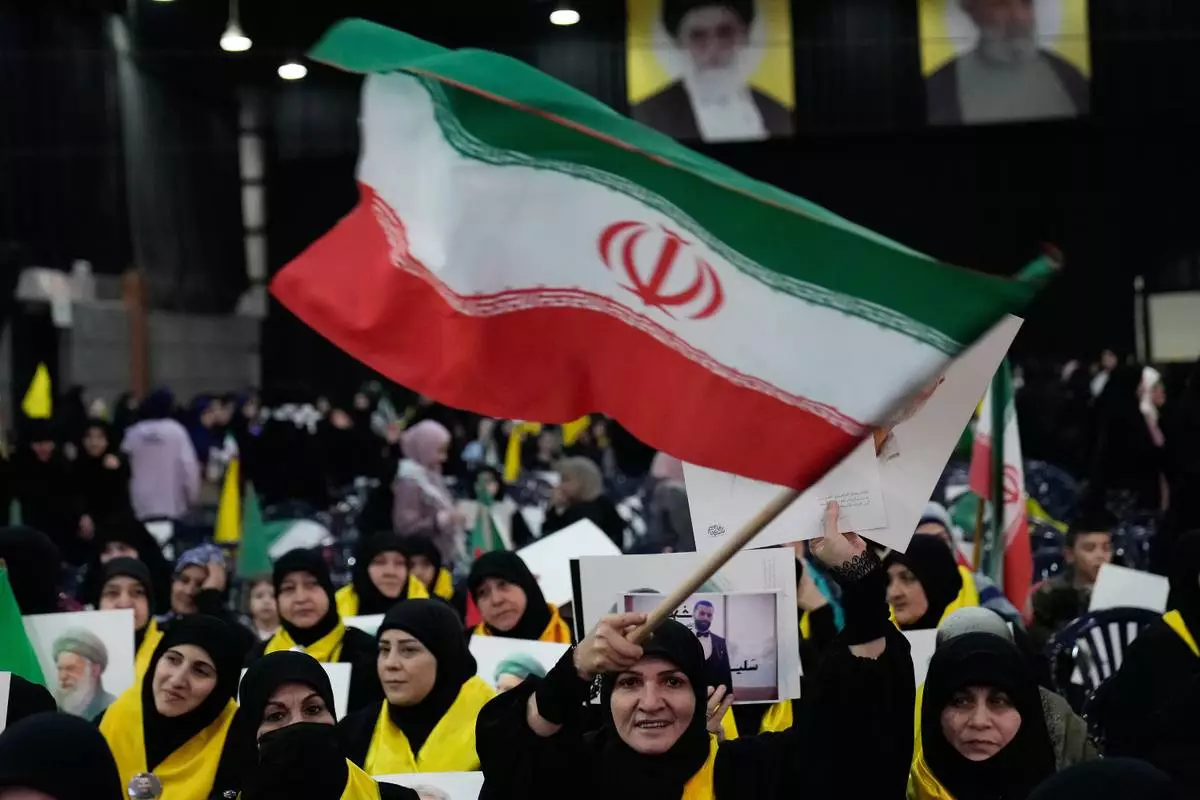
A Hezbollah supporter waves an Iranian flag during a rally to show their solidarity with the Iranian government, in the southern suburb of Beirut, Lebanon, Monday, Jan. 26, 2026. (AP Photo/Hussein Malla)
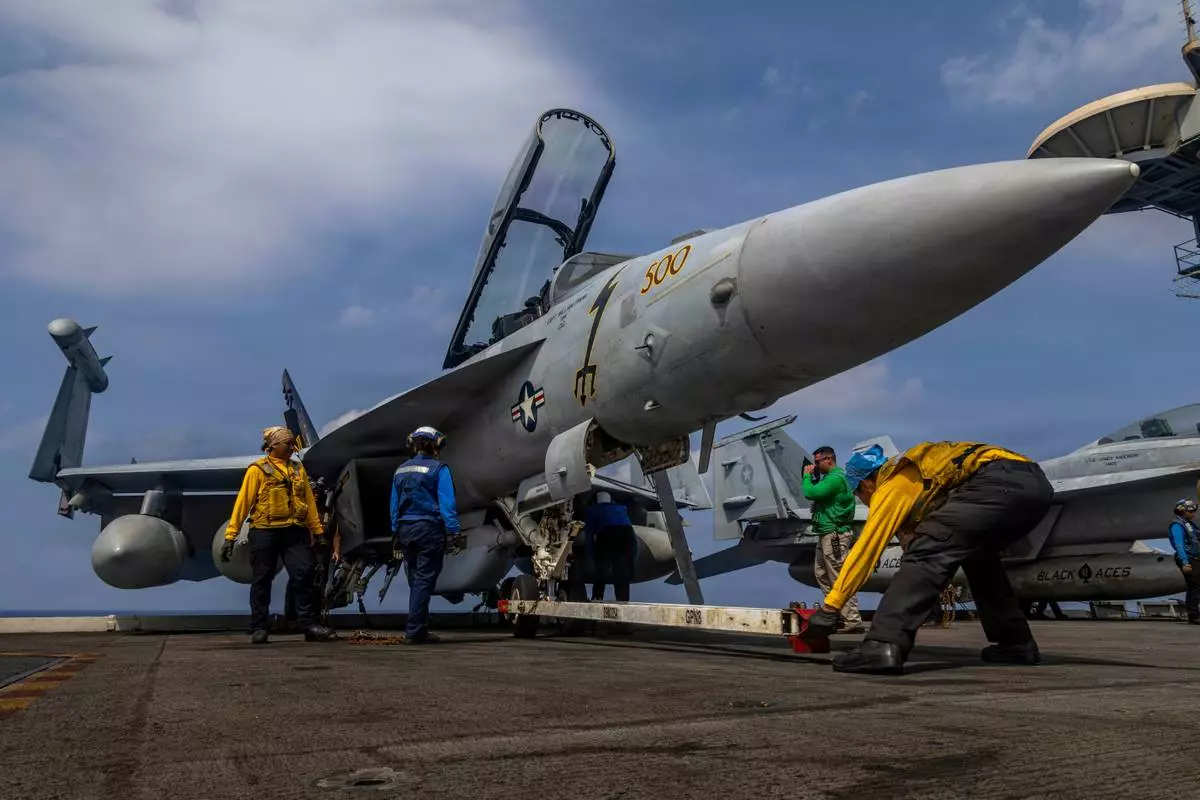
This photo provided by the U.S. Navy shows sailors preparing a Boeing EA-18G Growler on the flight deck of the Nimitz-class aircraft carrier USS Abraham Lincoln in the Indian Ocean on Jan. 21, 2026. (Mass Communication Specialist Seaman Daniel Kimmelman/U.S. Navy via AP)
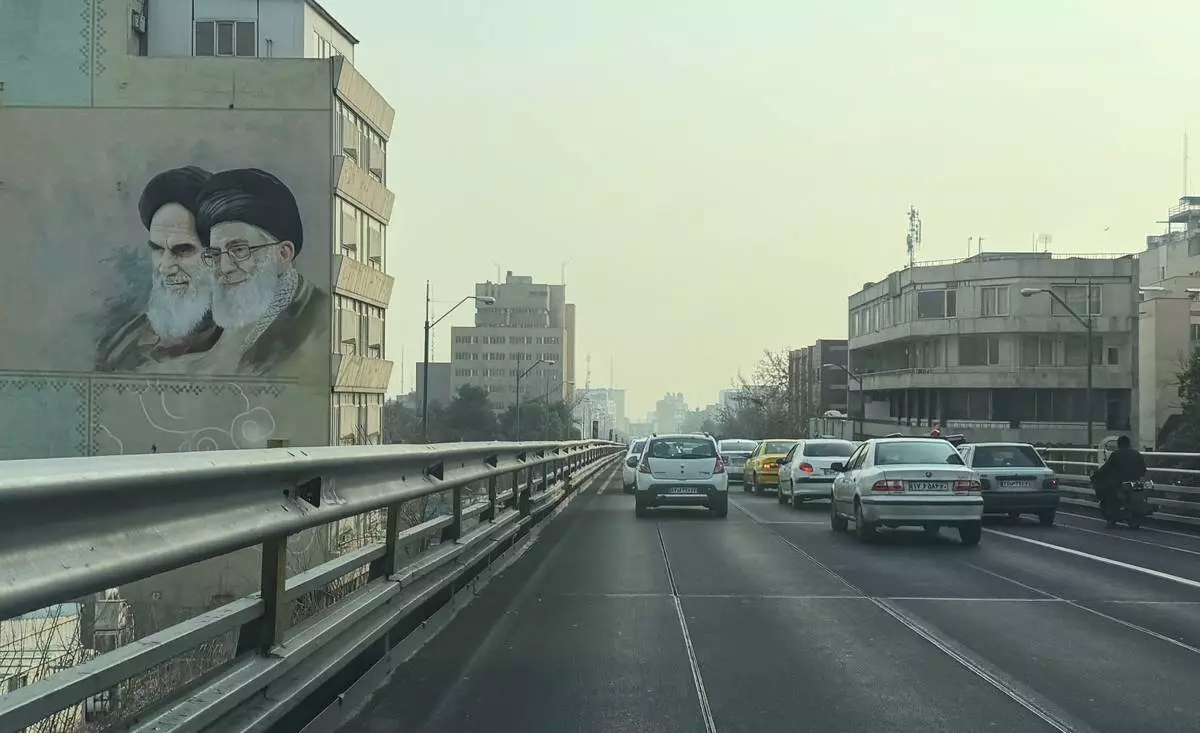
Vehicles drive past portrait of the late Iranian revolutionary founder Ayatollah Khomeini, left, and Supreme Leader Ayatollah Ali Khamenei, in downtown Tehran, Iran, Sunday, Jan. 25, 2026. (AP Photo/Vahid Salemi)
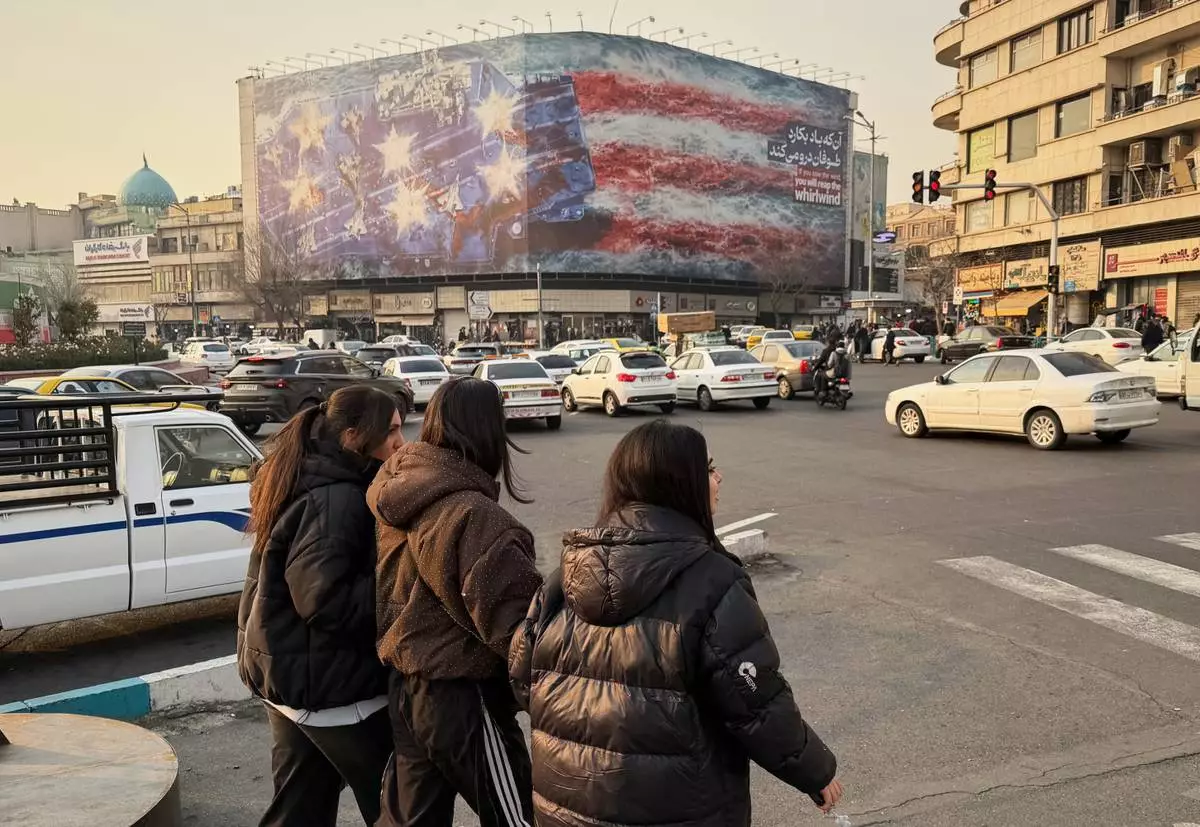
People walk in front a billboard with graphic showing a U.S aircraft carrier with damaged fighter jets on its deck, and sign reading in Farsi and English: "If you sow the wind, you'll reap whirlwind," at the Enqelab-e-Eslami (Islamic Revolution) square, in Tehran, Iran, Sunday, Jan. 25, 2026. (AP Photo/Vahid Salemi)