Skip to Content Facebook Feature Image

Trump's use of AI images pushes new boundaries, further eroding public trust, experts say

News

Trump's use of AI images pushes new boundaries, further eroding public trust, experts say
News

News

Trump's use of AI images pushes new boundaries, further eroding public trust, experts say

2026-01-28 02:51 Last Updated At:12:58

LOS ANGELES (AP) — The Trump administration has not shied away from sharing AI-generated imagery online, embracing cartoonlike visuals and memes and promoting them on official White House channels.

But an edited — and realistic — image of civil rights attorney Nekima Levy Armstrong in tears after being arrested is raising new alarms about how the administration is blurring the lines between what is real and what is fake.

Homeland Security Secretary Kristi Noem’s account posted the original image from Levy Armstrong's arrest before the official White House account posted an altered image that showed her crying. The doctored picture is part of a deluge of AI-edited imagery that has been shared across the political spectrum since the fatal shootings of Renee Good and Alex Pretti by U.S. Border Patrol officers in Minneapolis.

However, the White House’s use of artificial intelligence has troubled misinformation experts who fear the spreading of AI-generated or edited images erodes public perception of the truth and sows distrust.

In response to criticism of the edited image of Levy Armstrong, White House officials doubled down on the post, with deputy communications director Kaelan Dorr writing on X that the “memes will continue.” White House Deputy Press Secretary Abigail Jackson also shared a post mocking the criticism.

David Rand, a professor of information science at Cornell University, says calling the altered image a meme “certainly seems like an attempt to cast it as a joke or humorous post, like their prior cartoons. This presumably aims to shield them from criticism for posting manipulated media.” He said the purpose of sharing the altered arrest image seems “much more ambiguous” than the cartoonish images the administration has shared in the past.

Memes have always carried layered messages that are funny or informative to people who understand them, but indecipherable to outsiders. AI-enhanced or edited imagery is just the latest tool the White House uses to engage the segment of Trump’s base that spends a lot of time online, said Zach Henry, a Republican communications consultant who founded Total Virality, an influencer marketing firm.

“People who are terminally online will see it and instantly recognize it as a meme,” he said. “Your grandparents may see it and not understand the meme, but because it looks real, it leads them to ask their kids or grandkids about it.”

All the better if it prompts a fierce reaction, which helps it go viral, said Henry, who generally praised the work of the White House’s social media team.

The creation and dissemination of altered images, especially when they are shared by credible sources, “crystallizes an idea of what’s happening, instead of showing what is actually happening,” said Michael A. Spikes, a professor at Northwestern University and news media literacy researcher.

“The government should be a place where you can trust the information, where you can say it’s accurate, because they have a responsibility to do so," he said. "By sharing this kind of content, and creating this kind of content … it is eroding the trust — even though I’m always kind of skeptical of the term trust — but the trust we should have in our federal government to give us accurate, verified information. It’s a real loss, and it really worries me a lot.”

Spikes said he already sees the “institutional crises” around distrust in news organizations and higher education, and feels this behavior from official channels inflames those issues.

Ramesh Srinivasan, a professor at UCLA and the host of the Utopias podcast, said many people are now questioning where they can turn to for “trustable information.” “AI systems are only going to exacerbate, amplify and accelerate these problems of an absence of trust, an absence of even understanding what might be considered reality or truth or evidence,” he said.

Srinivasan said he feels the White House and other officials sharing AI-generated content not only invites everyday people to continue to post similar content but also grants permission to others who are in positions of credibility and power, like policymakers, to share unlabeled synthetic content. He added that given that social media platforms tend to “algorithmically privilege” extreme and conspiratorial content — which AI generation tools can create with ease — “we’ve got a big, big set of challenges on our hands.”

An influx of AI-generated videos related to Immigration and Customs Enforcement action, protests and interactions with citizens has already been proliferating on social media. After Renee Good was shot by an ICE officer while she was in her car, several AI-generated videos began circulating of women driving away from ICE officers who told them to stop. There are also many fabricated videos circulating of immigration raids and of people confronting ICE officers, often yelling at them or throwing food in their faces.

Jeremy Carrasco, a content creator who specializes in media literacy and debunking viral AI videos, said the bulk of these videos are likely coming from accounts that are “engagement farming," or looking to capitalize on clicks by generating content with popular keywords and search terms like ICE. But he also said the videos are getting views from people who oppose ICE and DHS and could be watching them as “fan fiction,” or engaging in “wishful thinking,” hoping that they're seeing real pushback against the organizations and their officers.

Still, Carrasco also believes that most viewers can't tell if what they're watching is fake, and questions whether they would know "what’s real or not when it actually matters, like when the stakes are a lot higher."

Even when there are blatant signs of AI generation, like street signs with gibberish on them or other obvious errors, only in the “best-case scenario” would a viewer be savvy enough or be paying enough attention to register the use of AI.

This issue is, of course, not limited to news surrounding immigration enforcement and protests. Fabricated and misrepresented images following the capture of deposed Venezuelan leader Nicolás Maduro exploded online earlier this month. Experts, including Carrasco, think the spread of AI-generated political content will only become more commonplace.

Carrasco believes that the widespread implementation of a watermarking system that embeds information about the origin of a piece of media into its metadata layer could be a step toward a solution. The Coalition for Content Provenance and Authenticity has developed such a system, but Carrasco doesn’t think that will become extensively adopted for at least another year.

“It’s going to be an issue forever now,” he said. I don’t think people understand how bad this is.”

__

Associated Press writers Jonathan J. Cooper in Phoenix and Barbara Ortutay in San Francisco contributed to this report.
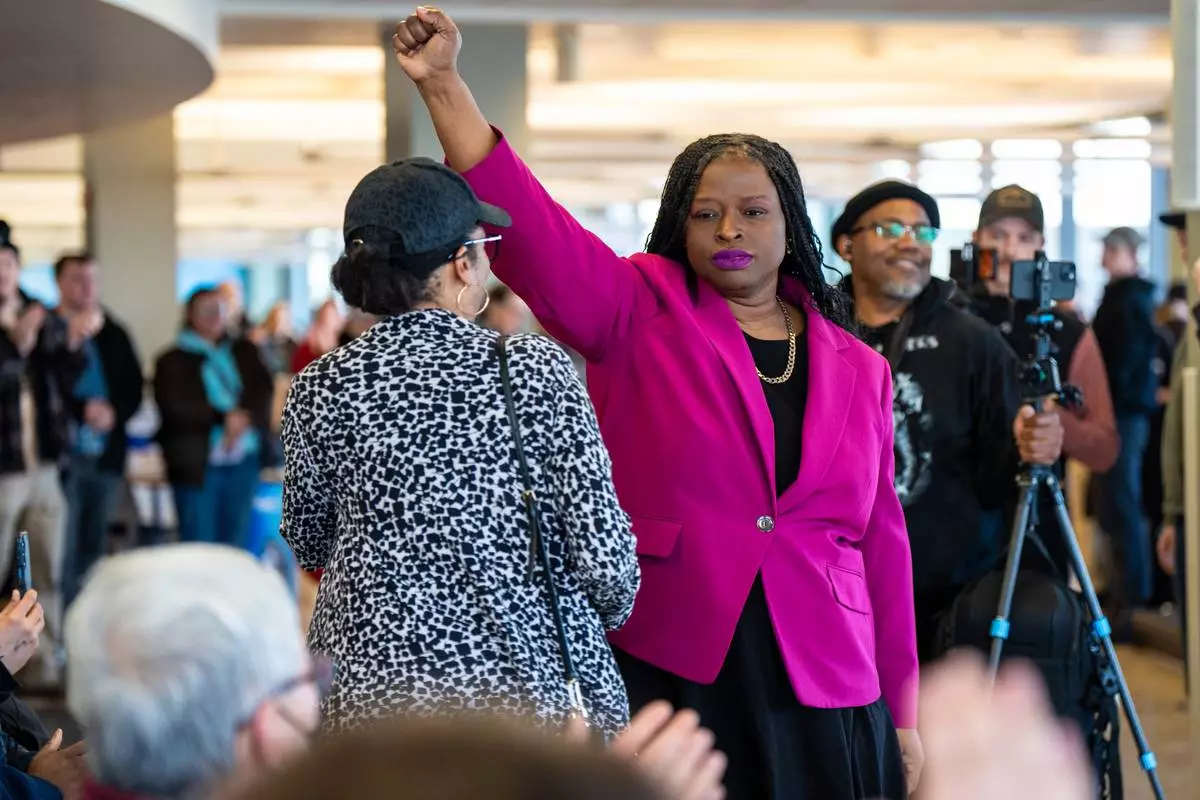
FILE - Nekima Levy Armstrong holds up her fist after speaking at an anti-ICE rally for Martin Luther King Jr., Monday, Jan. 19, 2026, in St. Paul, Minn. (AP Photo/Angelina Katsanis, File)
FILE - Nekima Levy Armstrong holds up her fist after speaking at an anti-ICE rally for Martin Luther King Jr., Monday, Jan. 19, 2026, in St. Paul, Minn. (AP Photo/Angelina Katsanis, File)
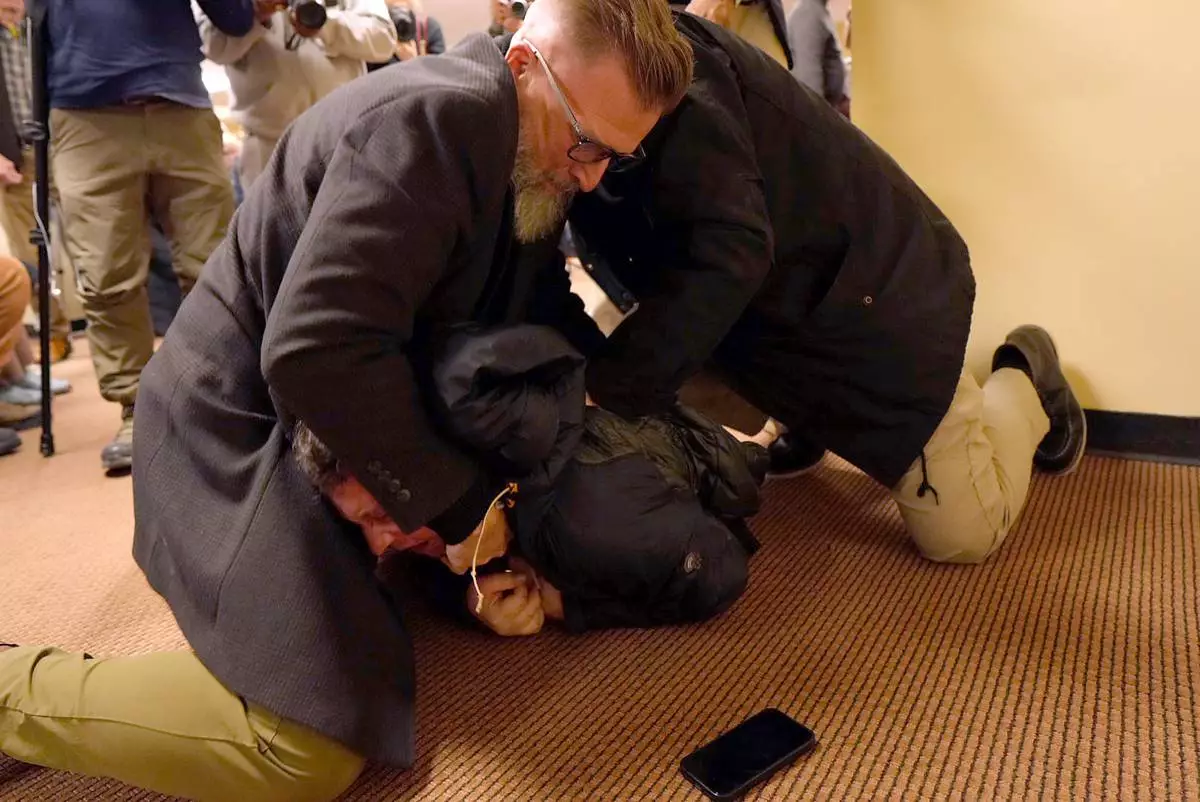
MINNEAPOLIS (AP) — A man sprayed an unknown substance on Democratic U.S. Rep. Ilhan Omar and was tackled to the ground Tuesday during a town hall Minneapolis, where tensions over federal immigration enforcement have come to a head after agents fatally shot an intensive care nurse and a mother of three this month.

The audience cheered as the man was pinned down and his arms were tied behind his back. In video of the incident, someone in the crowd can be heard saying, “Oh my god, he sprayed something on her.”

Just before that Omar had called for the abolishment of U.S. Immigration and Customs Enforcement and for Homeland Security Secretary Kristi Noem to resign or face impeachment. Calls are mounting on Capitol Hill for Noem to step down after the shooting deaths in Minneapolis of two people who protested deportations. Few Republicans have risen to her defense.

“ICE cannot be reformed,” Omar said, seconds before the attack.

Minneapolis police said officers saw the man use a syringe to spray an unknown liquid at Omar. They immediately arrested him and booked him at the county jail for third-degree assault, spokesperson Trevor Folke said. Forensic scientists responded to the scene.

Police identified the man as 55-year-old Anthony Kazmierczak. It was not immediately clear if Kazmierczak had an attorney. The county public defenders’ office could not immediately be reached.

Omar continued the town hall for about 25 more minutes after the man was ushered out by security, saying she would not be intimidated.

There was a strong, vinegarlike smell after the man pushed on the syringe, according to an Associated Press journalist who was there. Photos of the device, which fell to the ground when he was tackled, showed what appeared to be a light-brown liquid inside. There was no immediate word from officials on what it was.

Minneapolis Council Member LaTrisha Vetaw said some of the substance came into contact with her and State Sen. Bobby Joe Champion as well. She called it a deeply unsettling experience.

No one in the crowd of about 100 people had a noticeable physical reaction to the substance.

Walking out afterward, Omar said she felt a little flustered but was not hurt. She was going to be screened by a medical team.

She later posted on the social platform X: “I’m ok. I’m a survivor so this small agitator isn’t going to intimidate me from doing my work. I don’t let bullies win.”

The White House did not immediately respond to a message seeking comment Tuesday night.

President Donald Trump has frequently criticized the congresswoman and has stepped up verbal attacks on her in recent months as he turned his focus on Minneapolis. During a Cabinet meeting in December, he called her “garbage."

Hours earlier on Tuesday, the president criticized Omar as he spoke to a crowd in Iowa, saying his administration would only let in immigrants who “can show that they love our country.”

“They have to be proud, not like Ilhan Omar,” he said, drawing loud boos at the mention of her name.

He added: “She comes from a country that’s a disaster. So probably, it’s considered, I think — it’s not even a country.”

Omar is a U.S. citizen who fled her birthplace, Somalia, with her family at age 8 as a civil war tore apart the country.

The Minneapolis-St. Paul area is home to about 84,000 people of Somali descent — nearly a third of Somalis living in the U.S.

Democratic Minnesota Gov. Tim Walz expressed gratitude that Omar was safe, adding in a post on X: “Our state has been shattered by political violence in the last year. The cruel, inflammatory, dehumanizing rhetoric by our nation’s leaders needs to stop immediately.”

U.S. Rep. Nancy Mace, a South Carolina Republican, also denounced the assault.

“I am deeply disturbed to learn that Rep. Ilhan Omar was attacked at a town hall today” Mace said. “Regardless of how vehemently I disagree with her rhetoric — and I do — no elected official should face physical attacks. This is not who we are.”

Minneapolis Mayor Jacob Frey, a Democrat, called the attack “unacceptable.” He said he was relieved that Omar “is OK” and thanked police for their quick response, concluding: “This kind of behavior will not be tolerated in our city.”

The city has been reeling from the fatal shootings of two residents by federal immigration agents this month during Trump's massive immigration enforcement surge. Intensive care unit nurse Alex Pretti was killed Saturday, less than three weeks after Renee Good was fatally shot behind the wheel of her vehicle.

The attack came days after a man was arrested in Utah for allegedly punching U.S. Rep. Maxwell Frost, a Democrat from Florida, in the face during the Sundance Film Festival and saying Trump was going to deport him.

Threats against members of Congress have increased in recent years, peaking in 2021 in the aftermath of that year’s Jan. 6 attack on the U.S. Capitol, before dipping slightly only to climb again, according to the most recent figures from the U.S. Capitol Police.

Lawmakers have discussed the impact on their ability to hold town halls and public events, with some even citing the threat environment in their decisions not to seek reelection.

Omar has faced the most particular concern, long targeted with harsh language and personal attacks by Trump and other Republicans.

Following the assault on Omar, U.S. Capitol Police said in a statement that the agency was “working with our federal partners to see this man faces the most serious charges possible to deter this kind of violence in our society.”

It also released updated numbers detailing threats to members of Congress: 14,938 “concerning statements, behaviors, and communications directed against lawmakers, their families, staff and the Capitol Complex.”

That is a sharp increase from 2024, when the number of cases was 9,474, according to USCP. It is the third year in a row that the number of threats has increased.

Capitol Police have beefed up security measures across all fronts since Jan. 6, 2021, and the department has seen increased reporting after a new center was launched two years ago to process reports of threats.

Schoenbaum reported from Salt Lake City. Associated Press writers Audrey McAvoy in Honolulu, Mike Balsamo, Lisa Mascaro and Michelle Price in Washington, and Farnoush Amiri in New York contributed.

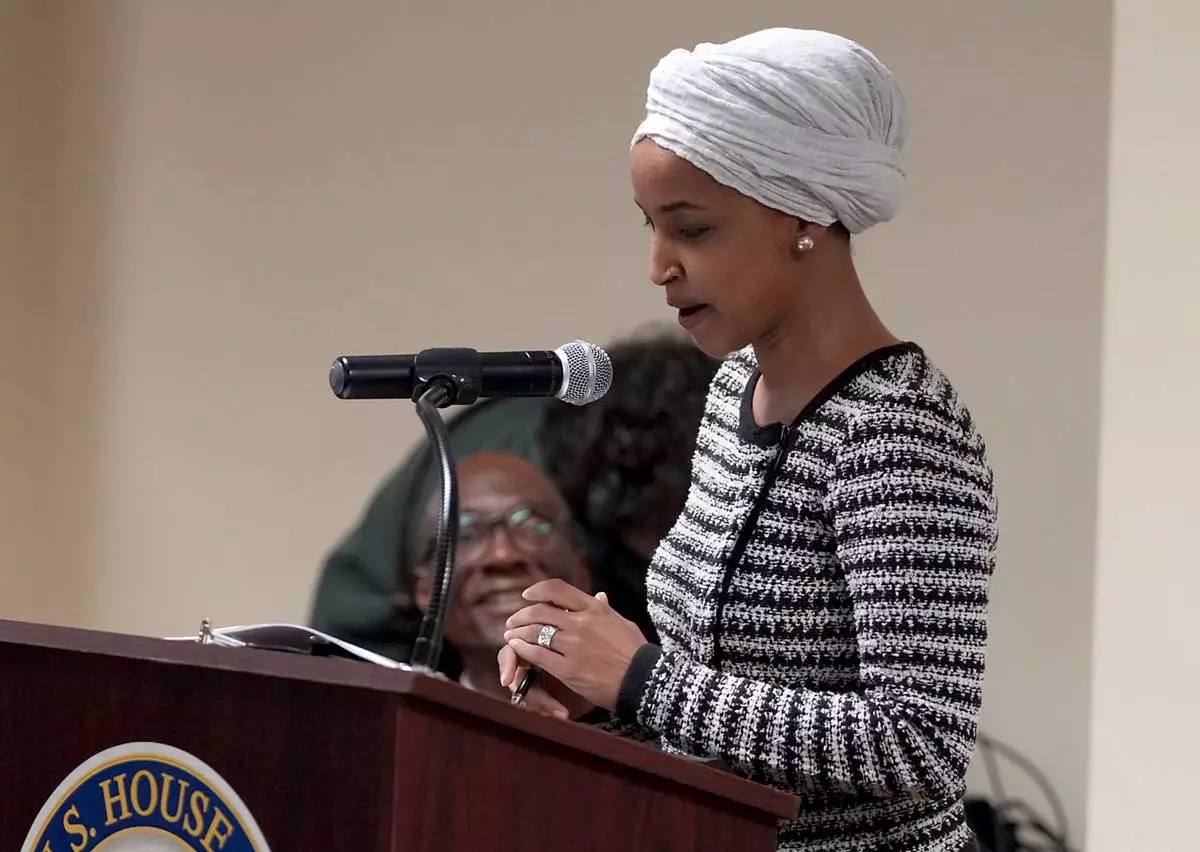
Rep. Ilhan Omar, D-Minn., speaks during a town hall in Minneapolis, Tuesday, Jan. 27, 2026. (Richard Tsong-Taatarii/Star Tribune via AP)

Rep. Ilhan Omar, D-Minn., speaks during a town hall in Minneapolis, Tuesday, Jan. 27, 2026. (Richard Tsong-Taatarii/Star Tribune via AP)

A man is tackled to the ground after spraying an unknown substance on U.S. Rep. Ilhan Omar, D-Minn., during a town hall on Tuesday, Jan. 27, 2026, in Minneapolis. (Richard Tsong-Taatarii/Star Tribune via AP)

A man is tackled to the ground after spraying an unknown substance on U.S. Rep. Ilhan Omar, D-Minn., during a town hall on Tuesday, Jan. 27, 2026, in Minneapolis. (Richard Tsong-Taatarii/Star Tribune via AP)

Recommended Articles