Skip to Content Facebook Feature Image

'Doomsday Clock' moves closer to midnight over threats from nuclear weapons, climate change and AI

News

'Doomsday Clock' moves closer to midnight over threats from nuclear weapons, climate change and AI
News

News

'Doomsday Clock' moves closer to midnight over threats from nuclear weapons, climate change and AI

2026-01-28 07:54 Last Updated At:08:00

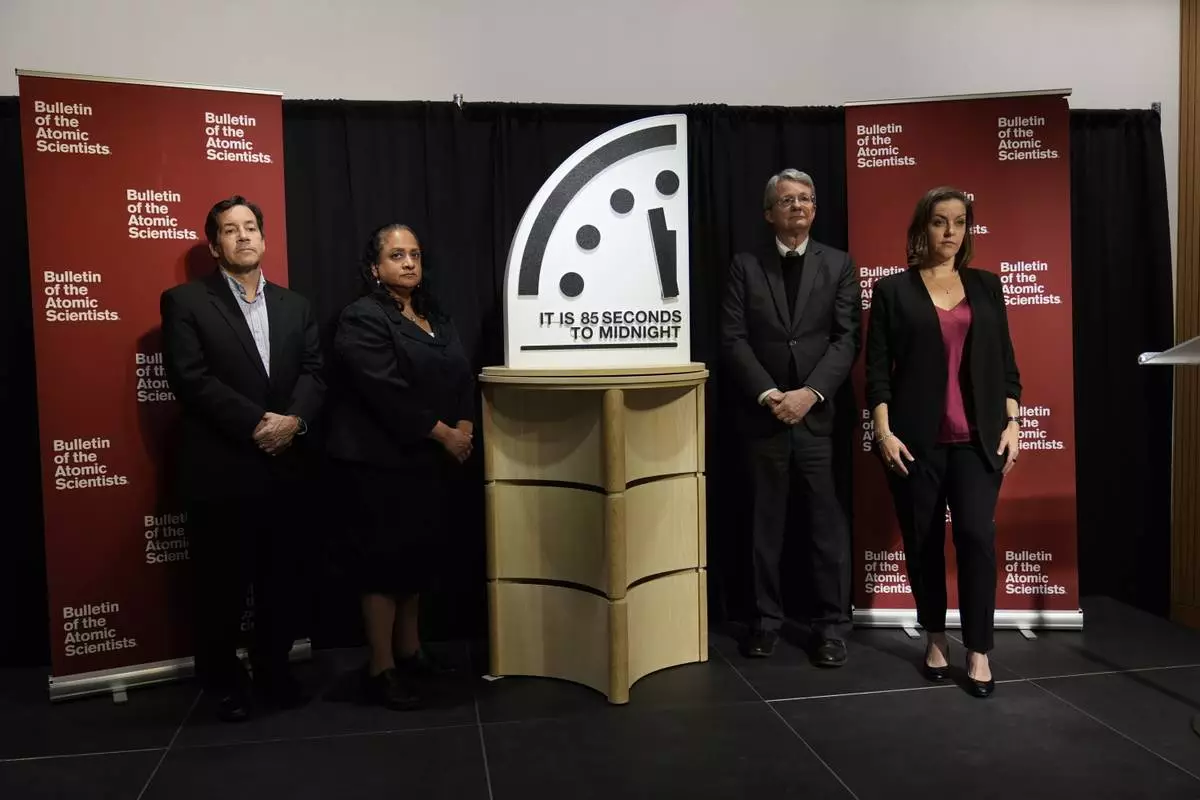
Earth is closer than it's ever been to destruction as Russia, China, the U.S. and other countries become “increasingly aggressive, adversarial, and nationalistic,” a science-oriented advocacy group said Tuesday as it advanced its “Doomsday Clock” to 85 seconds till midnight.

The Bulletin of the Atomic Scientist members had an initial demonstration Friday and then announced their results on Tuesday.

More Images
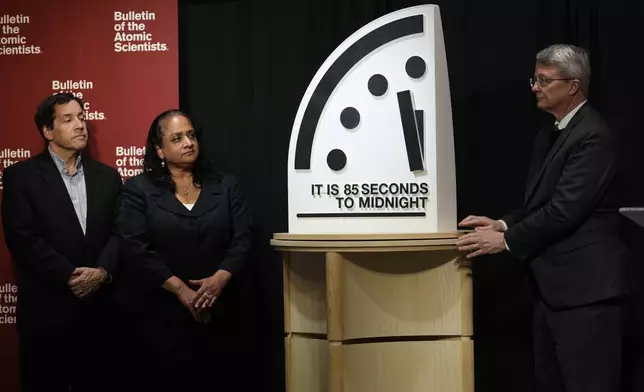
The Bulletin of the Atomic Scientists members, from left, Jon B. Wolfsthal, Asha M. George and Steve Fetter reveal the Doomsday Clock, set to 85 seconds to midnight, during a news conference at the Carnegie Endowment for International Peace, Friday, Jan. 23, 2026, in Washington. (AP Photo/Pablo Martinez Monsivais)

The Bulletin of the Atomic Scientists members, from left, Jon B. Wolfsthal, Asha M. George and Steve Fetter reveal the Doomsday Clock, set to 85 seconds to midnight, during a news conference at the Carnegie Endowment for International Peace, Friday, Jan. 23, 2026, in Washington. (AP Photo/Pablo Martinez Monsivais)
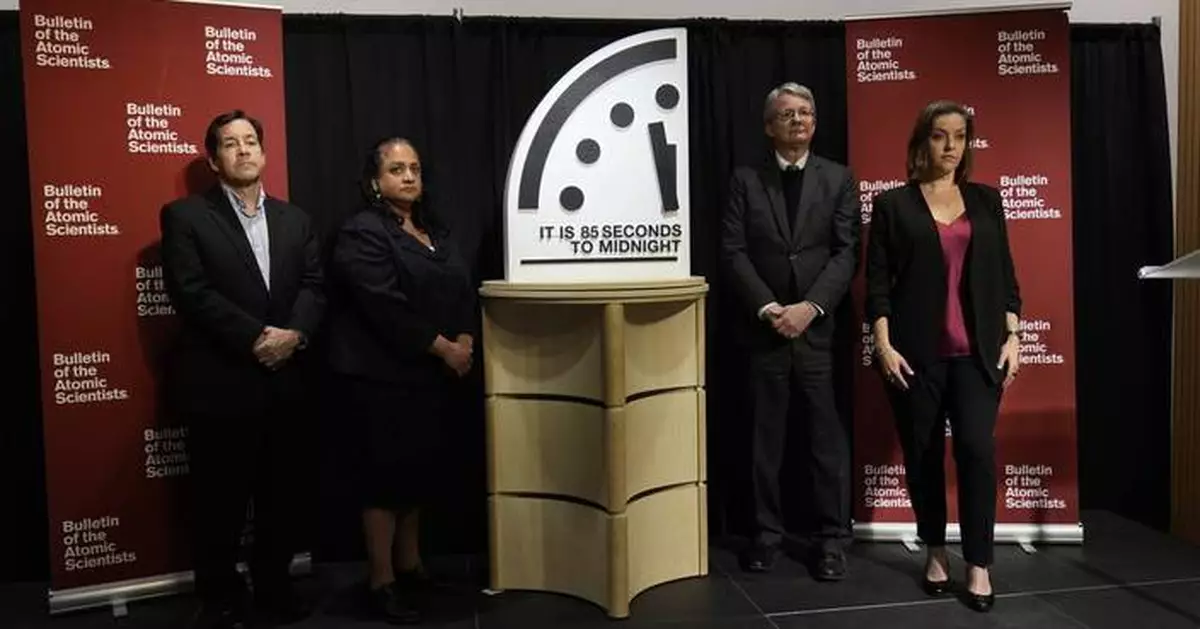
The Bulletin of the Atomic Scientist members, from left, Jon B. Wolfsthal, Asha M. George, Steve Fetter and Alexandra Bell, reveal the Doomsday Clock, set to 85 seconds to midnight, during a news conference at the Carnegie Endowment for International Peace, Friday, Jan. 23, 2026, in Washington. (AP Photo/Pablo Martinez Monsivais)
The Bulletin of the Atomic Scientist members, from left, Jon B. Wolfsthal, Asha M. George, Steve Fetter and Alexandra Bell, reveal the Doomsday Clock, set to 85 seconds to midnight, during a news conference at the Carnegie Endowment for International Peace, Friday, Jan. 23, 2026, in Washington. (AP Photo/Pablo Martinez Monsivais)

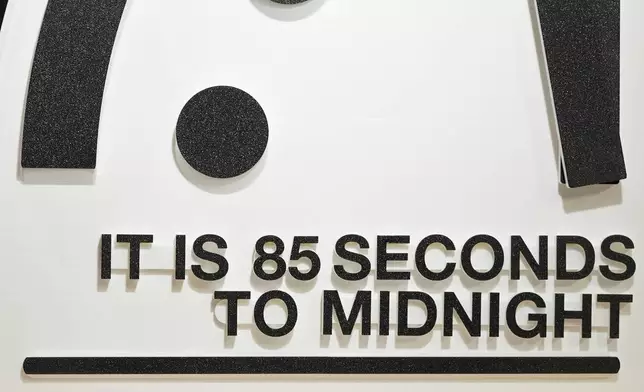
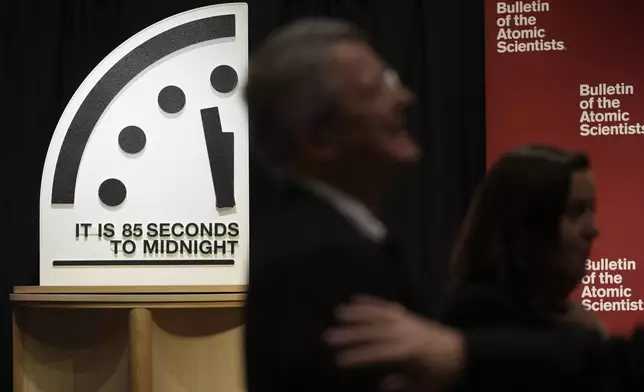
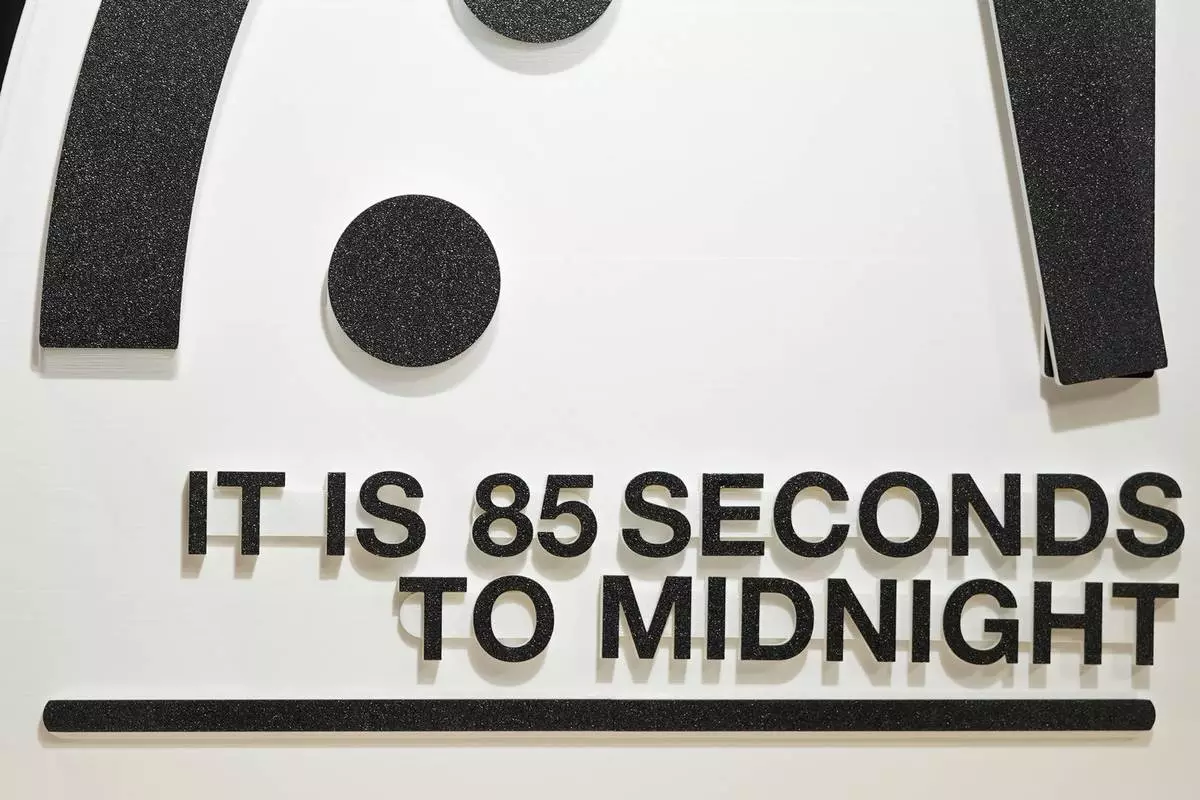
The Doomsday Clock of the Bulletin of the Atomic Scientists, set at 85 seconds to midnight, is displayed during a news conference at the Carnegie Endowment for International Peace, Friday, Jan. 23, 2026, in Washington. (AP Photo/Pablo Martinez Monsivais)

The Doomsday Clock of the Bulletin of the Atomic Scientists, set at 85 seconds to midnight, is displayed during a news conference at the Carnegie Endowment for International Peace, Friday, Jan. 23, 2026, in Washington. (AP Photo/Pablo Martinez Monsivais)

The Doomsday Clock of the Bulletin of the Atomic Scientists, set at 85 seconds to midnight, is displayed during a news conference at the Carnegie Endowment for International Peace, Friday, Jan. 23, 2026, in Washington. (AP Photo/Pablo Martinez Monsivais)

The Doomsday Clock of the Bulletin of the Atomic Scientists, set at 85 seconds to midnight, is displayed during a news conference at the Carnegie Endowment for International Peace, Friday, Jan. 23, 2026, in Washington. (AP Photo/Pablo Martinez Monsivais)

The Bulletin of the Atomic Scientist members, from left, Jon B. Wolfsthal, Asha M. George, Steve Fetter and Alexandra Bell, reveal the Doomsday Clock, set to 85 seconds to midnight, during a news conference at the Carnegie Endowment for International Peace, Friday, Jan. 23, 2026, in Washington. (AP Photo/Pablo Martinez Monsivais)

The Bulletin of the Atomic Scientist members, from left, Jon B. Wolfsthal, Asha M. George, Steve Fetter and Alexandra Bell, reveal the Doomsday Clock, set to 85 seconds to midnight, during a news conference at the Carnegie Endowment for International Peace, Friday, Jan. 23, 2026, in Washington. (AP Photo/Pablo Martinez Monsivais)

The scientists cited risks of nuclear war, climate change, potential misuse of biotechnology and the increasing use of artificial intelligence without adequate controls as it made the annual announcement, which rates how close humanity is from ending.

Last year the clock advanced to 89 seconds to midnight.

Since then, “hard-won global understandings are collapsing, accelerating a winner-takes-all great power competition and undermining the international cooperation” needed to reduce existential risks, the group said.

They worry about the threat of escalating conflicts involving nuclear-armed countries, citing the Russia-Ukraine war, May's conflict between India and Pakistan and whether Iran is capable of developing nuclear weapons after strikes last summer by the U.S. and Israel.

International trust and cooperation is essential because, "if the world splinters into an us-versus-them, zero-sum approach, it increases the likelihood that we all lose,” said Daniel Holz, chair of the group’s science and security board.

The group also highlighted droughts, heat waves and floods linked to global warming, as well as the failure of nations to adopt meaningful agreements to fight global warming — singling out U.S. President Donald Trump's efforts to boost fossil fuels and hobble renewable energy production.

Starting in 1947, the advocacy group used a clock to symbolize the potential and even likelihood of people doing something to end humanity. At the end of the Cold War, it was as close as 17 minutes to midnight. In the past few years, to address rapid global changes, the group has changed from counting down the minutes until midnight to counting down the seconds.

The group said the clock could be turned back if leaders and nations worked together to address existential risks.

The Associated Press’ climate and environmental coverage receives financial support from multiple private foundations. AP is solely responsible for all content. Find AP’s standards for working with philanthropies, a list of supporters and funded coverage areas at AP.org.
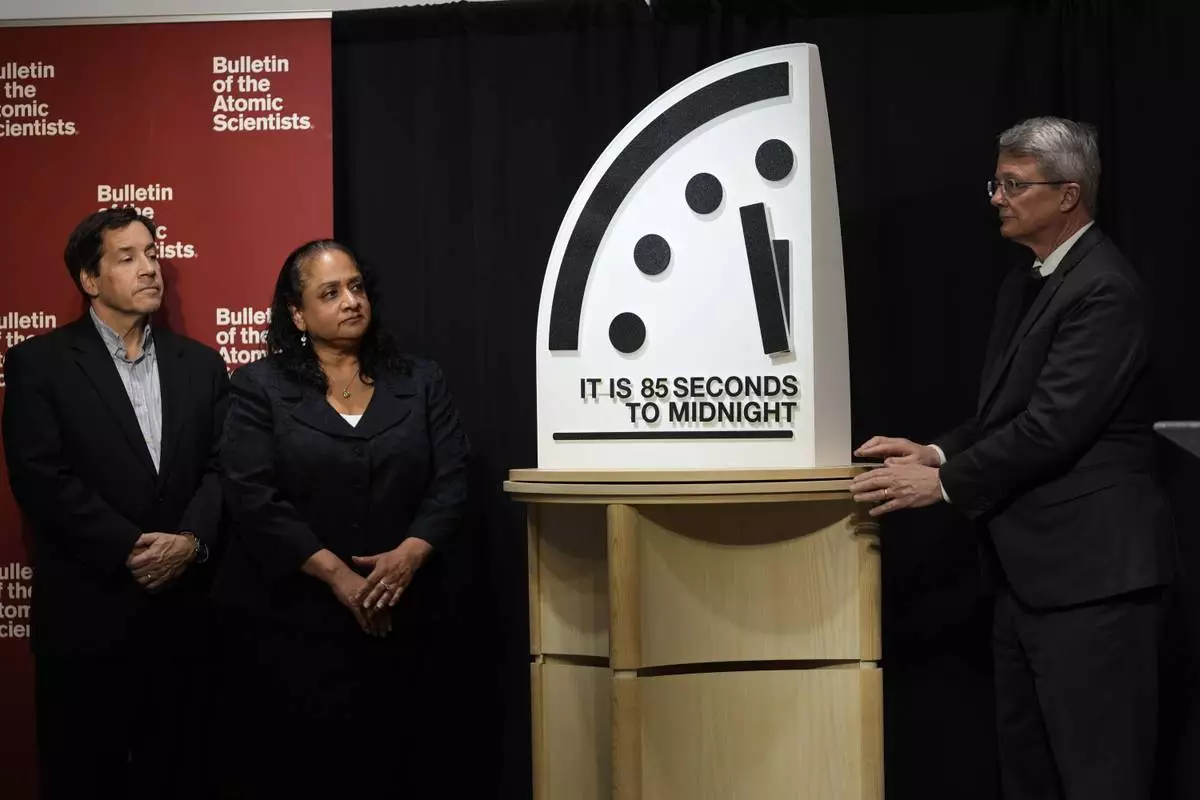
The Bulletin of the Atomic Scientists members, from left, Jon B. Wolfsthal, Asha M. George and Steve Fetter reveal the Doomsday Clock, set to 85 seconds to midnight, during a news conference at the Carnegie Endowment for International Peace, Friday, Jan. 23, 2026, in Washington. (AP Photo/Pablo Martinez Monsivais)
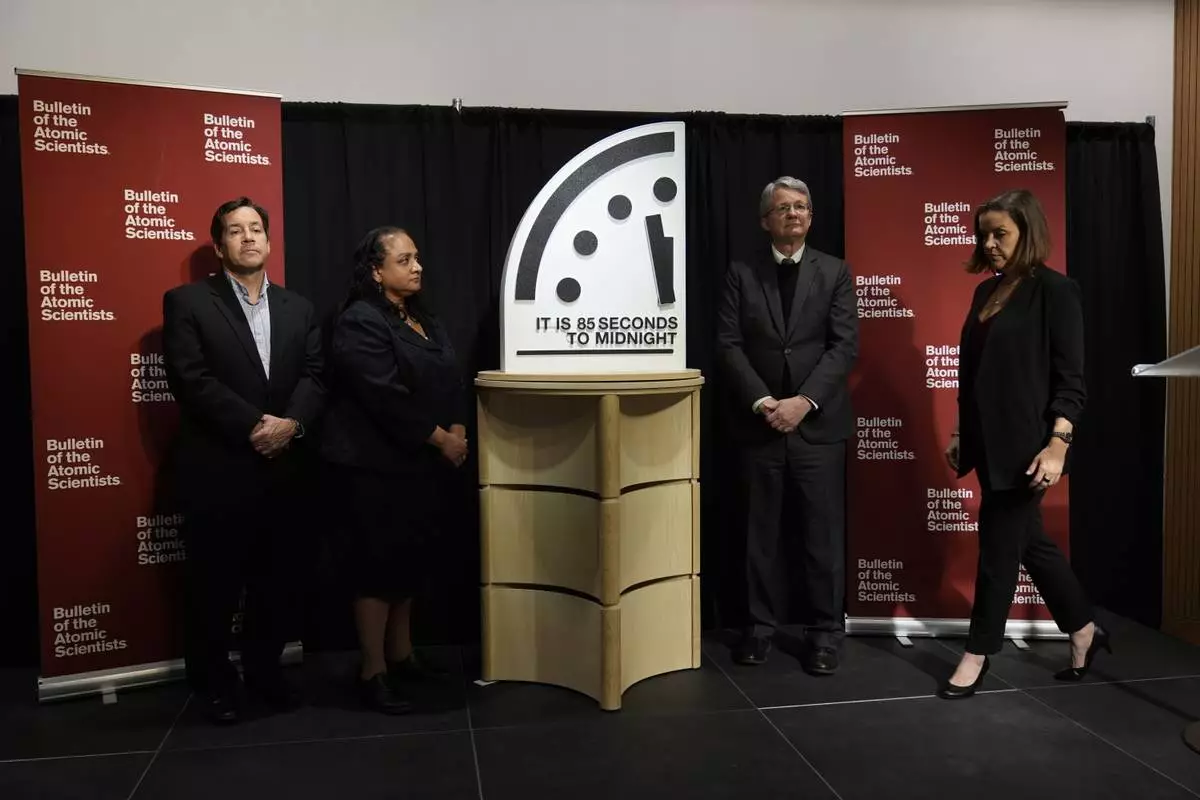
The Bulletin of the Atomic Scientists members, from left, Jon B. Wolfsthal, Asha M. George and Steve Fetter reveal the Doomsday Clock, set to 85 seconds to midnight, during a news conference at the Carnegie Endowment for International Peace, Friday, Jan. 23, 2026, in Washington. (AP Photo/Pablo Martinez Monsivais)
The Bulletin of the Atomic Scientist members, from left, Jon B. Wolfsthal, Asha M. George, Steve Fetter and Alexandra Bell, reveal the Doomsday Clock, set to 85 seconds to midnight, during a news conference at the Carnegie Endowment for International Peace, Friday, Jan. 23, 2026, in Washington. (AP Photo/Pablo Martinez Monsivais)
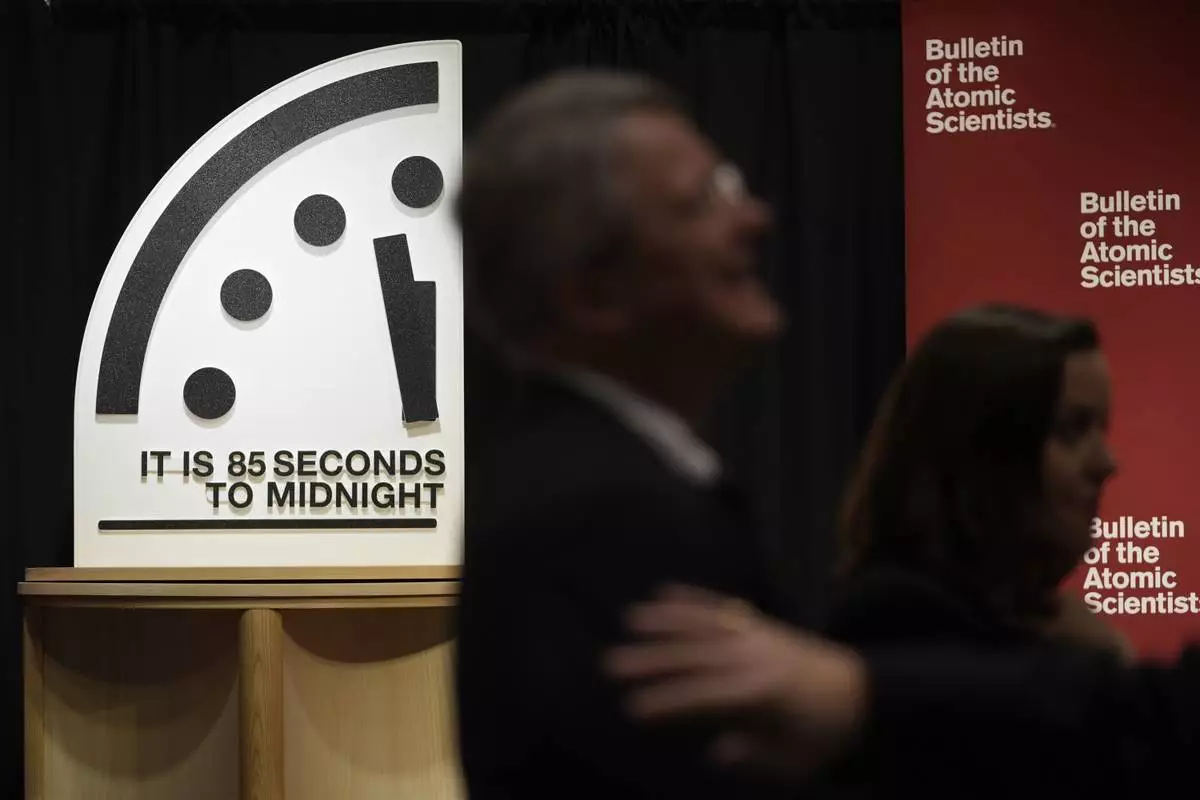
The Bulletin of the Atomic Scientist members, from left, Jon B. Wolfsthal, Asha M. George, Steve Fetter and Alexandra Bell, reveal the Doomsday Clock, set to 85 seconds to midnight, during a news conference at the Carnegie Endowment for International Peace, Friday, Jan. 23, 2026, in Washington. (AP Photo/Pablo Martinez Monsivais)
The Doomsday Clock of the Bulletin of the Atomic Scientists, set at 85 seconds to midnight, is displayed during a news conference at the Carnegie Endowment for International Peace, Friday, Jan. 23, 2026, in Washington. (AP Photo/Pablo Martinez Monsivais)


The Doomsday Clock of the Bulletin of the Atomic Scientists, set at 85 seconds to midnight, is displayed during a news conference at the Carnegie Endowment for International Peace, Friday, Jan. 23, 2026, in Washington. (AP Photo/Pablo Martinez Monsivais)

The Doomsday Clock of the Bulletin of the Atomic Scientists, set at 85 seconds to midnight, is displayed during a news conference at the Carnegie Endowment for International Peace, Friday, Jan. 23, 2026, in Washington. (AP Photo/Pablo Martinez Monsivais)

The Doomsday Clock of the Bulletin of the Atomic Scientists, set at 85 seconds to midnight, is displayed during a news conference at the Carnegie Endowment for International Peace, Friday, Jan. 23, 2026, in Washington. (AP Photo/Pablo Martinez Monsivais)

The Bulletin of the Atomic Scientist members, from left, Jon B. Wolfsthal, Asha M. George, Steve Fetter and Alexandra Bell, reveal the Doomsday Clock, set to 85 seconds to midnight, during a news conference at the Carnegie Endowment for International Peace, Friday, Jan. 23, 2026, in Washington. (AP Photo/Pablo Martinez Monsivais)

The Bulletin of the Atomic Scientist members, from left, Jon B. Wolfsthal, Asha M. George, Steve Fetter and Alexandra Bell, reveal the Doomsday Clock, set to 85 seconds to midnight, during a news conference at the Carnegie Endowment for International Peace, Friday, Jan. 23, 2026, in Washington. (AP Photo/Pablo Martinez Monsivais)

INDIANAPOLIS (AP) — IndyCar points leader Alex Palou has been docked five championship points after a postrace technical inspection found an assembly error on the No. 10 car he used in Sunday's Indianapolis 500.

The Chip Ganassi Racing team also lost five entrant points and was fined $10,000.

Series officials released a statement Monday saying they had found the team had made an assembly error that resulted in a rules violation and was not an intentional change.

Palou who owns four series titles, including three straight, finished sixth in Sunday's race. The Spaniard still maintains a 37-point advantage over American David Malukas, who was passed by winner Felix Rosenqvist in the final yards in the closest race in Indy 500 history and finished as runner-up for the second straight year.

The victory margin was 0.023 seconds.

AP auto racing: https://apnews.com/hub/auto-racing

Felix Rosenqvist, left, of Sweden, and Alex Palou, right,of Spain, pull out of the pit area during practice for the Indianapolis 500 auto race at Indianapolis Motor Speedway in Indianapolis, Sunday, May 24, 2026. (AP Photo/Michael Conroy)

Felix Rosenqvist, left, of Sweden, and Alex Palou, right,of Spain, pull out of the pit area during practice for the Indianapolis 500 auto race at Indianapolis Motor Speedway in Indianapolis, Sunday, May 24, 2026. (AP Photo/Michael Conroy)

Alex Palou (10), of Spain, leads the field into the first turn during the Indianapolis 500 auto race at Indianapolis Motor Speedway in Indianapolis, Sunday, May 24, 2026. (AP Photo/Michael Conroy)

Alex Palou (10), of Spain, leads the field into the first turn during the Indianapolis 500 auto race at Indianapolis Motor Speedway in Indianapolis, Sunday, May 24, 2026. (AP Photo/Michael Conroy)

Alex Palou, of Spain, makes a pit stop during the Indianapolis 500 auto race at Indianapolis Motor Speedway in Indianapolis, Sunday, May 24, 2026. (AP Photo/AJ Mast)

Alex Palou, of Spain, makes a pit stop during the Indianapolis 500 auto race at Indianapolis Motor Speedway in Indianapolis, Sunday, May 24, 2026. (AP Photo/AJ Mast)

Recommended Articles