Speech by FS at 3rd Hong Kong Capital Markets Forum 2026 (with photos/video)
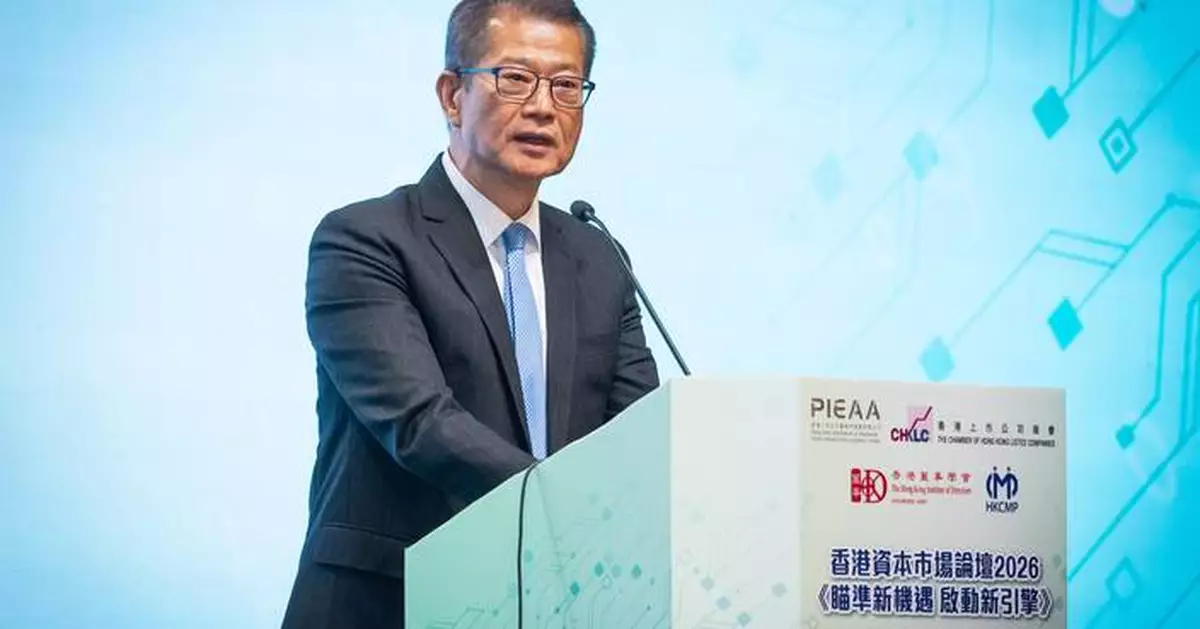
Following is the speech by the Financial Secretary, Mr Paul Chan, at the Hong Kong Capital Markets Forum 2026 today (January 28):
(Director-General of the Economic Affairs Department of the Liaison Office of the Central People's Government in the Hong Kong Special Administrative Region, Mr Xu Weigang), Clement (Chairman of the Hong Kong Association of Registered Public Interest Entity Auditors Limited, Mr Clement Chan), Kenneth (Executive Deputy Chairperson of the Chamber of Hong Kong Listed Companies, Dr Kenneth Lam), Kelvin (Chairman of Securities and Futures Commission, Dr Kelvin Wong), David (Chairman, Accounting and Financial Reporting Council, Dr David Sun), distinguished guests, ladies and gentlemen,
Good morning. It is a pleasure to join you at the third Hong Kong Capital Markets Forum. This year's theme, "Capturing the Next Growth Momentum," aptly reflects where Hong Kong stands today, and puts a spotlight on how to ensure financial services as a lasting engine of our economic growth.
Review of 2025
Looking back at 2025, market sentiment and global capital flows were shaped by a complex mix of geopolitical tensions, technological disruption, as well as unilateralism, tariff and policy unpredictability of certain jurisdictions. Many of us will remember the volatility that followed the "Liberation Day" shock, which reverberated across global markets.
Yet the Hong Kong market remained resilient and delivered a strong performance in 2025. The Hang Seng Index rose by 28 per cent. Average daily turnover increased by about 90 per cent to nearly HK$250 billion. The IPO (initial public offering) market was also vibrant, with 119 new listings raising over HK$280 billion, placing Hong Kong at the top of the global IPO league table.
The broader financial sector also demonstrated renewed confidence. Bank deposits rose by 12 per cent to HK$19.4 trillion. In asset and wealth management, Hong Kong-domiciled funds recorded net capital inflows of more than HK$380 billion in the first 11 months of 2025.
These capital inflows reflect global investors' confidence in Hong Kong and the underlying vitality of our market. One reason they choose Hong Kong is our policy predictability and consistency. Under the "one country, two systems" arrangement, Hong Kong is a free port. We sticked to this core value and did not retaliate against unilateral tariffs. In a world where investors increasingly value stability, transparency and freedom of capital movement, Hong Kong stands out as safe harbour for capital, and for many, a trusted platform to do business.
Another reason is the value being created and unleashed in this part of the world - particularly by Chinese technology firms. The "DeepSeek Moment" last year prompted investors at home and abroad to reassess the capabilities, competitiveness and value of China's technology companies. Many also realised that, up till then, they had under-allocated to the Mainland and Hong Kong markets.
Hong Kong going forward
Going forward, how do I see Hong Kong's capital markets developing in 2026? I am cautiously optimistic, for several reasons.
First, shifts in the geopolitical landscape - especially rising unilateralism and power politics - are prompting investors to diversify their asset allocation. Diversification is now the key theme. Governments and financial institutions are seeking greater strategic resilience. Recent movements in gold and silver prices reflect the growing interest in alternatives to US (United States) dollar denominated assets.
Second, China's development remains steady and positive. Last year, the Chinese economy met its growth target of 5 per cent, and growth this year is widely expected to be in the range of 4.5 per cent to 5 per cent. The year 2026 marks the start of the 15th Five-Year Plan period. China is pressing ahead with high-level, two-way opening-up, while pursuing technological self-reliance and integrating technological innovation with industry development. These will continue to power high-quality development for the country. China's technological potential should not be under estimated, and it will remain a key focus for international investors.
Just last week, I attended the World Economic Forum in Davos, Switzerland. Indeed, across regions, investors generally expressed optimism about the opportunities in China and in Hong Kong.
In my view, the global environment is shifting in ways that create new and favourable opportunities for Hong Kong. Our challenge is how to seize the moment and deliver tangible outcomes. More specifically, that involves supporting the country's high-quality development; matching the needs of Mainland enterprises going global and the appetite of international investors; and, at the same time, driving Hong Kong's own growth.
This will require us to further upgrade and deepen our capital markets, so that they stay competitive, resilient and well-positioned for the next phase of growth. In this regard, we are working on three priorities.
Our priorities
The first is to strengthen the competitiveness and appeal of our stock market. Over the years, we have undertaken listing reforms, such as Chapters 18A and 18C, to better support fundraising by new economy companies. Currently, we have asked HKEX (the Hong Kong Exchanges and Clearing Limited) to conduct another review of the listing regime to keep pace with the evolving needs of issuers and investors. It is also working on enhancements to the issuance framework for structured products, and exploring regional co-operation in products such as ETFs (exchange-traded funds).
At the same time, HKEX is also advancing initiatives to improve trading efficiency and risk management. These include board lot reforms, transition to an uncertificated securities market, and moving towards a T+1 settlement cycle as soon as practicable.
We also see significant scope to better utilise stocks and bonds held in custody. Last year, the Hong Kong Monetary Authority and HKEX entered into strategic co-operation on CMU OmniClear. The aim is to turn it into a multi-asset class platform that provides custodian services to both equity and debt securities. This will enhance interoperability in depository and collateral management, and facilitate more efficient use of such assets as collaterals to enhance their liquidity and return.
The second priority is to strengthen other parts of our capital markets, especially in areas of strategic importance. Our efforts focus on two directions. First, reinforcing our traditional strengths, such as asset and wealth management, and fixed income and currency markets. Second, developing new growth areas, including gold and commodities trading. Just two days ago, the HKSAR (Hong Kong Special Administrative Region) Government signed a co-operation agreement with the Shanghai Gold Exchange. This covers, among other things, a new gold central clearing system, gold storage facilities, and closer co-operation in physical gold trading. With these, a whole range of derivative products and services can be developed.
The third priority is to build a more vibrant offshore Renminbi (RMB) market. As more Mainland enterprises expand overseas and deepen co-operation with international partners, cross-border RMB usage is naturally increasing. We will continue to enhance offshore RMB liquidity, strengthen the supporting infrastructure and broaden the range of RMB-denominated investment and risk-management products. With the support of the relevant Central Authorities, we will further expand the breadth and depth of the various Connect schemes. In the process, we will also contribute to the prudent internationalisation of the RMB.
Concluding remarks
Ladies and gentlemen, the year 2026 will bring both challenges and opportunities. With Hong Kong's unique strengths under the "one country, two systems" arrangement, and with our concerted commitment to reinvent our capital markets, I am confident that we can capture the next growth momentum and bring Hong Kong's IFC (international financial centre) status to new heights. Thank you very much.
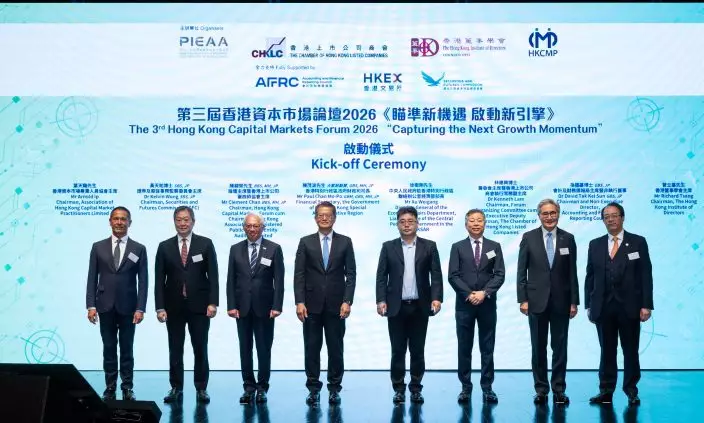
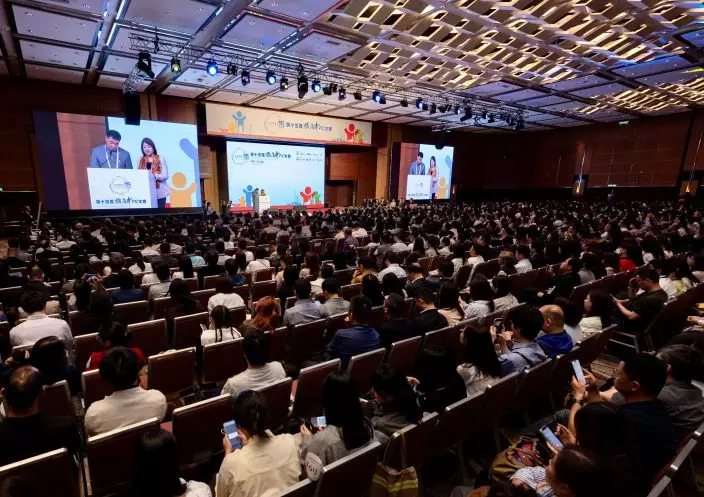
The 3rd Hong Kong Capital Markets Forum 2026, Source: HKSAR Government Press Releases
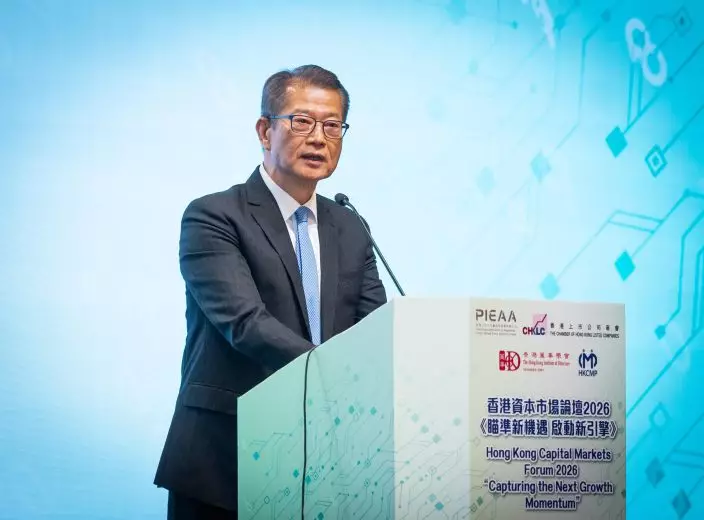
The Financial Secretary, Mr Paul Chan, Source: HKSAR Government Press Releases