Skip to Content Facebook Feature Image

NFL's turf guru has meticulous journey to prepare Levi's Stadium field for Super Bowl

Sport

NFL's turf guru has meticulous journey to prepare Levi's Stadium field for Super Bowl
Sport

Sport

NFL's turf guru has meticulous journey to prepare Levi's Stadium field for Super Bowl

2026-01-29 00:39 Last Updated At:00:40

SANTA CLARA, Calif. (AP) — Nick Pappas' process for preparing the Super Bowl field got underway long before the Seattle Seahawks and New England Patriots started getting ready for the 2025 season.

The NFL's turf guru picked the sod farm that began growing the field for the game about 16 months ago and spent time since then monitoring the progress. The job went into overdrive in January when Pappas and his crew started a monthlong installation and preparation process to make sure that the story of the game is about the teams and not the grass.

More Images
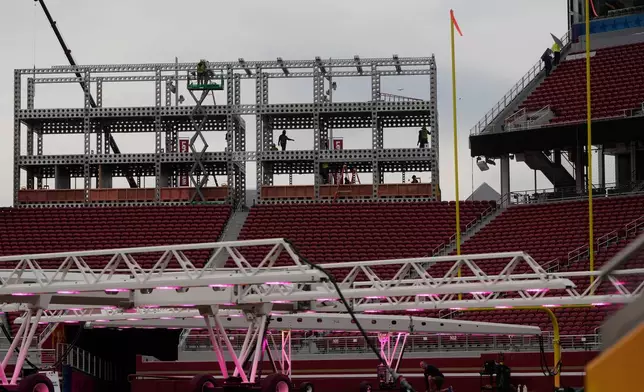
Workers build a structure above grow lights on the field at Levi's Stadium as it is prepared for the NFL's Super Bowl LX football game in Santa Clara, Calif., Tuesday, Jan. 20, 2026. (AP Photo/Jeff Chiu)
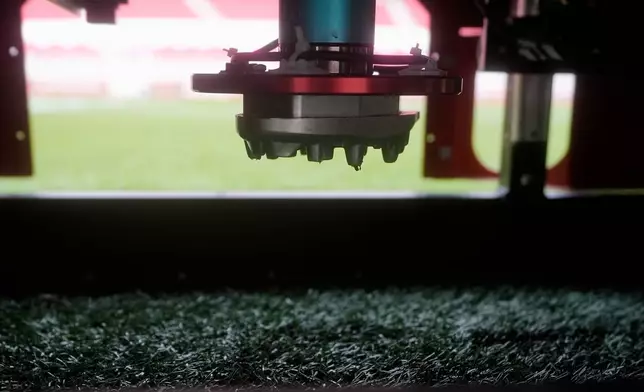
Workers build a structure above grow lights on the field at Levi's Stadium as it is prepared for the NFL's Super Bowl LX football game in Santa Clara, Calif., Tuesday, Jan. 20, 2026. (AP Photo/Jeff Chiu)

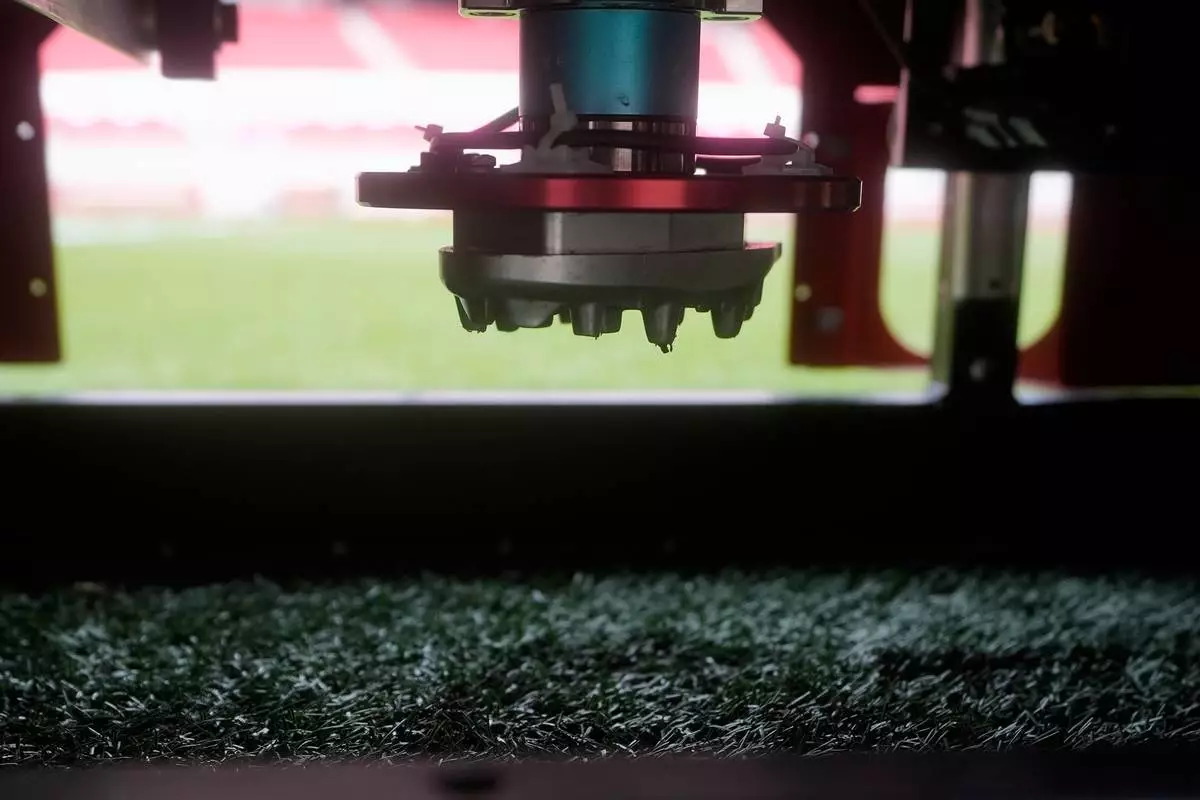
A Biomechanical Elite Athlete Shoe-Turf Tester (BEAST) is shown during a demonstration on the field at Levi's Stadium, as the turf is prepared for the NFL's Super Bowl LX football game, in Santa Clara, Calif., Tuesday, Jan. 20, 2026. (AP Photo/Jeff Chiu)
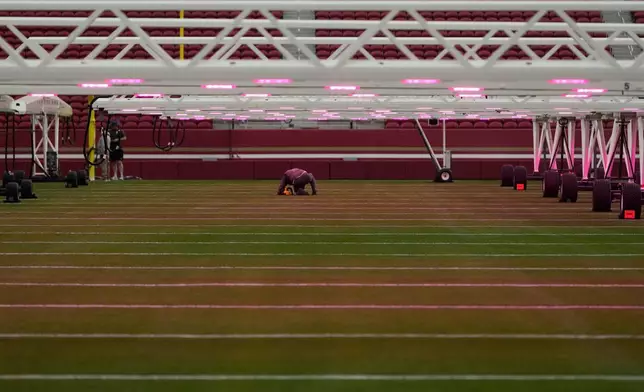
A Biomechanical Elite Athlete Shoe-Turf Tester (BEAST) is shown during a demonstration on the field at Levi's Stadium, as the turf is prepared for the NFL's Super Bowl LX football game, in Santa Clara, Calif., Tuesday, Jan. 20, 2026. (AP Photo/Jeff Chiu)

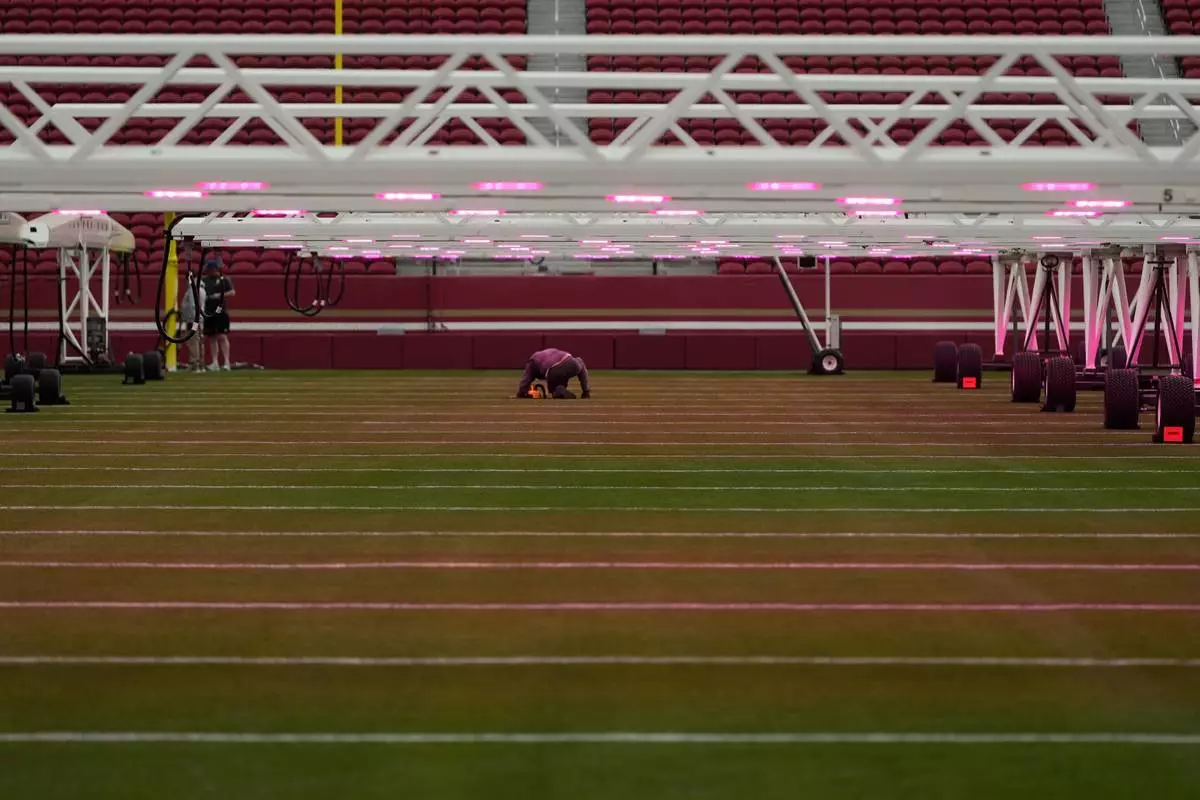
A worker kneels under grow lights on the field at Levi's Stadium as it is prepared for the NFL's Super Bowl LX football game in Santa Clara, Calif., Tuesday, Jan. 20, 2026. (AP Photo/Jeff Chiu)

A worker kneels under grow lights on the field at Levi's Stadium as it is prepared for the NFL's Super Bowl LX football game in Santa Clara, Calif., Tuesday, Jan. 20, 2026. (AP Photo/Jeff Chiu)

Field Director for the National Football League Nick Pappas is interviewed Tuesday, Jan. 20, 2026, at Levi's Stadium in Santa Clara, Calif., ahead of NFL's Super Bowl LX football game. (AP Photo/Jeff Chiu)
Field Director for the National Football League Nick Pappas is interviewed Tuesday, Jan. 20, 2026, at Levi's Stadium in Santa Clara, Calif., ahead of NFL's Super Bowl LX football game. (AP Photo/Jeff Chiu)

Signs for Super Bowl LX are displayed on the SAP Tower at Levi's Stadium in Santa Clara, Calif., Tuesday, Jan. 20, 2026. (AP Photo/Jeff Chiu)

Signs for Super Bowl LX are displayed on the SAP Tower at Levi's Stadium in Santa Clara, Calif., Tuesday, Jan. 20, 2026. (AP Photo/Jeff Chiu)

The field at Levi's Stadium will be the stage for the country's most-watched sporting event of the year on Feb. 8, along with the pregame and halftime festivities and concerts that make Super Bowl Sunday a cultural capstone.

“I always joke with everyone, it’s the most expensive real estate there is, everyone wants a piece of it,” Pappas said. “Trying to set that calendar up in a way that we have this time and space available to maintain it and work on the field and prepare it, but also provide time and slots for all those different entertainment pieces, the halftime rehearsals and so on. That becomes a bit of a challenge just to make sure that we can all get what we need done.”

The process is an intensive one, starting with picking the sod farm to grow the turf. Pappas settled on a farm about two hours east of Levi's Stadium in what was an easy choice as he had used the same farm to grow the grass for Super Bowl 58 in Las Vegas two years ago and that farm also is used by the San Francisco 49ers.

Pappas visited the farm every few months to monitor the three potential fields, cutting samples to test the surfaces for quality and appearance before settling on the winning choice earlier this month.

Pappas' crew then began removing the 49ers' old field on Jan. 6 — three days after the team's regular-season finale — and then put down the new surface for the Super Bowl on Jan. 8. Because the 49ers were still in the playoffs at that time and had a remote chance of hosting the NFC title game this past Sunday, Pappas was prepared to bring in a second field after that game if necessary.

That quickly proved unnecessary on wild-card weekend when a loss by Green Bay ended hopes of a 49ers home playoff game so the focus quickly turned to getting the field ready for the Super Bowl.

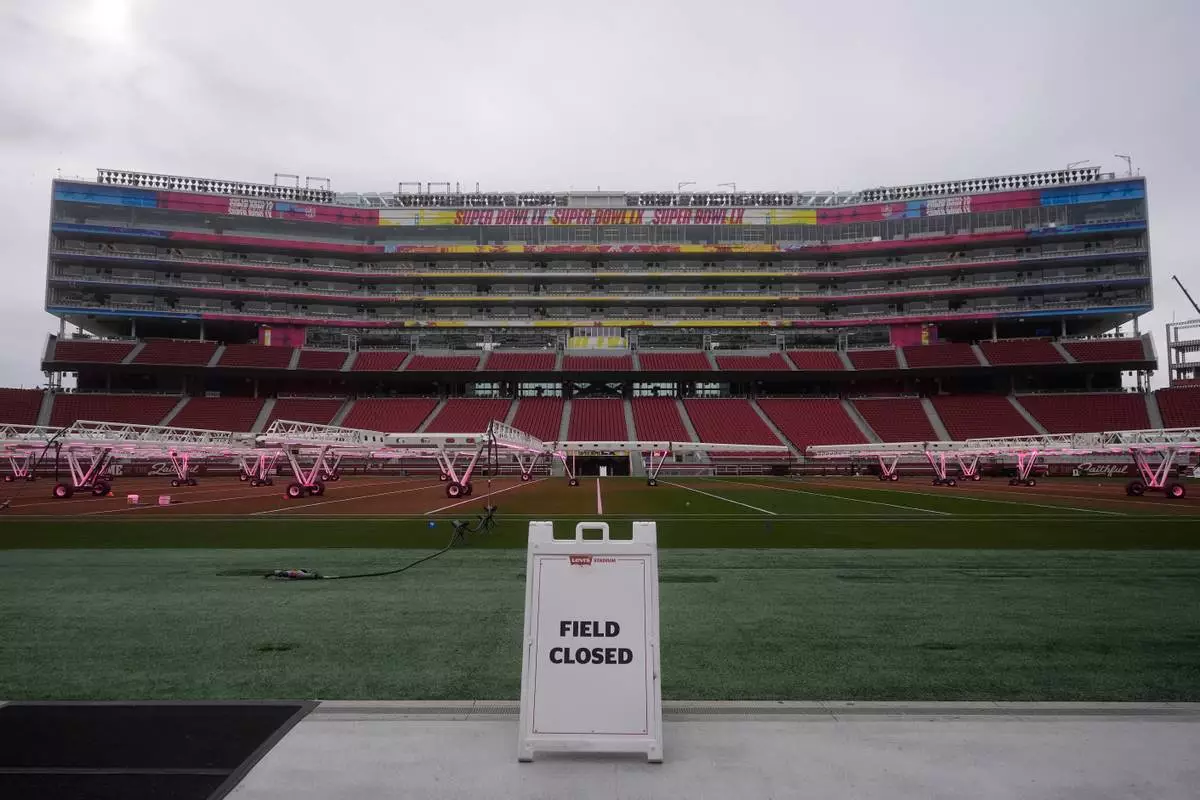
Most of the first two weeks were focused on getting the field in its best shape after rolling it out at Levi's Stadium. The crew aerates and top dresses the field to help create thicker grass, better drainage and a firmer field, mows it to get it to the proper length and uses fertilizer, grow lights and water to get it into the best condition possible.

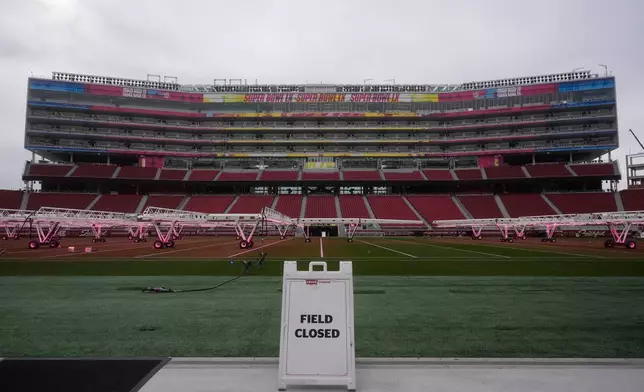
A dry January helped make the process easier, allowing the grounds crew to better control the amount of water for the field, and the grass spent much of each day under pink LED lights.

The field also undergoes extensive testing to ensure it is optimal for safety and performance. That proved to be a big issue three years ago when the field in Arizona was criticized for being too slippery, impacting the game won by Kansas City over Philadelphia.

The NFL uses two main tools to test fields around the league to measure traction and to determine that the surface isn't too hard or soft.

The BEAST — Biomechanical Elite Athlete Surface Tester — uses a robotic leg with a cleat to mimic the way NFL players jump, stop, start and change direction to make sure the field isn't too sticky or slippery. The field will be tested in 60 spots several times between installation and game day.

“We test the field spatially and determine that the end zones are playing like the center field and they’re playing like the wings of the field," said Philipe Aldahir, head of research and innovation for Biocore, the company that provides the BEAST to the league. “That's one dimension. The other one is over time. This field is fresh and it’s new and as activity takes place between now and the game, we want to ensure a similar level of traction from day one to the game.”

The STRIKE is also used at about 60 spots around the field and tests the firmness of the field.

The final touches included painting the yard lines, the logos and then finally the team logos for the end zone happen this week once the matchup was set.

The league uses a seasoned vet for that job with Brian Johnson in charge of painting the field. Johnson began working on the Super Bowl crew 30 years ago when it was played at Sun Devil Stadium in Tempe, Arizona, when Johnson worked at Arizona State.

“Painting ‘The Shield’ is his baby,” Pappas said.

Then the field gets turned over to the users, with the entertainers beginning their work on the field this week before the game.

“Everyone’s goal is to deliver perfection," Pappas said. "Whether you’re the group delivering the halftime show or you’re field crew delivering the field, the goal is perfection for everyone. So we have to work together and find a way to make it all happen.”

AP NFL: https://apnews.com/hub/NFL
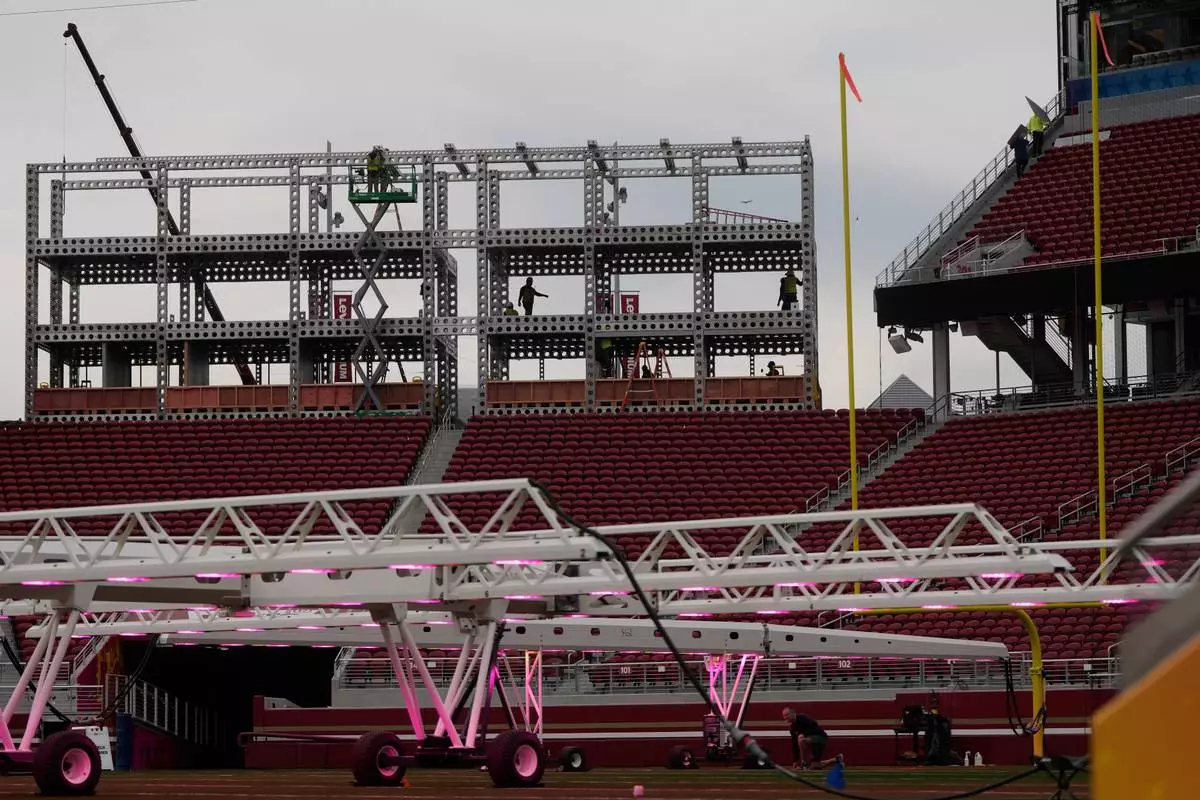
Workers build a structure above grow lights on the field at Levi's Stadium as it is prepared for the NFL's Super Bowl LX football game in Santa Clara, Calif., Tuesday, Jan. 20, 2026. (AP Photo/Jeff Chiu)
Workers build a structure above grow lights on the field at Levi's Stadium as it is prepared for the NFL's Super Bowl LX football game in Santa Clara, Calif., Tuesday, Jan. 20, 2026. (AP Photo/Jeff Chiu)

A Biomechanical Elite Athlete Shoe-Turf Tester (BEAST) is shown during a demonstration on the field at Levi's Stadium, as the turf is prepared for the NFL's Super Bowl LX football game, in Santa Clara, Calif., Tuesday, Jan. 20, 2026. (AP Photo/Jeff Chiu)
A Biomechanical Elite Athlete Shoe-Turf Tester (BEAST) is shown during a demonstration on the field at Levi's Stadium, as the turf is prepared for the NFL's Super Bowl LX football game, in Santa Clara, Calif., Tuesday, Jan. 20, 2026. (AP Photo/Jeff Chiu)

A worker kneels under grow lights on the field at Levi's Stadium as it is prepared for the NFL's Super Bowl LX football game in Santa Clara, Calif., Tuesday, Jan. 20, 2026. (AP Photo/Jeff Chiu)

A worker kneels under grow lights on the field at Levi's Stadium as it is prepared for the NFL's Super Bowl LX football game in Santa Clara, Calif., Tuesday, Jan. 20, 2026. (AP Photo/Jeff Chiu)

Field Director for the National Football League Nick Pappas is interviewed Tuesday, Jan. 20, 2026, at Levi's Stadium in Santa Clara, Calif., ahead of NFL's Super Bowl LX football game. (AP Photo/Jeff Chiu)
Field Director for the National Football League Nick Pappas is interviewed Tuesday, Jan. 20, 2026, at Levi's Stadium in Santa Clara, Calif., ahead of NFL's Super Bowl LX football game. (AP Photo/Jeff Chiu)

Signs for Super Bowl LX are displayed on the SAP Tower at Levi's Stadium in Santa Clara, Calif., Tuesday, Jan. 20, 2026. (AP Photo/Jeff Chiu)


Signs for Super Bowl LX are displayed on the SAP Tower at Levi's Stadium in Santa Clara, Calif., Tuesday, Jan. 20, 2026. (AP Photo/Jeff Chiu)

JOHANNESBURG (AP) — Human-caused climate change worsened the recent torrential rains and floods which devastated parts of southern Africa, killing more than 100 people and displacing over 300 000, researchers said Thursday.

A study by the World Weather Attribution, which analyzed the recent heavy rainfalls that caused severe flooding in parts of South Africa, Mozambique and Zimbabwe, showed that the region experienced a year's worth of rain in a period of 10 days.

It resulted in widespread damage to housing and infrastructure estimated to run into the millions of dollars, and caused untold human suffering, including the loss of lives.

Many homes and buildings in Mozambique were completely submerged under water, while roads and bridges were swept away in the South African provinces of Limpopo and Mpumalanga and parts of Zimbabwe.

The study was conducted by scientists from across the world using peer-reviewed methods to assess the impact of climate change on severe weather patterns and events.

The data obtained from the recent downpours, the rare magnitude of which occurs roughly once every 50 years, confirmed a “clear move toward more violent downpours,” the study shows.

It was also compounded by the current La Nina weather phenomenon which naturally brings wetter conditions in the southern Africa region but was now operating within a much warmer atmosphere.

“Our analysis clearly shows that our continued burning of fossil fuels is not only increasing the intensity of extreme rainfall, but turning events that would have happened anyway into something much more severe,” said Izidine Pinto, a senior climate researcher at the Royal Netherlands Meteorological Institute.

Pinto, who co-authored the study, said the climate models used struggled to pinpoint exactly how much worse the recent floods were made by climate change, but that a 40% increase in the intensity of the rains would be impossible to explain without human-caused climate change.

“It means what would have already been a serious period of heavy rain has been transformed into a more violent deluge that communities are not equipped to deal with,” he said.

The affected regions in southern Africa are no strangers to heavy downpours and flooding, but scientists were alarmed by the magnitude of the recent events.

“This event was a surprise to us because we have experienced the previous ones 25 years ago, which flooded the same areas,” said Bernardino Nhantumbo, a researcher with the Mozambique weather service.

“There are places that have recorded in two to three days the rainfall that was expected for the entire rainy season, so this was very challenging to accommodate in any circumstances.”

According to Nhantumbo, Mozambique is downstream to nine international rivers, so when an event like this happens a lot of damage is expected not only because of the heavy rainfall but also because of the stream flow.

“We forecast well because we have different models, but these are those events that even with a good forecast you cannot hold the damages that are associated,” he said.

The central and southern parts of Mozambique were the hardest hit, with the Gaza provincial capital of Xai-Xai and the nearby town of Chokwe largely submerged under water.

The researchers have also called for the development of climate models in Africa in order to best understand the dynamics and extent of the impact of climate change in the continent's various regions.

According to Friederike Otto, professor of climate science at the Centre for Environmental Policy at Imperial College in London, the lack of climate models developed in Africa was part of the reason why most models struggled to pinpoint exactly how much worse the recent floods were made by climate change.

"All climate models that we have that are freely available are developed outside of Africa. They are all developed within climate modeling centers in the U.S., Europe and some in Asia.

“But there is not a single climate model that is developed in Africa. Because of this they are usually designed so that they get the weather best in the regions they are made for, and that is true for all models,” she said.

People walk through floodwaters in Nkomazi, Mpumalanga Province, South Africa, on Friday, Jan. 16, 2026. (AP Photo/Alfonso Nqunjana)

People walk through floodwaters in Nkomazi, Mpumalanga Province, South Africa, on Friday, Jan. 16, 2026. (AP Photo/Alfonso Nqunjana)

This image made from video shows the scene after flooding in Tete Province, Mozambique, Thursday, Jan. 15, 2026. (AP Photo)

This image made from video shows the scene after flooding in Tete Province, Mozambique, Thursday, Jan. 15, 2026. (AP Photo)

Flood waters cover the Chibuto-Chaimite road in Gaza province, Mozambique, Saturday, Jan. 17, 2026. (AP Photo)

Flood waters cover the Chibuto-Chaimite road in Gaza province, Mozambique, Saturday, Jan. 17, 2026. (AP Photo)

Recommended Articles