Skip to Content Facebook Feature Image

Common sense and slowing down are the keys to avoiding icy weather accidents

News

Common sense and slowing down are the keys to avoiding icy weather accidents
News

News

Common sense and slowing down are the keys to avoiding icy weather accidents

2026-01-29 02:34 Last Updated At:02:41

For big parts of the United States, the past few days have brought lots of snow and lots of cold. Where there's snow and cold, there are slips, falls and ice-related injuries.

Authorities, first responders and medical professionals say that by following some common-sense rules, many of those problems can be reduced or avoided altogether.

From slowing down while driving on slick roads to imitating the slow, shuffling walk of penguins to never assuming lake ice is thick enough, changing behavior can keep people out of hospital emergency rooms.

“If there’s ice, there’s a risk,” said Dr. Robert Wahl, vice chief of Emergency Medicine at DMC Huron Valley-Sinai Hospital in Commerce Township, Michigan.

Southeastern Michigan, along with much of the eastern U.S., have been in a deep freeze for about a week as extreme cold followed by snowfall and plunging temperatures has left streets, driveways, parking lots and sidewalks hazardous.

Wahl says that when people tumble outdoors on ice, emergency rooms typically see three major groups of injuries: closed-head, outstretched hand and wrist injuries, and hip injuries.

Closed-head injuries really can be problematic, especially for the older adults, while outstretched hand injuries from trying to break a fall are painful, but most don’t require surgery, Wahl said.

“Broken hips. Those 100% need surgery,” he said.

Dr. Alexander Cotter of the Center for Spine and Orthopedics in Denver, advises adopting the “penguin protocol” of a small, shuffling gait while leaning forward to keep your center of gravity low.

“People all the time think that if you slip it's not going to be a big deal,” he said. “You're in a rush, looking at your phone and all of sudden you slide. If you're waddling, taking it slow you're going to be safer.”

Cotter specializes in physical medicine and rehabilitation, and pain management. When falling, he says people should try not to fall on their outstretched hands to avoid serious injuries to joints like elbows and rotator cuffs.

“Stay hands-free,” he said. “Think about tucking your chin down to protect your head. Leaning forward helps prevent the backwards fall. With forward falls, a lot of times you can take it on your shoulder.”

Wearing shoes or boots with tread and traction and limiting the amount of items you carry should be considered, too.

“Maybe not trying to be a superhero and taking everything (in) at one time,” Cotter said. “When you hurry, that's when you get injured. Be aware of what you're doing no matter what is going on. It’s common sense stuff and not the fault of any one person to not think of these things.”

Just prior to the current arctic blast, with daytime temperatures close to freezing and nighttime lows near or below zero degrees Fahrenheit (minus-17 Celsius), the Oakland County, Michigan, sheriff's office already was busy on a few of the county's 450 lakes.

The county borders Detroit to the north and northwest.

“Before the cold snap we had done six ice calls in nine days — people through the ice or animals through the ice,” Sheriff Mike Bouchard said Tuesday. “No ice should be considered safe just because we've had a few cold days or because you've measured in one spot.”

It's more about what you can't see, according to Bouchard.

“There are currents under the ice. There could be springs under the ice that melts it in one spot,” he said. “We've recovered two snowmobiles through the ice this year and saved two people out of a situation where they could have died.”

They've also seen animals perish. “We remind people if there's an animal on the ice, even a family pet, running out there doesn't help the pet and it certainly doesn't help you.”

Bouchard said that people walking, fishing or riding snowmobiles on the ice should measure the ice thickness in the area where they plan to be and not assume the thickness will be the same in all spots.

Take proper weather and safety equipment, he added.

“Have ice awls in your pocket to pull yourself out of the water,” he said. “When you're back on the ice, stay flat. You need to distribute your weight.”

When driving conditions deteriorate during a winter storm, it is important to take your time and not be in a rush, according to Kansas City Battalion Chief Riley Nolan.

“The main thing is for people to have patience,” Nolan said. “Leave in plenty of time, don't rush to anywhere you need to go.”

Nolan also suggests making sure you bring some rock salt, a small shovel, extra warm layers of clothing that cover your hands and face to keep yourself warm if your vehicle gets stuck in snow.

“If you do breakdown on the side of the road or have an incident, stay in your vehicle. Don't get out and wander away. Stay with your vehicle, stay warm,” Nolan said adding it is important that if you are stuck and staying warm by running your vehicle, to make sure your exhaust pipe is clear to avoid the fumes from harming you.

AAA-The Auto Club Group spokeswoman Adrienne Woodland said its also important for motorists to compensate for reduced tire traction and the distance between your vehicle and the one in front of you.

“You definitely do not want to tailgate on snowy and icy roads,” she said. “You want to allow sufficient room for maintenance vehicles. And with snow plows, stay at least 200 feet (60.9 meters) back from them.”

—————————-

Williams reported from Detroit. Ingram reported from Kansas City, Missouri.

Ice forms along the shore of Lake Michigan, Friday, Jan. 23, 2026, in Chicago. (AP Photo/Kiichiro Sato)
Ice forms along the shore of Lake Michigan, Friday, Jan. 23, 2026, in Chicago. (AP Photo/Kiichiro Sato)

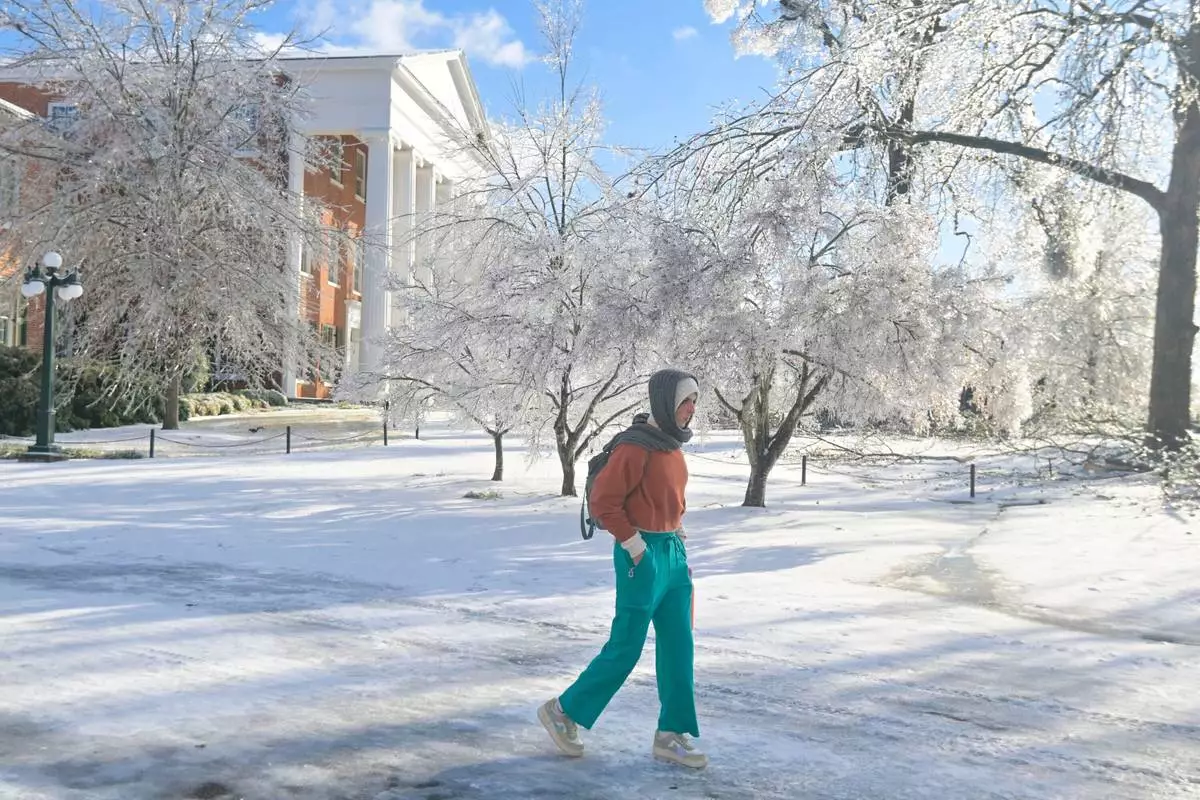
A woman walks across the campus of the University of Mississippi in Oxford, Miss. on Monday, Jan. 26, 2026, following a weekend ice storm. (AP Photo/Bruce Newman)
A woman walks across the campus of the University of Mississippi in Oxford, Miss. on Monday, Jan. 26, 2026, following a weekend ice storm. (AP Photo/Bruce Newman)

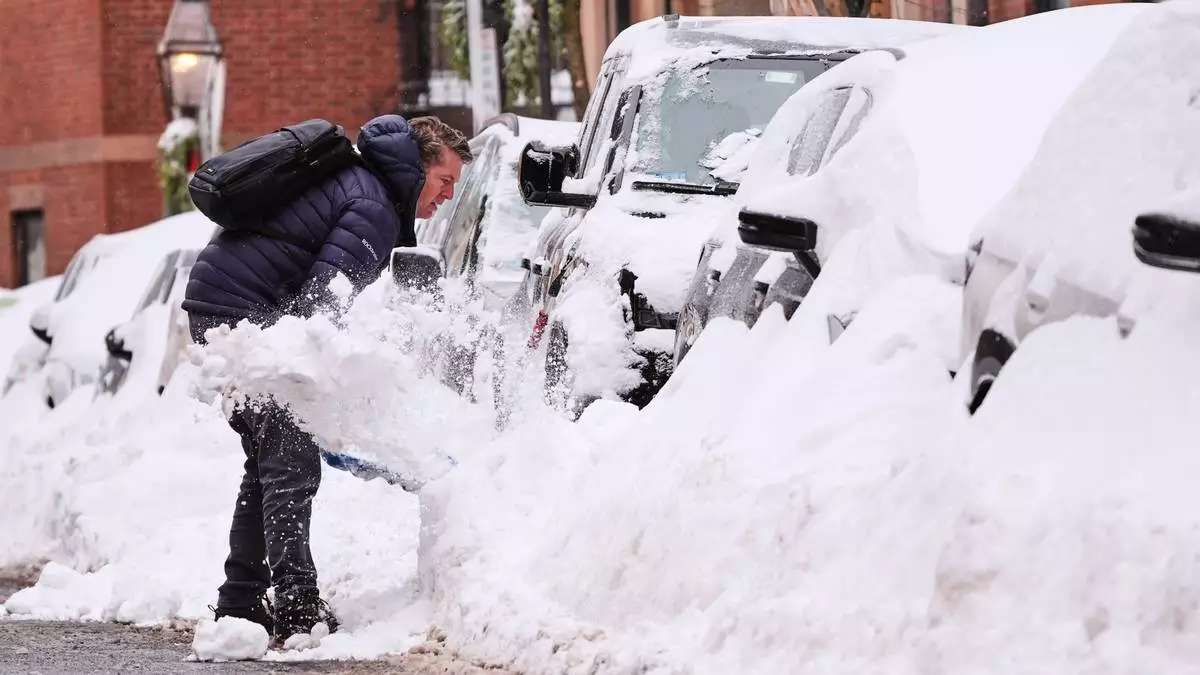
A man digs out his car on Beacon Hill following a winter storm that dump more than a foot of snow across the region, Monday, Jan. 26, 2026, in Boston. (AP Photo/Charles Krupa)

A man digs out his car on Beacon Hill following a winter storm that dump more than a foot of snow across the region, Monday, Jan. 26, 2026, in Boston. (AP Photo/Charles Krupa)
LAS VEGAS (AP) — The Las Vegas Review-Journal announced Friday that it will no longer print its rival the Las Vegas Sun for the first time in decades, amid an ongoing legal dispute over the nation's last joint operating agreement stemming from a 1970 law designed to preserve newspapers.

Readers “will not find a printed Las Vegas Sun insert inside,” the Review-Journal said in an editorial, noting the Sun maintains a website, has a few hundred thousand followers across social media platforms, and is free to produce its own newspaper.

“We encourage them to do so. The Review-Journal competes with countless sources of news and entertainment, but we would welcome one more. We just don’t want to foot the bill. It is time the Sun stood up on its own two feet,” the editorial said, without specifying the cost.

The two publications will be in court Friday and the Sun hopes a judge will order printing to immediately resume, attorney Leif Reid said in an email. It will be the first day in 76 years that the Sun hasn’t been printed, he said.

“This does irreparable harm to our community, as no one benefits when a local newspaper is prevented from being published,” he said.

The now-rare joint operating agreement required the Sun to be printed as a daily insert in the Review-Journal, while both companies remained editorially independent with separate newsrooms and websites.

A lower court had found the agreement was unenforceable because a 2005 update was never signed by the U.S. attorney general, and in February the U.S. Supreme Court declined to hear an appeal by the Sun.

The Review-Journal editorial called the Supreme Court decision a decisive victory, saying that halting publication of the Sun on Friday was “a result of 6½ years of litigation between the newspapers, precipitated by the Sun.”

Such agreements between rival publications have dwindled as part of a "long, slow goodbye of newspapers as we knew them,” said Ken Doctor, a news business analyst. The Detroit Free Press and the Detroit News ended a 40-year agreement last year. USA Today Co., which owns the Detroit Free Press, recently announced its plans to purchase the Detroit News.

In 1950, the Sun was founded in response to the Review-Journal’s refusal to negotiate with typesetters from the International Typographical Union. The union started its own newspaper and reached out to businessman Hank Greenspun for financial backing. The Greenspuns still own the paper.

The Review-Journal has been publishing since 1909, first as the Clark County Review. It is owned by the Adelson family, casino magnates and mega GOP donors, and remains the state’s largest newspaper.

The Review-Journal’s editorials lean more conservative, while the Sun’s lean liberal. The 1970 law signed by then President Richard Nixon, called the Newspaper Preservation Act, was designed to save newspapers costs while maintaining competition and editorial variety in cities as newspapers began to financially struggle.

The papers first entered into a joint operating agreement in 1989 when the Sun was struggling to stay afloat financially. The agreement made the Sun an afternoon newspaper during weekdays and a section within the Review-Journal on weekend mornings, while the Review-Journal handled production, distribution and advertising. The Review-Journal also collected all revenue and was required to pay the Sun monthly to cover the Sun’s news and editorial expenses.

In 2005 the agreement was amended to make the Sun an insert in the Review-Journal every morning.

Review-Journal owners sought to end the agreement in 2019, and in response the Sun’s owners filed a lawsuit alleging that ending the agreement violated anti-trust laws.

The 1970 law allowing such agreements was signed at a time when news options weren't as prevalent and there was more concern over news monopolies.

Las Vegas — and Nevada as a whole — today have more strong, independent news organizations compared to other places, said Stephen Bates, a journalism and media professor at the University of Nevada, Las Vegas.

The Sun also publishes online. But it has argued in court that losing its print product could make it harder to recruit staff, cause a loss in readers, and even force it to close.

Genelle Belmas, a journalism professor at the University of Kansas who specializes in media law, said it would be disappointing if the last joint operating agreement in the country ends. During visits to Vegas, she's enjoyed being able to pick up the Review-Journal and see the Sun folded inside, offering two differing points of view in one place. Online news outlets make it easier for consumers to stay in their echo chambers, she said.

“Every local news outlet we lose — and that includes big towns, small towns, whatever — is a loss of perspective and a loss of a potential alternative view,” Belmas said.

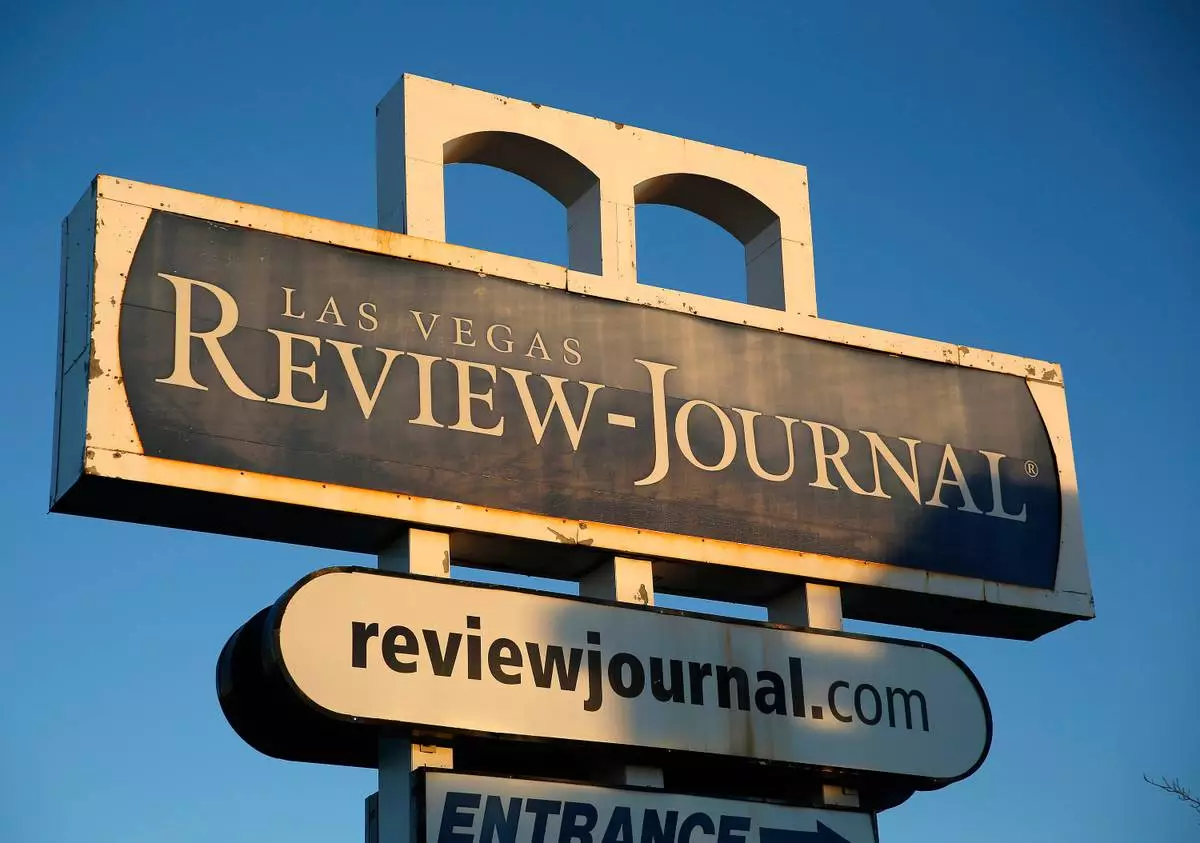
FILE - This Dec. 17, 2015 file photo shows a sign outside the building housing the Las Vegas Review-Journal in Las Vegas. AP Photo/John Locher, File)

FILE - This Dec. 17, 2015 file photo shows a sign outside the building housing the Las Vegas Review-Journal in Las Vegas. AP Photo/John Locher, File)

Recommended Articles