WASHINGTON (AP) — The Trump administration imposed sanctions Friday against Iran 's interior minister, accusing Eskandar Momeni of repressing nationwide protests that have challenged Tehran's theocratic government. The penalties are the latest by the United States and the European Union targeting high-ranking officials over the crackdown.
The administration says Momeni has overseen Iran's law enforcement forces that are responsible for the deaths of thousands of peaceful protesters.
Economic woes sparked the protests in late December before they broadened into a challenge to the Islamic Republic. The crackdown soon followed, which activists say has killed more than 6,000 people. Iranian officials and state media repeatedly refer to the demonstrators as “terrorists.”
The EU on Thursday imposed its own sanctions against Momeni, along with members of Iran's judicial system and other high-ranking officers.
“They were all involved in the violent repression of peaceful protests and the arbitrary arrest of political activists and human rights defenders,” according to the EU.
Also Friday, the Treasury Department's Office of Foreign Assets imposed sanctions on Babak Morteza Zanjani, an Iranian investor who is accused of embezzling billions of dollars in Iranian oil revenue for the benefit of the Iranian government. Two digital asset exchanges linked to Zanjani that have processed large volumes of funds were penalized, too.
The EU has agreed to list Iran’s paramilitary Revolutionary Guard as a terrorist organization, in a largely symbolic move that adds to pressure on Tehran.
In response, Iran is considering designating the militaries of EU countries as terrorist groups, according to a post Friday on X by Ali Larijani, the secretary of Iran’s Supreme National Security Council. The Iranian parliament is expected to pass that measure Sunday.
The EU did not immediately comment.
Included in the last set of U.S. sanctions is the secretary of the Supreme Council for National Security, whom the Treasury Department accuses of being one of the first officials to call for violence against Iranian protesters. The sanctions also target a group of 18 people and companies accused of participating in laundering money from sales of Iranian oil to foreign markets as part of a shadow banking network of sanctioned Iranian financial institutions.
Treasury Secretary Scott Bessent said the department “will continue to target Iranian networks and corrupt elites that enrich themselves at the expense of the Iranian people.”
"Like rats on a sinking ship, the regime is frantically wiring funds stolen from Iranian families to banks and financial institutions around the world. Rest assured, Treasury will act,” he said in a statement.
Among other things, the sanctions deny the people and firms access to any property or financial assets held in the U.S., limit travel to America and prevent U.S. companies and citizens from doing business with them.
Associated Press writers Jon Gambrell in Dubai, United Arab Emirates, and Sam McNeil in Brussels contributed to this report
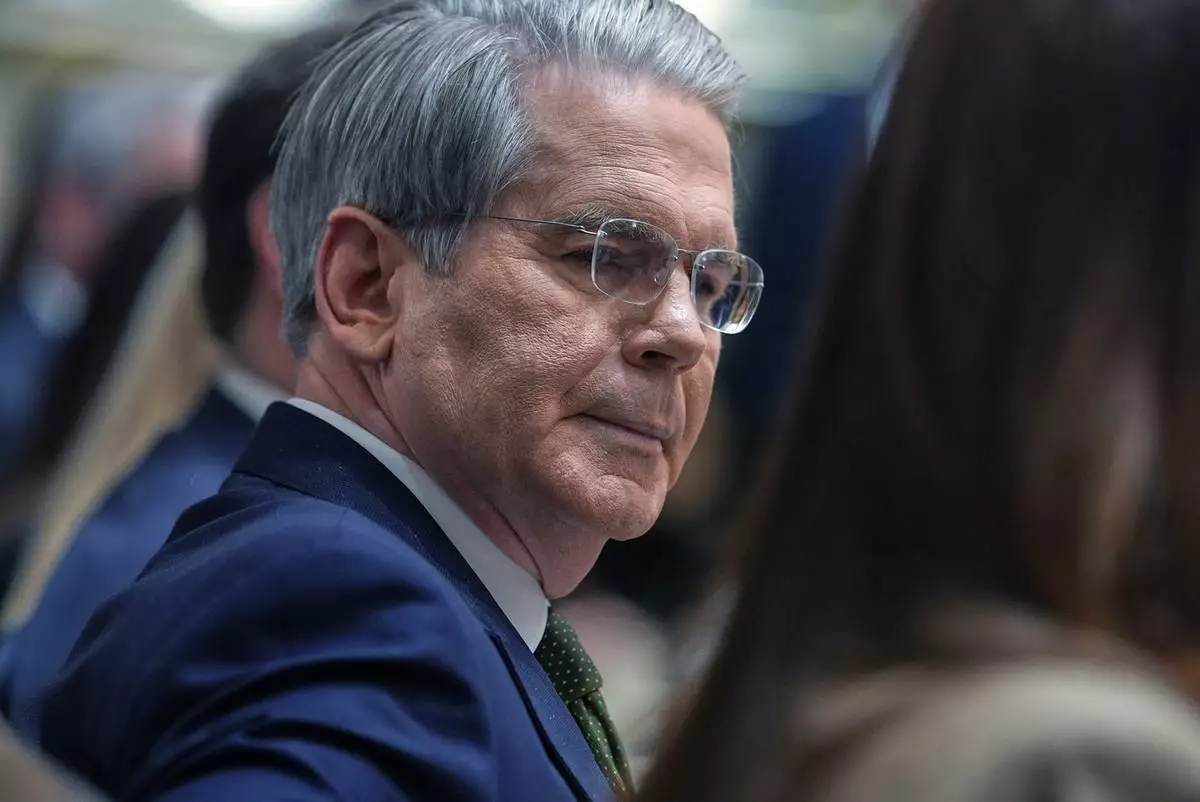
Treasury Secretary Scott Bessent listens during a cabinet meeting at the White House, Thursday, Jan. 29, 2026, in Washington. (AP Photo/Evan Vucci)
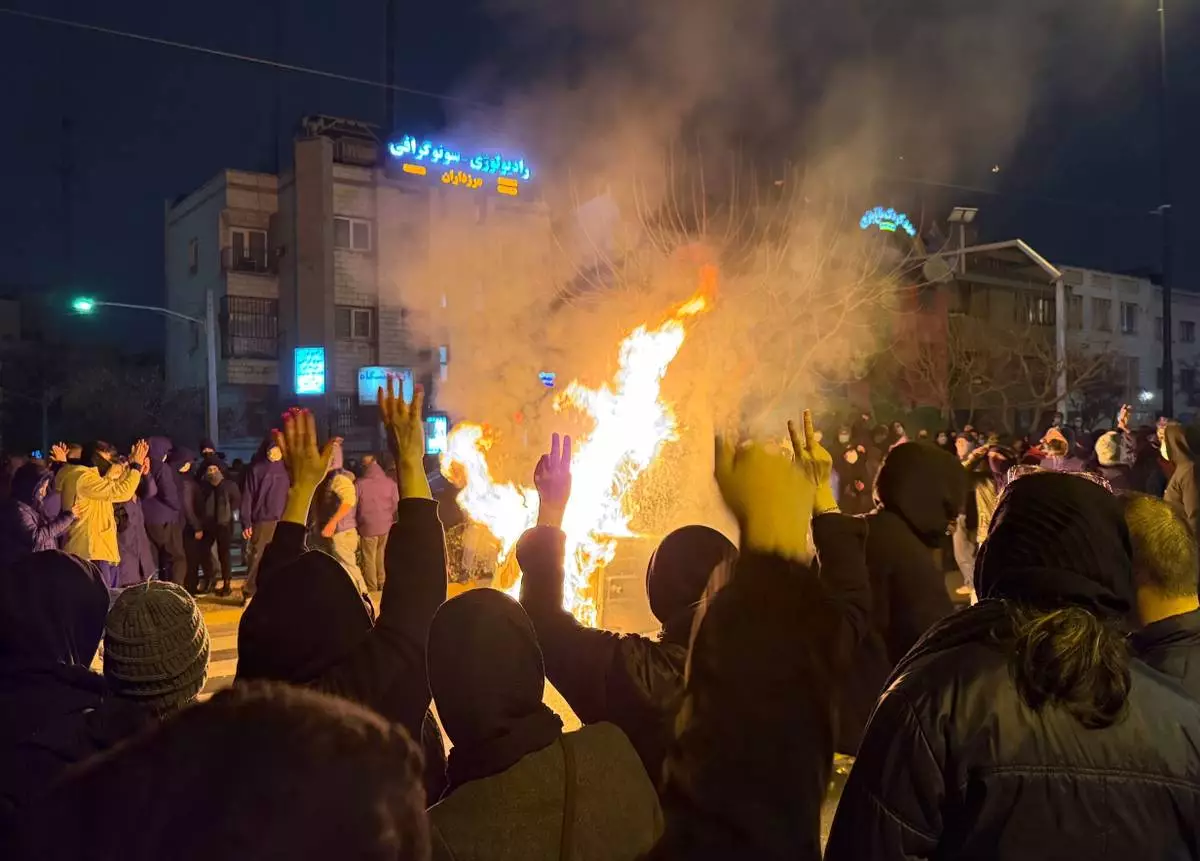
FILE - In this photo obtained by The Associated Press, Iranians attend an anti-government protest in Tehran, Iran, Jan. 9, 2026. (UGC via AP, File)

Protesters across the U.S. are calling for “no work, no school, no shopping” as part of a nationwide strike on Friday to oppose the Trump administration’s immigration crackdown.
The demonstrations are taking place amid widespread outrage over the killing Alex Pretti, an intensive care nurse who was shot multiple times after he used his cellphone to record Border Patrol officers conducting an immigration enforcement operation in Minneapolis. The death heightened scrutiny over the administration’s tactics after the Jan. 7 death of Renee Good, who was fatally shot behind the wheel of her vehicle by a U.S. Immigration and Customs Enforcement officer.
“The people of the Twin Cities have shown the way for the whole country — to stop ICE’s reign of terror, we need to SHUT IT DOWN,” said one of the many websites and social media pages promoting actions in communities around the United States.
Numerous businesses announced they would be closed during Friday's “blackout.” Others said they would be staying open but donating a portion of their proceeds to organizations that support immigrants and provide legal aid to those facing deportation.
Some schools in Arizona and Colorado preemptively canceled classes in anticipation of mass absences. Many other demonstrations were planned for students and others to gather at city centers, statehouses and churches across the country.
Just outside Minneapolis, hundreds gathered in the frigid cold early Friday at the Bishop Henry Whipple Federal Building, the site of regular protests in recent weeks.
After speeches from clergy members, demonstrators marched toward the facility’s restricted area, jeering at a line of DHS agents to “quit your jobs” and “get out of Minnesota.” Much of the group later dispersed after they were threatened with arrest by local law enforcement for blocking the road.
Michelle Pasko, a retired communications worker, said she joined the demonstration after witnessing federal agents stopping immigrants at a bus stop near her home in Minnetonka, Minnesota, a suburb of Minneapolis.
“They’re roaming our streets, they’re staying in hotels near our schools,” she said. “Everyone in this country has rights, and the federal government seems to have forgotten that. We’re here to remind them.”
In Michigan, dozens of students walked out of Friday morning classes at Groves High School in Birmingham, north of Detroit. The students braved the zero-degree temperatures and walked about a mile to the closest business district where a number of morning commuters honked horns in support.
“We’re here to protest ICE and what they’re doing all over the country, especially in Minnesota,” said Logan Albritton, a 17-year-old senior at Groves. “It’s not right to treat our neighbors and our fellow Americans this way.”
“The teachers, generally, have been pretty supportive,” Albritton added. “But there was an email sent out last night trying to get us not to do this, and we came and did it anyway.” Albritton said the email was more about the students’ safety.
In Maine, where Republican Sen. Susan Collins announced that ICE is ending its surge, people gathered outside a Portland church on Friday morning, holding signs that said “No ICE for ME,” a play on the state’s postal code.
Grace Valenzuela, an administrator with Portland Public Schools, decried an “enforcement system that treats our presence as suspect.” She said ICE’s actions brought “daily trauma” to the school system.
“Schools are meant to be places of learning, safety and belonging. ICE undermines that mission every time it destabilizes a family,” Valenzuela said.
Portland Mayor Mark Dion, a Democrat, spoke about the importance of speaking out in the wake of ICE’s actions in the city.
“Dissent is Democratic. Dissent is American. It’s the cornerstone of our democracy,” Dion said.
Associated Press writers Jake Offenhartz in Minneapolis, Patrick Whittle in Portland, Maine, and Corey Williams in Detroit contributed to this report.
People gather for a protest against ICE outside the Bishop Henry Whipple Federal Building, Friday, Jan. 30, 2026, in Minneapolis. (AP Photo/Adam Gray)
A protester rallies against the presence of U.S. Immigration Customs Enforcement in Maine, Friday, Jan. 23, 2026, in Portland, Maine. (AP Photo/Robert F. Bukaty)
People gather for a protest outside the Bishop Henry Whipple Federal Building, Friday, Jan. 30, 2026, in Minneapolis. (AP Photo/Adam Gray)