China's Shenzhou-21 astronauts have steadily carried out in-orbit experiments, health monitoring, and maintenance tasks aboard the Tiangong space station over the past week, according to the China Manned Space Agency (CMSA).
The crew consists of mission commander Zhang Lu and astronauts Wu Fei and Zhang Hongzhang. They have spent over three months in orbit, and are all in good condition.
In the field of space medicine, the astronauts have been continuing work on a pharmacokinetics research project. By collecting saliva samples, which will be sent back to the Earth, they aim to support researchers in studying how medications behave in microgravity. The resulting data will help improve in-orbit drug use protocols for future missions.
The crew also completed several key assessments using laptops and specialized software. These included tests on astronaut-machine trust, exploration and utilization research, metacognitive monitoring, emotional status, and emergency decision-making capabilities.
In terms of physical health, the crew participated in lower limb stimulation exercises while wearing biomimetic adhesive shoes. These exercises are designed to stimulate the flexor muscles of the legs under weightless conditions. Electromyography and muscle ultrasound data from the lower limb muscle groups were collected for further research.
Within the field of microgravity physical science, the astronauts replaced samples in the fluid physics experiment cabinet. They also cleaned and swapped out materials in the container-free chamber, performed electrode maintenance on axial mechanisms, and cleaned observation lenses.
To maintain the space station's habitable environment, the crew continued to carry out routine environmental monitoring and station operations management tasks, such as measuring airspeed and temperature, and recording personal noise exposure.
Last week, all three astronauts underwent medical check-ups, including dynamic electrocardiograph and blood pressure readings, non-invasive cardiac function tests, ultrasound scans of the abdomen, blood vessels and muscles, bone density measurements, and hearing assessments. These evaluations are essential for monitoring the crew's health conditions in orbit.
The crew also remained committed to daily physical exercise to combat the physiological changes associated with life in microgravity.
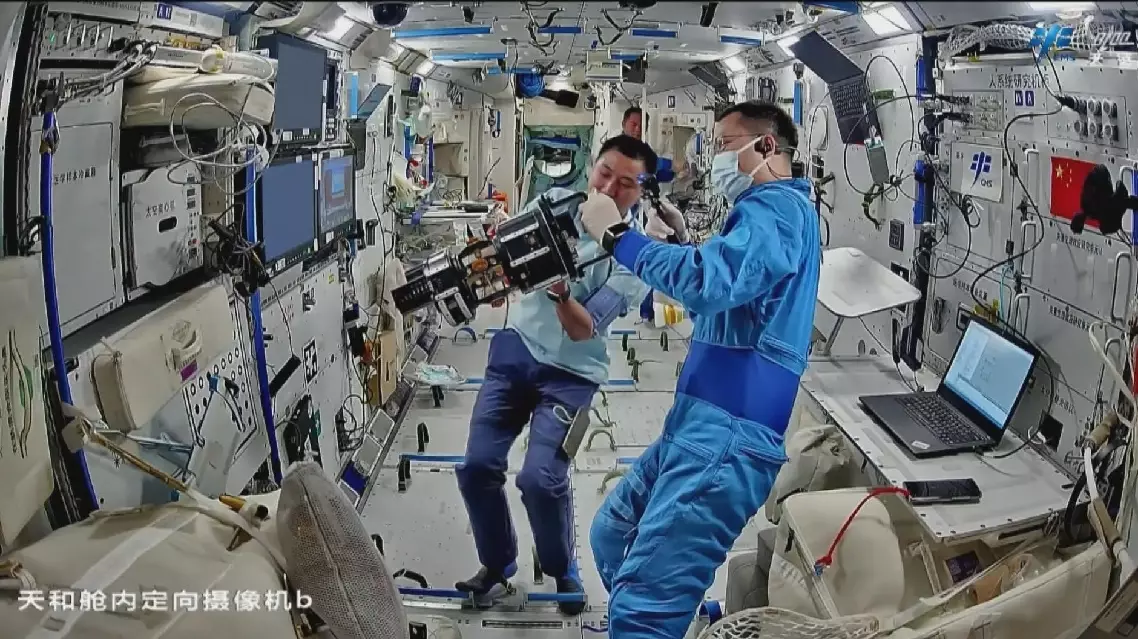
Shenzhou-21 crew advances experiments, maintains space station operations