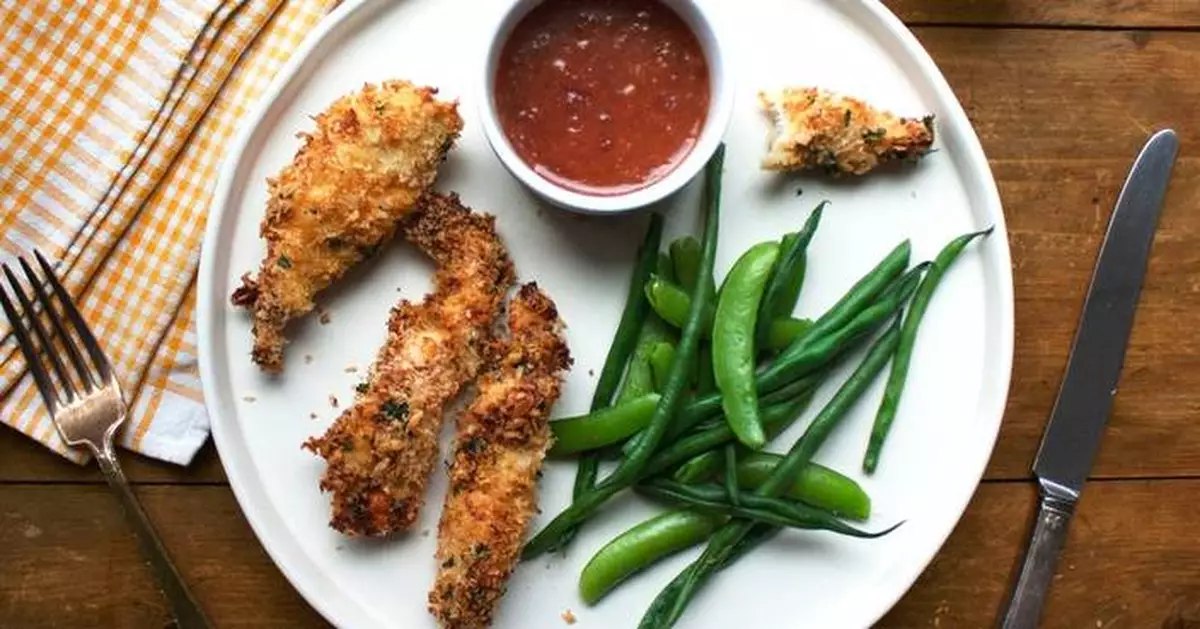
Sometimes a chicken nugget is just a chicken nugget. Sometimes it’s a crisp, panko-crusted strip of chicken breast with a sweet and tangy sauce. This is the latter.
Super Bowl Sunday is snack time at its finest. No one is looking for fancy footwork (at least not in the food realm; we do want to see that on the field). I have hosted more Super Bowl parties than I can (want to) count, and what I can tell you is that the delicate little canapes aren’t going to fly off the buffet as fast as the nachos.
The best Super Bowl food lives in the same realm as the best bar food. And that includes chicken tenders.
If you tend to think of chicken strips as a guilty, kiddie-centric pleasure, give yourself permission to relax and enjoy them. They're basically fried chicken sans bone.
But these chicken strips bake on a wire rack for maximum crispiness without frying. A little olive oil in the panko makes all the difference. For a spicy kick, add Sriracha to the egg wash.
Now the sauce, simple but game-changing: Melt apricot or orange preserves, stir in Dijon mustard and fresh thyme, and dip away. It’s sweet, tangy and herbaceous, perfect for dunking each golden strip.
Bake, sauce, serve. The platter disappears fast, so consider making a double batch for a larger crowd. Easy enough for a weeknight, special enough for the big game, and guaranteed to impress both kids and adults.
Serves 4 to 6
1/2 cup all-purpose flour
Kosher salt and freshly ground pepper to taste
2 large eggs
1/2 teaspoon Sriracha or other hot sauce, or to taste
1 1/2 cups Panko breadcrumbs
2 tablespoons olive oil
1 1/2 pounds boneless, skinless chicken breasts, cut crosswise into 1-inch thick strips (or use chicken tenders)
1 cup apricot or orange preserves
3 tablespoons Dijon mustard
1/2 teaspoon minced fresh thyme leaves
1. Preheat the oven to 400°F. Place a wire cooling rack into a rimmed baking sheet.
2. Place the flour, salt and pepper in a shallow bowl. Whisk together the eggs and Sriracha in a second shallow bowl. Combine the Panko and olive oil in a third bowl.
3. Working in small batches, toss the chicken strips in the flour, shake off any excess, dip them in the egg mixture, allow extra egg to drip back into the bowl, and roll them in the panko. Shake off any excess, then place the strips at least 1 inch apart on the wire rack. (It’s possible you may need to bake these in two batches.)
4. Bake until the chicken strips are golden brown and cooked through, 15 to 18 minutes.
5. While the chicken is cooking, place the preserves in a small saucepan or skillet. Heat over low heat until melted, stirring occasionally, then stir in the mustard and thyme. Transfer the sauce to a small bowl, transfer the chicken strips to a serving platter and serve hot.
Katie Workman writes regularly about food for The Associated Press. She has written two cookbooks focused on family-friendly cooking, “Dinner Solved!” and “The Mom 100 Cookbook.” She blogs at https://themom100.com/. She can be reached at Katie@themom100.com.
For more AP food stories, go to https://apnews.com/hub/recipes
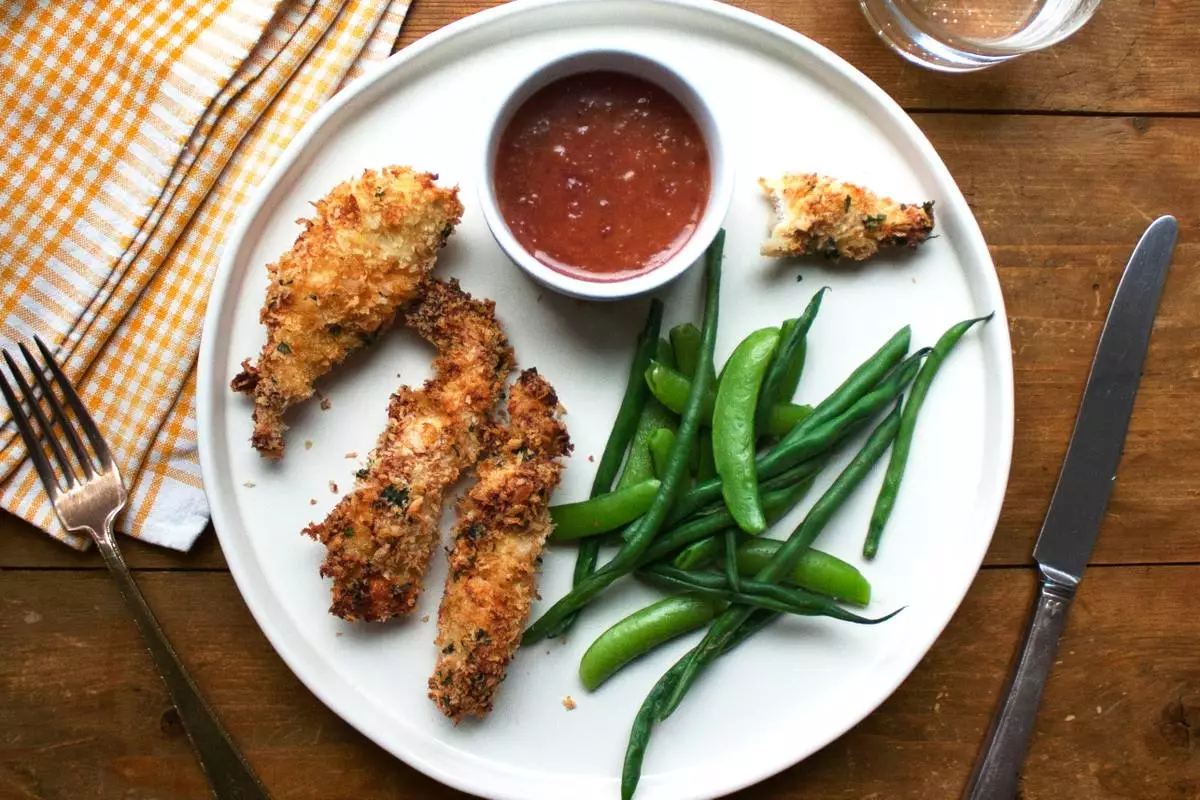
This image shows a recipe for crispy chicken strips with an apricot mustard dipping sauce. (Katie Workman via AP)
Charlotte's surge to at least the play-in tournament and possibly the playoffs in the Eastern Conference has been fueled in large part by the 3-point shot.
And by season's end, it's well within reach that the top two 3-point shooters in the NBA this season — at least in terms of makes — both might be wearing Hornets uniforms.
Charlotte rookie Kon Knueppel leads the NBA with his Hornets-record 261 made 3s so far this season, and LaMelo Ball is currently third in the league with 243 makes from beyond the arc. Between them: the Los Angeles Lakers' Luka Doncic, who is set to miss some time with a hamstring injury.
Knueppel already has the NBA record for 3s made by a rookie as well.
“He definitely needs to celebrate,” Hornets coach Charles Lee said.
If Knueppel and Ball finish 1-2 in the final standings for made 3s, they would become the second set of teammates in NBA history to hold down the top two spots on that list for a full season. The other, as one would likely guess, were the “Splash Brothers” — Golden State's Stephen Curry and Klay Thompson, who finished first and second in the season standings in four consecutive seasons from 2013-14 through 2016-17 (and nearly did it in 2012-13 as well).
Other pairings have come close. Antoine Walker and Paul Pierce were second and third in made 3s for Boston in 2001-02 (behind Ray Allen, the then-future Celtic who was playing for Milwaukee at the time). And in 1992-93, Phoenix's Dan Majerle tied Indiana's Reggie Miller for the made-3s title, with Suns teammate Danny Ainge finishing third.
Here's what we know so far regarding the NBA playoff field for this season.
— Eastern Conference playoff teams: Detroit, Boston, New York, Cleveland are in. At this point, Atlanta and Philadelphia would get the other two guaranteed spots but those are not clinched.
— East play-in teams: Nobody is locked into the play-in yet, but entering Friday, the four teams headed there are Toronto, Charlotte, Orlando and Miami.
— East eliminated teams: Milwaukee, Chicago, Indiana, Brooklyn and Washington.
— Western Conference playoff teams: Oklahoma City, San Antonio, the Los Angeles Lakers, Denver and Houston are in. Minnesota is likely to grab the sixth and final guaranteed spot.
— West play-in teams: Phoenix is probably going to the play-in tournament. Portland, the Los Angeles Clippers and Golden State definitely are.
— West eliminated teams: Memphis, New Orleans, Dallas, Utah and Sacramento.
— Hornets 127, Suns 107: Charlotte clinches no worse than a .500 record.
— Pistons 113, Timberwolves 108: Detroit closing in on East No. 1 seed.
— Thunder 139, Lakers 96: Luka Doncic hurt, Lakers tie 7th-biggest loss in team history.
— Cavaliers 118, Warriors 111: Cleveland on brink of clinching top-4 seed.
— Trail Blazers 118, Pelicans 106: Portland made 20 3s, New Orleans made nine.
— Spurs 118, Clippers 99: Victor Wembanyama sits, Spurs win 11th straight anyway.
— Indiana at Charlotte: A winning record this season is going to get Hornets’ coach Charles Lee some award votes.
— Minnesota at Philadelphia: Massive implications seeding-wise for both teams.
— Atlanta at Brooklyn: Hawks closing in on Southeast Division title, possibly No. 5 seed.
— Chicago at New York: Knicks nearing the 50-win mark yet again.
— Utah at Houston: The Rockets know they can’t afford a slipup in this spot.
— Toronto at Memphis: Raptors need a few wins down the stretch to avoid play-in.
— Boston at Milwaukee: Bucks coach Doc Rivers faces his former team, a day before expected Hall of Fame formal announcement.
— Orlando at Dallas: Magic coach Jamahl Mosley enjoyed a lot of nights when he was on the Mavs’ staff. He desperately needs one of those good nights here.
— New Orleans at Sacramento: A pair of teams building for the future.
— Washington at Miami: Bam Adebayo scored 83 against the Wizards last month. The rematch!
— San Antonio at Denver: Wembanyama vs. Nikola Jokic in potential West playoff pairing.
— Detroit at Philadelphia: Sorry, Detroit. Michigan-Arizona Final Four game tips off during this one.
Friday on NBA TV: Chicago-New York.
Saturday on Prime: San Antonio-Denver.
Saturday on NBA TV: Detroit-Philadelphia.
Oklahoma City (+135) is favored to win the NBA title, according to BetMGM Sportsbook, followed by Boston (+550), San Antonio (+550), Denver (+1100), Cleveland (+1200) and New York (+1600). Detroit, on its way to the No. 1 seed in the East, is +2500.
— April 10: All 30 teams play their 81st games of the season.
— April 12: All 30 teams play their regular season finales.
— April 14, 15 and 17: NBA play-in tournament dates.
— April 18 and 19: NBA playoff series openers.
— May 2, 3 or 4: Conference semifinals begin.
— May 10: NBA draft lottery.
— May 10-17: NBA draft combine.
— May 17 or 19: Eastern Conference finals begin on ESPN and ABC.
— May 18 or 20: Western Conference finals begin on NBC and Peacock.
— June 3: Game 1, NBA Finals on ABC. (Other finals dates: June 5, June 8, June 10, June 13, June 16 and June 19).
The Thunder had 14 different players score in their win over the Lakers on Thursday night. There have been only seven games in NBA history, including playoffs, where a team saw more players score at least one point in the same game.
The Spurs are 27-2 since Feb. 1 — and have picked up only 3 1/2 games on Oklahoma City (23-5) in that span. (By the way, the best record in the East since that date belongs to Atlanta at 20-6.)
AP NBA: https://apnews.com/nba
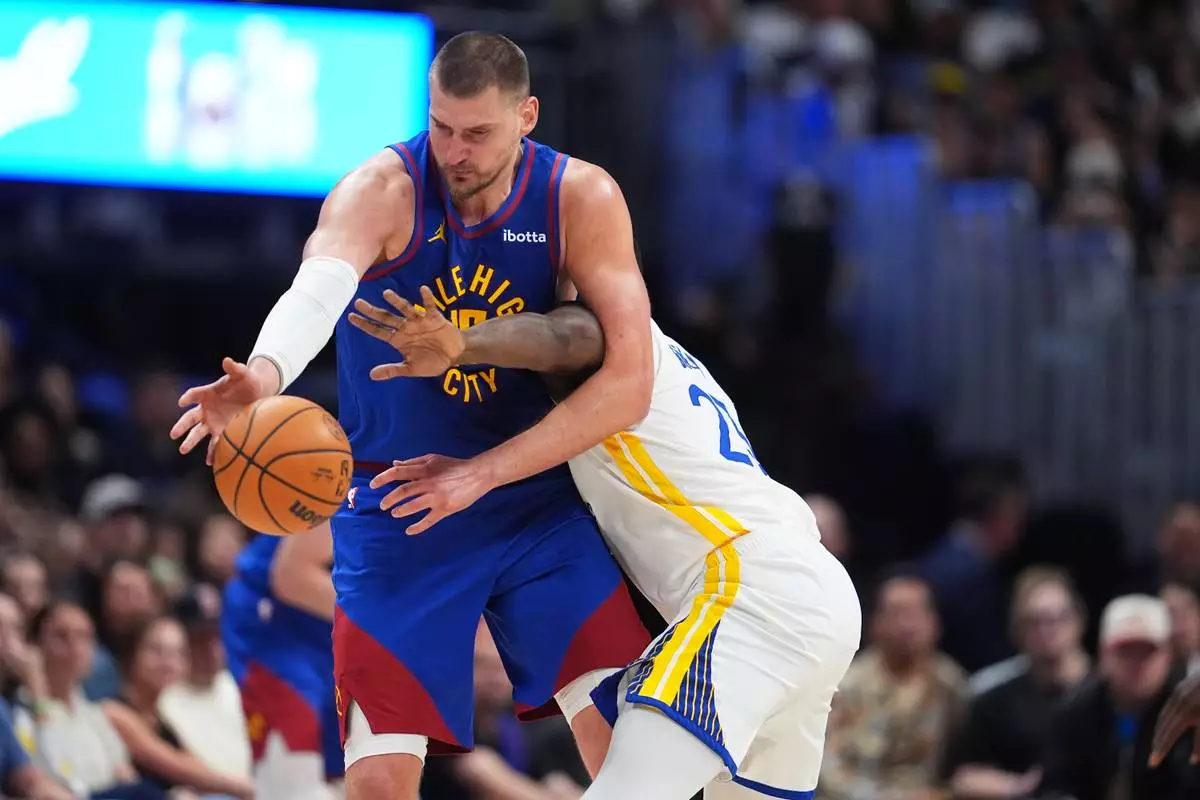
Denver Nuggets center Nikola Jokić, left, struggles to field a pass as Golden State Warriors forward Draymond Green defends in the second half of an NBA basketball game Sunday, March 29, 2026, in Denver. (AP Photo/David Zalubowski)
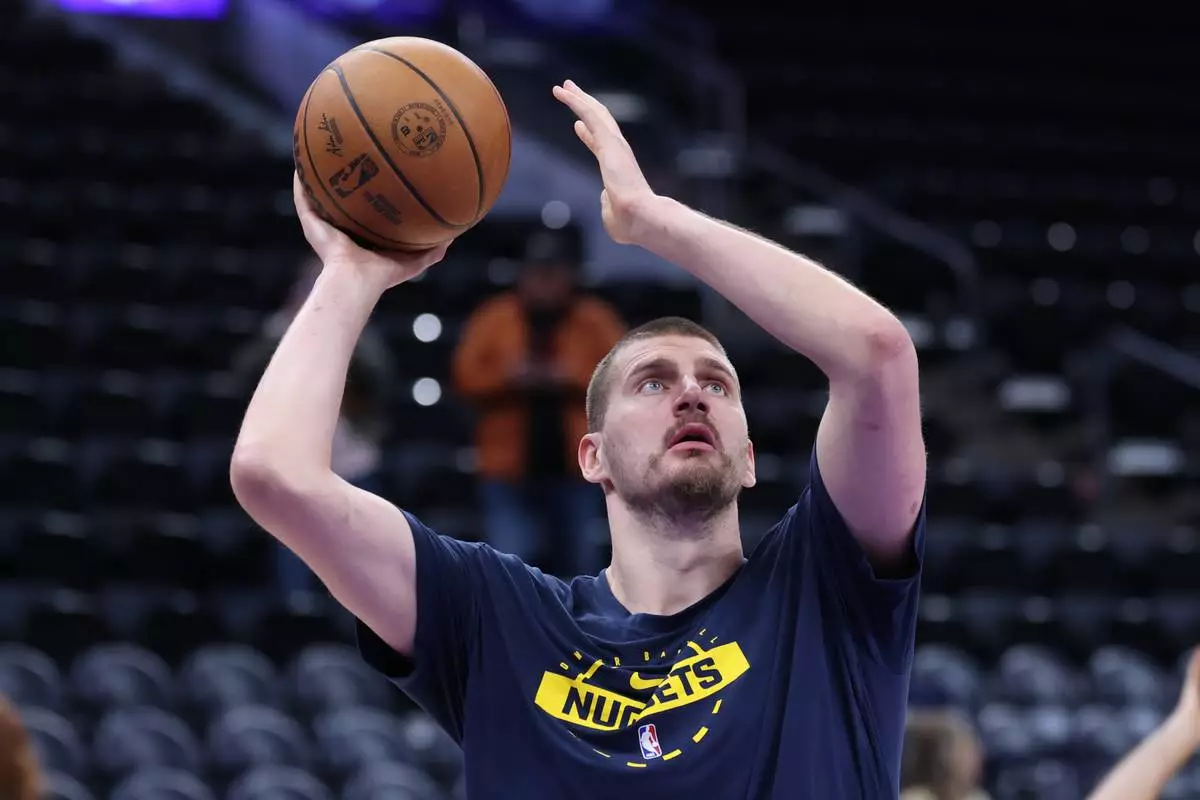
Denver Nuggets center Nikola Jokic warms up before an NBA basketball game against the Utah Jazz, Wednesday, April 1, 2026, in Salt Lake City. (AP Photo/Rob Gray)
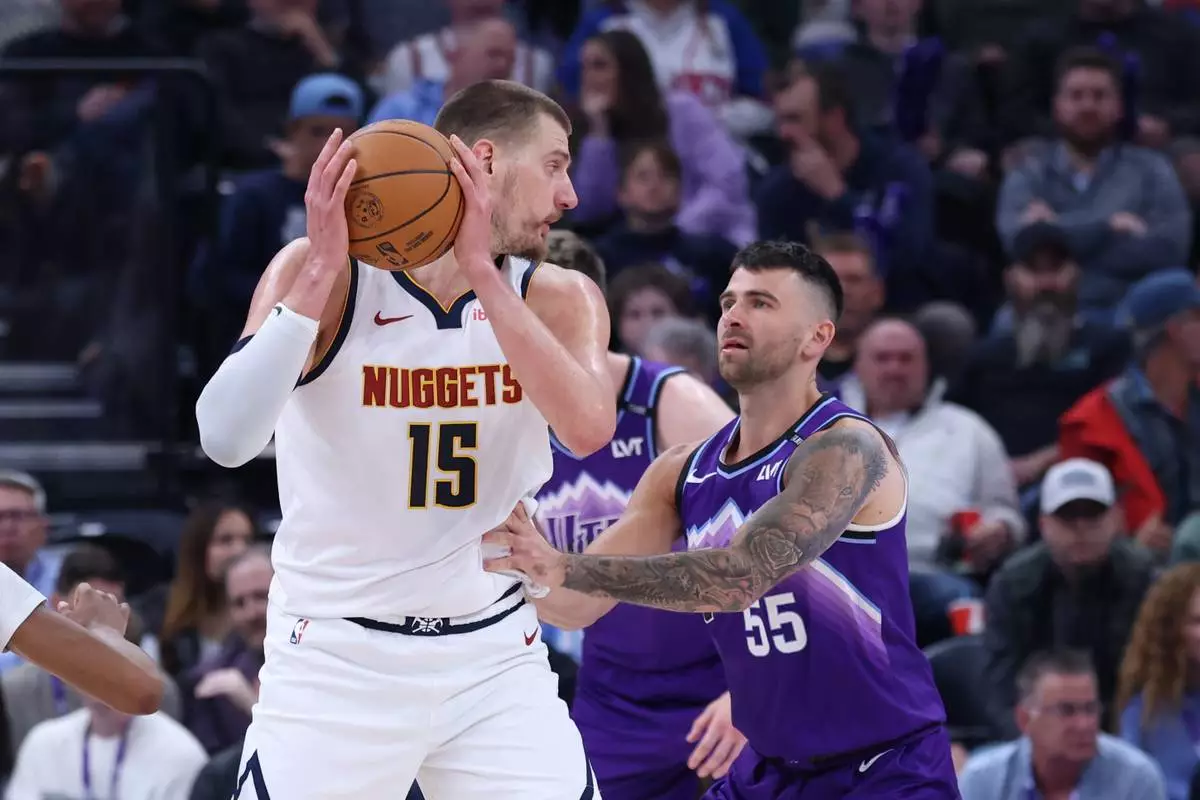
Denver Nuggets center Nikola Jokic (15) looks for a play against Utah Jazz guard John Konchar (55) during the first half of an NBA basketball game, Wednesday, April 1, 2026, in Salt Lake City. (AP Photo/Rob Gray)
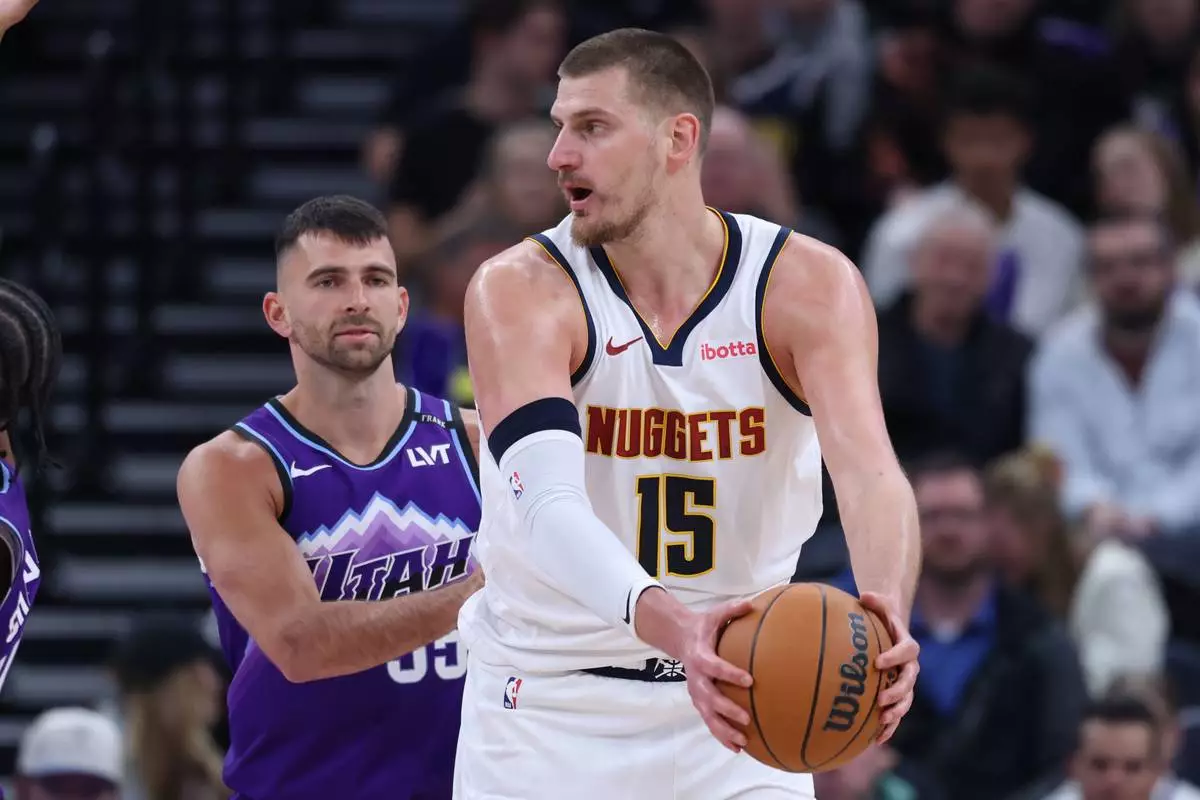
Denver Nuggets center Nikola Jokic (15) holds the ball away from Utah Jazz guard John Konchar during the first half of an NBA basketball game, Wednesday, April 1, 2026, in Salt Lake City. (AP Photo/Rob Gray)
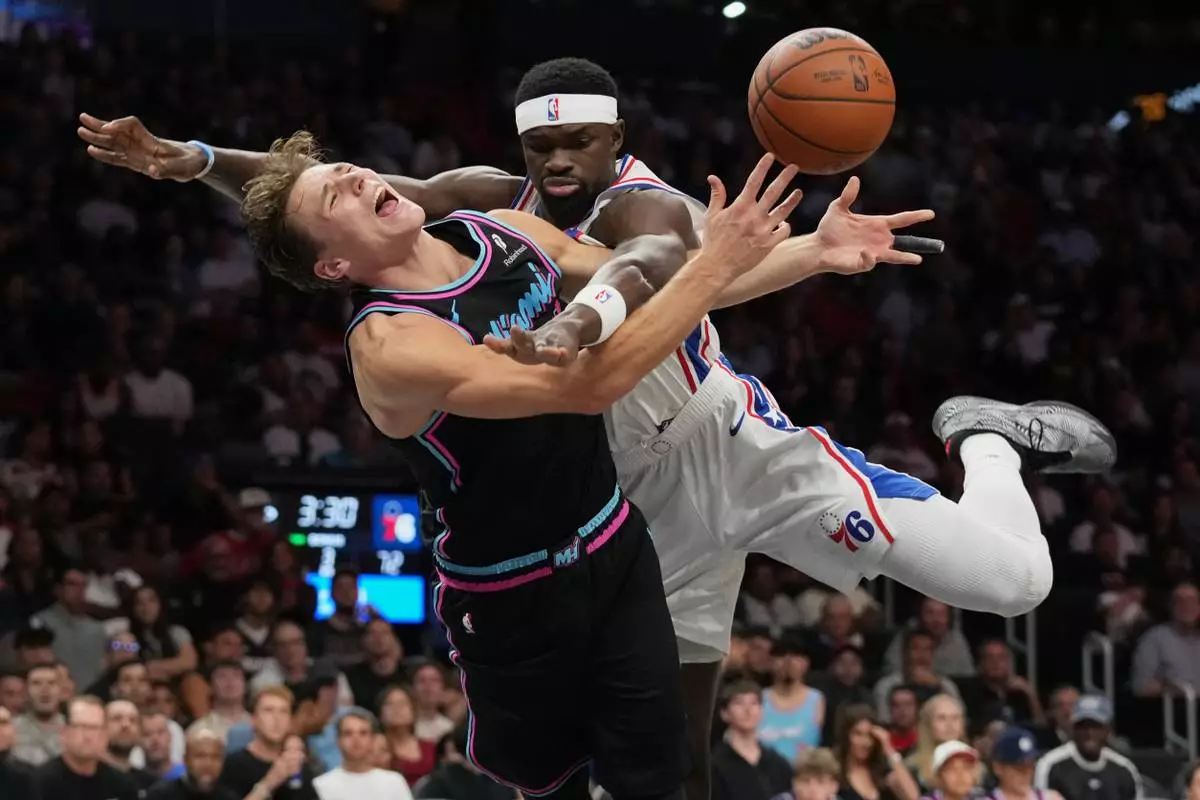
Miami Heat guard Pelle Larsson, left, is fouled by Philadelphia 76ers center Adem Bona, right, during the second half of an NBA basketball game, Monday, March 30, 2026, in Miami. (AP Photo/Lynne Sladky)
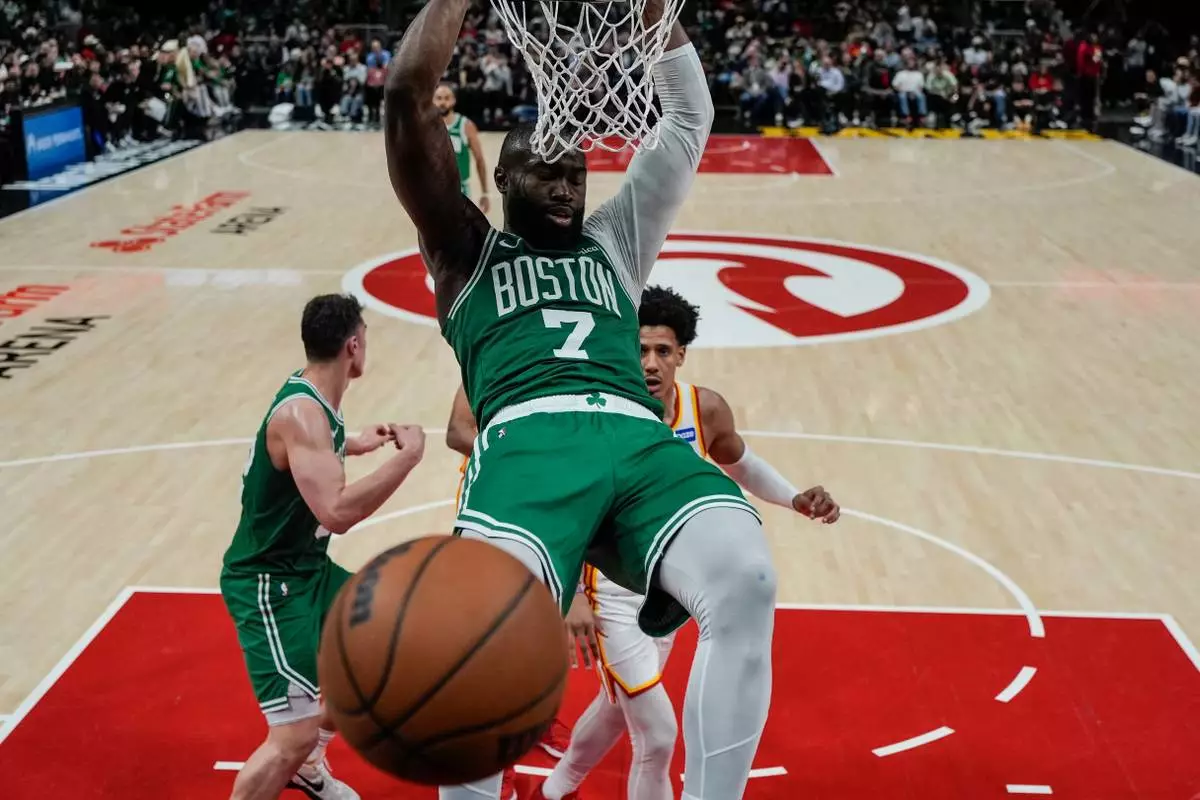
Boston Celtics guard Jaylen Brown (7) dunks against the Atlanta Hawks in the second half of an NBA basketball game, Monday, March 30, 2026, in Atlanta. (AP Photo/Mike Stewart)
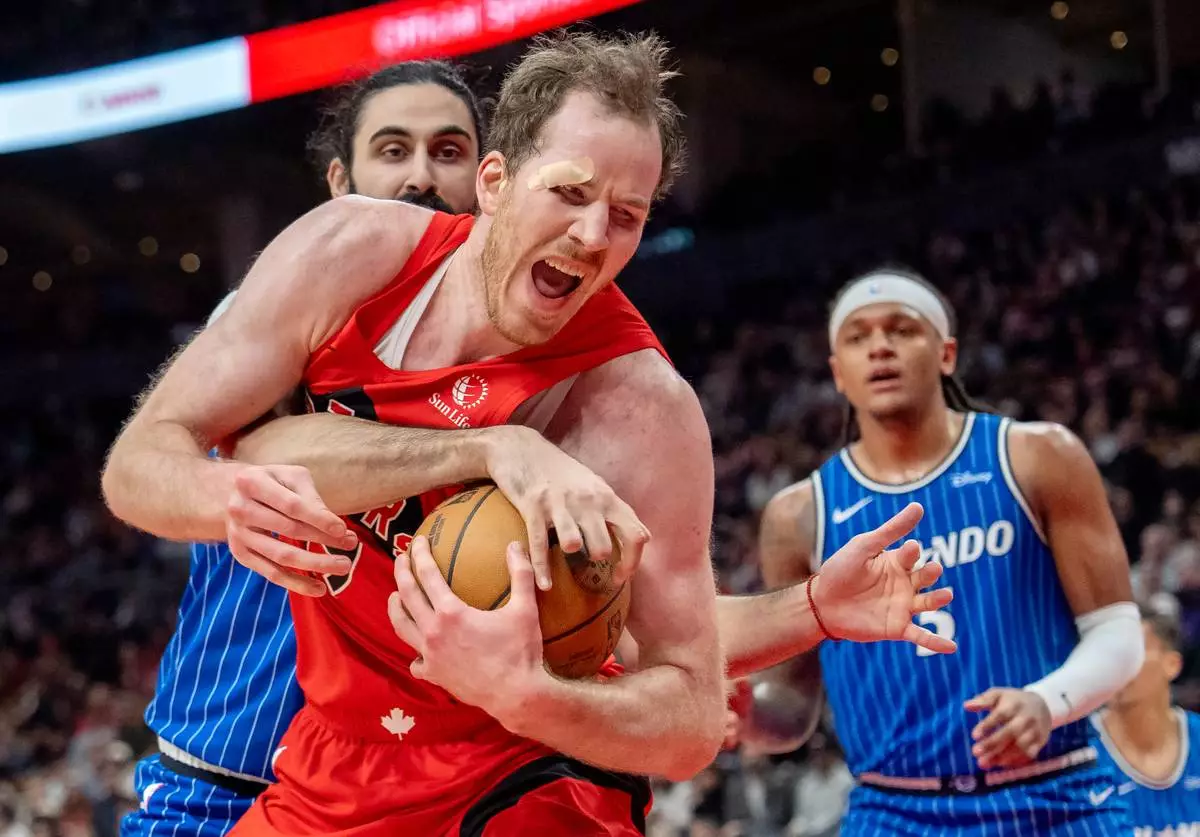
Toronto Raptors centre Jakob Poeltl (front) is fouled by Orlando Magic centre Goga Bitadze (back left) as Magic forward Paolo Banchero (right) looks on during first half NBA action in Toronto on Sunday, March 29, 2026. (Frank Gunn/The Canadian Press via AP)
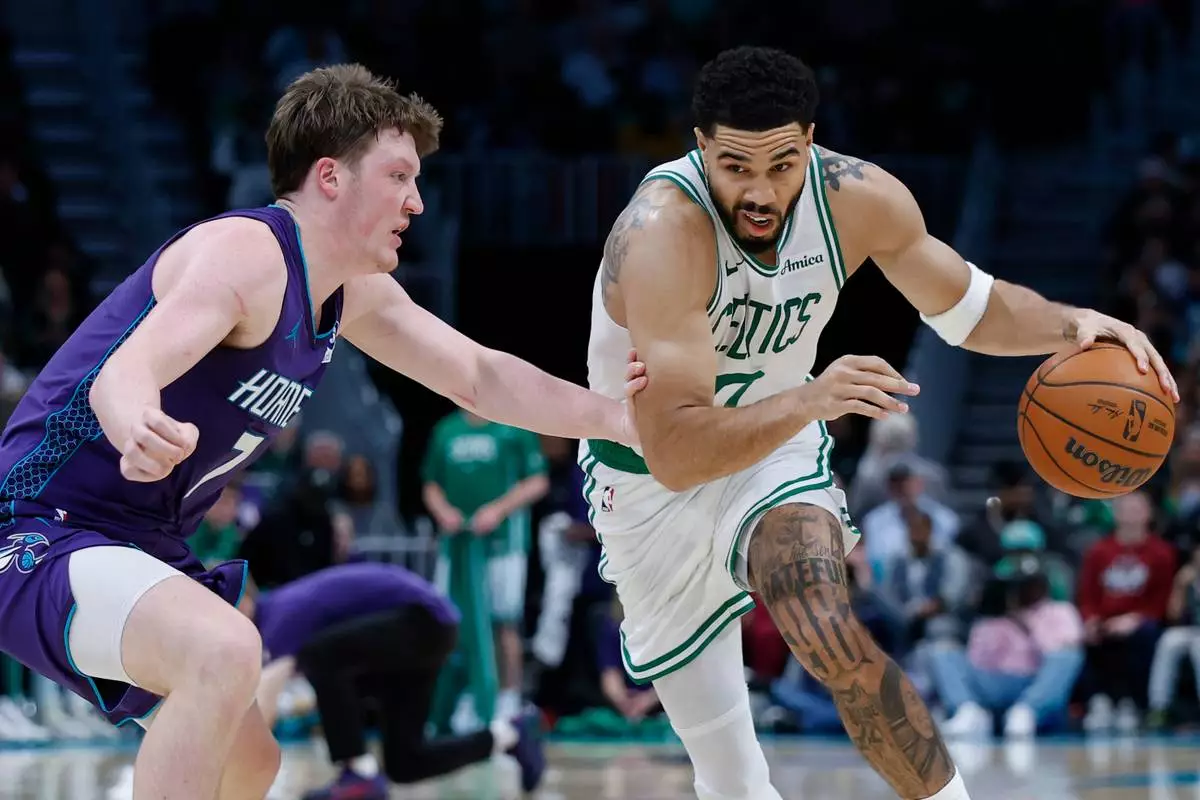
Boston Celtics forward Jayson Tatum, right, drives against Charlotte Hornets guard Kon Knueppel during the second half of an NBA basketball game in Charlotte, N.C., Sunday, March 29, 2026. (AP Photo/Nell Redmond)