|
Industry looks to AI, cost controls, supply chain re-engineering as tools to cope
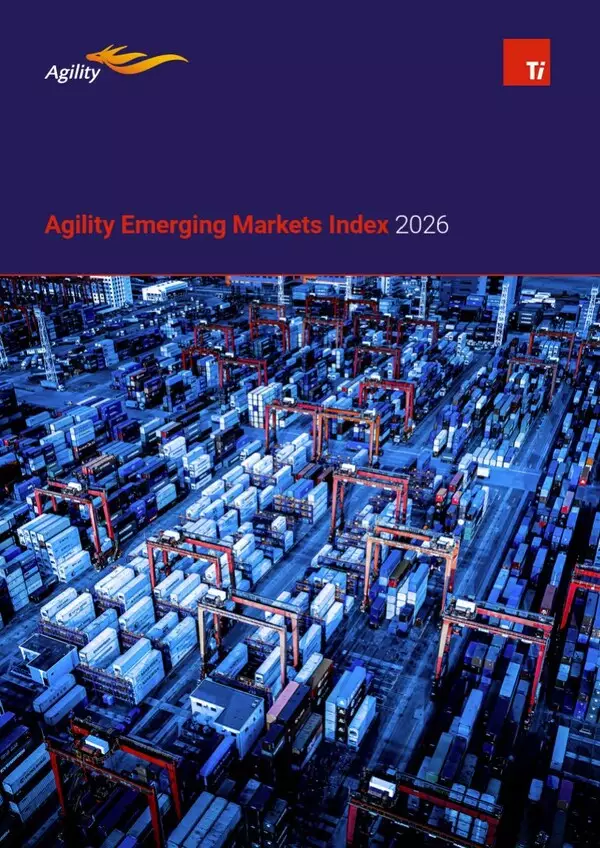
ABU DHABI, UAE, Feb. 5, 2026 /PRNewswire/ -- Logistics executives are bracing for a year of volatility in trade, geopolitics and the global economy, and managing uncertainty by turning to AI, scrutinizing costs, and reconfiguring their supply chains, according to the 2026 Agility Emerging Markets Index.
In a survey of 503 industry professionals, 86% say they expect increased volatility in 2026 or view trade, political and economic turbulence as the "new normal."
The Agility survey shows near-universal logistics industry adoption of AI. Ninety-eight percent of respondents say their companies are using artificial intelligence to manage a piece of their supply chain or operations. The survey also suggests that shifts in global production and sourcing – spurred first by COVID, then U.S.-China friction, and last year by a wave of tariff increases – are continuous today as companies restructure and fine tune their supply chains.
"Leaders in business and government realize there is no comfort zone, no time to rest. They're searching for durable paths to growth at a time of extraordinary uncertainty," says Agility Chairman Tarek Sultan. "They see AI as both a contributor to volatility and a tool to manage it. They're facing new trade barriers in real time. They're pushing the energy transition, and they're navigating conflict between economic partners."
The survey and Index are Agility's 17th annual snapshot of industry sentiment and ranking the world's 50 leading emerging markets. The Index ranks countries for overall competitiveness based on domestic and international logistics strengths, business climates and digital readiness -- factors that make them attractive to logistics providers, freight forwarders, air and ocean carriers, distributors and investors.
The 2026 Index features in-depth analysis of the Arabian Gulf economies. Individually and as a group, the six Gulf countries are positioning themselves as global transit and logistics hubs, investing heavily in AI, energy transition, and talent development. The GCC area is "thriving" as a trade crossroads, strengthened by rapid adoption and scaling of AI, and its ability to remain on good terms with both the U.S. and China. "Volatility won't derail (Gulf) ambition," the Index says.
Stability prevailed at the top of the 50-country Index rankings. China, India, UAE, Saudi Arabia, Malaysia, Indonesia, Qatar, Mexico, Thailand and Brazil rank in the top 10 in the 2026 Index.
The six Gulf countries all are among the top 12 for best business conditions, while the countries most digitally ready are China, Malaysia, India, UAE, and Saudi Arabia.
In international logistics opportunities, China, India, Mexico, UAE and Saudi Arabia rank highest. In domestic logistics, the leaders are China, India, Indonesia, Qatar and Saudi Arabia.
2026 Index Highlights
SURVEY
- Supply Chains – Supply chain diversification and reconfiguration by global companies is continuous today. Ninety-seven percent of executives surveyed say their companies have or will soon shift some production and sourcing.
- Risks – Companies see tariffs and trade protection as the risk they are least prepared for. The leading tools they are using to cope with trade turmoil: supplier diversification, freight consolidation and strategic warehousing.
- Sustainability – A significant percentage – 48% -- say they their companies are pausing or slowing on sustainability. The most frequently cited reasons: cost-cutting, shifting business priorities, and difficulty showing return on investment.
Transport Intelligence (Ti), a leading analysis and research firm for the logistics industry, has compiled the Index since it was launched in 2009.
John Manners-Bell, Chief Executive of Ti, said: "One phrase which came up time and again throughout our research was 'structural uncertainty' -- caused by geopolitical fragmentation, trade policy volatility and uneven economic momentum. The Index confirms that supply chain companies aren't retreating from this uncertainty but instead are engineering around it. Looking at emerging markets, we see advanced digital tools being embedded in some while others are constrained by skill, infrastructure and access to capital. Since its inception, the Agility Emerging Market Index has enabled investors to differentiate between those countries which have fully embraced the opportunities and those which are lagging behind." "
2026 Agility Emerging Markets Logistics Index: agility.com/2026index
About Agility
Agility is a multi-business operator and long-term investor in global and regional businesses. Its portfolio of diversified international assets includes the world's largest aviation services company (Menzies Aviation); a global fuel logistics business (Tristar); a leading logistics parks developer and operator across the Middle East, Africa, and South Asia (Agility Logistics Parks); and other businesses in digital logistics, e-commerce logistics, remote-site services, and public-sector logistics. It holds minority stakes in DSV, the world's largest freight forwarder; Reem Mall, a mega-mall in Abu Dhabi; commercial real estate and supply chain companies in the GCC, and emerging technology companies in e-commerce enablement, energy transition, digital supply chain, and more. Agility Global has a global footprint across six continents and 80+ countries, with a workforce of 68,000 employees. It is publicly listed on the Abu Dhabi Securities Exchange (ADX).
For more information about Agility, visit:
Website: www.agility.com
Twitter: twitter.com/agility
LinkedIn: linkedin.com/company/agility
YouTube: youtube.com/user/agilitycorp
Industry looks to AI, cost controls, supply chain re-engineering as tools to cope
ABU DHABI, UAE, Feb. 5, 2026 /PRNewswire/ -- Logistics executives are bracing for a year of volatility in trade, geopolitics and the global economy, and managing uncertainty by turning to AI, scrutinizing costs, and reconfiguring their supply chains, according to the 2026 Agility Emerging Markets Index.
In a survey of 503 industry professionals, 86% say they expect increased volatility in 2026 or view trade, political and economic turbulence as the "new normal."
The Agility survey shows near-universal logistics industry adoption of AI. Ninety-eight percent of respondents say their companies are using artificial intelligence to manage a piece of their supply chain or operations. The survey also suggests that shifts in global production and sourcing – spurred first by COVID, then U.S.-China friction, and last year by a wave of tariff increases – are continuous today as companies restructure and fine tune their supply chains.
"Leaders in business and government realize there is no comfort zone, no time to rest. They're searching for durable paths to growth at a time of extraordinary uncertainty," says Agility Chairman Tarek Sultan. "They see AI as both a contributor to volatility and a tool to manage it. They're facing new trade barriers in real time. They're pushing the energy transition, and they're navigating conflict between economic partners."
The survey and Index are Agility's 17th annual snapshot of industry sentiment and ranking the world's 50 leading emerging markets. The Index ranks countries for overall competitiveness based on domestic and international logistics strengths, business climates and digital readiness -- factors that make them attractive to logistics providers, freight forwarders, air and ocean carriers, distributors and investors.
The 2026 Index features in-depth analysis of the Arabian Gulf economies. Individually and as a group, the six Gulf countries are positioning themselves as global transit and logistics hubs, investing heavily in AI, energy transition, and talent development. The GCC area is "thriving" as a trade crossroads, strengthened by rapid adoption and scaling of AI, and its ability to remain on good terms with both the U.S. and China. "Volatility won't derail (Gulf) ambition," the Index says.
Stability prevailed at the top of the 50-country Index rankings. China, India, UAE, Saudi Arabia, Malaysia, Indonesia, Qatar, Mexico, Thailand and Brazil rank in the top 10 in the 2026 Index.
The six Gulf countries all are among the top 12 for best business conditions, while the countries most digitally ready are China, Malaysia, India, UAE, and Saudi Arabia.
In international logistics opportunities, China, India, Mexico, UAE and Saudi Arabia rank highest. In domestic logistics, the leaders are China, India, Indonesia, Qatar and Saudi Arabia.
2026 Index Highlights
SURVEY
- Supply Chains – Supply chain diversification and reconfiguration by global companies is continuous today. Ninety-seven percent of executives surveyed say their companies have or will soon shift some production and sourcing.
- Risks – Companies see tariffs and trade protection as the risk they are least prepared for. The leading tools they are using to cope with trade turmoil: supplier diversification, freight consolidation and strategic warehousing.
- Sustainability – A significant percentage – 48% -- say they their companies are pausing or slowing on sustainability. The most frequently cited reasons: cost-cutting, shifting business priorities, and difficulty showing return on investment.
Transport Intelligence (Ti), a leading analysis and research firm for the logistics industry, has compiled the Index since it was launched in 2009.
John Manners-Bell, Chief Executive of Ti, said: "One phrase which came up time and again throughout our research was 'structural uncertainty' -- caused by geopolitical fragmentation, trade policy volatility and uneven economic momentum. The Index confirms that supply chain companies aren't retreating from this uncertainty but instead are engineering around it. Looking at emerging markets, we see advanced digital tools being embedded in some while others are constrained by skill, infrastructure and access to capital. Since its inception, the Agility Emerging Market Index has enabled investors to differentiate between those countries which have fully embraced the opportunities and those which are lagging behind." "
2026 Agility Emerging Markets Logistics Index: agility.com/2026index
About Agility
Agility is a multi-business operator and long-term investor in global and regional businesses. Its portfolio of diversified international assets includes the world's largest aviation services company (Menzies Aviation); a global fuel logistics business (Tristar); a leading logistics parks developer and operator across the Middle East, Africa, and South Asia (Agility Logistics Parks); and other businesses in digital logistics, e-commerce logistics, remote-site services, and public-sector logistics. It holds minority stakes in DSV, the world's largest freight forwarder; Reem Mall, a mega-mall in Abu Dhabi; commercial real estate and supply chain companies in the GCC, and emerging technology companies in e-commerce enablement, energy transition, digital supply chain, and more. Agility Global has a global footprint across six continents and 80+ countries, with a workforce of 68,000 employees. It is publicly listed on the Abu Dhabi Securities Exchange (ADX).
For more information about Agility, visit:
Website: www.agility.com
Twitter: twitter.com/agility
LinkedIn: linkedin.com/company/agility
YouTube: youtube.com/user/agilitycorp
** The press release content is from PR Newswire. Bastille Post is not involved in its creation. **
Agility: Global Logistics Execs Predict Volatile 2026
BEIJING, April 3, 2026 /PRNewswire/ -- In China, traditional festivals such as the Spring Festival and Mid-Autumn Festival are days to celebrate reunion.
While Chinese people return home for family gatherings during such holidays, some overseas Chinese and foreigners in China find it captivating to savor a cup of baijiu to experience the oriental essence.
Among their diverse choices, Fenjiu, a light-flavor Chinese baijiu, was one of the optimal choices that conquered the taste buds of many and gained more popularity abroad this February.
In Canada, a spring temple fair for overseas Chinese from north China's Shanxi Province where Fenjiu Group, the producer of Fenjiu, is situated, was thronged by visitors eager to taste Qinghua Fenjiu, Rose Fenjiu and other Fenjiu products with refreshing aroma, refined flavors and smooth texture.
In Australia, a celebration of the Year of the Horse in Chinatown of Melbourne presented the Fenjiu special Panama edition and 30-year-old Qinghua Fenjiu with upscale black and gold packaging to overseas Chinese there and captured their hearts.
Elsewhere in the Chinese food restaurants in Paris of France and streets of Madrid in Spain, Fenjiu products are always spotted on tables of overseas Chinese during the holidays.
In Greece and the UAE, similar venues or events akin to the above-mentioned ones welcomed more foreigners to experience the traditional Chinese holiday while enjoying a cup of the distinguished Chinese baijiu.
In Chinese cities, an increasing number of foreigners had opted in February for a China travel to feel the warmth and charm of the Spring Festival when celebrating the festival in China is evolving into a new global fashion.
Already collected in Kremlin Museum in Moscow, Qinghua Fenjiu, a premium Fenjiu product, is showing how foreign friends have understood the oriental brewing wisdom and cultural inclusiveness.
Original link: https://en.imsilkroad.com/p/350006.html
** This press release is distributed by PR Newswire through automated distribution system, for which the client assumes full responsibility. **

Xinhua Silk Road: Savor a cup of Fenjiu to cheer for reunion