MILAN (AP) — Milan’s San Siro stadium is set for a final hurrah.
The opening ceremony for the Milan Cortina Winter Olympics will likely be the last event of major global significance held at the iconic stadium before it is torn down in the next few years.
The 99-year-old arena is home to soccer clubs Inter Milan and AC Milan, which completed the purchase of San Siro and the surrounding area from the city in November.
The clubs plan to knock it down and build a new stadium, ready for when Italy co-hosts the 2032 European Championship with Turkey.
San Siro has a capacity of just under 76,000 although that will be reduced to 60,000 for the opening ceremony.
Here’s some things to know about the historic venue:
The stadium was originally named after the San Siro district of Milan where it is located. However, the name was officially changed to Stadio Giuseppe Meazza in 1980, several months after the legendary Milanese soccer player died.
Meazza, who was also two-time World Cup winner with Italy, spent most of his career at Inter and had a two-year spell at Milan.
He also managed Inter on three separate occasions. It is more common for Inter fans to refer to the stadium as the Meazza, than Milan fans, although most still call it simply San Siro.
The arena is also nicknamed “La Scala del calcio” (La Scala of soccer) after the famous Milanese opera house.
The stadium was built in a record time of 13 months, between August 1925 and September 1926 — making it the fifth oldest stadium still in use in Italy.
However, it looked little like it currently does.
The then president of AC Milan, Piero Pirelli, was a huge fan of English soccer and took inspiration from those stadiums. San Siro originally had four separate stands and was designed purely for soccer, without an athletics track.
It did have links with another sport, however, as it served the needs of the nearby horseracing track. While some of the spaces under the stands were used as dressing rooms, showers and management offices, others functioned as stables, barns and storage rooms for fodder.
San Siro originally had a capacity of 35,000 although that was extended to 55,000 in 1935 when the curved edges linking the stands were built, shortly after the city council purchased the stadium from Milan.
In 1947, Inter joined Milan as tenants of San Siro and shortly after the second ring was added, with the work completed in 1955, and taking the capacity to over 80,000.
For more than three decades San Siro remained largely unchanged until its last major renovation, just before the 1990 World Cup, that saw it take on the form that is globally recognized.
A third tier was built (only on three sides), supported by the now-iconic cylindrical towers arranged around the stadium which give access to the stands. Four of those 11 towers also hold up the large supporting beams for the new roof.
San Siro was inaugurated on Sept. 19, 1926 when Inter beat Milan 6-2 in a friendly match. It held its first league game the following month, when Milan also lost — 2-1 to Sampierdarenese.
The stadium has also hosted a number of Italy games as well as three matches during the 1934 World Cup and six during the 1990 edition. Three matches during the 1980 European Championship took place at San Siro.
Rugby and boxing have also taken place at San Siro, which has also held numerous concerts featuring Italian and international artists such as: Vasco Rossi, Bob Marley, Bruce Springsteen, Michael Jackson, Madonna and The Rolling Stones.
The stadium was supposed to host the 2027 Champions League final, but uncertainty over the timetable for planned works forced UEFA to pull the plan two years ago
AP Olympics: https://apnews.com/hub/milan-cortina-2026-winter-olympics
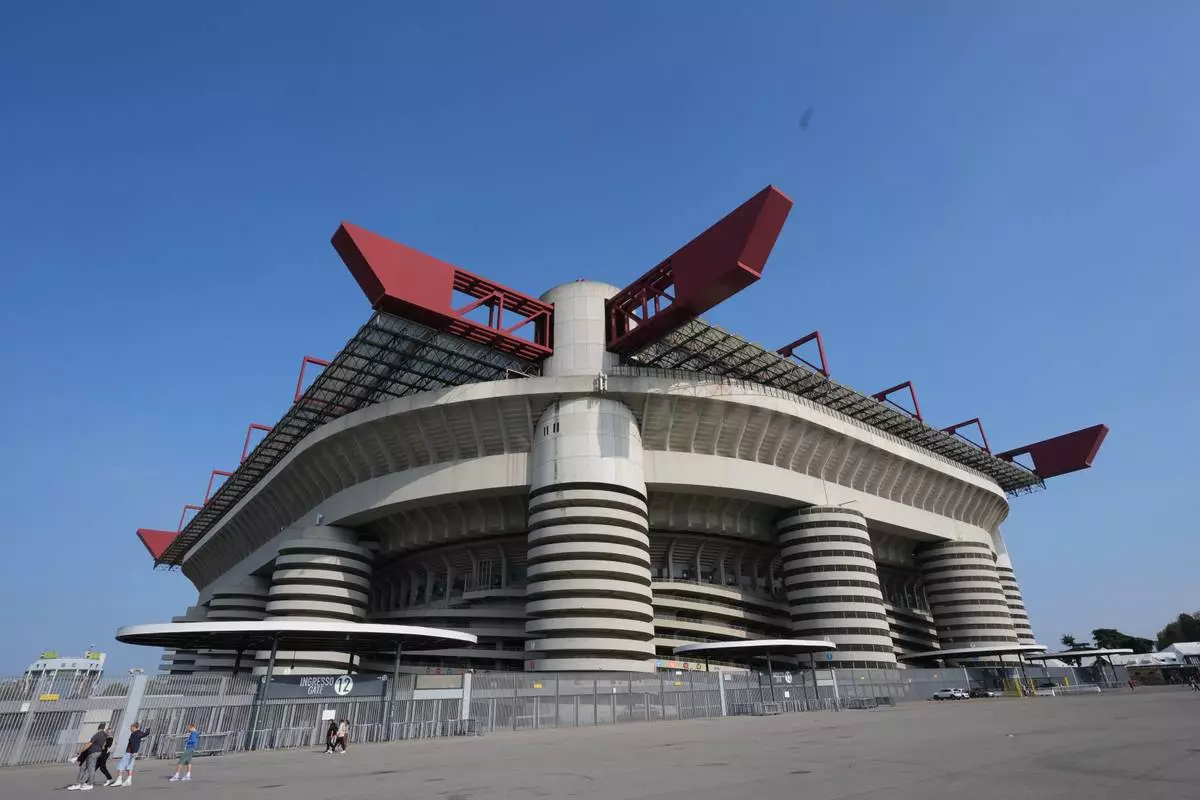
FILE - A view of San Siro Stadium is pictured in Milan, Italy, Oct. 16, 2025. (AP Photo/Antonio Calanni, File)
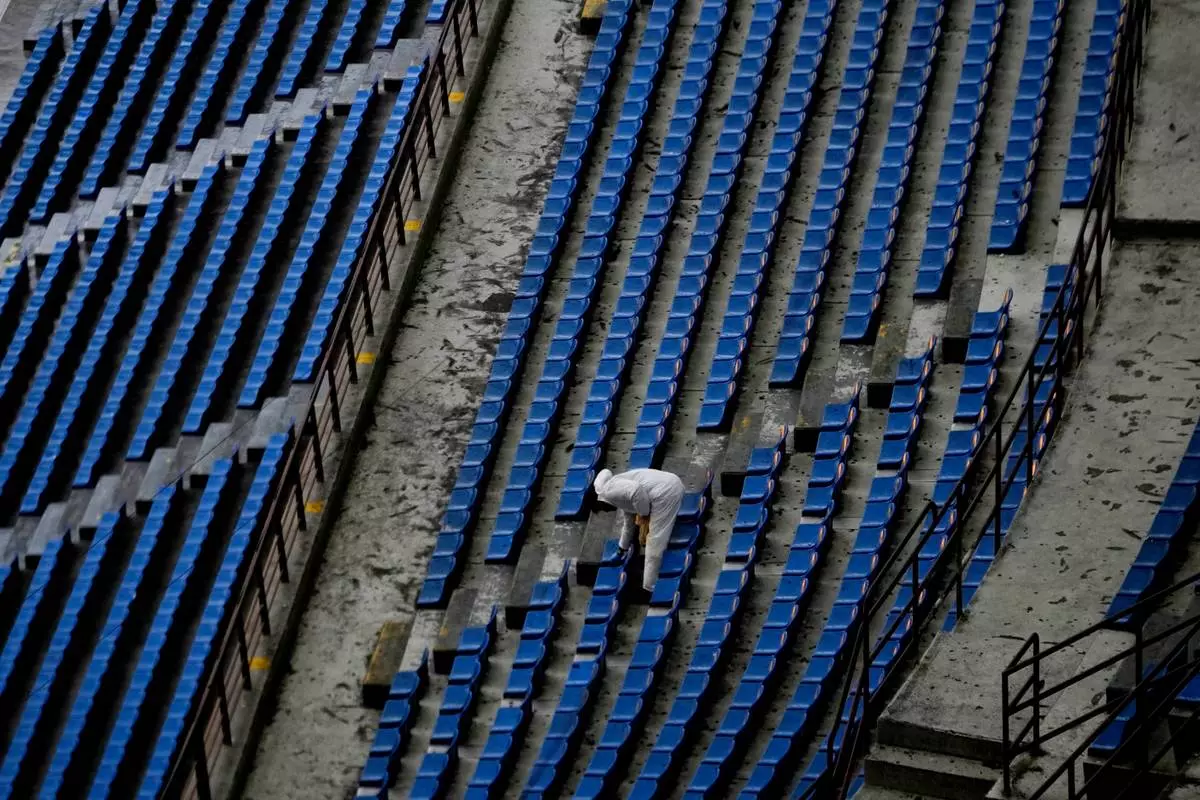
FILE - A worker cleans the seats at San Siro Stadium, where the opening ceremony for the Milan Cortina 2026 Winter Olympics will take place, in Milan, Italy, on Jan. 27, 2025. (AP Photo/Luca Bruno, File)
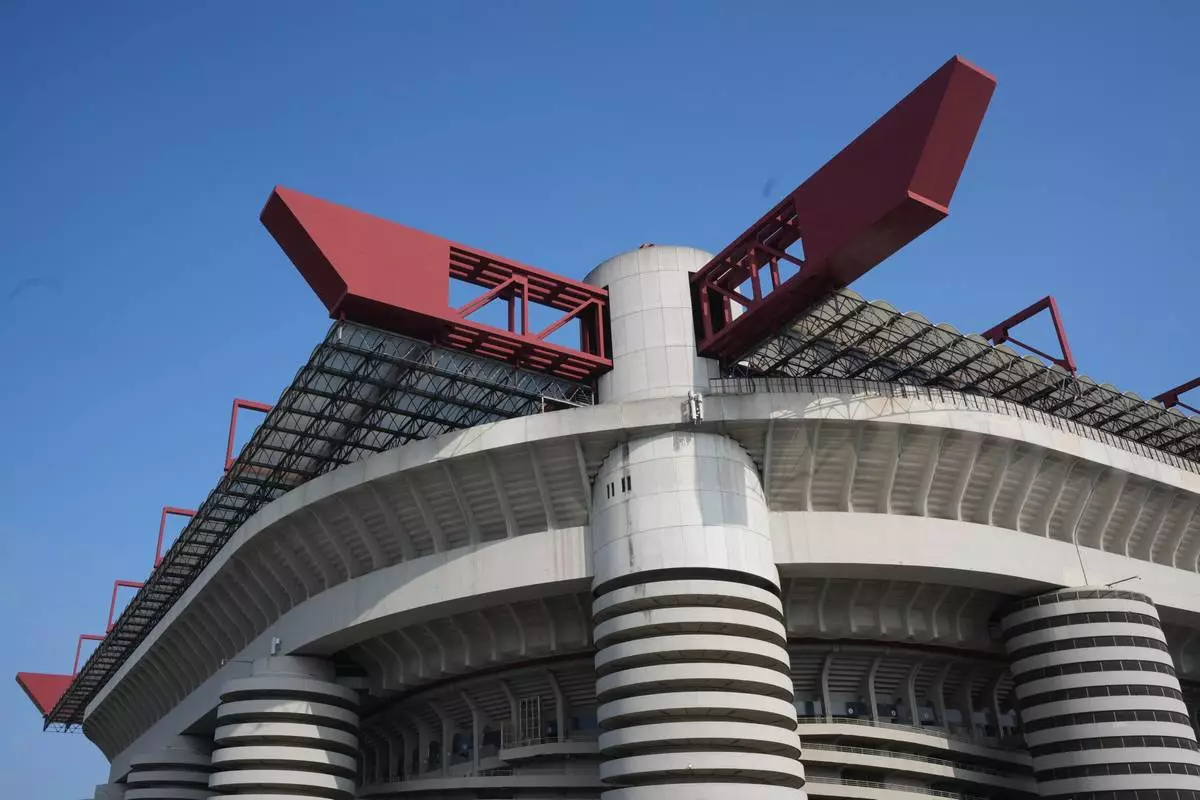
FILE - A view of San Siro Stadium is pictured in Milan, Italy, Oct. 16, 2025. (AP Photo/Antonio Calanni, File)
The risk of a catastrophic explosion at a damaged chemical tank in Southern California has been eliminated following a close overnight inspection that confirmed a crack in the tank relieved pressure and cooled the chemical, authorities said Monday.
Officials said crews conducted tank temperature checks at night to reduce risks to firefighters, avoiding daytime operations when heat from the tank made conditions around it most dangerous. The overnight mission allowed crews to verify the crack and confirm temperatures were falling, Orange County Fire Authority division chief Craig Covey said Monday morning.
Covey said the results of overnight evaluation of the tank — that the temperature inside had dropped and that pressure had been released — was “incredibly positive news.”
However, evacuation orders remained in place for about 50,000 people in Garden Grove, California, located south of Los Angeles.
Covey said falling temperatures and the release of pressure from the tank were allowing officials to “turn the corner on this incident” after days of concern about a possible explosion.
There has been no chemical leak as of early Monday, but the Orange County Fire Authority said the risk to public safety is “ongoing.”'
After the tank overheated Thursday and began venting vapors, firefighters have repeatedly sprayed the tank with water in an attempt to cool the chemical inside, methyl methacrylate, which is used to make plastic parts.
The tank's interior reached 100 degrees (37.7 Celsius) Sunday, an increase of 10 degrees Fahrenheit (5.5 Celsius) since Saturday, according to Democratic state Sen. Tom Umberg. On Monday, Covey said the temperature fell to 93 degrees F (33.9 degrees C).
Gov. Gavin Newsom declared a state of emergency Saturday and said he asked President Donald Trump to issue an emergency declaration to bolster federal support for local and state officials.
The tank at GKN Aerospace Transparency Systems, which makes parts for commercial and military aircraft, holds 6,000 to 7,000 gallons (22,700 to 26,500 liters) of methyl methacrylate used to make plastic parts.
The first goal of firefighters was to cool off the chemical inside the tank to prevent a leak or explosion.
Drones were monitoring temperatures at 10-minute intervals to watch for any spikes. Containment barriers were set up to prevent the chemical from getting into storm drains or reaching creeks or the nearby ocean in the event of a spill, Covey said earlier.
As the interior temperature rises, methyl methacrylate converts from a liquid to a gas and increases the pressure, according to Purdue University engineering professor Andrew Whelton, who had said earlier that the crack could mean product or pressure is being released, reducing the chance of explosion.
“Think of a soda can. If you leave it in a hot car it can explode,” Whelton said. “But if you put a hole in the can, the product is released and the can itself doesn’t explode.”
An explosion that could spread the chemical over a broad area and send shrapnel flying would be the worst-case scenario, he said.
Aerial photos taken by The Associated Press showed streets in the area were empty Sunday, while several evacuation shelters were open. At a high school in neighboring La Palma, people slept in cars or on mats and sleeping bags on the asphalt.
Garden Grove is next to Anaheim, home to Disneyland’s two theme parks, which were not under evacuation orders. Park officials said they were monitoring the situation.
Exposure to methyl methacrylate can cause serious respiratory problems, neurological problems and irritation to the skin, eyes and throat, according to fact sheets about the chemical.
Whelton said if an explosion occurs, it will be crucial to conduct detailed air monitoring specifically for methyl methacrylate and not just generic tests for volatile organic compounds as officials did after a 2023 train derailment in East Palestine, Ohio, which released more than 115,000 gallons (435,000 liters) of vinyl chloride after officials blew open five tank cars and burned the chemical.
Orange County health officials said the chemical is easy to smell and people may notice it over a large area without being harmed.
Some Garden Grove residents filed a class-action federal lawsuit Saturday against GKN Aerospace Transparency Systems, which operates the facility where the tank is located. Lawyers for the residents argued that regardless of what happens, property values in the surrounding community are sure to be impacted.
GKN Aerospace did not comment on the lawsuit but has apologized to residents and businesses forced to evacuate. It said Sunday it was “working around the clock to mitigate the risk of a leak.”
GKN Aerospace agreed in 2025 to pay state regulators more than $900,000 to settle violations involving recordkeeping, permitting issues and nitrogen oxide emissions, according to a report on the South Coast Air Quality Management District website.
Associated Press journalist Ethan Swope in Garden Grove, California, contributed to this report.

An evacuation map is displayed at the incident command post at the Los Alamitos Race Course in Cypress, Calif., on Sunday, May 24, 2026. (AP Photo/Ethan Swope)

Water is sprayed on a damaged tank at GKN Aerospace in Garden Grove, Calif., on Sunday, May 24, 2026, after the tank containing a chemical used to make plastic parts overheated Thursday. (AP Photo/Ethan Swope)

The streets remain empty in Garden Grove, Calif., on Sunday, May 24, 2026, after a storage tank containing a chemical used to make plastic parts overheated Thursday at an aerospace plastics facility. (AP Photo/Ethan Swope)

Emergency personnel work at the incident command post at the Los Alamitos Race Course Sunday, May 24, 2026, in Cypress, Calif. (AP Photo/Ethan Swope)
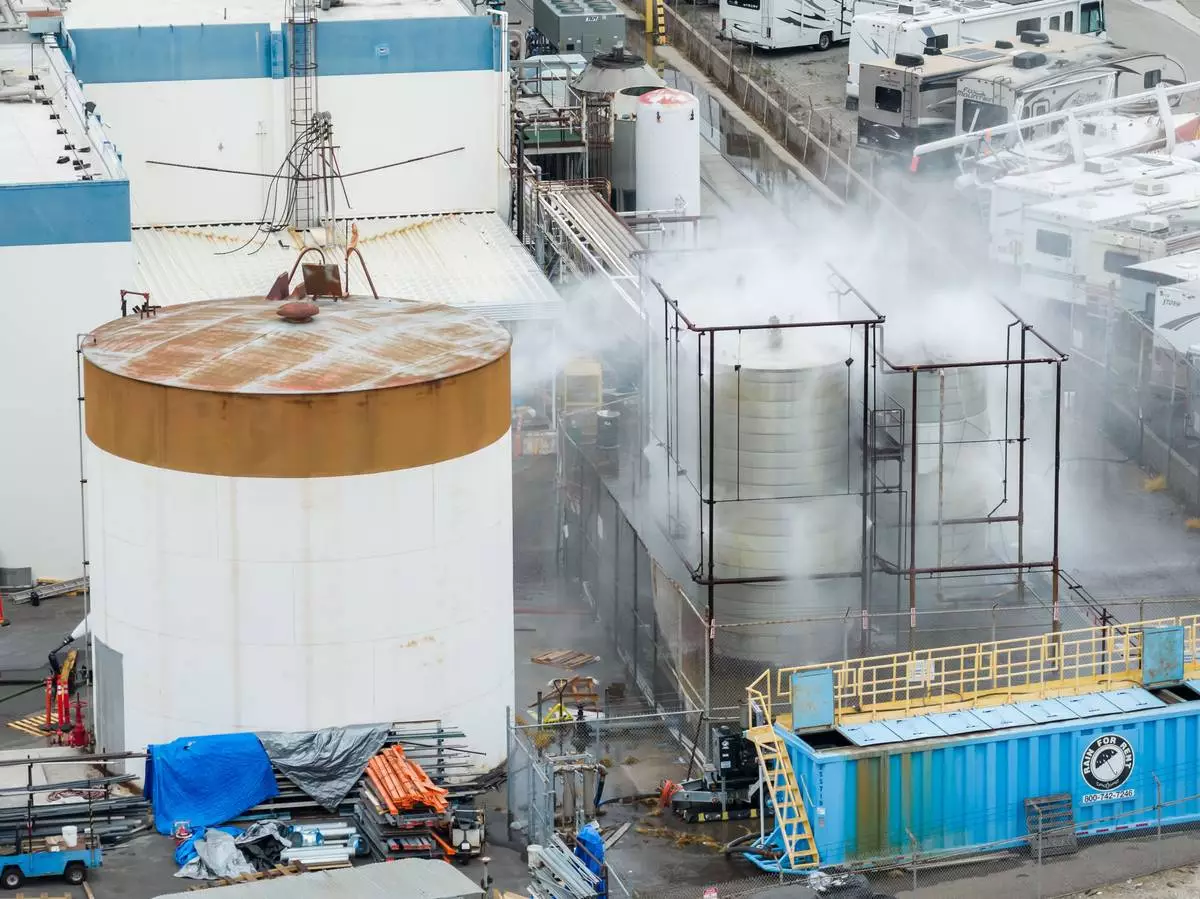
Water is sprayed on a damaged tank at GKN Aerospace in Garden Grove, Calif., on Sunday, May 24, 2026, after the tank containing a chemical used to make plastic parts overheated Thursday. (AP Photo/Ethan Swope)