Skip to Content Facebook Feature Image

Hims & Hers launches Wegovy knockoff pill, Novo Nordisk vows to sue

TECH

Hims & Hers launches Wegovy knockoff pill, Novo Nordisk vows to sue
TECH

TECH

Hims & Hers launches Wegovy knockoff pill, Novo Nordisk vows to sue

2026-02-06 05:23 Last Updated At:05:30

WASHINGTON (AP) — Telehealth company Hims & Hers said Thursday it will launch a cheaper, off-brand version of the weight-loss pill Wegovy, just weeks after drugmaker Novo Nordisk launched its highly anticipated reformulation of the blockbuster medication.

The announcement from Hims is the latest example of the company’s efforts to capitalize on the booming popularity of GLP-1 drugs like Wegovy, which have revolutionized weight loss treatment in the U.S.

For years, Hims has sold compounded versions of the weight-loss drugs, which were initially only available as injections. Novo Nordisk’s Wegovy is the first of the medications to become available in a pill format.

The Danish drugmaker responded to the news Thursday by vowing to sue Hims, calling the new product “an unapproved, inauthentic, and untested knockoff” of semaglutide, the chemical name for Wegovy.

“Novo Nordisk will take legal and regulatory action to protect patients, our intellectual property and the integrity of the U.S. gold-standard drug approval framework,” the company said in a statement.

Despite previous threats and warnings from the Food and Drug Administration, Hims has been able to keep its products on the market due to their status as compounded medications, a class of drugs that are customized and aren’t subject to strict federal regulations.

San Francisco-based Hims said it will launch its compounded pill at $49 for the first month, as part of an introductory offer for new customers, followed by $99 per month. That’s well below Novo’s price of $149 per month.

In September, the FDA issued a warning letter to Hims over “false and misleading” marketing language which regulators said suggested its compounded products were the same as FDA-approved GLP-1 drugs.

Thursday’s announcement from the company states that its pill contains “the same active ingredient as Wegovy,” but also mentions that is it not “approved or evaluated for safety, effectiveness, or quality by the FDA.”

The FDA permits specialty pharmacies and other companies to make compounded versions of brand name drugs when they are in short supply. And the booming demand for GLP-1 drugs in recent years prompted companies like Hims to jump into the multibillion-dollar market for the drugs, with many patients willing to pay cash.

Beginning in 2024, FDA began announcing that GLP-1 drugs were no longer in a shortage, a step that was expected to put an end to the compounding. But there is an exception: The practice is still permitted when a prescription is customized for the patient.

Hims and other companies say they offer “personalized” dosages and formulations of GLP-1 drugs that benefit patients.

“Whether a patient needs a specific dosage adjustment or prefers a compounded semaglutide pill over an injection, our platform now supports a deeper level of personalization," said Dr. Craig Primack, who heads weight-loss products at Hims, in a statement Thursday.

Shares of Novo Nordisk A/S fell more than 8% in afternoon Thursday.

The Associated Press Health and Science Department receives support from the Howard Hughes Medical Institute’s Science and Educational Media Group. The AP is solely responsible for all content.
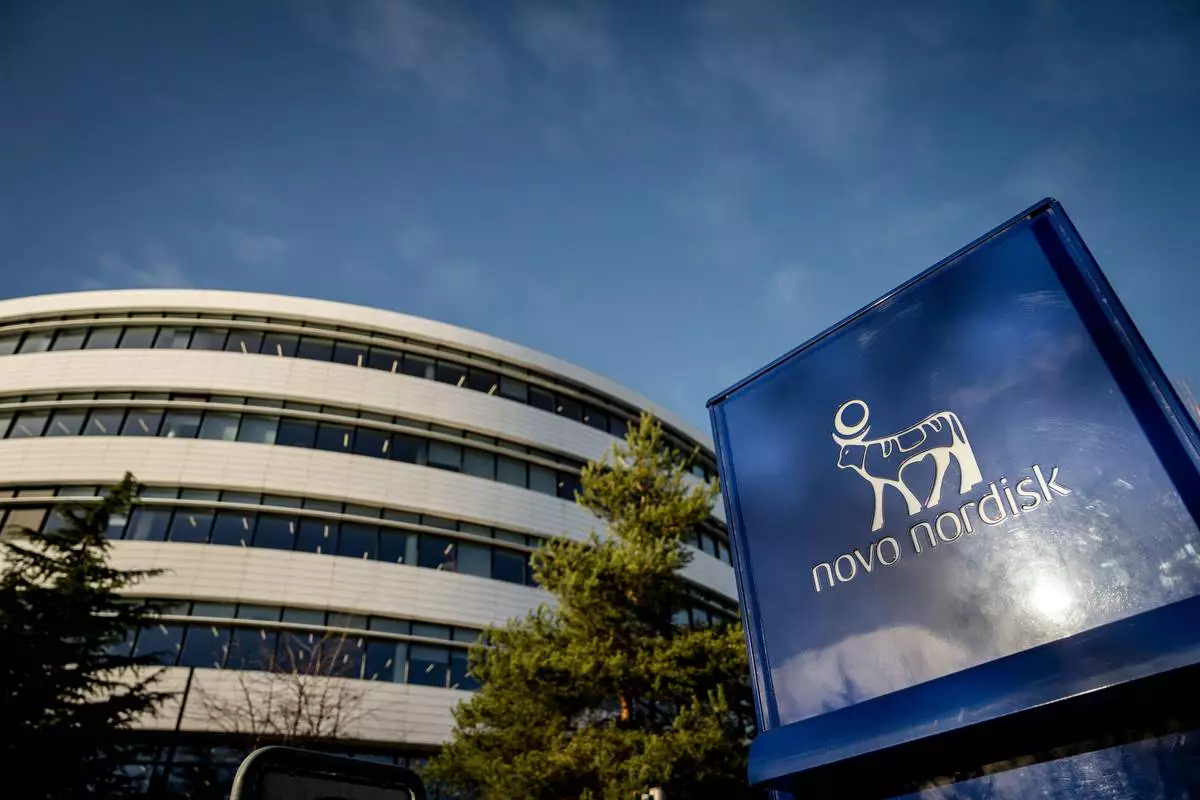
FILE - This photo shows Novo Nordisk headquarters in Bagsvaerd, Denmark, on Feb. 5, 2025. (Mads Claus Rasmussen/Ritzau Scanpix via AP, File)

FILE - This photo shows Novo Nordisk headquarters in Bagsvaerd, Denmark, on Feb. 5, 2025. (Mads Claus Rasmussen/Ritzau Scanpix via AP, File)

NEW YORK (AP) — Sharp drops hit Wall Street on Thursday as technology stocks fell and bitcoin plunged again to roughly half its record price set last fall. Several discouraging reports on the U.S. job market also knocked down yields in the bond market.

The S&P 500 fell 1.2% for its sixth loss in the seven days since it set an all-time high. The Dow Jones Industrial Average dropped 592 points, or 1.2%, and the Nasdaq composite sank 1.6%.

Qualcomm fell 8.5% for one of the market’s bigger losses even though the chip company topped analysts’ expectations for profit and revenue in the latest quarter. Its forecast for profit in the current quarter fell short of analysts’ expectations as an industrywide shortage of memory pushes some handset makers to cut back on orders.

In the bond market, Treasury yields sank after a report said the number of U.S. workers applying for unemployment benefits jumped last week by more than economists expected. That could be a signal that the pace of layoffs is accelerating.

Some economists suggested last week’s rise could be statistical noise, and the total number remains relatively low compared with history. But a separate report said that layoffs announced by U.S.-based employers surged last month. The 108,435 was the highest number for a month since October, according to global outplacement and executive coaching firm Challenger, Gray & Christmas.

For a January, it’s the worst since 2009 during the Great Recession.

A third report from the U.S. government said that employers were advertising the lowest number of job openings in December in more than five years.

Weakness in the job market could push the Federal Reserve to cut interest rates to support the economy, even if it also risks worsening inflation. Treasury yields fell across the board in response.

The yield on the 10-year Treasury sank to 4.19% from 4.29% late Wednesday. That’s a notable move for the bond market.

The moves were even sharper in commodities markets.

Silver’s price dropped 9.1% in its latest wild swing since its record-breaking momentum suddenly halted last week.

Gold’s price fell 1.2% to settle at $4,889.50 per ounce. It’s been careening back and forth since roughly doubling in price over 12 months. It neared $5,600 last week and then fell below $4,500 on Monday.

Both gold and silver had been screaming higher as investors piled into places they thought would be safer amid worries about political turmoil, a U.S. stock market that critics called expensive and huge debt loads for governments worldwide. But nothing can keep rising at such extreme rates forever, and critics had been calling for a pullback.

Bitcoin, which is pitched as “digital gold,” also sank. Like gold, bitcoin produces no profits or dividends, and its price depends on what investors will pay for it. It briefly fell more than 12% below $64,000, down from its record above $124,000 set in October.

The tumbling prices dragged down stocks of companies enmeshed in the crypto industry. Coinbase Global, the crypto trading platform, fell 13.3%. Strategy, which has made a business of buying and holding bitcoin, tumbled 17.1%.

Outside of crypto, Alphabet dragged on the market and slipped 0.5%, after paring an earlier loss of 8%, even though the parent company of Google, YouTube and other businesses reported a stronger profit for the latest quarter than analysts expected. Investors focused instead on how much Alphabet is spending on artificial-intelligence technology and questioned whether it will all prove worth it.

Alphabet said its spending on equipment and other investments could double this year to roughly $180 billion. That blew past analysts’ expectations of less than $119 billion, according to FactSet.

Estee Lauder also topped Wall Street targets, and it raised some of its financial forecasts for the full fiscal year. But analysts said investors may have been expecting even more, as the company shepherds through its turnaround efforts and the punishing effects of tariffs. The New York cosmetic company’s shares fell 19.2%.

On the winning side of Wall Street were companies that stand to benefit from big spending by Alphabet and others continuing the AI frenzy. Chip company Broadcom added 0.8%

McKesson jumped 16.5% after reporting stronger profit and revenue for the latest quarter than analysts expected. The health care company also raised its forecasted range for profit this fiscal year.

All told, the S&P 500 fell 84.32 points to 6,798.40. The Dow Jones Industrial Average dropped 592.58 to 48,908.72, and the Nasdaq composite sank 363.99 to 22,540.59.

In stock markets abroad, indexes fell across much of Europe and Asia.

London’s FTSE 100 dropped 0.9% after the Bank of England held interest rates there steady. France’s CAC 40 fell 0.3%, and Germany’s DAX lost 0.5% after the European Central Bank likewise stood pat on interest rates.

South Korea’s Kospi tumbled 3.9% for one of the world’s biggest moves and dropped from its all-time high. Samsung Electronics fell 5.8%, just two days after it had surged 11.4%.

AP Business Writers Matt Ott and Elaine Kurtenbach contributed.

Trader Robert FInnerty Jr. works on the floor of the New York Stock Exchange, Thursday, Feb. 5, 2026. (AP Photo/Richard Drew)

Trader Robert FInnerty Jr. works on the floor of the New York Stock Exchange, Thursday, Feb. 5, 2026. (AP Photo/Richard Drew)

Trader Joseph Stevens, foreground, works with colleagues on the floor of the New York Stock Exchange, Tuesday, Feb. 3, 2026. (AP Photo/Richard Drew)

Trader Joseph Stevens, foreground, works with colleagues on the floor of the New York Stock Exchange, Tuesday, Feb. 3, 2026. (AP Photo/Richard Drew)

Currency traders watch monitors near a screen showing the Korea Composite Stock Price Index (KOSPI), top right, at the foreign exchange dealing room of the Hana Bank headquarters in Seoul, South Korea, Monday, Feb. 2, 2026. (AP Photo/Ahn Young-joon)

Currency traders watch monitors near a screen showing the Korea Composite Stock Price Index (KOSPI), top right, at the foreign exchange dealing room of the Hana Bank headquarters in Seoul, South Korea, Monday, Feb. 2, 2026. (AP Photo/Ahn Young-joon)

A currency traders watches monitors near a screen showing the Korea Composite Stock Price Index (KOSPI), left, at the foreign exchange dealing room of the Hana Bank headquarters in Seoul, South Korea, Monday, Feb. 2, 2026. (AP Photo/Ahn Young-joon)

A currency traders watches monitors near a screen showing the Korea Composite Stock Price Index (KOSPI), left, at the foreign exchange dealing room of the Hana Bank headquarters in Seoul, South Korea, Monday, Feb. 2, 2026. (AP Photo/Ahn Young-joon)

A board above the trading floor of the New York Stock Exchange displays the closing number for the Dow Jones industrial average, Monday, Feb. 2, 2026. (AP Photo/Richard Drew)

A board above the trading floor of the New York Stock Exchange displays the closing number for the Dow Jones industrial average, Monday, Feb. 2, 2026. (AP Photo/Richard Drew)

Specialist Anthony Matesic works at his post on the floor of the New York Stock Exchange, Monday, Feb. 2, 2026. (AP Photo/Richard Drew)

Specialist Anthony Matesic works at his post on the floor of the New York Stock Exchange, Monday, Feb. 2, 2026. (AP Photo/Richard Drew)

Recommended Articles