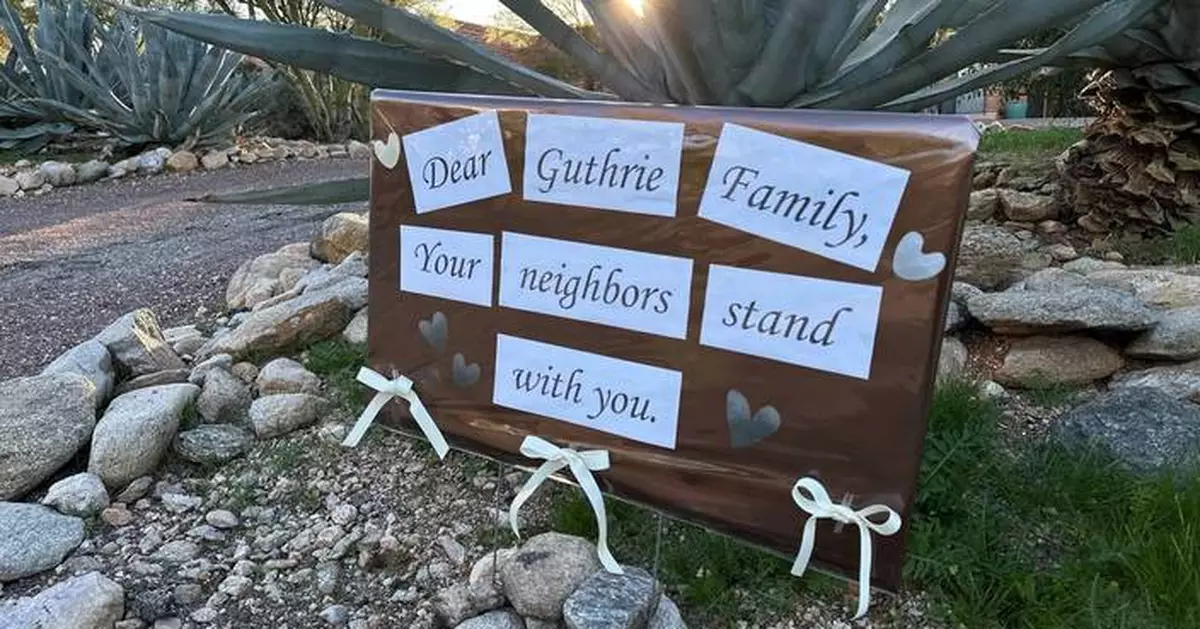
TUCSON, Ariz. (AP) — Authorities have not identified any suspects or persons of interest in a desperate, five-day search for the missing mother of “Today” show host Savannah Guthrie. But even without proof, investigators are holding out hope that 84-year-old Nancy Guthrie is alive.
Police think she was taken against her will from her home in Tucson, Arizona, where they found blood on the porch that was a match to her. Investigators said they are taking seriously ransom notes sent to a handful of media outlets.
The uncertainty surrounding Nancy Guthrie’s kidnapping has attracted the attention of the American public, much like other famous abductions throughout U.S. history.
Here's a look at some of those cases.
The 20-month-old son of the renowned American aviator was kidnapped from the second-floor nursery of their New Jersey home in 1932, a few years after the elder Lindbergh completed the first nonstop, solo trans-Atlantic flight. After a dozen ransom notes and multiple meetings between a middleman and someone who identified himself only as “John,” a driver found the baby's body partially buried only a few miles from the family's home. Investigators eventually identified the mystery man as a German-American carpenter, who was convicted and died by electric chair in 1936.
The 19-year-old son of the famous singer was kidnapped from a Lake Tahoe lodge in 1963, a couple weeks after the assassination of President John F. Kennedy. Two days later, the elder Sinatra paid a $240,000 ransom and his son was released by one of the three abductors, who all were later convicted.
The 19-year-old granddaughter of newspaper magnate William Randolph Hearst was abducted in 1974 by a little-known militant group, becoming one of the most sensational cases of the era. She later joined her captors in a series of crimes.
A group called the Symbionese Liberation Army said it was holding her as a “prisoner of war” and demanded donations for poor people in exchange for her release, though she remained a captive even after her family met the ransom.
Two months after her abduction, the case took a startling turn when Hearst declared her allegiance to the far-left group. Her declaration of loyalty introduced much of the nation to Stockholm syndrome, a term describing the bond that victims of kidnappings sometimes develop with their captors as a psychological coping mechanism.
Hearst took part in the robbery of a San Francisco bank in 1974 and was sentenced to seven years in prison. President Jimmy Carter commuted her sentence after she had served 22 months, and President Bill Clinton pardoned her years later.
An 11-year-old Dugard was abducted off the street in Meyers, California, in 1991, and remained missing for over 18 years. One of her abductors drew suspicion in 2009 when he visited the campus of the University of California, Berkeley, with two adolescent girls, who were later discovered to be Dugard's daughters. Dugard resurfaced that year, and the couple that took her pleaded guilty to kidnapping and rape charges.
The 14-year-old girl was kidnapped at knife-point from her home in Salt Lake City in 2002 and held captive by a couple for about nine months. Her sister, who had been pretending to sleep when Smart was taken from their shared bedroom, later identified the abductor's voice as that of a man the family had hired to work on their roof. He and his wife were identified through widely shared sketches and photos, leading to Smart's recovery.
The still-unsolved 1996 abduction and murder of 9-year-old Hagerman in Arlington, Texas, spurred the development of the AMBER (America’s Missing: Broadcast Emergency Response) Alert system, which rapidly disseminates information about missing children in the U.S.
The three young women were abducted by a man in Cleveland, Ohio, between 2002 and 2004 and held captive for more than a decade. In 2013, Berry escaped with her 6-year-old daughter, fathered by her captor, and sent police to rescue the other women.
The abduction and murder of the 11-year-old Navajo girl in 2016 led to the passage of a federal law that carved out funding to help tribal communities establish emergency alert systems.
At the time of Mike's kidnapping in the Navajo Nation, tribal law enforcement did not have its own notification system, and communication gaps between tribal and local law enforcement caused a multihour delay in issuing an AMBER Alert.
The federal Ashlynne Mike AMBER Alert in Indian Country Act was enacted in 2018.
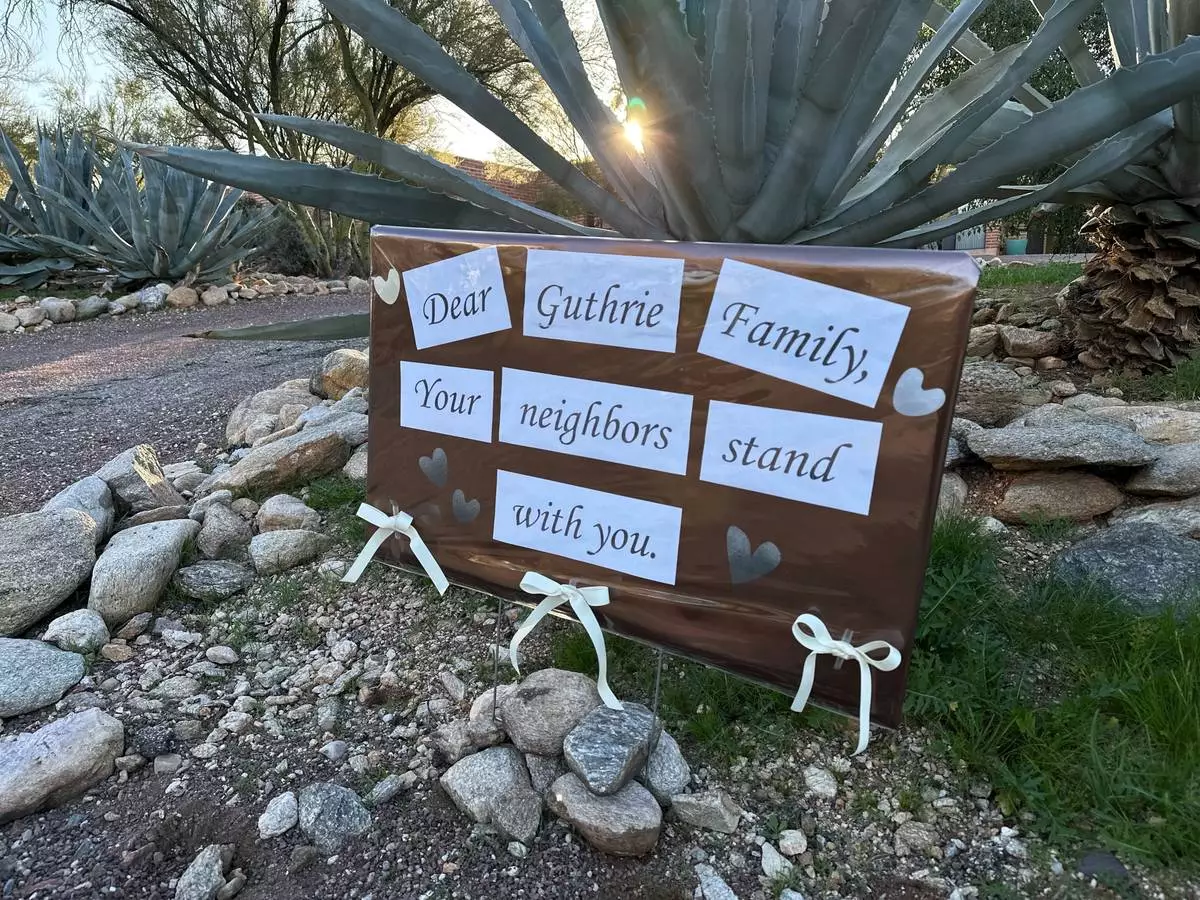
/// Neighbors of Nancy Guthrie, the daughter of "Today" host Savannah Guthrie, show support for the family in metro Tucson, Ariz., on Tuesday, Feb. 3, 2026, as the search continues to find Nancy who was reported missing. (AP Photo/Sejal Govindarao)