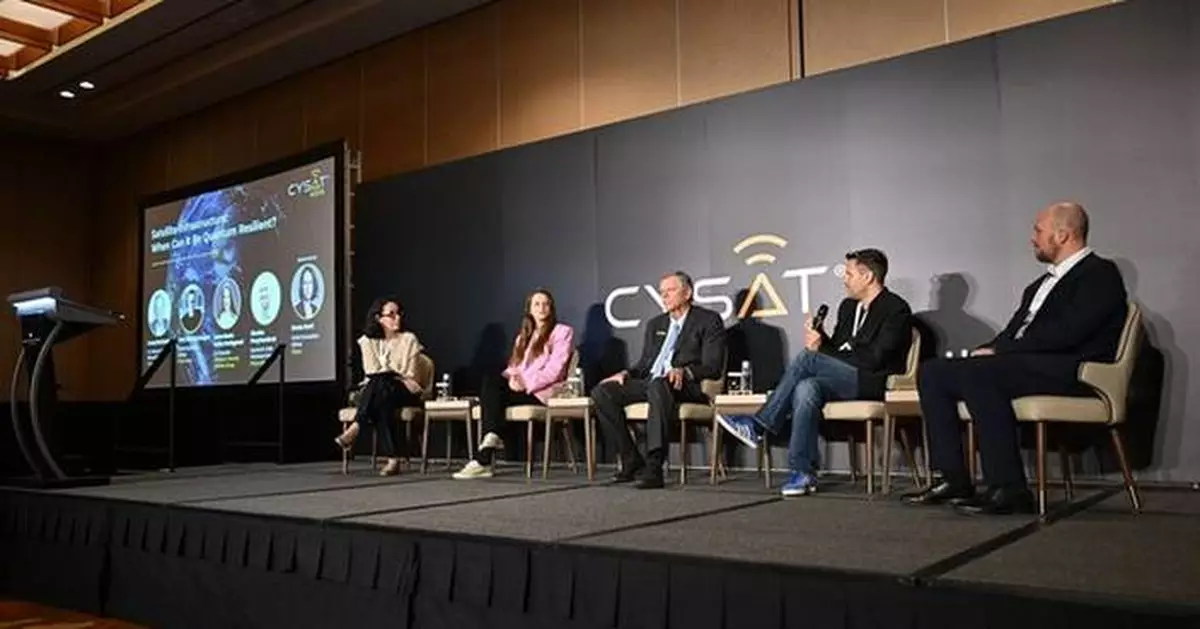
SINGAPORE, Feb. 6, 2026 /PRNewswire/ -- Following the global success of its European and American editions, CYSAT Asia concluded its first-ever regional event in Singapore yesterday. Co-organised by SGInnovate and the European cybersecurity leader CYSEC, the event gathered 400 participants, global experts, government officials, and industry pioneers from 25 European and Asian countries to address the urgent need for resilient space infrastructure.
The event convened leading voices from across the space tech and cybersecurity sectors to discuss the why's and how's of securing space assets, the impact of quantum computing on space cybersecurity, and the need for collaborative partnerships and strong talent pipelines to support this burgeoning industry.
From investors to global corporations, key speakers at the event included representatives from Airbus, the European Commission, Fraunhofer, Institute of Electrical and Electronics Engineering, IonQ, IQT, and Thales, alongside Singaporean Deep Tech startups SpeQtral and MicroSec. Also present were industry stakeholders Infocomm Media Development Authority (IMDA), CyberSG R&D Programme Office (CRPO), and CyberSG Talent, Innovation and Growth (TIG) Collaboration Centre.
"Through CYSAT Asia, we've extended that mission to one of the most consequential intersections in technology today: the confluence of space tech and cybersecurity", said Dr. Lim Jui, CEO, SGInnovate. "We're confident that the insights and connections shared today will catalyse innovation in this area, and lead to the development of more secure space infrastructure across the region."
Exploring the landscape of space cyberthreats, and their impact on critical sectors
Speakers underscored how attacks on space systems now have immediate, real-world consequences, from Global Navigation Satellite System (GNSS) spoofing disrupting thousands of commercial flights annually to cyber vulnerabilities in legacy satellite architectures never designed for today's threat environment. The event affirmed that resilience must be designed end-to-end — across satellites, ground stations, receivers, and the data flows that connect them.
Beyond defence and commercial uses, panellists also emphasised that cybersecurity is now foundational to civil space services, where trust in data integrity and governance underpins safe use for disaster response, climate monitoring, and national planning.
In his address, David Koh, Singapore's Commissioner of Cybersecurity and Chief Executive of the Cyber Security Agency of Singapore mentioned that there are rapid technological advancements accelerating the growth of the space industry, and emphasised that cybersecurity must now be "baked" into the design of these technologies to prevent disruptions with spillover effects across borders. Meanwhile, Jonathan Hung, Executive Director of the Office for Space Technology & Industry, Singapore (OSTIn), Singapore's national space office, emphasised that cyber resilience in space requires close coordination across government, industry, and the broader ecosystem. Strong cyber resilience underpins trust in space-enabled services, and is strengthened through robust multi-agency partnerships here in Singapore.
Highlighting opportunities for growth and collaboration
With the goal of raising awareness around space cybersecurity and laying important groundwork for the establishment of cross-industry collaboration, CYSAT Asia highlighted the critical role of public-private partnerships, international cooperation, and ecosystem-level investment.
Hsien-Hui Tong, Executive Director of Investments at SGInnovate noted that although both space and cybersecurity are established sectors, their intersection remains under-invested, often failing between traditional commercial and sovereign funding models. Progress will depend on coordinated action – from governments acting as early anchor customers, to investors supporting deployment-ready solutions, and ecosystems enabling companies to test, integrate, and scale across borders.
Building a pipeline of space cybersecurity talent
The development of a long-term talent pipeline was also a key theme at the event. Experts likened a robust talent ecosystem to an iceberg: while certifications represent the visible tip, critical thinking and an adaptive mindset will be the critical factors underpinning success. They emphasised the need for a "Swiss Army Knife" skillsets, with multi-disciplinary abilities bridging the gap between IT and operational technology, and called for industry-vetted, hands-on training to prepare professionals for high-stakes environments.
"Space systems today underpin critical national infrastructure, yet they remain a 'ticking cyber bomb' if we do not act collectively." quotes Patrick Trinkler, CEO of CYSEC. "CYSAT Asia 2026 has proven that securing these assets requires a diverse mix of talent — from cryptographers to mission operators — working outside of traditional silos to address the converging commercial, sovereign, and military stakes of 2030. Our goal is to ensure that as the space environment becomes more congested and contested, the integrity of our orbital data remains unassailable."
To further bridge the gap between space tech and cybersecurity, CYSAT Asia hosted a series of technical keynotes and hands-on workshops, equipping industry professionals with knowledge at the intersection of space tech, cybersecurity, AI, and quantum computing. These workshops were part of the CYSAT Academy programme, an initiative designed to provide training and certifications in relevant, high-impact areas. At CYSAT Asia, the Academy ran two workshops:
Looking ahead to CYSAT Asia 2027, SGInnovate and CYSEC will continue to engage local and international ecosystems to bridge the gap between awareness and meaningful action, while building and bringing the community together to achieve true resiliency for space cybersecurity.
Selected keynotes, technical sessions, and the event photo gallery are available for review. For more information and to access on-demand highlights, please visit: www.cysat.eu.
About CYSEC
CYSEC is a European cybersecurity company based in Switzerland and France, with additional locations in Italy and Luxembourg. The company provides world-leading, high-performance cybersecurity tools to ensure robustness, confidentiality, and integrity for the space internet networks & critical infrastructures. Since 2021, CYSEC has also been the organiser of CYSAT, the leading event in space cybersecurity in Europe, bringing together key industry players each year to discuss security challenges and implement solutions.
About SGInnovate
SGInnovate is a Deep Tech ecosystem builder and investor, backed by the Singapore Government. Our expertise and approach combines investments, talent development and community-building to catalyse the translation of emerging technologies into tomorrow's opportunities.
Through our flagship Deep Tech Central platform, we connect individuals, founders and companies to specialised resources and opportunities across all technological domains and stages of growth. Our portfolio of emerging tech startups comprises some of the most promising companies leading the commercialisation of research developed from Singapore's RIE ecosystem.
Connect with us at SGInnovate.com.
** The press release content is from PR Newswire. Bastille Post is not involved in its creation. **
Space Cybersecurity Leaders Convene in Singapore to Address Escalating Threats in Inaugural Edition of CYSAT Asia
|
Announced alongside M Series Smart Assist Module launch on Kickstarter
NEW YORK, April 4, 2026 /PRNewswire/ -- Yarbo, a company focused on intelligent yard robotics, today announced the Yarbo Open Platform, a long-term initiative currently under development and planned for release in early 2027. Designed to expand Yarbo's modular yard robot system across both software and hardware, the platform is intended to support deeper customization, broader smart home connectivity, and new forms of user and developer-driven functionality over time. The announcement coincides with the launch of the Smart Assist Module (SAM) for the M Series on Kickstarter.
The Open Platform is not available today. Instead, it reflects Yarbo's roadmap for how its ecosystem may evolve over time, including a three-layer software architecture built around an Open API, SDK, and no-code Automation Editor, as well as a hardware expansion framework designed to support future user-built and developer-built modules.
A Structured Approach to Software Integration and Automation
The Yarbo Open Platform is structured to accommodate different levels of technical expertise, from everyday users to experienced developers. It is designed to provide multiple entry points into the Yarbo ecosystem, enabling both software-driven automation and hardware-level expansion.
On the software side, the platform consists of three layers:
- Yarbo Open API — intended to enable connectivity between Yarbo devices and external platforms, allowing them to participate in broader home automation scenarios.
- Yarbo SDK — a set of development tools, including code libraries and documentation, designed for developers building custom features or integrations.
- Yarbo Automation Editor — a visual, drag-and-drop interface within the Yarbo app that allows users to create automation workflows without writing code.
Together, these components are intended to make automation accessible to a wide range of users, while also supporting more advanced development use cases.
The platform is also designed to support compatibility with widely used smart home ecosystems, including Home Assistant, Google Home, and Amazon Alexa, enabling users to incorporate Yarbo into existing connected home setups.
Extending Capability Through Hardware
In addition to software capabilities, the Open Platform introduces a hardware expansion approach designed to extend Yarbo's functionality beyond its existing modules.
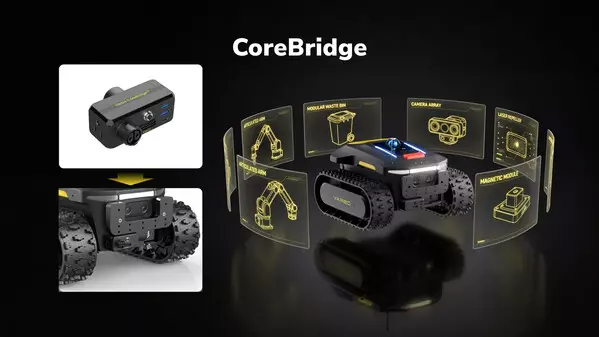
At the center of this is CoreBridge, a standardized hardware interface currently in development that is intended to provide access to Yarbo's mechanical mounting points, power system, and data connections. It is designed to support third-party development and user-built extensions, allowing new types of functionality beyond pre-defined modules.
One example of this extensibility is an electromagnet-based module, which can be attached via CoreBridge to enable Yarbo to latch onto and move objects such as garbage bins. In a potential use scenario, this could enable automated movement of a bin to the curb on collection day and its return afterward.
This combination of software and hardware openness reflects an effort to expand the role of outdoor robotics beyond fixed-function devices.
Smart Assist Module Launch on Kickstarter
Alongside the Open Platform announcement, Yarbo is launching the Smart Assist Module (SAM) for the M Series on Kickstarter.
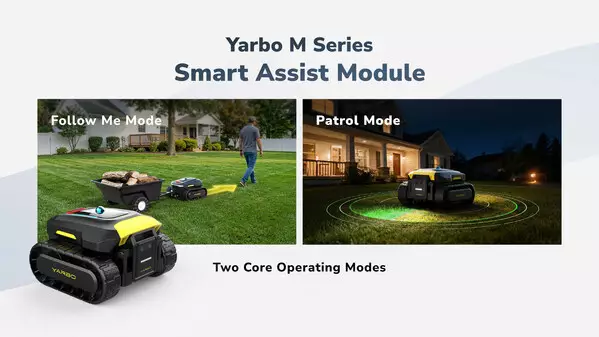
The module introduces two primary features designed to expand how users interact with their yard robot in everyday use:
- Follow Me Mode — enabling Yarbo to move alongside the user while carrying tools or materials, reducing the need for manual transport during yard work.
- Patrol Mode — allowing Yarbo to move along customizable routes around the property, with features such as remote live view, app-based alerts, and optional audio notifications via its built-in speaker, providing an added layer of awareness and convenience for users managing outdoor spaces.
The Smart Assist Module is positioned as part of Yarbo's broader effort to extend the practical use cases of its modular system.
Looking Ahead
The Yarbo Open Platform is planned for release in early 2027 and is being developed to support both the Y Series and M Series. By introducing a framework that combines software integration, developer tools, and hardware extensibility, Yarbo aims to enable a broader range of applications while allowing users to define how the system evolves over time.
Further details will be shared as development progresses.
About Yarbo
Yarbo is defining a new category of outdoor robotics with its Modular Yard Robot. Known for its automated snow blower robots, Yarbo introduced a modular system designed for year-round use. Powered by a single intelligent core unit, the system supports interchangeable modules for mowing, leaf blowing, snow clearing, and more—creating a more efficient approach to outdoor maintenance for homeowners.
Announced alongside M Series Smart Assist Module launch on Kickstarter
NEW YORK, April 4, 2026 /PRNewswire/ -- Yarbo, a company focused on intelligent yard robotics, today announced the Yarbo Open Platform, a long-term initiative currently under development and planned for release in early 2027. Designed to expand Yarbo's modular yard robot system across both software and hardware, the platform is intended to support deeper customization, broader smart home connectivity, and new forms of user and developer-driven functionality over time. The announcement coincides with the launch of the Smart Assist Module (SAM) for the M Series on Kickstarter.
The Open Platform is not available today. Instead, it reflects Yarbo's roadmap for how its ecosystem may evolve over time, including a three-layer software architecture built around an Open API, SDK, and no-code Automation Editor, as well as a hardware expansion framework designed to support future user-built and developer-built modules.
A Structured Approach to Software Integration and Automation
The Yarbo Open Platform is structured to accommodate different levels of technical expertise, from everyday users to experienced developers. It is designed to provide multiple entry points into the Yarbo ecosystem, enabling both software-driven automation and hardware-level expansion.
On the software side, the platform consists of three layers:
- Yarbo Open API — intended to enable connectivity between Yarbo devices and external platforms, allowing them to participate in broader home automation scenarios.
- Yarbo SDK — a set of development tools, including code libraries and documentation, designed for developers building custom features or integrations.
- Yarbo Automation Editor — a visual, drag-and-drop interface within the Yarbo app that allows users to create automation workflows without writing code.
Together, these components are intended to make automation accessible to a wide range of users, while also supporting more advanced development use cases.
The platform is also designed to support compatibility with widely used smart home ecosystems, including Home Assistant, Google Home, and Amazon Alexa, enabling users to incorporate Yarbo into existing connected home setups.
Extending Capability Through Hardware
In addition to software capabilities, the Open Platform introduces a hardware expansion approach designed to extend Yarbo's functionality beyond its existing modules.
At the center of this is CoreBridge, a standardized hardware interface currently in development that is intended to provide access to Yarbo's mechanical mounting points, power system, and data connections. It is designed to support third-party development and user-built extensions, allowing new types of functionality beyond pre-defined modules.
One example of this extensibility is an electromagnet-based module, which can be attached via CoreBridge to enable Yarbo to latch onto and move objects such as garbage bins. In a potential use scenario, this could enable automated movement of a bin to the curb on collection day and its return afterward.
This combination of software and hardware openness reflects an effort to expand the role of outdoor robotics beyond fixed-function devices.
Smart Assist Module Launch on Kickstarter
Alongside the Open Platform announcement, Yarbo is launching the Smart Assist Module (SAM) for the M Series on Kickstarter.
The module introduces two primary features designed to expand how users interact with their yard robot in everyday use:
- Follow Me Mode — enabling Yarbo to move alongside the user while carrying tools or materials, reducing the need for manual transport during yard work.
- Patrol Mode — allowing Yarbo to move along customizable routes around the property, with features such as remote live view, app-based alerts, and optional audio notifications via its built-in speaker, providing an added layer of awareness and convenience for users managing outdoor spaces.
The Smart Assist Module is positioned as part of Yarbo's broader effort to extend the practical use cases of its modular system.
Looking Ahead
The Yarbo Open Platform is planned for release in early 2027 and is being developed to support both the Y Series and M Series. By introducing a framework that combines software integration, developer tools, and hardware extensibility, Yarbo aims to enable a broader range of applications while allowing users to define how the system evolves over time.
Further details will be shared as development progresses.
About Yarbo
Yarbo is defining a new category of outdoor robotics with its Modular Yard Robot. Known for its automated snow blower robots, Yarbo introduced a modular system designed for year-round use. Powered by a single intelligent core unit, the system supports interchangeable modules for mowing, leaf blowing, snow clearing, and more—creating a more efficient approach to outdoor maintenance for homeowners.
** This press release is distributed by PR Newswire through automated distribution system, for which the client assumes full responsibility. **
Yarbo Introduces Open Platform Strategy, Opening Its Robotics System to Developers and Smart Home Ecosystems
Yarbo Introduces Open Platform Strategy, Opening Its Robotics System to Developers and Smart Home Ecosystems