|
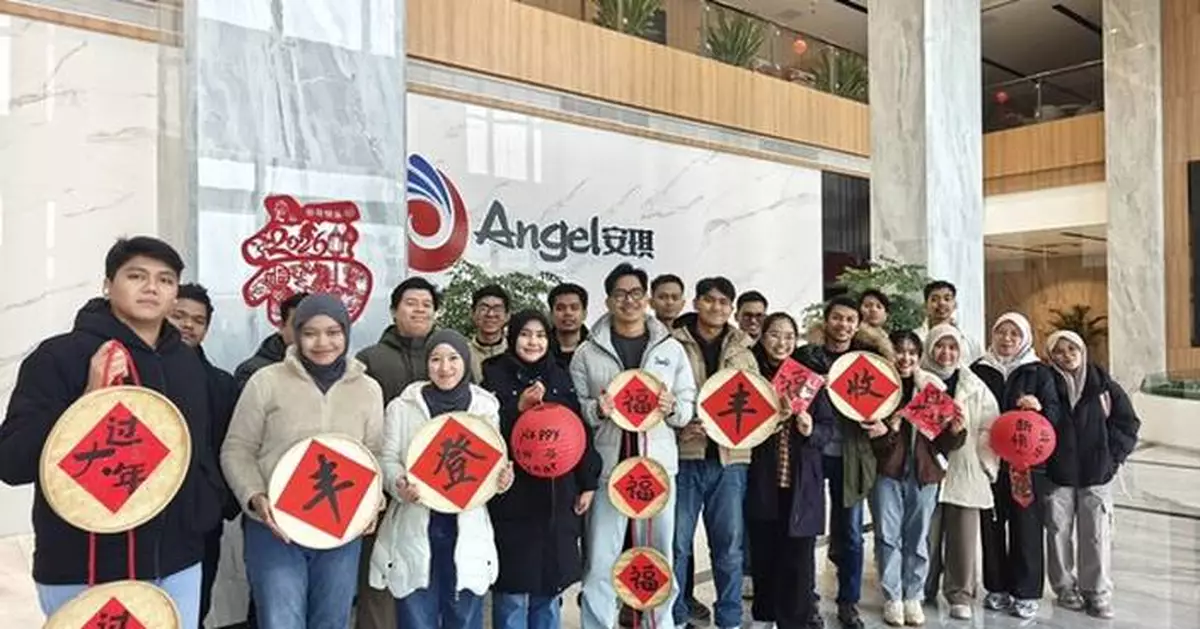
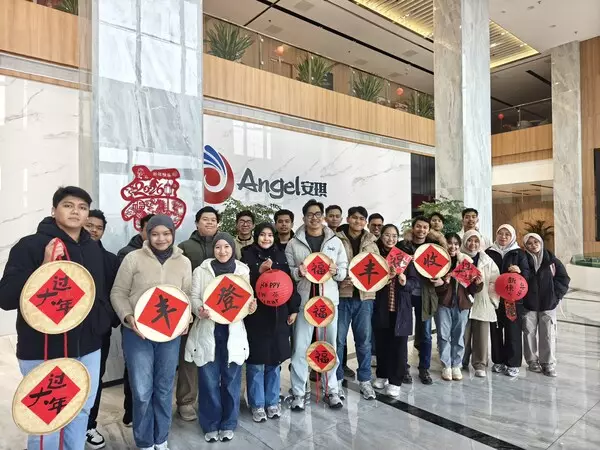
YICHANG, China, Feb. 6, 2026 /PRNewswire/ -- Angel Yeast Group (SH600298) recently welcomed 29 employees from Indonesia to its headquarters in Yichang, China, for a six-month structured training program. The initiative is designed to develop a cohort of skilled professionals to support the commissioning and operations of Angel's Indonesia facility. As the Chinese Lunar New Year approaches, these young Indonesian trainees are not only learning yeast production techniques but are also gaining firsthand exposure to Spring Festival traditions.
In preparation for the holiday, Angel's Yichang facility has been decorated to mark the Spring Festival. As they stroll through the city, trainees see shopping malls bustling with people buying holiday goods, while traditional folk melodies fill the parks. Aqil, one of the participants, said, "Everyone here is preparing for the celebrations. Amid all the festive excitement, I can truly feel the energy and richness of the culture." Before joining Angel, Aqil worked at a local technology company. Like many young professionals, he was attracted to companies with a strong international presence. This customized training program is designed to help him transition into his new role, enhance his technical skills, and strengthen cross-cultural collaboration and teamwork. The multinational program officially began on November 26 last year at China Three Gorges University and consists of 20 days of classroom instruction followed by five months of hands-on operational training.
The Angel Indonesia project represents a key milestone in the company's international expansion. As an integral part of its global growth strategy, the project is expected to help build local industry capabilities, create job opportunities, and strengthen linkages across the broader value chain. The training program aims to encourage participants to adapt proactively to the new environment, engage in meaningful cultural exchange, and develop a solid mastery of both theoretical knowledge and practical skills, laying a strong foundation for the future plant's safe, stable, and reliable operations.
Setting up a subsidiary in Indonesia will allow Angel to take advantage of local resources, the strategic location, and tariff advantages, accelerating its expansion into neighboring Asian markets. The project, launched in 2025 in south-central Lampung Province, is located next to the joint venture partner's sugarcane mill. The site is currently under development, with completion and commissioning scheduled for 2027. The project includes a yeast production line with an annual capacity of 20,000 tons, supported by a wastewater treatment facility capable of processing 3,500 tons per day, as well as an organic fertilizer project designed to reduce waste and improve resource efficiency, with an annual output of 20,000 tons. Angel Yeast Indonesia will source large quantities of locally produced molasses, converting by-products into usable inputs while promoting cleaner production practices. Wastewater from yeast production will be treated and converted into organic fertilizer, and fine yeast by-products will be sold as animal feed, supporting local agriculture and livestock farming, while serving as a practical example of circular economy principles.
The Angel Yeast Indonesia plant is a key part of the company's global manufacturing network. For Angel, global operations extend beyond expanding production capacity; they focus on supporting the local yeast industry through technology transfer and workforce development, while contributing to growth across related value chains and creating employment opportunities. These young trainees are being prepared to become the core team of the Indonesia facility, playing an important role in enabling global operations, industrial collaboration, and cross-cultural engagement.
YICHANG, China, Feb. 6, 2026 /PRNewswire/ -- Angel Yeast Group (SH600298) recently welcomed 29 employees from Indonesia to its headquarters in Yichang, China, for a six-month structured training program. The initiative is designed to develop a cohort of skilled professionals to support the commissioning and operations of Angel's Indonesia facility. As the Chinese Lunar New Year approaches, these young Indonesian trainees are not only learning yeast production techniques but are also gaining firsthand exposure to Spring Festival traditions.
In preparation for the holiday, Angel's Yichang facility has been decorated to mark the Spring Festival. As they stroll through the city, trainees see shopping malls bustling with people buying holiday goods, while traditional folk melodies fill the parks. Aqil, one of the participants, said, "Everyone here is preparing for the celebrations. Amid all the festive excitement, I can truly feel the energy and richness of the culture." Before joining Angel, Aqil worked at a local technology company. Like many young professionals, he was attracted to companies with a strong international presence. This customized training program is designed to help him transition into his new role, enhance his technical skills, and strengthen cross-cultural collaboration and teamwork. The multinational program officially began on November 26 last year at China Three Gorges University and consists of 20 days of classroom instruction followed by five months of hands-on operational training.
The Angel Indonesia project represents a key milestone in the company's international expansion. As an integral part of its global growth strategy, the project is expected to help build local industry capabilities, create job opportunities, and strengthen linkages across the broader value chain. The training program aims to encourage participants to adapt proactively to the new environment, engage in meaningful cultural exchange, and develop a solid mastery of both theoretical knowledge and practical skills, laying a strong foundation for the future plant's safe, stable, and reliable operations.
Setting up a subsidiary in Indonesia will allow Angel to take advantage of local resources, the strategic location, and tariff advantages, accelerating its expansion into neighboring Asian markets. The project, launched in 2025 in south-central Lampung Province, is located next to the joint venture partner's sugarcane mill. The site is currently under development, with completion and commissioning scheduled for 2027. The project includes a yeast production line with an annual capacity of 20,000 tons, supported by a wastewater treatment facility capable of processing 3,500 tons per day, as well as an organic fertilizer project designed to reduce waste and improve resource efficiency, with an annual output of 20,000 tons. Angel Yeast Indonesia will source large quantities of locally produced molasses, converting by-products into usable inputs while promoting cleaner production practices. Wastewater from yeast production will be treated and converted into organic fertilizer, and fine yeast by-products will be sold as animal feed, supporting local agriculture and livestock farming, while serving as a practical example of circular economy principles.
The Angel Yeast Indonesia plant is a key part of the company's global manufacturing network. For Angel, global operations extend beyond expanding production capacity; they focus on supporting the local yeast industry through technology transfer and workforce development, while contributing to growth across related value chains and creating employment opportunities. These young trainees are being prepared to become the core team of the Indonesia facility, playing an important role in enabling global operations, industrial collaboration, and cross-cultural engagement.
** The press release content is from PR Newswire. Bastille Post is not involved in its creation. **
Angel Yeast Indonesia Project: Strengthening Foundations through Technical Training and Building Consensus through Cultural Exchange
|
Announced alongside M Series Smart Assist Module launch on Kickstarter
NEW YORK, April 4, 2026 /PRNewswire/ -- Yarbo, a company focused on intelligent yard robotics, today announced the Yarbo Open Platform, a long-term initiative currently under development and planned for release in early 2027. Designed to expand Yarbo's modular yard robot system across both software and hardware, the platform is intended to support deeper customization, broader smart home connectivity, and new forms of user and developer-driven functionality over time. The announcement coincides with the launch of the Smart Assist Module (SAM) for the M Series on Kickstarter.
The Open Platform is not available today. Instead, it reflects Yarbo's roadmap for how its ecosystem may evolve over time, including a three-layer software architecture built around an Open API, SDK, and no-code Automation Editor, as well as a hardware expansion framework designed to support future user-built and developer-built modules.
A Structured Approach to Software Integration and Automation
The Yarbo Open Platform is structured to accommodate different levels of technical expertise, from everyday users to experienced developers. It is designed to provide multiple entry points into the Yarbo ecosystem, enabling both software-driven automation and hardware-level expansion.
On the software side, the platform consists of three layers:
- Yarbo Open API — intended to enable connectivity between Yarbo devices and external platforms, allowing them to participate in broader home automation scenarios.
- Yarbo SDK — a set of development tools, including code libraries and documentation, designed for developers building custom features or integrations.
- Yarbo Automation Editor — a visual, drag-and-drop interface within the Yarbo app that allows users to create automation workflows without writing code.
Together, these components are intended to make automation accessible to a wide range of users, while also supporting more advanced development use cases.
The platform is also designed to support compatibility with widely used smart home ecosystems, including Home Assistant, Google Home, and Amazon Alexa, enabling users to incorporate Yarbo into existing connected home setups.
Extending Capability Through Hardware
In addition to software capabilities, the Open Platform introduces a hardware expansion approach designed to extend Yarbo's functionality beyond its existing modules.
At the center of this is CoreBridge, a standardized hardware interface currently in development that is intended to provide access to Yarbo's mechanical mounting points, power system, and data connections. It is designed to support third-party development and user-built extensions, allowing new types of functionality beyond pre-defined modules.
One example of this extensibility is an electromagnet-based module, which can be attached via CoreBridge to enable Yarbo to latch onto and move objects such as garbage bins. In a potential use scenario, this could enable automated movement of a bin to the curb on collection day and its return afterward.
This combination of software and hardware openness reflects an effort to expand the role of outdoor robotics beyond fixed-function devices.
Smart Assist Module Launch on Kickstarter
Alongside the Open Platform announcement, Yarbo is launching the Smart Assist Module (SAM) for the M Series on Kickstarter.
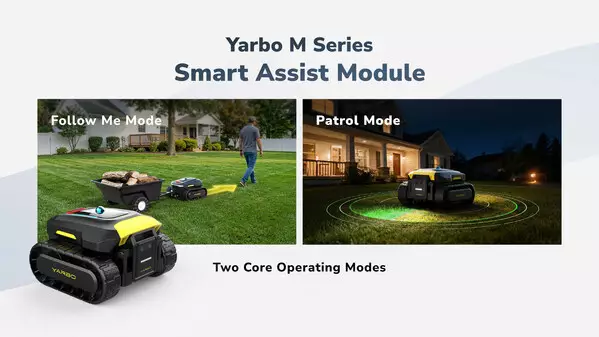
The module introduces two primary features designed to expand how users interact with their yard robot in everyday use:
- Follow Me Mode — enabling Yarbo to move alongside the user while carrying tools or materials, reducing the need for manual transport during yard work.
- Patrol Mode — allowing Yarbo to move along customizable routes around the property, with features such as remote live view, app-based alerts, and optional audio notifications via its built-in speaker, providing an added layer of awareness and convenience for users managing outdoor spaces.
The Smart Assist Module is positioned as part of Yarbo's broader effort to extend the practical use cases of its modular system.
Looking Ahead
The Yarbo Open Platform is planned for release in early 2027 and is being developed to support both the Y Series and M Series. By introducing a framework that combines software integration, developer tools, and hardware extensibility, Yarbo aims to enable a broader range of applications while allowing users to define how the system evolves over time.
Further details will be shared as development progresses.
About Yarbo
Yarbo is defining a new category of outdoor robotics with its Modular Yard Robot. Known for its automated snow blower robots, Yarbo introduced a modular system designed for year-round use. Powered by a single intelligent core unit, the system supports interchangeable modules for mowing, leaf blowing, snow clearing, and more—creating a more efficient approach to outdoor maintenance for homeowners.
Announced alongside M Series Smart Assist Module launch on Kickstarter
NEW YORK, April 4, 2026 /PRNewswire/ -- Yarbo, a company focused on intelligent yard robotics, today announced the Yarbo Open Platform, a long-term initiative currently under development and planned for release in early 2027. Designed to expand Yarbo's modular yard robot system across both software and hardware, the platform is intended to support deeper customization, broader smart home connectivity, and new forms of user and developer-driven functionality over time. The announcement coincides with the launch of the Smart Assist Module (SAM) for the M Series on Kickstarter.
The Open Platform is not available today. Instead, it reflects Yarbo's roadmap for how its ecosystem may evolve over time, including a three-layer software architecture built around an Open API, SDK, and no-code Automation Editor, as well as a hardware expansion framework designed to support future user-built and developer-built modules.
A Structured Approach to Software Integration and Automation
The Yarbo Open Platform is structured to accommodate different levels of technical expertise, from everyday users to experienced developers. It is designed to provide multiple entry points into the Yarbo ecosystem, enabling both software-driven automation and hardware-level expansion.
On the software side, the platform consists of three layers:
- Yarbo Open API — intended to enable connectivity between Yarbo devices and external platforms, allowing them to participate in broader home automation scenarios.
- Yarbo SDK — a set of development tools, including code libraries and documentation, designed for developers building custom features or integrations.
- Yarbo Automation Editor — a visual, drag-and-drop interface within the Yarbo app that allows users to create automation workflows without writing code.
Together, these components are intended to make automation accessible to a wide range of users, while also supporting more advanced development use cases.
The platform is also designed to support compatibility with widely used smart home ecosystems, including Home Assistant, Google Home, and Amazon Alexa, enabling users to incorporate Yarbo into existing connected home setups.
Extending Capability Through Hardware
In addition to software capabilities, the Open Platform introduces a hardware expansion approach designed to extend Yarbo's functionality beyond its existing modules.
At the center of this is CoreBridge, a standardized hardware interface currently in development that is intended to provide access to Yarbo's mechanical mounting points, power system, and data connections. It is designed to support third-party development and user-built extensions, allowing new types of functionality beyond pre-defined modules.
One example of this extensibility is an electromagnet-based module, which can be attached via CoreBridge to enable Yarbo to latch onto and move objects such as garbage bins. In a potential use scenario, this could enable automated movement of a bin to the curb on collection day and its return afterward.
This combination of software and hardware openness reflects an effort to expand the role of outdoor robotics beyond fixed-function devices.
Smart Assist Module Launch on Kickstarter
Alongside the Open Platform announcement, Yarbo is launching the Smart Assist Module (SAM) for the M Series on Kickstarter.
The module introduces two primary features designed to expand how users interact with their yard robot in everyday use:
- Follow Me Mode — enabling Yarbo to move alongside the user while carrying tools or materials, reducing the need for manual transport during yard work.
- Patrol Mode — allowing Yarbo to move along customizable routes around the property, with features such as remote live view, app-based alerts, and optional audio notifications via its built-in speaker, providing an added layer of awareness and convenience for users managing outdoor spaces.
The Smart Assist Module is positioned as part of Yarbo's broader effort to extend the practical use cases of its modular system.
Looking Ahead
The Yarbo Open Platform is planned for release in early 2027 and is being developed to support both the Y Series and M Series. By introducing a framework that combines software integration, developer tools, and hardware extensibility, Yarbo aims to enable a broader range of applications while allowing users to define how the system evolves over time.
Further details will be shared as development progresses.
About Yarbo
Yarbo is defining a new category of outdoor robotics with its Modular Yard Robot. Known for its automated snow blower robots, Yarbo introduced a modular system designed for year-round use. Powered by a single intelligent core unit, the system supports interchangeable modules for mowing, leaf blowing, snow clearing, and more—creating a more efficient approach to outdoor maintenance for homeowners.
** This press release is distributed by PR Newswire through automated distribution system, for which the client assumes full responsibility. **
Yarbo Introduces Open Platform Strategy, Opening Its Robotics System to Developers and Smart Home Ecosystems

Yarbo Introduces Open Platform Strategy, Opening Its Robotics System to Developers and Smart Home Ecosystems