CORTINA D'AMPEZZO, Italy (AP) — Before U.S. skier Lindsey Vonn's devastating crash on Sunday while racing on a badly injured left knee, Iran's Alpine women's skiing coach shared words of admiration for the American.
“She's my superhero,” Mitra Kalhor told The Associated Press in the Cortina Olympic and Paralympic Village on Thursday.
Click to Gallery

United States' bobsledders Frank Del Duca, left and Boone Niederhofer speak with De Aundre John, right, a bobsledder from Trinidad and Tobago after trading their unique national team pins, at the Cortina Olympic Village, during the 2026 Winter Olympics, in Cortina d'Ampezzo, Italy, Tuesday, Feb. 3, 2026. (AP Photo/Jennifer McDermott)
Italian luge athlete Leon Felderer poses for a photo with Italy's national pin, at the Cortina Olympic Village, during the 2026 Winter Olympics, in Cortina d'Ampezzo, Italy, Thursday Feb. 5, 2026. (AP Photo/Jennifer McDermott)
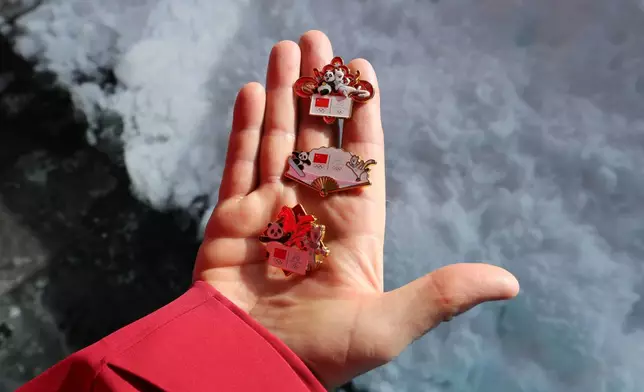
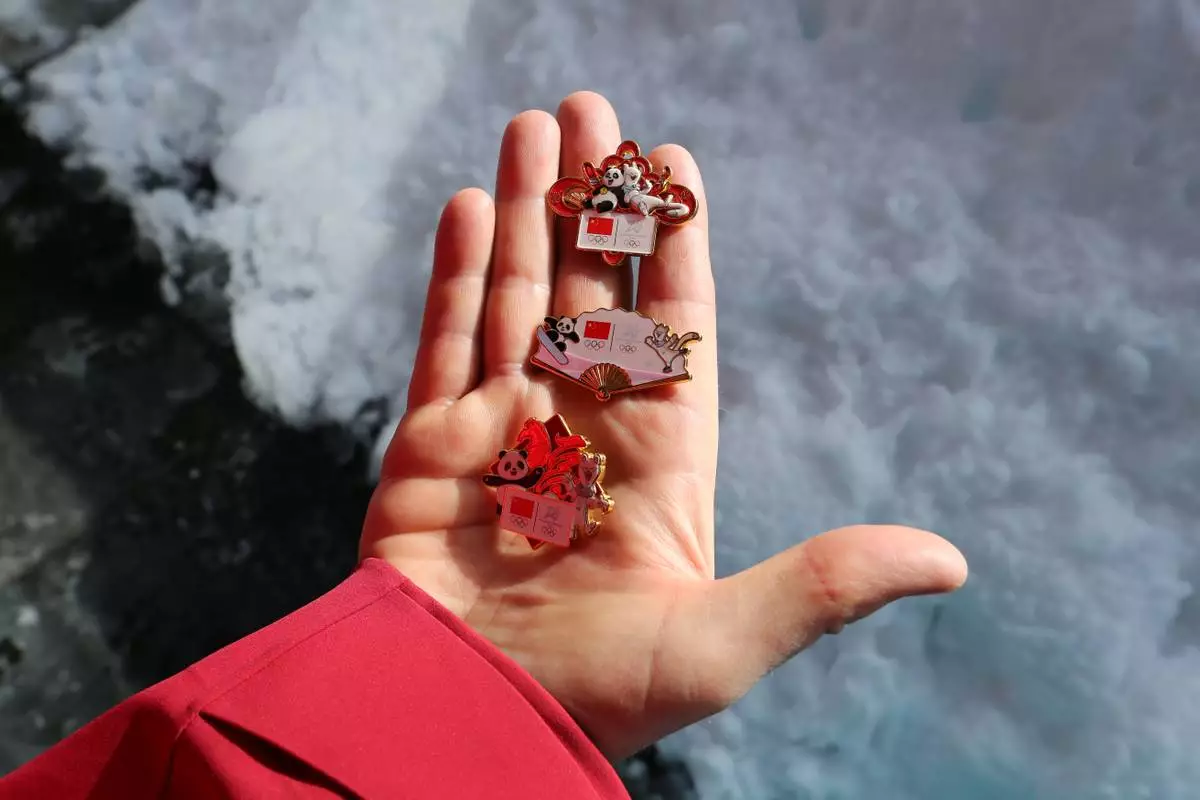
Patrick Shannon, a coach for the Chinese skeleton team, displays China's three pin designs at the Milan Cortina Olympic Village, during the 2026 Winter Olympics, in Cortina d'Ampezzo, Italy, Thursday Feb. 5, 2026. (AP Photo/Jennifer McDermott)
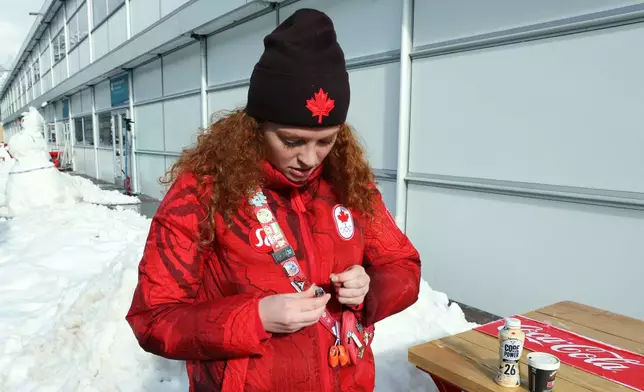
Kailey Allan, who is competing for Canada in the inaugural women's doubles luge looks at her favorite pins, at the Cortina Olympic Village, during the 2026 Winter Olympics, in Cortina d'Ampezzo, Italy, Thursday Feb. 5, 2026. (AP Photo/Jennifer McDermott)

United States' bobsledders Frank Del Duca, left and Boone Niederhofer speak with De Aundre John, right, a bobsledder from Trinidad and Tobago after trading their unique national team pins, at the Cortina Olympic Village, during the 2026 Winter Olympics, in Cortina d'Ampezzo, Italy, Tuesday, Feb. 3, 2026. (AP Photo/Jennifer McDermott)
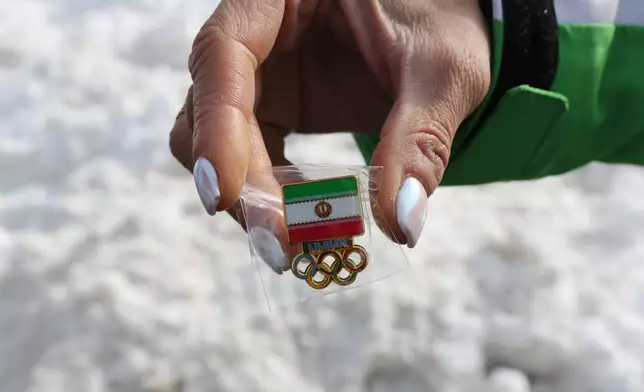
Iran's coach for Alpine women's skiing, Mitra Kalhor displays Iran's national pin for the 2026 Winter Olympics at the Cortina Olympic Village, in Cortina d'Ampezzo, Italy, Thursday Feb. 5, 2026. (AP Photo/Jennifer McDermott)

Iran's coach for Alpine women's skiing, Mitra Kalhor poses for a photo at the Cortina Olympic Village, during the 2026 Winter Olympics, in Cortina d'Ampezzo, Italy, Thursday Feb. 5, 2026. (AP Photo/Jennifer McDermott)
The Olympic Games are a place of camaraderie, where bitterness between governments like the U.S. and Iran is often of little relevance. That conviviality is likewise shown by athletes trading national team pins, a popular and beloved Olympic tradition.
“I would love to get a pin from Lindsey Vonn,” Kalhor said, noting that she met the three-time Olympic medalist previously at the world championships.
Kalhor said Sunday that her heart broke when Vonn crashed, and called her “super strong.” Vonn broke her leg, according to a statement from the hospital treating her.
Pin trading dates back to the first modern Olympic Games, revived by Pierre de Coubertin in 1896. Athletes are proudly wearing lanyards displaying pins from other teams and show them off on social media.
At the top of Cortina’s Olympia delle Tofane course, where Vonn raced in the women’s downhill on Sunday, skiers on Friday swapped pins while fog delayed their training runs.
Just as Kalhor would love a pin from Vonn, many have been coveting Kalhor’s Iran pins; she started with about 30, and by Thursday was almost out. Iranians are scarce — their team has just four athletes, only one in Cortina.
Kalhor said that she has been shocked that everyone is hunting for a pin from a nation that has never won a Winter Games medal.
“All the countries came to us — ‘It is possible to change the pins’? For me, it was really interesting because I never thought somebody would like to get it, or somebody would change the pin with my flag, but it was very nice,” she said. “The people were so excited.”
On Tuesday, American bobsledder Boone Niederhofer set out on a mission to find Iranian skier Sadaf Savehshemshaki. Niederhofer told the AP that he was specifically seeking the Iranian pin because of its rarity.
“It’s a way to interact with people who you might not otherwise,” Niederhofer said while walking through the athletes' village.
But he didn't locate Savehshemshaki. And, as of Sunday morning, he still hadn't found an Iranian to trade with.
There are other prized pins in Cortina, and the athletes' village is the hub for their exchange. China’s are admired for their beauty and variety; the team brought three designs showing a Chinese panda with the Olympic mascot Tina. A Netherlands pin featuring tiny clogs is esteemed for its uniqueness. Many athletes sought pins from countries with small delegations, like the Philippines.
Even before the Games officially began, Kailey Allan’s crossbody bag was covered in pins. She is competing for Canada in the inaugural women’s doubles luge at the Olympics, and her team pin shows a moose on a luge sled.
It’s easy to do, she said. First, she introduces herself. They talk about their sports and journeys to the Olympics, then make the trade.
Pin-swapping isn’t just for athletes and coaches, either; Olympic staff, volunteers, journalists and collectors get in on the craze, asking those they meet, “Do you have a pin for me?”
American luge athlete Sophia Kirkby posted videos on social media from a pottery studio before the Olympics, as she made hundreds of pins herself. Hers highlight women in sport with athletes in ponytails.
“Everyone wants a pin and it’s crazy how it’s a currency here,” she said during a news conference Friday. “I feel like the pin trading queen because essentially what I did was, I came to the Olympics and I brought my own currency.”
On Thursday, the AP spotted Iran's Kalhor at an outdoor coffee stand, a popular gathering spot in the athletes' village. As a former athlete turned coach, Kalhor didn't discuss politics. She spoke only about her love of Vonn and the pin trading tradition.
Walking back to her room, she was stopped by an Italian security guard who wanted a pin. It was her very last one, but she gave it to him all the same, even though he didn't have any to trade.
She said she was “super happy” that all her pins were gone so early in the Games; it showed that everyone loved them.
AP Winter Olympics coverage: https://apnews.com/hub/milan-cortina-2026-winter-olympics
The Associated Press’ climate and environmental coverage receives financial support from multiple private foundations. AP is solely responsible for all content. Find AP’s standards for working with philanthropies, a list of supporters and funded coverage areas at AP.org.

Italian luge athlete Leon Felderer poses for a photo with Italy's national pin, at the Cortina Olympic Village, during the 2026 Winter Olympics, in Cortina d'Ampezzo, Italy, Thursday Feb. 5, 2026. (AP Photo/Jennifer McDermott)
Patrick Shannon, a coach for the Chinese skeleton team, displays China's three pin designs at the Milan Cortina Olympic Village, during the 2026 Winter Olympics, in Cortina d'Ampezzo, Italy, Thursday Feb. 5, 2026. (AP Photo/Jennifer McDermott)
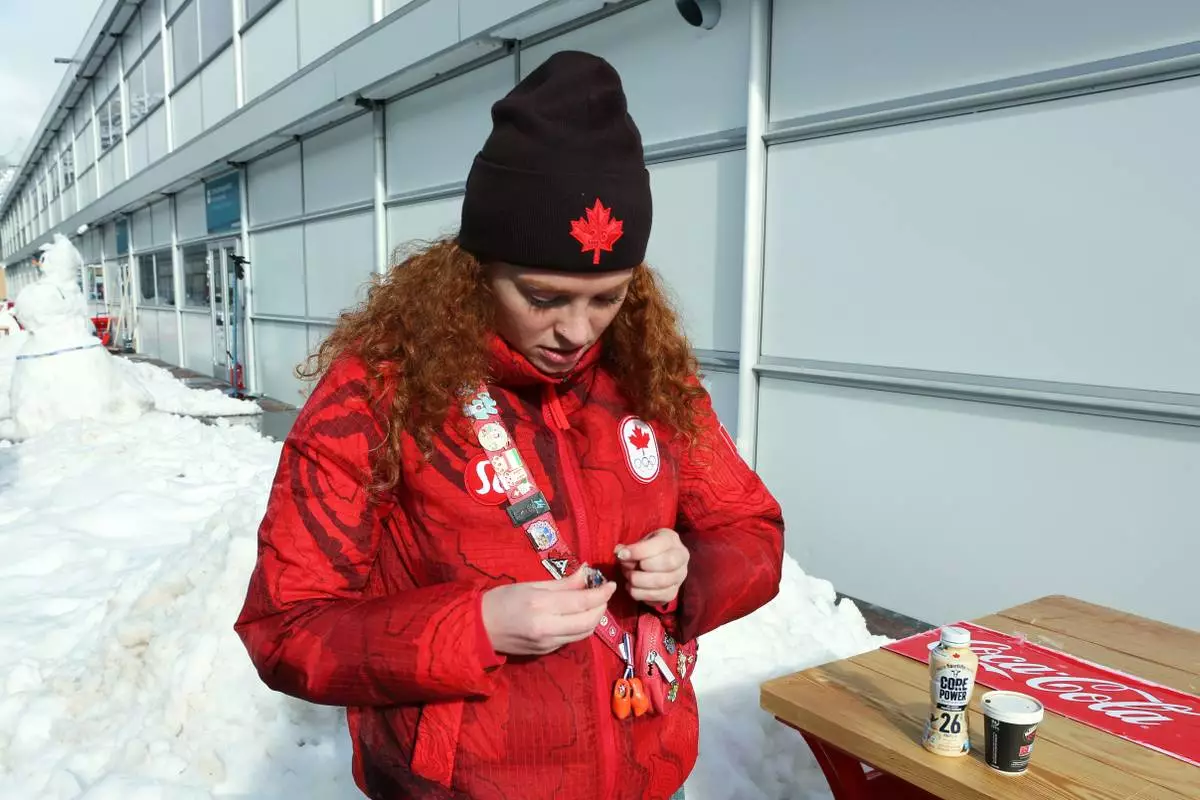
Kailey Allan, who is competing for Canada in the inaugural women's doubles luge looks at her favorite pins, at the Cortina Olympic Village, during the 2026 Winter Olympics, in Cortina d'Ampezzo, Italy, Thursday Feb. 5, 2026. (AP Photo/Jennifer McDermott)

United States' bobsledders Frank Del Duca, left and Boone Niederhofer speak with De Aundre John, right, a bobsledder from Trinidad and Tobago after trading their unique national team pins, at the Cortina Olympic Village, during the 2026 Winter Olympics, in Cortina d'Ampezzo, Italy, Tuesday, Feb. 3, 2026. (AP Photo/Jennifer McDermott)
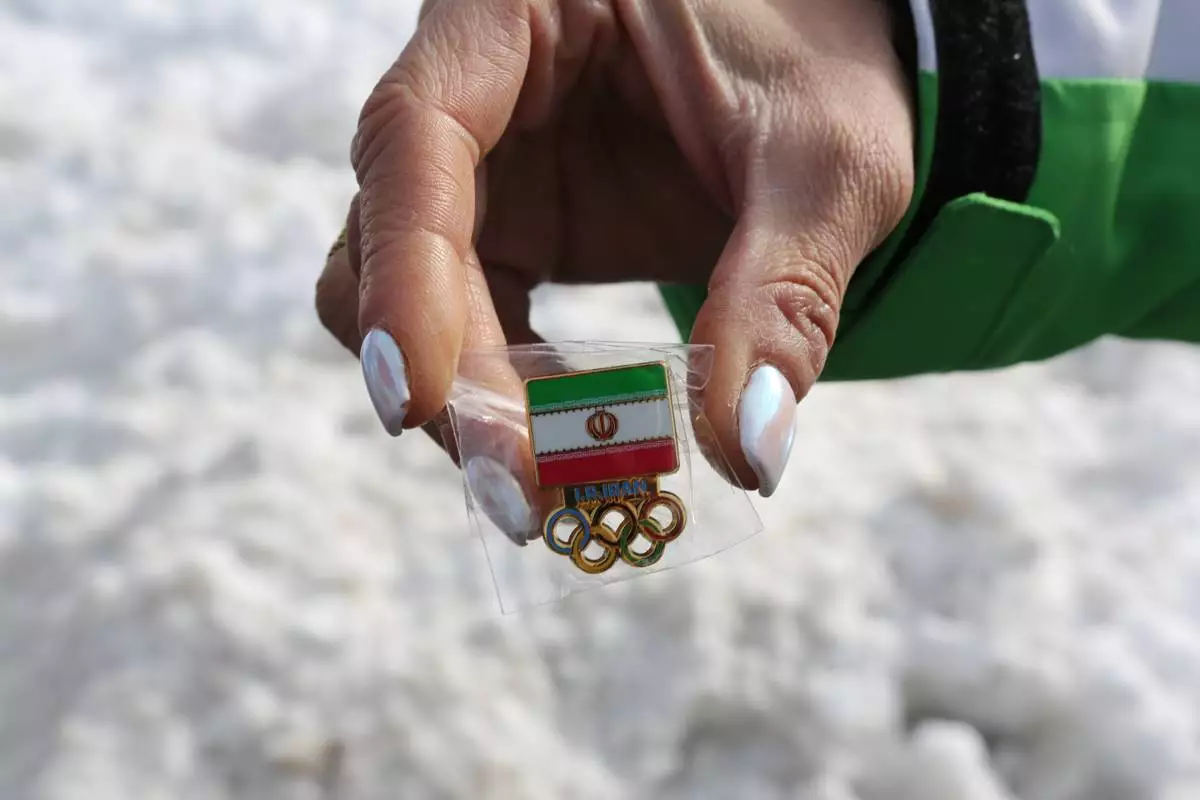
Iran's coach for Alpine women's skiing, Mitra Kalhor displays Iran's national pin for the 2026 Winter Olympics at the Cortina Olympic Village, in Cortina d'Ampezzo, Italy, Thursday Feb. 5, 2026. (AP Photo/Jennifer McDermott)

Iran's coach for Alpine women's skiing, Mitra Kalhor poses for a photo at the Cortina Olympic Village, during the 2026 Winter Olympics, in Cortina d'Ampezzo, Italy, Thursday Feb. 5, 2026. (AP Photo/Jennifer McDermott)

TOKYO (AP) — The governing party of Prime Minister Sanae Takaichi secured a two-thirds supermajority in a key parliamentary election Sunday, Japanese media reported citing preliminary results, earning a landslide victory thanks to her popularity.
Takaichi, in a televised interview with public television network NHK following her sweeping victory, said she is now ready to pursue policies to make Japan strong and prosperous.
NHK, citing results of vote counts, said Takaichi’s Liberal Democratic Party, or LDP, alone secured 316 seats by early Monday, comfortably surpassing a 261-seat absolute majority in the 465-member lower house, the more powerful of Japan's two-chamber parliament. That marks a record since the party's foundation in 1955 and surpasses the previous record of 300 seats won in 1986 by late Prime Minister Yasuhiro Nakasone.
A smiling Takaichi placed a big red ribbon above each winner’s name on a signboard at the LDP's headquarters, as accompanying party executives applauded.
Despite the lack of a majority in the other chamber, the upper house, the huge jump from the preelection share in the superior lower house would allow Takaichi to make progress on a right-wing agenda that aims to boost Japan’s economy and military capabilities as tensions grow with China and she tries to nurture ties with the United States.
Takaichi said she would try to gain support from the opposition while firmly pushing forward her policy goals.
“I will be flexible,” she said.
Takaichi is hugely popular, but the governing LDP, which has ruled Japan for most of the last seven decades, has struggled with funding and religious scandals in recent years. She called Sunday’s early election only after three months in office, hoping to turn that around while her popularity is high.
The ultraconservative Takaichi, who took office as Japan’s first female leader in October, pledged to “work, work, work,” and her style, which is seen as both playful and tough, has resonated with younger fans who say they weren't previously interested in politics.
The opposition, despite the formation of a new centrist alliance and a rising far-right, was too splintered to be a real challenger. The new opposition alliance of LDP’s former coalition partner, Buddhist-backed dovish Komeito, and the liberal-leaning Constitutional Democratic Party of Japan, is projected to sink to half of their combined preelection share of 167 seats.
Takaichi was betting with this election that her LDP party, together with its new partner, the Japan Innovation Party, would secure a majority.
Akihito Iwatake, a 53-year-old office worker, said he welcomed the big win by the LDP because he felt the party went too liberal in the past few years. “With Takaichi shifting things more toward the conservative side, I think that brought this positive result,” he said.
The prime minister wants to push forward a significant shift to the right in Japan’s security, immigration and other policies. The LDP's right-wing partner, JIP leader Hirofumi Yoshimura, has said his party will serve as an “accelerator” for this push.
Japan has recently seen far-right populists gain ground, such as the anti-globalist and surging nationalist party Sanseito. Exit polls projected a big gain for Sanseito.
The first major task for Takaichi when the lower house reconvenes in mid-February is to work on a budget bill, delayed by the election, to fund economic measures that address rising costs and sluggish wages.
Takaichi has pledged to revise security and defense policies by December to bolster Japan’s offensive military capabilities, lifting a ban on weapons exports and moving further away from the country’s postwar pacifist principles.
She has been pushing for tougher policies on foreigners, anti-espionage and other measures that resonate with a far-right audience, but ones that experts say could undermine civil rights.
Takaichi also wants to increase defense spending in response to U.S. President Donald Trump’s pressure for Japan to loosen its purse strings.
She now has time to work on these policies, without an election until 2028.
Though Takaichi said that she's seeking to win support for policies seen as divisive in Japan, she largely avoided discussing ways to fund soaring military spending, how to fix diplomatic tension with China and other issues.
Her rightward shift is unlikely to redirect Japan's foreign policy and Takaichi is expected to maintain good relations with South Korea given shared concerns about threats from North Korea and China. But but Seoul would worry about a Japanese attempt to revise the country's pacifist constitution or to further build up military because of Japan's wartime past, said Leif-Eric Easley, professor of international studies at Ewha Womans University in Seoul.
In her campaign speeches, Takaichi enthusiastically talked about the need for proactive government spending to fund “crisis management investment and growth,” such as measures to strengthen economic security, technology and other industries. Takaichi also seeks to push tougher measures on immigration, including stricter requirements for foreign property owners and a cap on foreign residents.
Sunday's election “underscores a problematic trend in Japanese politics in which political survival takes priority over substantive policy outcomes,” said Masato Kamikubo, a Ritsumeikan University politics professor. “Whenever the government attempts necessary but unpopular reforms ... the next election looms.”
Sunday’s vote coincided with fresh snowfall across the country, including in Tokyo. Record snowfall in northern Japan over the past few weeks blocked roads and was blamed for dozens of deaths nationwide.
Associated Press writers Mayuko Ono and Hiromi Tanoue contributed to this report.
Sanae Takaichi, Japan's prime minister and president of the ruling Liberal Democratic Party (LDP), receives an interview at the LDP headquarters Sunday, Feb. 8, 2026 in Tokyo, (Keisuke Hosojima/Kyodo News via AP)
Sanae Takaichi, Japan's prime minister and president of the ruling Liberal Democratic Party (LDP), puts pins marking the names of candidates who won lower house elections at the LDP headquarters Sunday, Feb. 8, 2026 in Tokyo. (Keisuke Hosojima/Kyodo News via AP)
Yoshihiko Noda, left, and Kenta Saito, right, co-heads of the newly formed Japanese political party Centrist Reform Alliance, attend their press conference Sunday, Feb. 8, 2026 in Tokyo, (Yohei Fukai/Kyodo News via AP)
Sanae Takaichi, center, Japan's prime minister and president of the ruling Liberal Democratic Party (LDP), puts pins marking the names of candidates who won lower house elections, at the LDP headquarters Sunday, Feb. 8, 2026 in Tokyo, (Kim Kyung-Hoon/Pool Photo via AP)
Sanae Takaichi, center, Japan's prime minister and president of the ruling Liberal Democratic Party (LDP), speaks during an interview at the LDP headquarters Sunday, Feb. 8, 2026 in Tokyo. (Kim Kyung-Hoon/Pool Photo via AP)
Japan's ruling Liberal Democratic Party (LDP) Secretary-General Shunichi Suzuki and other lawmakers puts pins marking the names of candidates who won lower house elections at the LDP headquarters in Tokyo, Sunday Feb. 8, 2026. (Kim Kyung-Hoon/Pool Photo via AP)
Election officials open ballot boxes as they prepare to count the votes in the lower house election in Tokyo, Sunday, Feb. 8, 2026. (AP Photo/Louise Delmotte)
Staff prepare to count the votes for the lower house election in Tokyo, Sunday, Feb. 8, 2026. (AP Photo/Louise Delmotte)
A voter fills in a ballot in the lower house election at a polling station Sunday, Feb. 8, 2026, in Tokyo. (AP Photo/Louise Delmotte)
A voter fills in a ballot in the upper house election at a polling station Sunday, Feb. 8, 2026, in Tokyo. (AP Photo/Louise Delmotte)
A voter casts a ballot in the upper house election at a polling station Sunday, Feb. 8, 2026, in Tokyo. (AP Photo/Louise Delmotte)