
Skip to Content Facebook Feature Image

Lindsey Vonn's fall explained: A reverse banked section, an unfortunate bump and an inflated air bag

Sport

Lindsey Vonn's fall explained: A reverse banked section, an unfortunate bump and an inflated air bag
Sport

Sport

Lindsey Vonn's fall explained: A reverse banked section, an unfortunate bump and an inflated air bag

2026-02-09 02:16 Last Updated At:02:20

CORTINA D'AMPEZZO, Italy (AP) — Lindsey Vonn knows the Olympic downhill course better than anyone.

She’s won a record 12 World Cup races on the Olympia delle Tofane track — split evenly between six downhills and six super-Gs — and has a total of 20 podium results there, stretching back to her very first year on the entire circuit in 2004.

So how did the 41-year-old American standout lose control just 12.5 seconds into her run and crash so spectacularly at the Milan Cortina Winter Games on Sunday?

Here’s what happened and why:

The highlight of the downhill course is the Tofana schuss, a narrow chute between two walls of Dolomite rock where the skiers accelerate to 80 mph (130 kph).

But the real key to the Olympia delle Tofane track comes above the schuss, where there’s a key right turn that includes an uphill stretch. That’s where Vonn went down.

“It’s incredibly reverse banked,” said Kristian Ghedina, the Cortina native and former racer who grew up in a home just below the finish line. “That’s where your speed for the rest of the course gets determined and if you don’t take the right trajectory it makes a huge difference because you end up going uphill.”

Vonn was fighting that reverse bank and trending slightly uphill when she got rocked into the air by a bump, causing her to clip the fourth gate with her right side.

That’s when the real disaster started to unfold.

Vonn tried to twist and regain her balance in mid-air but landed awkwardly with her skis perpendicular to the fall line, ensuring a brutal fall. She tumbled over, got bounced into the air again and landed on her neck area and slid down a ways before coming to a stop in the middle of the course, away from the safety netting but clearly in serious trouble.

Hours later, Vonn underwent surgery for a broken left leg and was in stable condition.

“It’s super flat after it so the goal is to be as close to that gate as possible and she really nailed the turn but she was too close to it so she got hooked into it," Norwegian skier Kajsa Vickhoff Lie said of the gate. “But that’s how it is with the Olympics, you really want to be on the limit and she was a little bit over the limit."

While it’s always bumpy in that section, this year the final bump is “more of a kicker,” Lie noted, which is why Vonn got popped up suddenly into the air.

“I watched the video, and probably like anybody else, saw that she went through that panel, that uphill double, and for sure kicked her in the air and there was a pretty significant fall after that,” head U.S. ski coach Paul Kristofic told The Associated Press.

Women's race director Peter Gerdol said the section where Vonn lost control was “not really more different than other years.”

“This is the Cortina downhill and this year we’re talking about the Olympics,” he told AP. "It’s awarding Olympic medals so has to be somehow challenging.

Had attention been paid to controlling the size of that bump?

“Not severely,” Gerdol said. “Because actually today, all the athletes went through quite easily. Lindsey made a mistake and it happens. It can happen in any section of the course. It happened there but it could have been in another.”

When she came to a stop, Vonn's skis were facing in opposite directions, still attached to her bindings. She then moved her left arm toward her body and was laying there alone and virtually immobile until help arrived after some tense moments. She received care for long minutes before she was airlifted away by helicopter.

The mandatory safety air bag inflated under her racing suit during the crash, supplier Dainese confirmed to The AP. The air bag, which is triggered by a complicated algorithm when racers lose control, may have softened her landing.

It was evident that the air bag had opened, because Vonn’s chest appeared puffed out when she was lying on the snow.

Marco Pastore, who works on the safety system for Dainese, said the air bag deflates after about 20 seconds, so that likely happened while Vonn was lying on the snow after her crash. Eventually, Dainese will try to retrieve a sort of “black box” sensor that could reveal data on the fall.

“She was wearing it when they took her away in the helicopter,” Pastore said. “So we haven’t gotten the data yet.”

AP Sports Writer Steve Douglas contributed to this report.

AP Olympics: https://apnews.com/hub/milan-cortina-2026-winter-olympics
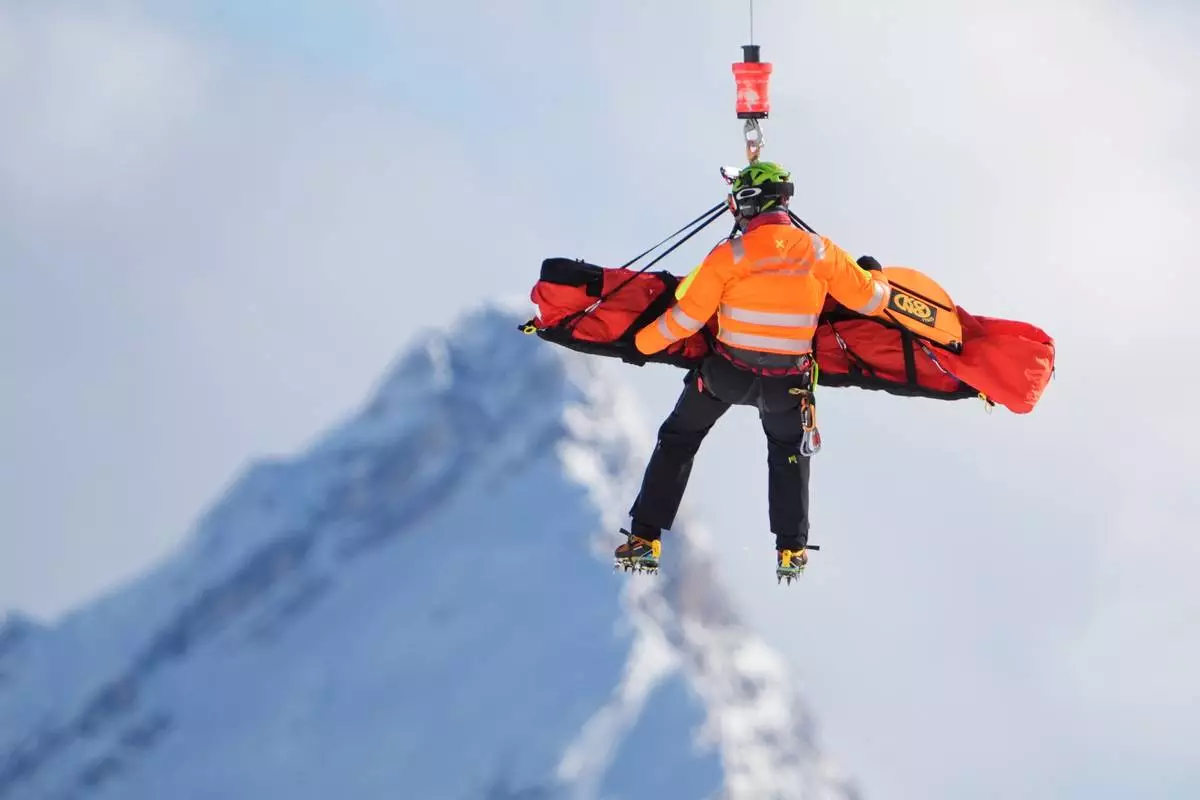
United States' Lindsey Vonn is airlifted away after a crash during an alpine ski women's downhill race, at the 2026 Winter Olympics, in Cortina d'Ampezzo, Italy, Sunday, Feb. 8, 2026. (AP Photo/Jacquelyn Martin)


United States' Lindsey Vonn is airlifted away after a crash during an alpine ski women's downhill race, at the 2026 Winter Olympics, in Cortina d'Ampezzo, Italy, Sunday, Feb. 8, 2026. (AP Photo/Jacquelyn Martin)

TOKYO (AP) — The governing party of Prime Minister Sanae Takaichi secured a two-thirds supermajority in a key parliamentary election Sunday, Japanese media reported citing preliminary results, earning a landslide victory thanks to her popularity.

Takaichi, in a televised interview with public television network NHK following her sweeping victory, said she is now ready to pursue policies that would make Japan strong and prosperous.

NHK, citing results of vote counts, said Takaichi’s Liberal Democratic Party, or LDP, alone secured 316 seats by early Monday, comfortably surpassing a 261-seat absolute majority in the 465-member lower house, the more powerful of Japan's two-chamber parliament. That marks a record since the party's foundation in 1955 and surpasses the previous record of 300 seats won in 1986 by late Prime Minister Yasuhiro Nakasone.

A smiling Takaichi placed a big red ribbon above each winner’s name on a signboard at the LDP's headquarters, as accompanying party executives applauded.

Despite the lack of a majority in the other chamber, the upper house, the huge jump from the preelection share in the superior lower house would allow Takaichi to make progress on a right-wing agenda that aims to boost Japan’s economy and military capabilities as tensions grow with China and she tries to nurture ties with the United States.

Takaichi said that she would firmly push forward her policy goals while trying to gain support from the opposition.

“I will be flexible,” she said.

Takaichi is hugely popular, but the governing LDP, which has ruled Japan for most of the last seven decades, has struggled with funding and religious scandals in recent years. She called Sunday’s early election only after three months in office, hoping to turn that around while her popularity is high.

The ultraconservative Takaichi, who took office as Japan’s first female leader in October, pledged to “work, work, work,” and her style, which is seen as both playful and tough, has resonated with younger fans who say they weren't previously interested in politics.

The opposition, despite the formation of a new centrist alliance and a rising far-right, was too splintered to be a real challenger. The new opposition alliance of LDP’s former coalition partner, Buddhist-backed dovish Komeito, and the liberal-leaning Constitutional Democratic Party of Japan, is projected to sink to half of their combined preelection share of 167 seats.

Takaichi was betting with this election that her LDP party, together with its new partner, the Japan Innovation Party, would secure a majority.

Akihito Iwatake, a 53-year-old office worker, said he welcomed the big win by the LDP because he felt the party went too liberal in the past few years. “With Takaichi shifting things more toward the conservative side, I think that brought this positive result,” he said.

The prime minister wants to push forward a significant shift to the right in Japan’s security, immigration and other policies. The LDP's right-wing partner, JIP leader Hirofumi Yoshimura, has said his party will serve as an “accelerator” for this push.

Japan has recently seen far-right populists gain ground, such as the anti-globalist and surging nationalist party Sanseito. Exit polls projected a big gain for Sanseito.

The first major task for Takaichi when the lower house reconvenes in mid-February is to work on a budget bill, delayed by the election, to fund economic measures that address rising costs and sluggish wages.

Takaichi has pledged to revise security and defense policies by December to bolster Japan’s offensive military capabilities, lifting a ban on weapons exports and moving further away from the country’s postwar pacifist principles.

She has been pushing for tougher policies on foreigners, anti-espionage and other measures that resonate with a far-right audience, but ones that experts say could undermine civil rights.

Takaichi also wants to increase defense spending in response to U.S. President Donald Trump’s pressure for Japan to loosen its purse strings.

She now has time to work on these policies, without an election until 2028.

Though Takaichi said that she's seeking to win support for policies seen as divisive in Japan, she largely avoided discussing ways to fund soaring military spending, how to fix diplomatic tension with China and other issues.

In her campaign speeches, Takaichi enthusiastically talked about the need for proactive government spending to fund “crisis management investment and growth,” such as measures to strengthen economic security, technology and other industries. Takaichi also seeks to push tougher measures on immigration, including stricter requirements for foreign property owners and a cap on foreign residents.

Sunday's election “underscores a problematic trend in Japanese politics in which political survival takes priority over substantive policy outcomes,” said Masato Kamikubo, a Ritsumeikan University politics professor. “Whenever the government attempts necessary but unpopular reforms ... the next election looms.”

Sunday’s vote coincided with fresh snowfall across the country, including in Tokyo. Record snowfall in northern Japan over the past few weeks blocked roads and was blamed for dozens of deaths nationwide.

Associated Press writers Mayuko Ono and Hiromi Tanoue contributed to this report.

Yoshihiko Noda, left, and Kenta Saito, right, co-heads of the newly formed Japanese political party Centrist Reform Alliance, attend their press conference Sunday, Feb. 8, 2026 in Tokyo, (Yohei Fukai/Kyodo News via AP)

Yoshihiko Noda, left, and Kenta Saito, right, co-heads of the newly formed Japanese political party Centrist Reform Alliance, attend their press conference Sunday, Feb. 8, 2026 in Tokyo, (Yohei Fukai/Kyodo News via AP)

Sanae Takaichi, center, Japan's prime minister and president of the ruling Liberal Democratic Party (LDP), puts pins marking the names of candidates who won lower house elections, at the LDP headquarters Sunday, Feb. 8, 2026 in Tokyo, (Kim Kyung-Hoon/Pool Photo via AP)

Sanae Takaichi, center, Japan's prime minister and president of the ruling Liberal Democratic Party (LDP), puts pins marking the names of candidates who won lower house elections, at the LDP headquarters Sunday, Feb. 8, 2026 in Tokyo, (Kim Kyung-Hoon/Pool Photo via AP)

Sanae Takaichi, center, Japan's prime minister and president of the ruling Liberal Democratic Party (LDP), speaks during an interview at the LDP headquarters Sunday, Feb. 8, 2026 in Tokyo. (Kim Kyung-Hoon/Pool Photo via AP)

Sanae Takaichi, center, Japan's prime minister and president of the ruling Liberal Democratic Party (LDP), speaks during an interview at the LDP headquarters Sunday, Feb. 8, 2026 in Tokyo. (Kim Kyung-Hoon/Pool Photo via AP)

Japan's ruling Liberal Democratic Party (LDP) Secretary-General Shunichi Suzuki and other lawmakers puts pins marking the names of candidates who won lower house elections at the LDP headquarters in Tokyo, Sunday Feb. 8, 2026. (Kim Kyung-Hoon/Pool Photo via AP)

Japan's ruling Liberal Democratic Party (LDP) Secretary-General Shunichi Suzuki and other lawmakers puts pins marking the names of candidates who won lower house elections at the LDP headquarters in Tokyo, Sunday Feb. 8, 2026. (Kim Kyung-Hoon/Pool Photo via AP)

Election officials open ballot boxes as they prepare to count the votes in the lower house election in Tokyo, Sunday, Feb. 8, 2026. (AP Photo/Louise Delmotte)

Election officials open ballot boxes as they prepare to count the votes in the lower house election in Tokyo, Sunday, Feb. 8, 2026. (AP Photo/Louise Delmotte)

Staff prepare to count the votes for the lower house election in Tokyo, Sunday, Feb. 8, 2026. (AP Photo/Louise Delmotte)

Staff prepare to count the votes for the lower house election in Tokyo, Sunday, Feb. 8, 2026. (AP Photo/Louise Delmotte)

A voter fills in a ballot in the lower house election at a polling station Sunday, Feb. 8, 2026, in Tokyo. (AP Photo/Louise Delmotte)

A voter fills in a ballot in the lower house election at a polling station Sunday, Feb. 8, 2026, in Tokyo. (AP Photo/Louise Delmotte)

A voter fills in a ballot in the lower house election at a polling station Sunday, Feb. 8, 2026, in Tokyo. (AP Photo/Louise Delmotte)

A voter fills in a ballot in the lower house election at a polling station Sunday, Feb. 8, 2026, in Tokyo. (AP Photo/Louise Delmotte)

A voter fills in a ballot in the upper house election at a polling station Sunday, Feb. 8, 2026, in Tokyo. (AP Photo/Louise Delmotte)

A voter fills in a ballot in the upper house election at a polling station Sunday, Feb. 8, 2026, in Tokyo. (AP Photo/Louise Delmotte)

A voter casts a ballot in the upper house election at a polling station Sunday, Feb. 8, 2026, in Tokyo. (AP Photo/Louise Delmotte)

A voter casts a ballot in the upper house election at a polling station Sunday, Feb. 8, 2026, in Tokyo. (AP Photo/Louise Delmotte)

A voter casts a ballot in the upper house election at a polling station Sunday, Feb. 8, 2026, in Tokyo. (AP Photo/Louise Delmotte)

A voter casts a ballot in the upper house election at a polling station Sunday, Feb. 8, 2026, in Tokyo. (AP Photo/Louise Delmotte)

Recommended Articles