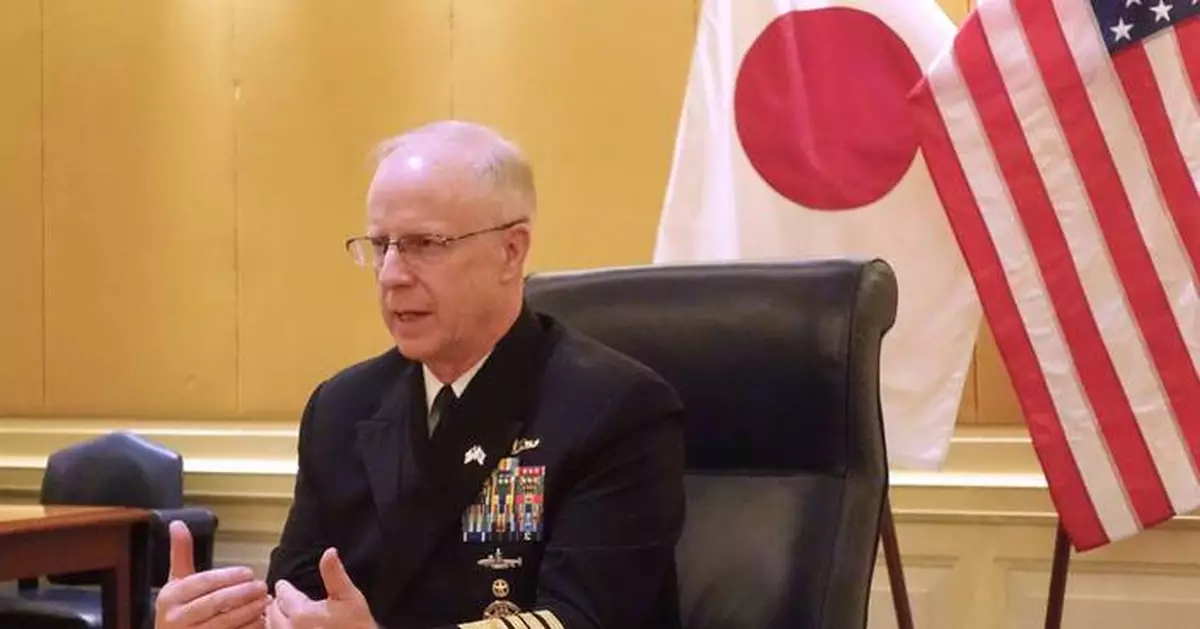
WASHINGTON (AP) — The U.S. Navy’s top uniformed officer wants to convince commanders to use smaller, newer assets for missions instead of consistently turning to huge aircraft carriers — as seen now in the American military buildups off Venezuela and Iran.
Adm. Daryl Caudle's vision — what he calls his “ Fighting Instructions ” — calls for the Navy to deploy more tailored groups of ships and equipment that would offer the sea service more flexibility to respond to crises as they develop.
The new strategy comes as the Trump administration has moved aircraft carriers and other ships to regions around the world as concerns have cropped up, often disrupting standing deployment plans, scrambling ships to sail thousands of miles and putting increasing strain on vessels and equipment that are already facing mounting maintenance issues.
The world's largest aircraft carrier, the USS Gerald R. Ford, was redirected late last year from the Mediterranean Sea to the Caribbean Sea, where the crew ultimately supported last month's operation to capture then-Venezuelan President Nicolás Maduro. And two weeks ago, the USS Abraham Lincoln arrived in the Middle East as tensions with Iran rise, having been pulled from the South China Sea.
In a recent interview with The Associated Press before the document’s rollout, Caudle said his strategy would make the Navy’s presence in regions like the Caribbean much leaner and better tailored to meet actual threats.
Caudle said he’s already spoken with the commander of U.S. Southern Command, which encompasses the Caribbean and Venezuela, “and we’re in negotiation on what his problem set is — I want to be able to convey that I can meet that with a tailored package there.”
Speaking broadly, Caudle said he envisions the mission in the Caribbean focusing more on interdictions and keeping an eye on merchant shipping.
The U.S. military has already seized multiple suspicious and falsely flagged tankers connected with Venezuela that were part of a global shadow fleet of merchant vessels that help governments evade sanctions.
“That doesn’t really require a carrier strike group to do that,” Caudle said, adding that he believes the mission could be done with some smaller littoral combat ships, Navy helicopters and close coordination with the Coast Guard.
The Navy has had 11 ships, including the Ford and several amphibious assault ships with thousands of Marines, in South American waters for months. It is a major shift for a region that has historically seen deployments of one or two smaller Navy ships.
“I don’t want a lot of destroyers there driving around just to actually operate the radar to get awareness on motor vessels and other tankers coming out of port,” Caudle said. “It’s really not a well-suited match for that mission.”
To compensate, Caudle envisions leaning more heavily on drones or other robotic systems to offer military commanders the same capabilities but with less investment from Navy ships. He acknowledges this will not be an easy sell.
Caudle said even if a commander knows about a new capability, the staff “may not know how to ask for that, integrate it, and know how to employ it in an effective way to bring this new niche capability to bear.”
“That requires a bit of an education campaign here,” he later added.
President Donald Trump has favored large and bold responses from the Navy and has leaned heavily toward displays of firepower.
Trump has referred to aircraft carriers and their accompanying destroyers as armadas and flotillas. He also revived the historic battleship title for a planned type of ship that would sport hypersonic missiles, nuclear cruise missiles, rail guns and high-powered lasers.
If built, the proposed “Trump-class battleship” would be longer and larger than the World War II-era Iowa-class battleships, though the Navy has not only struggled to field some of the technologies that Trump says will be aboard but it has had challenges building even smaller, less sophisticated ships on time and on budget.
Given this trend, Caudle said if the Lincoln's recent redeployment to the Middle East were to happen under his new plan, he would talk with the Indo-Pacific commander about how to compensate for the loss.
"So, as Abraham Lincoln comes out, I’ve got a three ship (group) that’s going to compensate for that,” Caudle suggested as an example.
Caudle argues that his vision already is in place and working in Europe and North America “for the last four or five years.”
He said this could apply soon in the Bering Strait, which separates Russia and Alaska, noting that “the importance of the Arctic continues to get more and more prevalent” as China, Russia and the U.S. prioritize the region.
Trump has cited the threat from China and Russia in his demands to take over Greenland, the Arctic island overseen by NATO ally Denmark.
Caudle said he knows he needs to offer the commanders in that region “more solutions” and his “tailored force packages would be a way to get after that.”

FILE - U.S. Chief of Naval Operations, Adm. Daryl Caudle, talks to selected journalists during his visit in Tokyo, Nov. 17, 2025. (AP Photo/Mari Yamaguchi, File)

WASHINGTON (AP) — Ghislaine Maxwell, the former girlfriend of Jeffrey Epstein, declined to answer questions from House lawmakers in a deposition Monday, but indicated that if President Donald Trump ended her prison sentence, she was willing to testify that neither he nor former President Bill Clinton had done anything wrong in their connections with Epstein.
The House Oversight Committee had wanted Maxwell to answer questions during a video call to the federal prison camp in Texas where she’s serving a 20-year sentence for sex trafficking, but she invoked her Fifth Amendment rights to avoid answering questions that would be self-incriminating. She’s come under new scrutiny as lawmakers try to investigate how Epstein, a well-connected financier, was able to sexually abuse underage girls for years.
Amid a reckoning over Epstein's abuse that has spilled into the highest levels of businesses and governments around the globe, lawmakers are searching for anyone who was connected to Epstein and may have facilitated his abuse. So far, the revelations have shown how both Trump and Clinton spent time with Epstein in the 1990s and early 2000s, but they have not been credibly accused of wrongdoing.
Dressed in a brown, prison-issued shirt and sitting at a conference table with a bottle of water, Maxwell repeatedly said she was invoking “my Fifth Amendment right to silence,” video later released by the committee showed.
During the closed-door deposition, Maxwell's attorney David Oscar Markus said in a statement to the committee that “Maxwell is prepared to speak fully and honestly if granted clemency by President Trump.”
He added that both Trump and Clinton “are innocent of any wrongdoing," but that ”Ms. Maxwell alone can explain why, and the public is entitled to that explanation."
Democrats said that was a brazen effort by Maxwell to have Trump end her prison sentence.
“It’s very clear she’s campaigning for clemency,” said Rep. Melanie Stansbury, a New Mexico Democrat.
Asked Monday about Maxwell's appeal, the White House pointed to previous remarks from the president that indicated the prospect of a pardon was not on his radar.
And other Republicans push backed to the notion quickly after Maxwell made the appeal.
“NO CLEMENCY. You comply or face punishment,” Republican Rep. Anna Paulina Luna, wrote on social media. “You deserve JUSTICE for what you did you monster.”
Maxwell has also been seeking to have her conviction overturned, arguing that she was wrongfully convicted. The Supreme Court rejected her appeal last year, but in December she requested that a federal judge in New York consider what her attorneys describe as “substantial new evidence” that her trial was spoiled by constitutional violations.
Maxwell's attorney cited that petition as he told lawmakers she would invoke her Fifth Amendment rights.
Family members of the late Virginia Giuffre, one of the most outspoken victims of Epstein, also released a letter to Maxwell making it clear they did not consider her “a bystander” to Epstein's abuse.
“You were a central, deliberate actor in a system built to find children, isolate them, groom them, and deliver them to abuse,” Sky and Amanda Roberts wrote in the letter addressed to Maxwell.
Maxwell was moved from a federal prison in Florida to a low-security prison camp in Texas last summer after she participated in two-days of interviews with Deputy Attorney General Todd Blanche.
The Republican chair of the committee, Rep. James Comer of Kentucky, had also subpoenaed her at the time, but her attorneys have consistently told the committee that she wouldn't answer questions. However, Comer came under pressure to hold the deposition as he pressed for the committee to enforce subpoenas on Bill Clinton and former Secretary of State Hillary Clinton. After Comer threatened them with contempt of Congress charges, they both agreed to sit for depositions later this month.
Comer has been haggling with the Clintons over whether that testimony should be held in a public hearing, but Comer reiterated Monday that he would insist on holding closed-door depositions and later releasing transcripts and video.
Meanwhile, several lawmakers visited a Justice Department office in Washington Monday to look through unredacted versions of the files on Epstein that the department has released to comply with a law passed by Congress last year. As part of an arrangement with the Justice Department, lawmakers were given access to the over 3 million released files in a reading room with four computers. Lawmakers can only make handwritten notes, and their staff are not allowed in with them.
Rep. Jamie Raskin, the top Democrat on the House Judiciary Committee, spent several hours in the reading room Monday morning. He told reporters as he returned to the Capitol that even if all the House members who triggered the vote on releasing the files “spent every waking hour over at the Department of Justice, it would still take us months to get through all of those documents.”
Democrats on Raskin's committee are looking ahead to a Wednesday hearing with Attorney General Pam Bondi, where they are expected to sharply question her on the publication of the Epstein files. The Justice Department failed to redact the personal information of many victims, including inadvertently releasing nude photos of them.
“Over and over we begged them, please be careful, please be more careful,” said Jennifer Freeman, an attorney representing survivors. “The damage has already been done. It feels incompetent, it feels intimidating and it feels intentional.”
Democrats also say the Justice Department redacted information that should have been made public, including information that could lead to scrutiny of Epstein’s associates.
Rep. Thomas Massie, a Kentucky Republican who sponsored the legislation to force the release of the files, said that after reviewing the unredacted versions for several hours, he had found the names of six men “that are likely incriminated by their inclusion.” He called on the Justice Department to pursue accountability for the men, but said he could potentially name them in a House floor speech, where his actions would be constitutionally protected from lawsuits.
Massie, along with California Democratic Rep. Ro Khanna, said they also came across a number of files that still had redactions. They said that was likely because the FBI had turned over redacted versions of the files to the Justice Department.
Khanna said “it wasn't just Epstein and Maxwell” who were involved in sexually abusing underage girls.
Release of the files has set in motion multiple political crises around the world, including in the United Kingdom, where Prime Minister Keir Starmer is clinging to his job after it was revealed his former ambassador to the U.S. had maintained close ties to Epstein. But Democratic lawmakers bemoaned that so far U.S. political figures seem to be escaping unscathed.
“I’m just afraid that the general worsening and degradation of American life has somehow conditioned people not to take this as seriously as we should be taking it,” Raskin said.
Rep. Jaime Raskin, D Md., speaks to reporters on Capitol Hill after reviewing unredacted Jeffrey Epstein files at the Department of Justice, Monday Feb. 9, 2026, in Washington. (AP Photo Nathan Ellgren)
House Oversight Committee Chairman James Comer, R-Ky., joined at left by Rep. Andy Biggs, R-Ariz., speaks to reporters after a closed-circuit deposition with Ghislaine Maxwell, the former girlfriend and confidante of sex trafficker Jeffrey Epstein, at the Capitol in Washington, Monday, Feb. 9, 2026. (AP Photo/J. Scott Applewhite)

House Oversight Committee Chairman James Comer, R-Ky., flanked by Rep. Andy Biggs, R-Ariz., left, and Rep. William Timmons, R-S.C., speaks to reporters after a closed-circuit deposition with Ghislaine Maxwell, the former girlfriend and confidante of sex trafficker Jeffrey Epstein, at the Capitol in Washington, Monday, Feb. 9, 2026. (AP Photo/J. Scott Applewhite)