Thomas Frank was fired by Tottenham on Wednesday after only eight months in charge and with his team just five points above the relegation zone in the Premier League.
Despite leading Spurs to the round of 16 in the Champions League, Frank has overseen a desperate domestic campaign. A 2-1 loss to Newcastle on Tuesday was greeted by boos from the home fans and left Spurs still without a league win in 2026.
“The Club has taken the decision to make a change in the Men’s Head Coach position and Thomas Frank will leave today,” Tottenham said in a statement. “Thomas was appointed in June 2025, and we have been determined to give him the time and support needed to build for the future together.
“However, results and performances have led the Board to conclude that a change at this point in the season is necessary.”
Frank’s exit means Spurs are on the lookout for a sixth head coach in less than seven years since Mauricio Pochettino departed in 2019.
The Dane was appointed at the end of last season when Ange Postecoglou was fired despite leading Tottenham to its first trophy in 17 years by winning the Europa League and securing Champions League qualification.
Frank had built up an impressive reputation for his work during a nine-year spell at Brentford when he established the modest London club as a Premier League force. But he was unable to repeat that success at Tottenham, where he won just seven of 26 games in the league.
Spurs’ last league win was Dec. 28 and defeat at home to Newcastle extended a ruinous run to one win in 11 in England’s top flight.
Spurs dropped to 16th in the standings on Tuesday and two places above the relegation zone.
Frank was not helped by an extensive injury list that included star players James Maddison, Dejan Kulusevski, Rodrigo Bentancur, Mohammed Kudus and Lucas Bergvall.
Captain Cristian Romero was also absent against Newcastle after being sent off in the previous game against Manchester United.
Frank said after defeat to Newcastle that he was “convinced” he would still be in charge for the next match against Arsenal later this month.
“If you do something right, you build something that can last,” he said. “Of course, we are not in a top position now. Everyone knows — directors, ownership, myself — what position we are in, what we need to improve and what we need to do better. That is what we are working very hard on.”
Frank is not alone in failing to revive Tottenham. He followed in the footsteps of some of soccer's top coaches, including Antonio Conte and José Mourinho, who could not bring success to the North London club.
And even when Postecoglou managed to deliver major silverware and a place in the money-spinning Champions League, it wasn't enough to save his job.
Postecoglou paid the price for a woeful domestic campaign that saw Spurs finish in 17th-place — their lowest since the Premier League was founded in 1992.
League form has also proved costly for Frank, whose team was on fewer points than Postecoglou's at this stage last year.
James Robson is at https://x.com/jamesalanrobson
AP soccer: https://apnews.com/hub/soccer
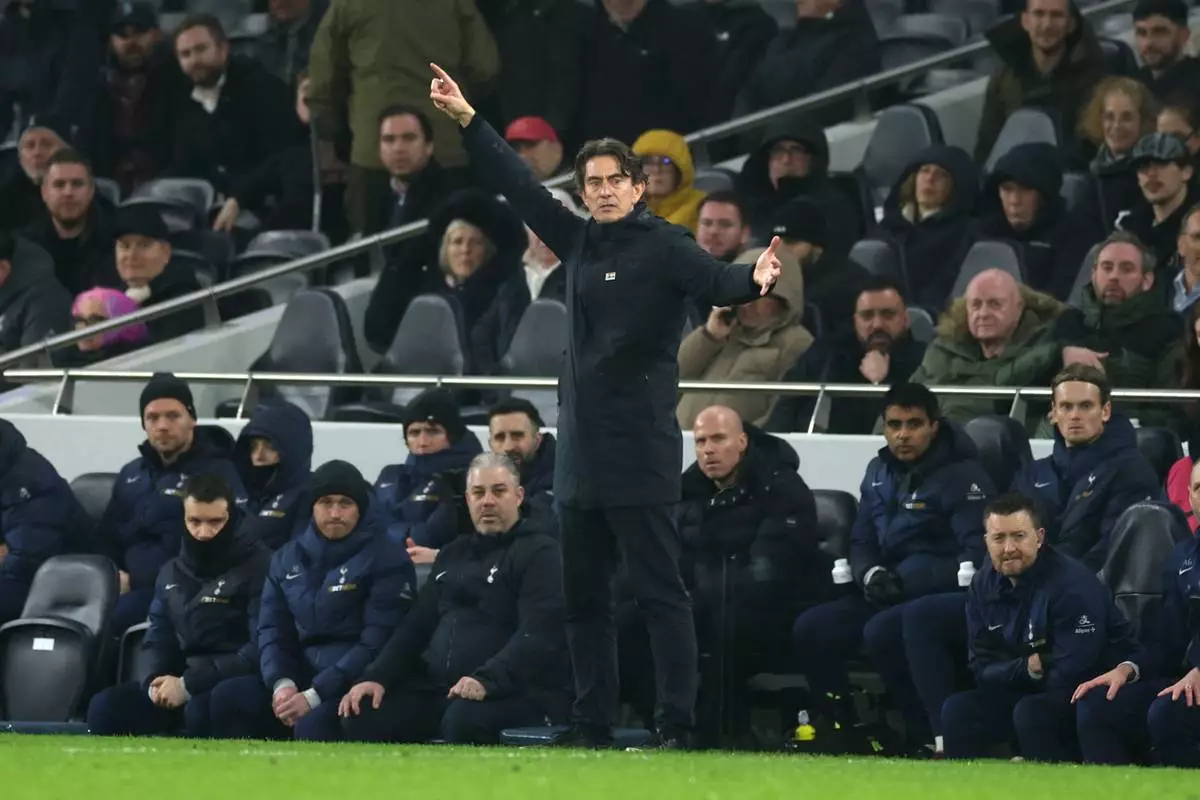
Tottenham's head coach Thomas Frank gestures during the English Premier League soccer match between Tottenham and Newcastle in London, Tuesday, Feb. 10, 2026. (AP Photo/Ian Walton)

Tottenham's head coach Thomas Frank gestures during the English Premier League soccer match between Tottenham and Newcastle in London, Tuesday, Feb. 10, 2026. (AP Photo/Ian Walton)
There aren’t many lawmakers like Thomas Massie left in Congress.
The renegade Republican who rose to prominence as an idiosyncratic and stubborn outlier in his party, popular in the Kentucky district that repeatedly sent him to the House, lost his primary bid for reelection Tuesday after a vicious and costly attack by President Donald Trump.
The stunning outcome caps a career like few others and shows the extent of the president’s ability to badger, badmouth and eventually boot out his political adversaries — and that no lawmaker is apparently safe. Massie's defeat comes after the Trump-led ouster of Sen. Bill Cassidy in Louisiana over the weekend and the president's endorsement Tuesday of Texas Attorney General Ken Paxton in his challenge to Sen. John Cornyn, which sent chills through the Senate.
Trump had reserved his fiercest attacks for Massie, a quirky conservative who had become among the most powerful rank-and-file Republicans in the House because of his willingness to vote as he pleased, rather than as the party demanded. And now he's been toppled like so many other Republicans who crossed the president.
Massie was undaunted after losing to Ed Gallrein, a former Navy SEAL handpicked by Trump.
“If the legislative branch always votes with the president, we do have a king,” Massie told cheering supporters Tuesday night. But if lawmakers follow the Constitution, he said, “we have a republic.”
Massie also teased that his political career may not be over quite yet during the closing moments of his concession speech, as a raucous crowd broke into chants of “2028!” and “President!”
“You’ve made a compelling argument,” he replied. “We’ll talk about it later.”
Trump said of Massie’s defeat: “He deserves to lose.”
Massie rose from the House Republican backbench, charting his own path and showing again and again he was willing to buck his party and the president.
He voted against Trump’s big tax cuts bill last year, worried the several trillion-dollar costs would add to the nation’s deficits.
He rejected Trump’s military forays against Iran and Venezuela, opposed to U.S. intervention overseas, and he routinely voted against U.S. foreign aid, including to Israel, drawing millions of dollars against him from pro-Israel interest groups.
And perhaps most remarkably, Massie, in partnership with Democratic Rep. Ro Khanna of California, persisted in a long-shot effort to force the Justice Department’s release of the Jeffrey Epstein files.
It was his work on the Epstein files, perhaps more than any of his repeated votes against spending bills and other party priorities, that elevated Massie's profile.
Khanna said on X Tuesday that Massie “lost because he had the guts to stand up to the Epstein class and against the war.”
Trump lashed out at the “lowlife” Massie as the congressman pushed the issue last year, prolonging a political headache for the White House.
First elected in 2012, at the tail end of the GOP tea party wave before Trump’s Make America Great Again movement burst onto the scene, Massie stood out from the start.
An engineer by training, Massie designed several patents — some on display in his office — as well as a debt calculator that blinks in flashing red numerals as the nation’s deficits pile up. He often wears a miniature version of the debt calculator as a lapel pin.
He married his high school sweetheart, Rhonda, and joined her at the Massachusetts Institute of Technology. They raised their four children living largely off the grid in a solar-power home he designed himself, making him something of a legend among a generation of do-it-yourselfers. He raised cattle, drove an early Tesla and drank raw milk.
Inspired by fellow Kentuckian Rand Paul after having put up lawn signs for the senator’s election, the libertarian-leaning Massie ran for office himself.
Once he won his own House seat, Massie declined to join the newly forming Freedom Caucus, his own far-right views not fully aligning with the conservative coalition.
Trump set his sights on Massie in 2020 during his first presidential term, when the congressman dared to object to a $2.2 trillion aid package to combat the coronavirus pandemic.
At the time, Massie refused to allow the COVID-19 package to be approved without a formal roll call, forcing hundreds of lawmakers back to the Capitol. Trump called him a “third rate Grandstander.”
Trump did not let up his criticisms, even after Massie's wife died in 2024. Massie announced in 2025 that he had remarried, after proposing to Carolyn Grace Moffa, a former Paul staffer, on the steps of the Library of Congress. He said they planned to live on the farm.
The president suggested that Massie got remarried too quickly, writing on social media that “his wife will soon find out that she’s stuck with a LOSER!”
Associated Press reporter Thomas Beaumont contributed from Des Moines, Iowa.

Rep. Thomas Massie, R-Ky., smiles as he speaks during an election night watch party after losing the Republican party's nomination at the Marriott Cincinnati Airport, Tuesday, May 19, 2026, in Hebron, Ky. (AP Photo/Carolyn Kaster)
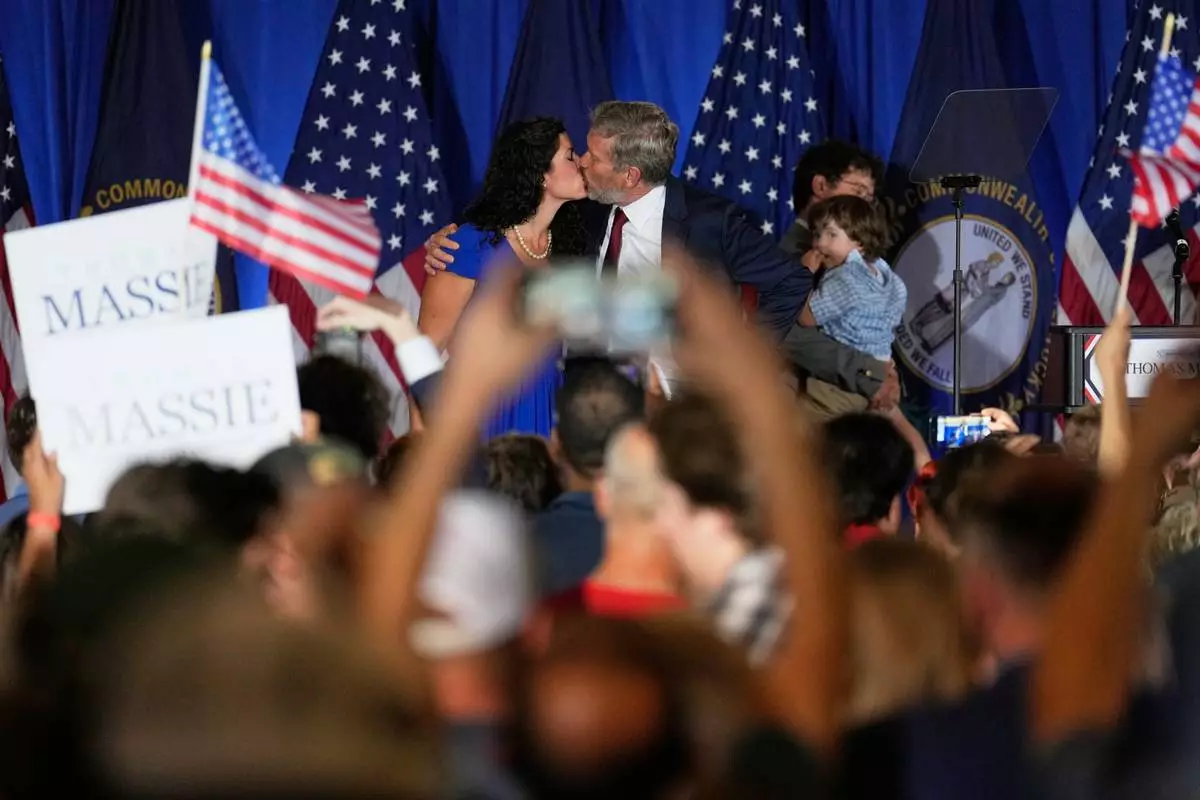
Rep. Thomas Massie, R-Ky., kisses his wife, Carolyn Moffa, during an election night watch party after losing the Republican party's nomination at the Marriott Cincinnati Airport, Tuesday, May 19, 2026, in Hebron, Ky. (AP Photo/Carolyn Kaster)
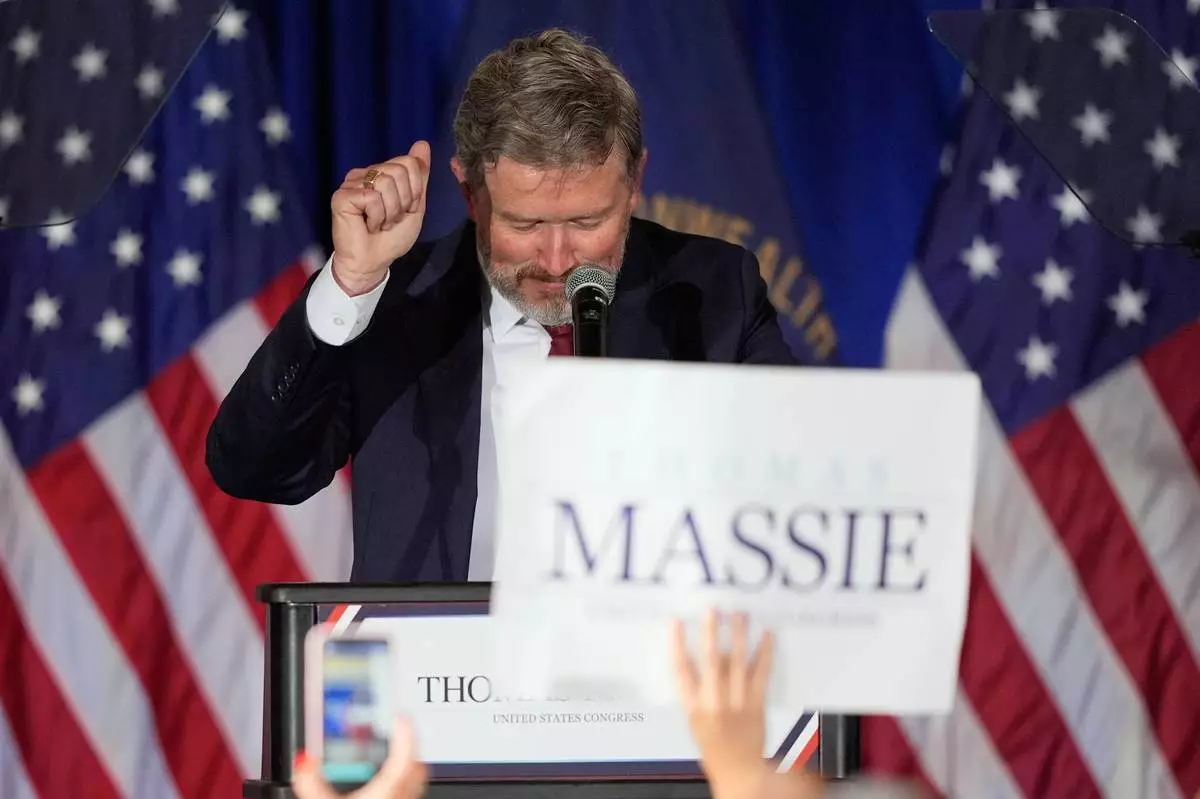
Rep. Thomas Massie, R-Ky., reacts as he speaks during an election night watch party after losing the Republican party's nomination at the Marriott Cincinnati Airport, Tuesday, May 19, 2026, in Hebron, Ky. (AP Photo/Carolyn Kaster)