Skip to Content Facebook Feature Image

Milei takes on Argentina's unions, drawing protests as senators debate his labor overhaul

News

Milei takes on Argentina's unions, drawing protests as senators debate his labor overhaul
News

News

Milei takes on Argentina's unions, drawing protests as senators debate his labor overhaul

2026-02-12 10:33 Last Updated At:13:07

BUENOS AIRES, Argentina (AP) — Thousands of workers mobilized by powerful trade unions converged outside Argentina’s Congress on Wednesday, blocking traffic and clashing with police as senators debated an overhaul of labor laws that is considered crucial to libertarian President Javier Milei’s shock therapy program.

Security forces struggled to control the crowds in a central square of downtown Buenos Aires, firing water cannons and rubber bullets. Protesters lobbed petrol bombs, stones and water bottles. Authorities said they made at least 15 arrests, among them protesters accused of attacking police officers.

More Images
A police water cannon sprays a fire sparked by a Molotov cocktail during clashes at a march by trade unions and opposition groups against a labor reform bill proposed by President Javier Milei's government in Buenos Aires, Argentina, Wednesday, Feb. 11, 2026. (AP Photo/Gustavo Garello)
A police water cannon sprays a fire sparked by a Molotov cocktail during clashes at a march by trade unions and opposition groups against a labor reform bill proposed by President Javier Milei's government in Buenos Aires, Argentina, Wednesday, Feb. 11, 2026. (AP Photo/Gustavo Garello)

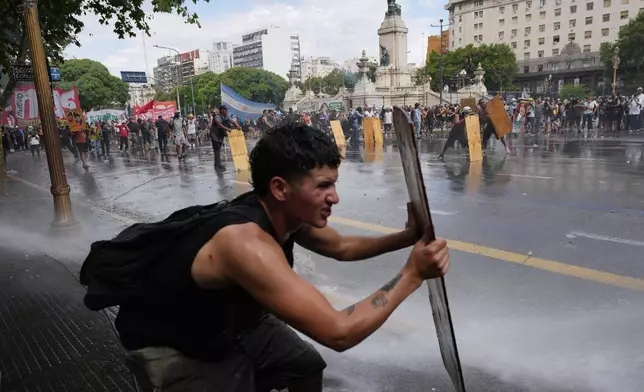
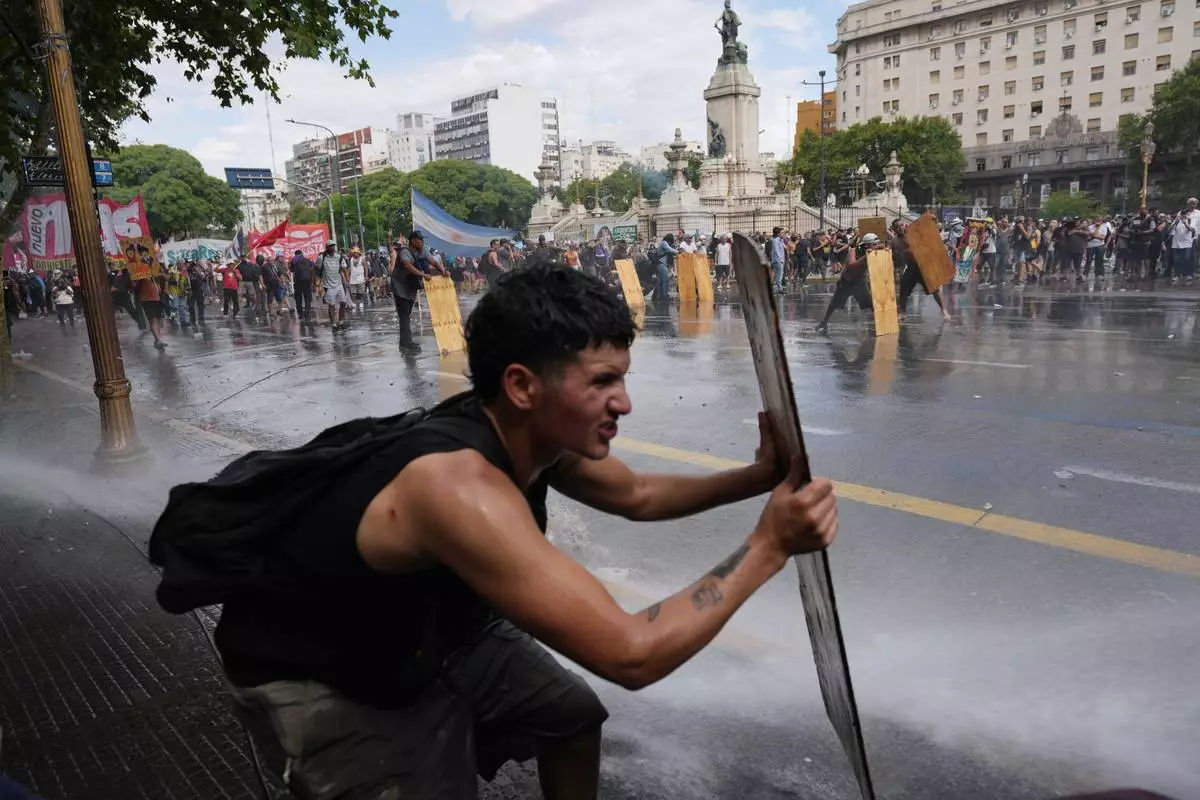
Protesters shield themselves with wooden boards as police spray water during clashes at a march by trade unions and opposition groups against a labor reform bill proposed by President Javier Milei's government in Buenos Aires, Argentina, Wednesday, Feb. 11, 2026. (AP Photo/Rodrigo Abd)

Protesters shield themselves with wooden boards as police spray water during clashes at a march by trade unions and opposition groups against a labor reform bill proposed by President Javier Milei's government in Buenos Aires, Argentina, Wednesday, Feb. 11, 2026. (AP Photo/Rodrigo Abd)

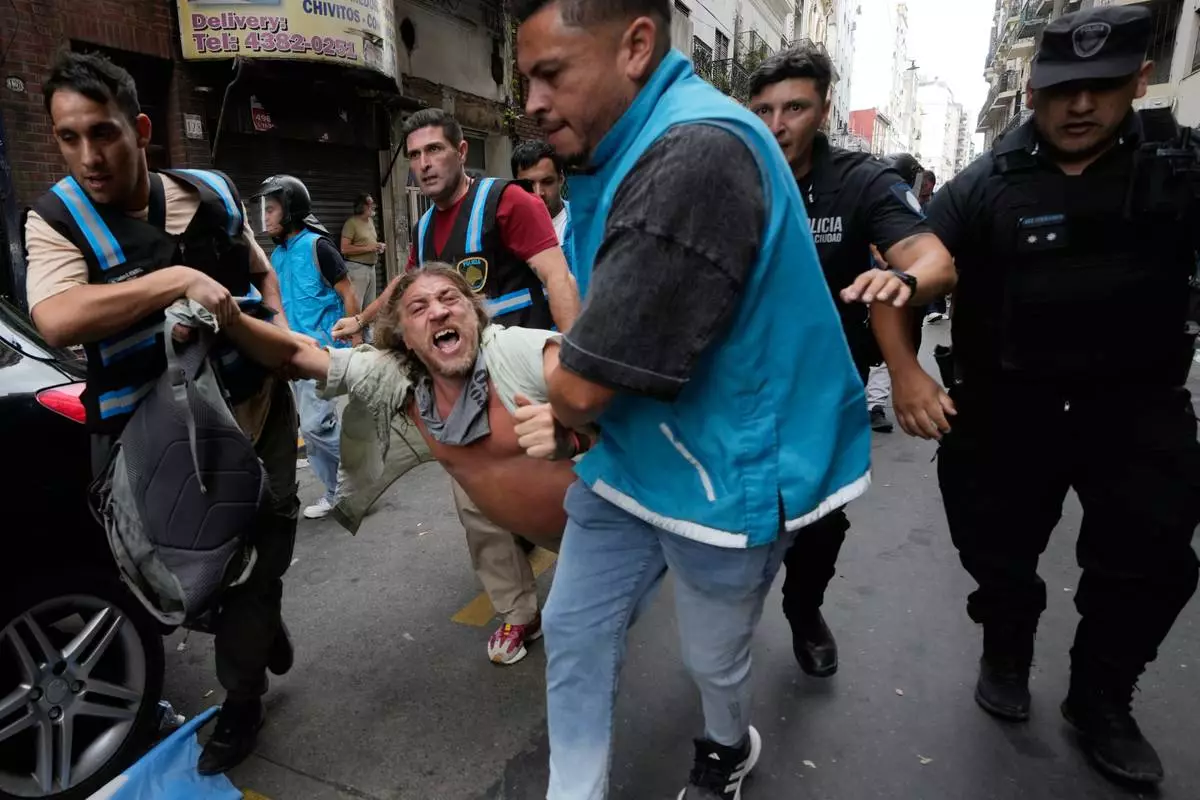
Police detain a protester during a march by trade unions and opposition groups protesting a labor reform bill proposed by President Javier Milei's government in Buenos Aires, Argentina, Wednesday, Feb. 11, 2026. (AP Photo/Gustavo Garello)

Police detain a protester during a march by trade unions and opposition groups protesting a labor reform bill proposed by President Javier Milei's government in Buenos Aires, Argentina, Wednesday, Feb. 11, 2026. (AP Photo/Gustavo Garello)

People take cover as police and protesters clash during a march by trade unions and opposition groups against a labor reform bill proposed by President Javier Milei's government in Buenos Aires, Argentina, Wednesday, Feb. 11, 2026. (AP Photo/Rodrigo Abd)

People take cover as police and protesters clash during a march by trade unions and opposition groups against a labor reform bill proposed by President Javier Milei's government in Buenos Aires, Argentina, Wednesday, Feb. 11, 2026. (AP Photo/Rodrigo Abd)

A Molotov cocktail bursts into flames in front of police during a march by unions and opposition supporters against a labor reform bill proposed by President Javier Milei's government in Buenos Aires, Argentina, Wednesday, Feb. 11, 2026.(AP Photo/Rodrigo Abd)

A Molotov cocktail bursts into flames in front of police during a march by unions and opposition supporters against a labor reform bill proposed by President Javier Milei's government in Buenos Aires, Argentina, Wednesday, Feb. 11, 2026.(AP Photo/Rodrigo Abd)

The fiery standoff underscored the sensitivity of labor rights in this nation dominated since the 1940s by Peronism, a populist movement that has swung right and left ideologically but has always claimed to champion workers' rights.

Supporters of Milei's proposed labor law changes say high severance payouts and taxes makes it almost impossible to fire employees, constraining productivity and discouraging business from formal employment. Almost half of Argentines work off the books. Private sector job growth has remained stagnant for 14 years.

“With the modernization of the labor system, more people will have access to formal, legal employment,” Milei’s La Libertad Avanza party said in a statement as the debate kicked off. “We are rebuilding Argentina from the ground up, starting with employment.”

The bill is bitterly opposed by labor unions and their Peronist allies in Congress, who argue the bill would roll back important measures to protect workers from abuse and the nation’s notoriously frequent economic shocks.

“If severance pay, overtime and vacation time — in other words, all the protections workers have gained over time — are up for grabs, it won’t make things better for anyone,” said Axel Kicillof, the governor of Buenos Aires province and the most powerful elected official in the Peronist opposition.

Successive governments, as well as a military dictatorship, have promised to overhaul Argentina’s labor legislation and have failed.

“This is the most important reform in the last 50 years,” said Sen. Patricia Bullrich, leader of the La Libertad Avanza bloc in Congress. “No government has achieved it, and I believe we will.”

One far-reaching reform came tantalizingly close in 1984 only to collapse in the Senate by a single vote. Another cleared the Peronist-dominated Congress in 2000, only to be discredited by a vote-buying scandal and promptly overturned. Yet another attempt in 2017 didn’t even make it to a vote due to union pushback.

Milei himself used an executive order to muscle through an overhaul after entering office in 2023, only for it to get tied up in court after unions filed for injunctions.

But after clinching a big midterm victory last year, with help from his ally U.S. President Donald Trump, Milei has a fresh mandate to enact reforms that for decades businesses have desired and international financial institutions have demanded.

The bill under discussion would curb the right to strike, extend trial periods during which companies can fire unproductive new employees, defang national trade unions by allowing collective bargaining at company level and unwind a byzantine system of severance payments by narrowing grounds for wrongful dismissal.

Experts said that even if the government is forced to make concessions in Congress, the passage of anything called a “labor reform” would be a huge achievement in Argentina, where many current legal clauses have remained unchanged since the mid-1970s.

“I’m skeptical about whether it’s going to induce a massive formalization of workers in the labor market. That’s why I think the importance is much more political, symbolic,” said Ignacio Labaqui, a Buenos Aires-based senior analyst at risk consultancy Medley Global Advisors. “For Peronism, it would definitely be a huge defeat.”

Milei and his officials lashed out at left-wing opponents Wednesday as scuffles between protesters and police left the streets outside Congress littered with shards of glass, smoldering garbage and the remnants of rubber bullets.

“The stale old union establishment is calling to ‘set the country on fire’ because they don’t like labor modernization,” government spokesperson Javier Lanari wrote on X. “They choose to protect their sectoral privileges at the expense of harming Argentines.”

Despite the show of force, some doubted that Argentina’s old-school trade unions would put up much more of a fight.

With their Peronist backers weakened in Congress and reputation long sullied by allegations of corruption and cronyism, the trade federations are not the force they once were. Mass protests petered out in the last year as both Milei and union bosses shied away from frontal assaults in favor of negotiations.

As a result, experts say the government has watered down some initial proposals that threatened to bankrupt the unions, for instance by requiring employees to opt in to membership, rather than having members’ dues taken automatically, as is now the case.

“The unions need to protest today to reinforce their base and show them that they're fighting, but the true negotiations happened behind closed doors, and they have been very successful,” said Ana Iparraguirre, an Argentine political analyst and partner at Washington-based strategy firm GBAO. “They were smart enough to negotiate to preserve the things that were important to them.”

The heated debate in the Senate was expected to stretch into the early-morning hours Thursday. If approved, the bill goes to the lower house of Congress next month.

Associated Press writers Clara Preve and Débora Rey contributed to this report.

A police water cannon sprays a fire sparked by a Molotov cocktail during clashes at a march by trade unions and opposition groups against a labor reform bill proposed by President Javier Milei's government in Buenos Aires, Argentina, Wednesday, Feb. 11, 2026. (AP Photo/Gustavo Garello)
A police water cannon sprays a fire sparked by a Molotov cocktail during clashes at a march by trade unions and opposition groups against a labor reform bill proposed by President Javier Milei's government in Buenos Aires, Argentina, Wednesday, Feb. 11, 2026. (AP Photo/Gustavo Garello)

Protesters shield themselves with wooden boards as police spray water during clashes at a march by trade unions and opposition groups against a labor reform bill proposed by President Javier Milei's government in Buenos Aires, Argentina, Wednesday, Feb. 11, 2026. (AP Photo/Rodrigo Abd)
Protesters shield themselves with wooden boards as police spray water during clashes at a march by trade unions and opposition groups against a labor reform bill proposed by President Javier Milei's government in Buenos Aires, Argentina, Wednesday, Feb. 11, 2026. (AP Photo/Rodrigo Abd)

Police detain a protester during a march by trade unions and opposition groups protesting a labor reform bill proposed by President Javier Milei's government in Buenos Aires, Argentina, Wednesday, Feb. 11, 2026. (AP Photo/Gustavo Garello)

Police detain a protester during a march by trade unions and opposition groups protesting a labor reform bill proposed by President Javier Milei's government in Buenos Aires, Argentina, Wednesday, Feb. 11, 2026. (AP Photo/Gustavo Garello)

People take cover as police and protesters clash during a march by trade unions and opposition groups against a labor reform bill proposed by President Javier Milei's government in Buenos Aires, Argentina, Wednesday, Feb. 11, 2026. (AP Photo/Rodrigo Abd)

People take cover as police and protesters clash during a march by trade unions and opposition groups against a labor reform bill proposed by President Javier Milei's government in Buenos Aires, Argentina, Wednesday, Feb. 11, 2026. (AP Photo/Rodrigo Abd)

A Molotov cocktail bursts into flames in front of police during a march by unions and opposition supporters against a labor reform bill proposed by President Javier Milei's government in Buenos Aires, Argentina, Wednesday, Feb. 11, 2026.(AP Photo/Rodrigo Abd)


A Molotov cocktail bursts into flames in front of police during a march by unions and opposition supporters against a labor reform bill proposed by President Javier Milei's government in Buenos Aires, Argentina, Wednesday, Feb. 11, 2026.(AP Photo/Rodrigo Abd)
NEW YORK (AP) — Kamala Harris “wrote off rural America" during the 2024 presidential campaign and failed to attack Donald Trump with sufficient “negative firepower," according to a long-awaited post-election autopsy released on Thursday by the Democratic National Committee.

The committee's chair, Ken Martin, shared the 192-page report only after facing intense internal pressure from frustrated Democratic operatives concerned with his leadership. Martin had originally promised to release the autopsy, only to keep it under wraps for months because he was concerned it would be a distraction ahead of the midterms as Democrats mobilize to take back control of Congress.

On Tuesday, Martin apologized for his handling of the situation and conceded that the report was withheld because it “was not ready for primetime."

Although the autopsy criticizes Democrats' focus on “identity politics,” it sidesteps some of the most controversial elements of the 2024 campaign. The report does not address former President Joe Biden’s decision to seek reelection, the rushed selection of Harris to replace him on the ticket or the party's acrimonious divide over the war in Gaza.

“I am not proud of this product; it does not meet my standards, and it won’t meet your standards,” Martin wrote in an essay on Substack on Thursday. “I don’t endorse what’s in this report, or what’s left out of it. I could not in good faith put the DNC’s stamp of approval on it. But transparency is paramount.”

A spokesperson for Harris did not immediately respond to a request for comment.

The initial reaction from Democratic operatives was a mix of bafflement and anger over Martin's handling of the situation.

“Why not say this in 2024, or bring in more people to finish it, instead of turning this into the dumbest media cycle for 7-8 months?” Democratic strategist Steve Schale wrote on social media.

The postelection report, which was authored by Democratic consultant Paul Rivera, calls for “a renewed focus on the voters of Middle America and the South, who have come to believe they are not included in the Democratic vision of a stronger and more dynamic America for everyone.”

“Millions of Americans are suffering from poor access to healthcare, manufacturing and job losses, and a failing infrastructure, yet continue to be persuaded to vote against their best interests because they do not see themselves reflected in the America of the Democratic Party,” the report says.

The autopsy points to a reduction in support and training for Democratic state parties, voter registration shifts and “a persistent inability or unwillingness to listen to all voters.”

Thursday's release comes as Martin confronts a crisis of confidence among party officials who are increasingly concerned about the health of their political machine barely a year into his term. Some Democratic operatives have had informal discussions about recruiting a new chair, even though most believe that Martin’s job wasn't in serious jeopardy ahead of the midterm elections.

The report found that Harris and her allies failed to focus enough on Trump's negatives, especially his felony convictions. This was part of a broader criticism that Democrats' messaging is too focused on reason and winning arguments, “even in cycles when the electorate is defined by rage.”

“There was a decision in the 2024 Democratic leadership not to engage in negative advertising at the scale required,” the report states. “The Trump campaign and supportive Super PACs went full throttle against Vice President Harris, but there was not sufficient or similar negative firepower directed at Trump by Democrats.”

The report continues: “It was essential to prosecute a more effective case as to why Trump should have been disqualified from ever again taking office. The grounds were there, but the messaging did not make the case.”

Trump's attack on Harris' transgender policies were cited as a key contrast.

Specifically, the report suggested the Democratic nominee was “boxed” in by the Trump campaign's “very effective” ad that highlighted Harris' previous statement of support for taxpayer-funded gender-affirming surgeries for prison inmates.

Democratic pollsters believed that “if the Vice President would not change her position – and she did not – then there was nothing which would have worked as a response," the report said.

The report criticized Harris' outreach to key segments of America while condemning the party's focus on “identity politics.”

“Harris wrote off rural America, assuming urban/suburban margins would compensate. The math doesn’t work,” the report says. “You can’t lose rural areas by overwhelming margins and make it up elsewhere when rural voters are a significant share of the electorate. If Democrats are to reclaim leadership in the Heartland or the South, candidates must perform well in rural turf. Show up, listen, and then do it again.”

The report also references Democrats' underperformance with male voters of color.

“Male voters require direct engagement. The gender gap can be narrowed. Deploy male messengers, address economic concerns, and don’t assume identity politics will hold male voters of color,” it says.

President Donald Trump speaks during an event about loosening a federal refrigerant rule, in the Oval Office at the White House, Thursday, May 21, 2026, in Washington. (AP Photo/Jacquelyn Martin)

President Donald Trump speaks during an event about loosening a federal refrigerant rule, in the Oval Office at the White House, Thursday, May 21, 2026, in Washington. (AP Photo/Jacquelyn Martin)

Former Vice President Kamala Harris speaks during a fireside chat on Thursday, May 7, 2026, in Las Vegas. (AP Photo/Ty ONeil)

Former Vice President Kamala Harris speaks during a fireside chat on Thursday, May 7, 2026, in Las Vegas. (AP Photo/Ty ONeil)

FILE - Democratic National Committee chair Ken Martin speaks during an interview with The Associated Press at DNC headquarters, Jan. 12, 2026, in Washington. (AP Photo/Allison Robbert, File)

FILE - Democratic National Committee chair Ken Martin speaks during an interview with The Associated Press at DNC headquarters, Jan. 12, 2026, in Washington. (AP Photo/Allison Robbert, File)

Recommended Articles